
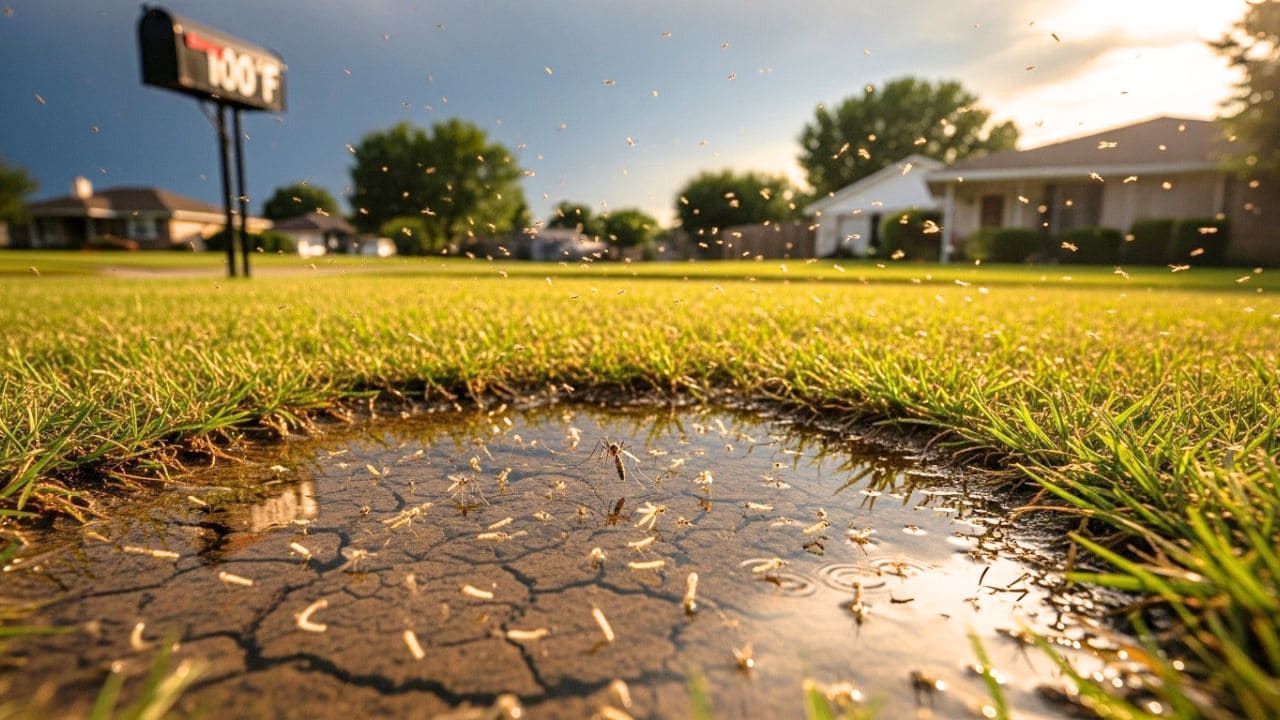
If you’ve stepped outside after a heatwave and felt like you walked straight into a mosquito cloud, you’re not imagining it. Mosquitoes surge dramatically in the days and weeks following a heatwave — and the reason is a perfect storm of biology, standing water, and accelerated breeding cycles that most homeowners never see coming.
I’ve lived next to a retention pond for over two decades. I’ve watched this play out every single summer. The heatwave bakes everything, people think the mosquitoes are gone, and then — bam — they’re everywhere.
This article breaks down exactly what happens to mosquito populations during and after extreme heat, why the post-heatwave rebound is so intense, what it means for your backyard and your health, and — most importantly — what you can do right now to get ahead of it. Keep reading. This one might actually save you a summer.
The Science Behind Mosquitoes After a Heatwave: What’s Really Going On
Here’s the thing most people get wrong: they assume extreme heat kills mosquitoes. It doesn’t. Not really. What it does is temporarily suppress adult activity while quietly setting the stage for a population explosion the moment temperatures drop back to that sweet spot.
Mosquitoes are ectothermic insects, meaning their body temperature is directly regulated by the environment around them. When ambient temperatures spike past the mid-90s Fahrenheit, adult mosquitoes retreat. They hide in shaded vegetation, under leaves, in cool crawl spaces — anywhere they can find moisture and shade. They’re not dead. They’re waiting.
Meanwhile, eggs and larvae that were already deposited in standing water before the heatwave don’t just stop developing — they actually accelerate. Warmer water temperatures speed up larval growth significantly. According to entomologist David Lowenstein of Michigan State University, under normal conditions the mosquito life cycle takes about two weeks. Under elevated heat, that cycle can compress to just 7 to 10 days.
That’s a full generation faster. So by the time temperatures cool back down to comfortable levels, you’ve got a massive cohort of newly hatched adults — all hungry, all seeking blood meals, all at once. That’s the swarm you experience.
The Role of Standing Water and Post-Heatwave Rain
Heatwaves are often followed by sudden rainfall. That combination is catastrophic from a mosquito standpoint. The rain replenishes or creates new standing water breeding sites — clogged gutters, birdbaths, plant saucers, retention pond margins, anything that holds even an inch of water. And after a dry stretch, there are even more neglected containers than usual.
I can tell you from personal experience: after any major heat event near our retention pond, I do a complete property sweep within 48 hours. Every time, without exception, I find new water pooling in spots I hadn’t thought about. That’s where the next generation starts.
Why Are Mosquitoes Worse After a Heat Wave? The Post-Heatwave Rebound Explained
There’s a pattern that repeats itself every summer and it’s almost clockwork. During the hottest stretch of days, mosquito complaints drop. People go outside more. They think the heat solved the problem. Then temperatures moderate, maybe there’s a bit of rain, and the complaints spike higher than they were before.
Several compounding factors drive this rebound:
- Compressed life cycles during the heat produce large synchronized adult hatching events.
- Adult mosquitoes that hid during the heatwave re-emerge all at once, hungrier than normal due to the forced fast.
- Post-heatwave cooling brings temperatures into the optimal mosquito activity range of roughly 70–85°F.
- Evening humidity rises, creating ideal foraging conditions.
- New breeding sites from rain or condensation are rapidly colonized.
As experts at Placer Mosquito and Vector Control have noted publicly, post-heatwave periods can produce significant spikes in mosquito populations — including those carrying West Nile Virus. That’s not alarmism. That’s a pattern confirmed by vector control agencies across multiple states.
Do Heatwaves Kill Mosquitoes?
Sort of — but not the way you’d hope. Extreme and sustained temperatures above 95–100°F can stress or kill adult mosquitoes, especially if humidity drops sharply. Heatwaves can temporarily dry up shallow standing water, which does eliminate some active breeding sites. So yes, during the peak of an extreme heat event, you may see fewer mosquitoes.
But here’s the catch: the eggs don’t die. Mosquito eggs — particularly those of Aedes species like the Asian tiger mosquito — are remarkably desiccation-resistant. They can survive completely dry conditions for months. The moment moisture returns, development resumes.
Research published in PLOS Neglected Tropical Diseases examining Aedes albopictus population dynamics found that while extreme heat initially suppresses population growth, an “abnormal onset time” or prolonged high temperature can have complex and sometimes counterproductive effects on long-term population control. The takeaway: heat is not your mosquito solution. It’s a temporary inconvenience for them.
Understanding the Mosquito Life Cycle and How Heat Speeds It Up
Knowing this cycle is how you actually beat them. Mosquitoes go through four life stages:
- Egg — Laid in or near standing water. Can remain dormant for months in dry conditions.
- Larva — Aquatic stage. Wrigglers visible in stagnant water. Highly temperature-sensitive. Warm water accelerates development dramatically.
- Pupa — Non-feeding transitional stage, also aquatic. Lasts just 1–3 days in warm conditions.
- Adult — Emerges ready to breed and feed. Females require a blood meal to develop eggs. One female can lay up to 100 eggs per batch.
During a heatwave, the egg-to-adult timeline shrinks from two weeks to potentially 7–10 days. That means in a single summer month, you could see three generations complete their cycle instead of two. Each generation is exponentially larger. This is the math behind why mosquitoes suddenly seem everywhere.
Retention Ponds, Backyard Standing Water, and Mosquito Breeding Grounds After a Heatwave
Living next to a retention pond for 20 years has been an education. These ponds are the single biggest mosquito factory in most suburban neighborhoods — and after a heatwave, they’re supercharged.
During extreme heat, pond margins dry out and water recedes. Eggs get deposited at the waterline. When temperatures drop and water returns, all those eggs hatch at once. If the pond has slow-moving or stagnant edges, it’s a breeding paradise. That’s when I see the worst outbreaks in my neighborhood.
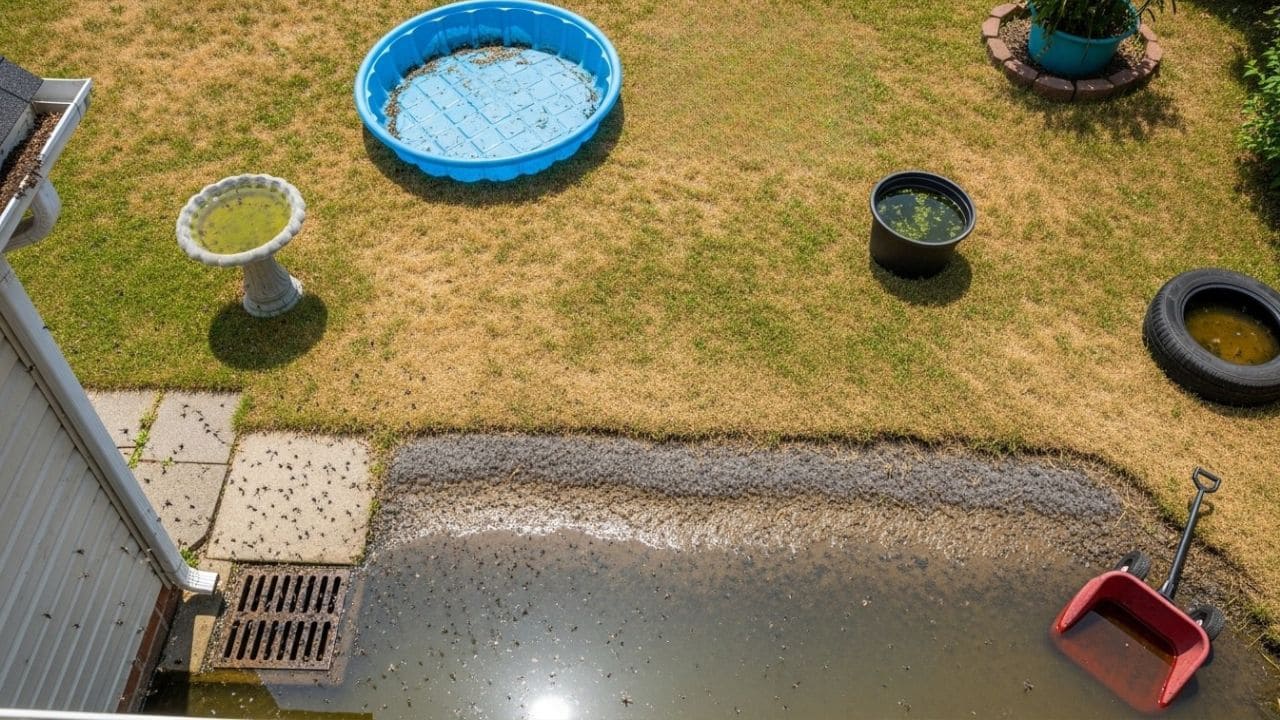
Common post-heatwave mosquito breeding sites around your property:
- Clogged rain gutters holding residual moisture
- Birdbaths (water evaporated during heat, then refilled by rain)
- Pot saucers and planter drip trays
- Buckets, tarps, or pool covers collecting water
- Low spots in lawns and garden beds
- Old tires left outdoors
- Retention pond margins with slow or no flow
- Children’s toys, wagons, or wading pools left outside
I’ve dumped water from more buckets, hats, and forgotten flowerpots than I can count. The ones you forget are always the worst offenders.
Mosquito-Borne Disease Risk After a Heatwave: What Health Agencies Are Saying
This is where it gets serious. Post-heatwave mosquito surges aren’t just annoying — they coincide with elevated disease transmission risk. The CDC and state health departments consistently flag late summer as peak West Nile Virus season, which overlaps almost perfectly with post-heatwave rebound periods in most of the continental US.
West Nile Virus tends to peak in July and August across most states. In Michigan, for instance, the Michigan Department of Health and Human Services regularly issues advisories during post-heatwave periods, urging residents to eliminate standing water and use EPA-registered repellents. People over 60 and those with compromised immune systems face higher risk of severe symptoms including high fever, neck stiffness, and neurological complications.
Beyond West Nile, the Asian tiger mosquito (Aedes albopictus) — increasingly present in more US regions — is a vector for dengue, Zika, and chikungunya. Climate Central’s analysis of weather data from 1979 to 2022 found that the number of annual “mosquito days” increased in 173 out of 242 monitored US locations, by an average of 16 days per year. Longer seasons mean more exposure windows.
That said — don’t panic. Most mosquito bites remain just that: bites. Awareness and prevention go a long way. The goal is reducing exposure, not fear.
Mosquito Control After a Heatwave: Practical Strategies That Actually Work
I’ve tried almost everything over 20 years. Here’s what I’ve found actually moves the needle, especially in the post-heatwave surge period.
1. Source Reduction — The Most Effective First Step
Nothing beats eliminating breeding sites. Do a full property walkthrough within 48 hours of any significant rainfall following a heatwave. Focus on:
- Emptying and scrubbing all containers (mosquito eggs cling to container walls)
- Cleaning gutters and downspouts
- Changing birdbath water every 3 days minimum
- Turning over or covering anything that can hold water
2. Biological Control: Mosquito Dunks and Bacillus thuringiensis israelensis (BTI)
For water you can’t drain — retention ponds, rain barrels, ornamental ponds — mosquito dunks containing BTI are highly effective. BTI is a naturally occurring soil bacterium that’s lethal to mosquito larvae but completely harmless to other wildlife, pets, and humans. The EPA has registered it as safe for use in drinking water containers. I’ve used them in the retention pond margins for years. They work.
3. Larvicides and Targeted Adulticides
If you’re dealing with a retention pond, coordinate with your local mosquito abatement district. Many counties have free programs, especially post-heatwave when surge events are expected. Targeted larviciding (treating water before adults hatch) is far more effective and less disruptive to beneficial insects than broadcast adulticide spraying.
4. Personal Protection Strategies
The CDC recommends EPA-registered repellents for personal protection. Your best options:
- DEET (N,N-Diethyl-meta-toluamide) — Proven, long-lasting, available in 10–30% concentrations for most situations
- Picaridin — Odorless alternative, comparable effectiveness to DEET
- IR3535 — Gentle formulation, good for children and sensitive skin
- Oil of Lemon Eucalyptus (OLE) — Plant-based option; not recommended for children under 3
- Wear long sleeves and light-colored clothing during peak mosquito activity hours (dusk to dawn)
5. Yard and Landscape Modifications
- Keep grass trimmed — adult mosquitoes rest in tall grass and dense shrubbery during daylight
- Improve drainage in low-lying areas of your lawn
- Install or maintain window and door screens
- Use outdoor fans on patios and decks — mosquitoes are weak fliers and struggle in even moderate airflow
- Consider planting mosquito-repelling plants like citronella, basil, or lavender near seating areas
Climate Change, Longer Mosquito Seasons, and What’s Coming
This isn’t just a this-summer problem. The broader context matters for long-term planning.
Climate Central’s analysis covering 1979 to 2022 shows that 173 out of 242 US locations experienced an average increase of 16 more “mosquito days” per year — defined as days with humidity above 42% and temperatures between 50–95°F. The eastern US is seeing particularly strong increases driven by both temperature rises and elevated humidity.
Shannon LaDeau, senior scientist at the Cary Institute of Ecosystem Studies, has noted that climate-driven changes essentially mean an earlier start to spring and a longer-lasting fall for mosquito activity. More warm days = more mosquito generations = larger populations over the season.
The World Mosquito Program and other international health bodies have documented significant geographic expansion of mosquito-borne diseases in Europe and Australia linked to warming conditions. Dengue, Zika, and chikungunya cases are appearing in regions where they were previously unheard of. For US homeowners, this means the vigilance practices that used to matter just in peak summer now need to extend further into spring and fall.
What to Do Right Now: Your Post-Heatwave Mosquito Action Checklist
Don’t wait for the swarm. Act within 48 hours of a heatwave breaking. Here’s the prioritized action list:
- Walk every inch of your property looking for water-holding containers. Empty and scrub them.
- Check and clean gutters if you haven’t recently.
- Apply BTI dunks to any standing water you cannot drain (ponds, rain barrels).
- Report unmaintained water sources (neighbor’s neglected pool, municipal drainage issue) to your local health or mosquito control district.
- Stock up on CDC-recommended repellent (DEET or picaridin) for personal protection during evening hours.
- Mow and trim vegetation to eliminate adult resting habitat.
- Contact your local mosquito abatement district if you have a retention pond or shared water feature nearby.
Frequently Asked Questions (FAQs)
Q. Why do mosquitoes seem to disappear during a heatwave?
Adult mosquitoes retreat to cool, shaded, moist resting spots when temperatures exceed roughly 95°F. They’re not dead — they’re hiding. The larvae in water, however, continue developing and may actually speed up.
Q. How long after a heatwave do mosquitoes come back?
Typically within 24–72 hours of temperatures moderating. If there’s rainfall, expect a surge within a week as newly hatched adults emerge from accelerated larval development.
Q. Does hot dry weather reduce mosquito populations long-term?
Prolonged severe drought can suppress populations by eliminating breeding sites. But eggs survive desiccation and hatch rapidly when water returns. A severe drought followed by rain often produces a larger-than-normal rebound.
Q. What temperature is too hot for mosquitoes to be active?
Most species become significantly less active above 90–95°F. The optimal activity range is generally 70–85°F. Below 50°F, most mosquitoes cease flying entirely. But the window between those extremes covers most of the US summer.
Final Thoughts: Don’t Let the Heatwave Fool You
Mosquitoes suddenly everywhere after a heatwave is one of those summer patterns that catches people off guard every year. The heat creates a false sense of security. The biology happening underneath — in warm water, in dormant eggs, in shaded resting adults — doesn’t care about your optimism. It just waits.
After 20 years managing mosquito pressure near a retention pond, I’ve learned the same lesson every single season: the homeowners who act first, act before the swarm arrives. Source reduction, BTI treatment, personal protection, and communication with local vector control agencies — these are the tools that work. Not luck, not wishful thinking.
The next heatwave is coming. And so is the rebound. You now know exactly why and exactly what to do about it. Act within that 48-hour window after temperatures break, and you’ll be ahead of the surge instead of swatting at it.
📢 Have You Noticed a Mosquito Surge After a Recent Heatwave?
Drop your experience in the comments below. What’s worked in your yard? Are you dealing with a retention pond, a birdbath problem, or something else entirely? Your real-world knowledge helps other homeowners — and it helps build a community response to a problem that’s only going to grow with warming temperatures.
Share this article with a neighbor dealing with the same issue. The more people who understand the heatwave rebound effect, the better prepared our neighborhoods will be.
Editorial Team & Contributors

Raashid Ansari, Founder, Content Researcher & Author - MosquiTalk
Not an entomologist — just a genuinely curious writer who started researching mosquitoes and couldn't stop. What began as casual reading about repellents and bite prevention gradually turned into a deep ongoing dive into vector biology, disease epidemiology, animal health impacts, and the real science behind mosquito control. Everything published here is carefully edited, and written with one purpose: giving readers accurate, accessible information they can actually trust and use to protect themselves, their families, and their pets, birds and cattle.
Active across social platforms, regularly publishes, and genuinely invested in spreading mosquito awareness where it matters most. Because informed readers make better decisions — and better decisions save lives.