
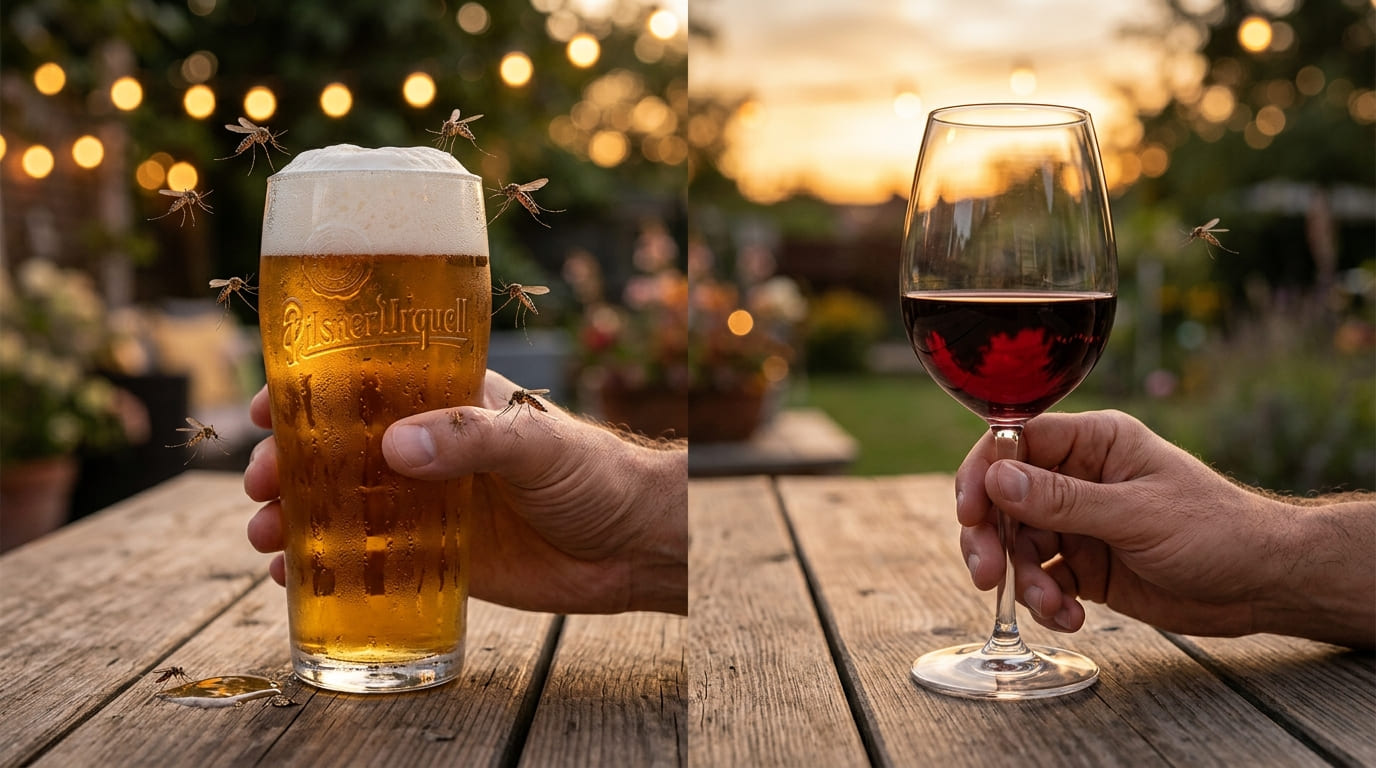
Which Alcoholic Drinks Attract Mosquitoes the Most?
Beer attracts mosquitoes the most — but here’s the kicker. It’s not really about the beer itself. Every alcoholic drink you consume, whether it’s a cold lager, a glass of red wine, or a cocktail, flips a biological switch in your body that makes you significantly more attractive to mosquitoes. And if you’re the person at every backyard barbecue who always seems to walk away with the most bites? Your evening drink might have a lot more to do with that than you think.
Multiple peer-reviewed studies — including a landmark 2002 paper in the Journal of the American Mosquito Control Association and a 2010 controlled trial in PLOS ONE — confirm that alcohol consumption measurably increases how attractive you are to mosquitoes. The science is real, it’s reproducible, and it has serious public health implications, especially in regions where mosquito-borne diseases like malaria, dengue, and Zika are active.
So why does beer edge out wine in the mosquito attraction contest? What’s actually happening in your body? And more importantly — what can you actually do about it? Read on. This gets more interesting.
The Science Behind Alcohol and Mosquito Attraction
Before we pit beer against wine in a bug-bite showdown, it’s worth understanding why alcohol attracts mosquitoes at all. Because it’s not as simple as “they smell the booze on your breath.”
Mosquitoes are remarkably sophisticated hunters. They locate hosts using a layered sensory system — carbon dioxide (CO₂) from your breath, body heat, skin moisture, and the unique chemical cocktail your skin produces. When you drink alcohol, you alter multiple signals in that cocktail simultaneously. And not in your favor.
What Happens to Your Body When You Drink Alcohol?
Here’s the chain reaction alcohol triggers — and why each step is a flashing neon sign to a hungry mosquito:
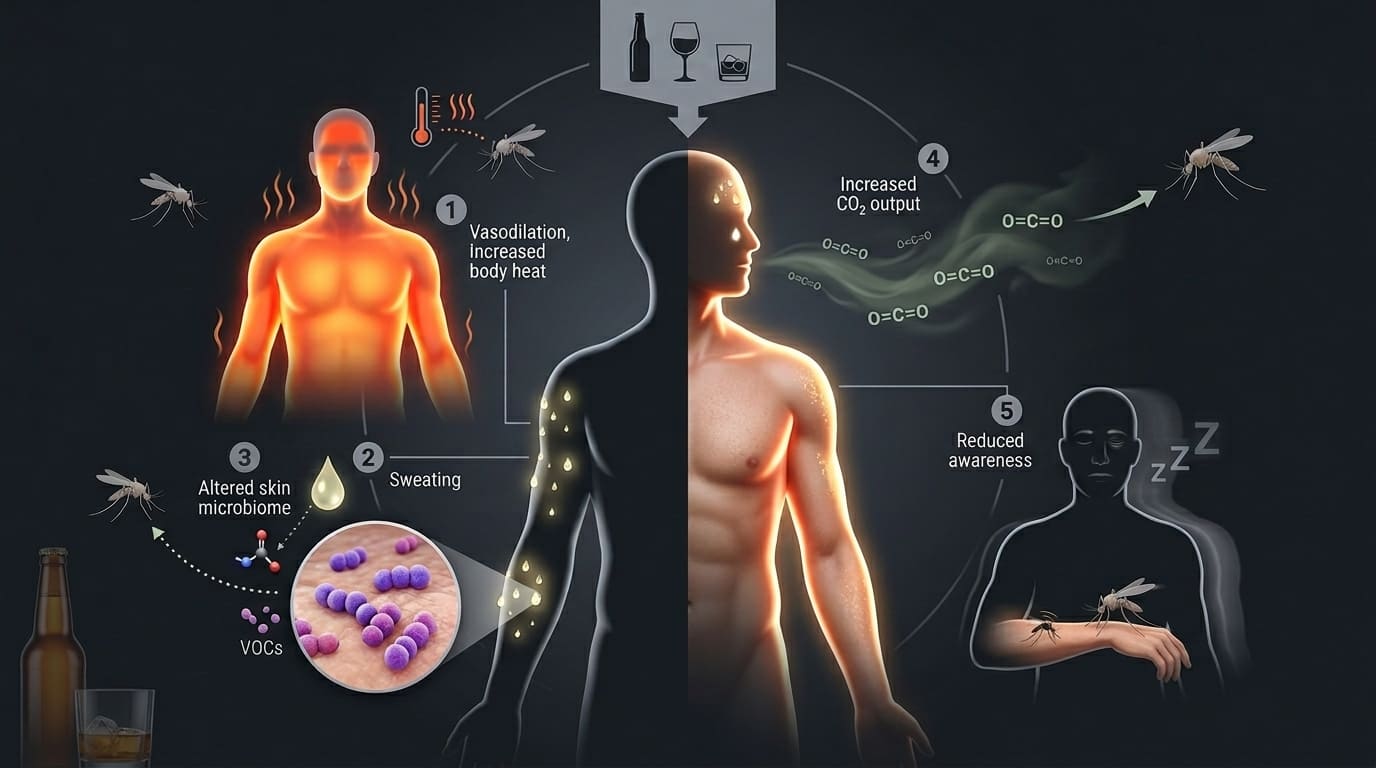
- Vasodilation — Alcohol causes blood vessels to dilate. Warm blood moves closer to the surface of your skin. Your skin literally radiates more heat, and mosquitoes detect surface heat with precision before they bite.
- Increased Sweating — Ethanol triggers sweat production. Sweat contains lactic acid, ammonia, and other volatile organic compounds (VOCs) that mosquitoes are known to track. More sweat = stronger scent signal.
- Altered Skin Microbiome — Alcohol changes the microbial composition on your skin surface. Certain bacteria like Streptococcus species have been linked to increased mosquito magnetism in both lab and field studies. The 2025 music festival research published via bioRxiv found this correlation in 465 real-world participants.
- Increased CO₂ Output — Metabolism speeds up when processing alcohol, which modestly increases the carbon dioxide you exhale. CO₂ is the primary long-range attractant mosquitoes use to locate hosts from up to 164 feet away.
- Reduced Awareness — This one doesn’t show up in lab papers, but it’s real. People who are drinking pay less attention to the mosquito landing on their arm. Mosquitoes get more time to feed, undisturbed.
All of this applies whether you’re drinking beer, wine, whiskey, or a gin and tonic. The ethanol is the engine driving these changes.
Beer vs. Wine: Which One Attracts Mosquitoes More?
This is the real question people are searching for. But the answer is not that simple: beer has a measurable edge — but not for the reasons most people assume.
Why Beer Is the Bigger Mosquito Magnet
The 2002 study published in the Journal of the American Mosquito Control Association is the most cited research on this topic. Japanese researchers had 13 volunteers drink beer or water, then measured mosquito landings. The results were unambiguous — mosquito attraction significantly increased after beer consumption. One 12-ounce beer was all it took.
A follow-up study from Burkina Faso, published in PLOS ONE (2010), reinforced this finding with the malaria vector Anopheles gambiae. Researchers tested 25 beer drinkers and 18 water drinkers using a Y-tube olfactometer. Beer drinkers attracted significantly more mosquitoes. Water drinkers showed no change.
But here’s what makes beer uniquely worse compared to wine or spirits:
- Carbonation off-gasses CO₂ constantly. The open beer in your hand isn’t just fermented grain water — it’s a continuous CO₂ emitter. That fizzling bubbling creates an additional, sustained attractant layer that still wine, whiskey, and vodka simply don’t produce.
- The fermentation aroma. Beer has a distinctive VOC profile from fermentation — acetaldehyde, isoamyl acetate, and other compounds — that overlaps with the fermented plant odors mosquitoes naturally associate with food sources. Some mosquito species are known to feed on fermenting fruit. Beer smells familiar to them in a very primal way.
- More likely to be consumed quickly and in quantity. Let’s be honest — people drink beer faster than they sip wine. Higher and faster ethanol intake amplifies all the body chemistry changes above.
Does Wine Attract Mosquitoes? Yes — Just Differently
Wine gets less attention in the research, largely because most studies used beer as the alcohol delivery method. But that doesn’t mean wine drinkers get a free pass.
A 2025 pre-print study from the Netherlands — the largest field study to date with 465 festival participants — found that people who drank beer OR wine in the previous 12 hours were significantly more likely to attract mosquitoes. That’s a meaningful data point. Both beverages, grouped together, produced the effect.
Wine causes the same vasodilation. The same increase in sweat. The same skin microbiome shift. Red wine in particular adds tannins and a complex aromatic VOC profile. There’s no controlled head-to-head study directly comparing beer versus wine in terms of mosquito attraction yet — and that’s a research gap worth noting — but the underlying mechanism is identical.
Quick Comparison: Beer vs. Wine vs. Spirits — Mosquito Attraction Factors
| Attraction Factor | Beer | Wine | Spirits |
|---|---|---|---|
| Vasodilation (Skin Warmth) | High | High | High |
| Increased Sweating | High | High | High |
| CO₂ Off-Gassing (Carbonation) | High ✓ | Low (still wine) | Low |
| Altered Skin Microbiome | Yes | Yes | Yes |
| Fermentation VOC Profile | Strong | Moderate | Varies |
| Research Evidence Strength | Strong (direct studies) | Moderate | Limited |
| Overall Mosquito Attraction Risk | Highest | Moderate-High | Moderate |
What About Spirits, Cocktails, and Hard Seltzers?
People rarely ask about vodka or whiskey in the context of mosquito attraction — but they should.
Spirits are typically consumed in smaller volumes, which means a lower total ethanol load per drink. That said, they still trigger vasodilation, sweating, and metabolic changes. The attraction effect is likely real but more dose-dependent than with beer.
Hard seltzers and sparkling wines? Those re-introduce the carbonation factor. A sparkling rosé or a hard seltzer brings you closer to beer in terms of the CO₂ off-gassing issue. It’s a detail most people overlook.
Does Drinking Wine Attract Mosquitoes?
Yes — drinking wine does attract mosquitoes. Unambiguously. If you’ve been holding out hope that switching from beer to a glass of white at your next outdoor dinner would keep the bugs off, the science doesn’t support that.
The 2025 pre-print field study from the Netherlands — the largest real-world study of its kind with 465 participants at a music festival — found that people who reported drinking beer or wine in the previous 12 hours were significantly more likely to have mosquitoes land on them. Wine was listed explicitly alongside beer. Not as a safer alternative. As an equivalent trigger.
Here’s why wine drinkers attract mosquitoes:
- Ethanol from wine triggers vasodilation — your blood vessels dilate, warm blood rises to the skin surface, and your body radiates more heat. Mosquitoes detect that surface warmth directly.
- Wine increases sweating. Sweat carries lactic acid, uric acid, and VOCs that mosquitoes track. A glass of wine — red or white — starts this process within minutes of ingestion.
- Wine modestly increases CO₂ output as your metabolism works to process ethanol. CO₂ is the primary long-range signal mosquitoes use to find a host — detectable from over 150 feet away.
- Wine alters your skin’s microbial environment. The ethanol shifts the balance of bacteria on your skin surface, some of which — particularly Streptococcus species — are known to correlate with higher mosquito attractiveness.
The only meaningful advantage wine has over beer: still wine doesn’t continuously off-gas CO₂ the way a carbonated beer does. That single compounding factor is removed. Everything else is identical.
If you’re at an outdoor wine evening and wondering why you’re scratching your ankles — now you know. The wine didn’t save you. It just didn’t add the bubbles.
Does Red Wine Attract Mosquitoes More Than White Wine?
This is the question wine drinkers specifically want answered — and it’s a fair one. Red and white wine are chemically quite different. Does that matter to a mosquito?
There is no direct controlled study comparing red wine versus white wine in terms of mosquito attraction. That research gap exists. But we can reason through it clearly based on what we know.
Why Red Wine May Be a Stronger Mosquito Trigger
- Higher histamine content. Red wine is naturally rich in histamines — compounds that form during fermentation from the skins, seeds, and stems included in red wine production. Mosquito bites cause itching through histamine release. If your histamine baseline is already elevated from a glass of red, each bite will likely itch more intensely and swell more visibly. That’s a double effect: more bites, worse reaction per bite.
- More complex VOC (volatile organic compound) profile. The extended skin contact during red wine fermentation creates a wider array of aromatic compounds — tannins, polyphenols, and fermentation byproducts. The VOC signature from red wine consumption is richer and more complex than white. Whether mosquitoes specifically prefer this profile over white wine’s isn’t tested, but a stronger aromatic output is generally a stronger signal.
- Tannins and skin interaction. Tannins in red wine interact with skin proteins and can subtly alter skin surface chemistry. This is speculative territory in terms of mosquito studies, but it’s a biochemically real interaction that white wine doesn’t produce to the same degree.
White Wine vs. Red Wine: The Practical Verdict
Both red and white wine increase mosquito attraction through the same core pathway — ethanol, vasodilation, sweating, CO₂ output. Red wine adds the histamine layer and a more complex VOC profile on top.
If you already react strongly to mosquito bites — big welts, intense itching, slow fading — red wine is probably the worse choice for an outdoor evening. Not dramatically so, but meaningfully so. If you have histamine sensitivity or are prone to allergic-type reactions to bites, white wine is the less problematic option. Neither one keeps you safe without repellent.
Are Mosquitoes Attracted to Wine? What the Research Actually Shows
Yes. Mosquitoes are attracted to the conditions that wine creates in your body — and to a lesser degree, to the drink itself when it’s sitting open nearby.
Let’s separate two distinct things here, because people conflate them:
1. Are Mosquitoes Attracted to You After Drinking Wine?
Strongly yes. As covered above — the ethanol in wine triggers vasodilation, increased sweating, elevated CO₂ output, and skin microbiome changes. All four of those are known mosquito attractants. The 2025 music festival study confirmed wine drinkers attracted significantly more mosquitoes in real-world conditions, not just a laboratory.
The effect starts quickly — within 15–20 minutes of your first glass as the ethanol enters your bloodstream and begins triggering metabolic changes. It doesn’t require several drinks. One glass is enough to shift your body chemistry measurably.
2. Are Mosquitoes Attracted to an Open Glass of Wine?
Modestly, yes — but less so than beer. Mosquitoes are drawn to fermentation products in the wild. They feed on rotting fruit and fermenting plant material in nature, which means they’ve evolved receptors sensitive to ethanol, acetic acid, and other fermentation byproducts.
An open glass of still wine sits there passively. It’s not bubbling CO₂ into the air the way beer does. Its ethanol does slowly evaporate, creating a faint attractant scent — but it’s a much weaker signal than an open carbonated beer, and far weaker than the signals coming off your own body after drinking.
The practical takeaway: the wine in the glass isn’t your main problem. You, after drinking the wine, are.
How Long After Drinking Wine Are You More Attractive to Mosquitoes?
It depends on how much you drank and your individual metabolism, but the general window is meaningful.
- Vasodilation begins within minutes of your first drink and peaks around 30–60 minutes after consumption.
- Increased sweating and altered skin chemistry can persist for 2–4 hours as your body processes the ethanol.
- Skin microbiome disruption from alcohol may take longer to normalize — potentially 6–12 hours, though this is less precisely studied.
The 2025 festival study captured people who had drunk beer or wine in the previous 12 hours — and still found elevated attraction. So even if your wine was hours ago, the effect may linger. This is particularly relevant for outdoor mornings after an evening of wine on the patio.
Other Factors That Make You a Mosquito Magnet While Drinking
Alcohol doesn’t operate in isolation. It amplifies factors that are already working against you. Understanding these helps you defend yourself smarter.
- Blood Type O — Research suggests Type O blood may attract more mosquito landings than Type A. The evidence is mixed, but if you’re Type O and drinking a beer outdoors? That’s a compounding effect worth being aware of.
- Skipping Sunscreen — The 2025 music festival study found that people who skipped sunscreen were also more likely to attract mosquitoes. The oils in sunscreen may act as a mild barrier or odor masker.
- Not Showering Before Going Out — Bacteria accumulate on the skin throughout the day. Streptococcus genus bacteria were found to correlate with higher mosquito attractiveness scores in field research. A quick shower before an outdoor evening event actually matters.
- Dark Clothing — Mosquitoes use vision as well as smell. Dark colors — black, navy, deep red — make you more visible against the horizon at dusk, which is peak biting time.
- Pregnancy — Pregnant women exhale more CO₂ and run a higher body temperature, already two of the primary attraction signals. Adding alcohol to that mix compounds the risk.
- Recent Exercise — Working out raises lactic acid in sweat and elevates body temperature. If you’re heading to an outdoor event straight from the gym, that combination plus a drink is genuinely notable.
The Mosquito-Borne Disease Risk Connection: Why This Matters Beyond Itchy Bites
This is where the conversation shifts from mildly interesting to genuinely important.
The PLOS ONE study from Burkina Faso wasn’t just curious about mosquito behavior. It was studying malaria vectors — Anopheles gambiae mosquitoes, the primary African malaria-carrying species. The researchers explicitly stated: “persons drinking alcohol should be careful about their increased risk to mosquito bites and therefore exposure to mosquito-borne diseases.”
The CDC identifies several major mosquito-borne illnesses that remain active in parts of the world and, increasingly, in the US:
- Malaria — Still responsible for hundreds of thousands of deaths annually worldwide, primarily in sub-Saharan Africa
- Dengue Fever — Increasingly present in Southern US states; symptoms include severe flu-like illness
- Zika Virus — Major concern during pregnancy due to potential developmental complications
- West Nile Virus — Endemic in North America; most cases are mild but can cause serious neurological disease in older adults and immunocompromised individuals
For most people in low-risk domestic settings, a few extra mosquito bites from a beer at the backyard barbecue is an annoyance, not a health emergency. But for travelers heading to malaria-endemic regions, or anyone in areas with active dengue or Zika transmission — this information matters, and the practical advice to layer your protection is not optional.
Does Alcohol Make Mosquito Bites Itch More? The Histamine Connection
Here’s something that doesn’t get discussed enough. Alcohol elevates histamine levels in your system. Mosquito bites trigger an immune response via histamine release — that’s what causes the itch and the welt.
So alcohol creates a double disadvantage:
- You attract more bites because of the body chemistry changes alcohol triggers.
- Each bite may produce a more intense itching reaction because your histamine baseline is already elevated.
Red wine in particular is high in naturally occurring histamines. People who already have histamine sensitivity might notice that a glass of red wine before an outdoor dinner makes both the bites more frequent and the reaction noticeably more intense. That’s not coincidence.
How to Protect Yourself From Mosquitoes While Still Enjoying Your Drink
Nobody’s suggesting you stop drinking to appease the mosquitoes. That’s not realistic, and it’s not necessary. The goal is to layer your protection so that the extra attraction signal from alcohol is offset by actual deterrents.
Practical Steps That Actually Work
- Apply EPA-registered insect repellent before going outside. DEET (10–30%), picaridin, IR3535, or oil of lemon eucalyptus (OLE) are all CDC-recommended options. Apply to exposed skin and outside of clothing. This is the single most effective thing you can do.
- Shower before your outdoor event. Removing accumulated bacteria and sweat reduces the chemical signal on your skin before alcohol amplifies what’s left. Small move, meaningful impact.
- Keep your beer covered between sips. A can or cup with a lid cuts the direct CO₂ plume emanating from carbonated beverages. You can still enjoy your drink — just reduce its broadcast range.
- Wear light-colored, long-sleeve clothing. Light colors make you less visible. Long sleeves reduce the surface area available for bites. In peak mosquito hours (dusk and dawn), this matters especially.
- Use a fan. Mosquitoes are weak fliers. A simple oscillating fan disrupts their ability to navigate toward you and disperses the CO₂ cloud around you. Outdoor fans are one of the most underrated mosquito deterrents.
- Choose your timing wisely. Mosquito activity peaks between dusk and dawn. If you can move outdoor drinking to midday or early afternoon, you’re outside peak activity windows for most species.
- Eliminate standing water nearby. Mosquitoes breed in as little as a bottle cap of stagnant water. Check birdbaths, flower pots, gutters, and puddles within 100 feet of your outdoor space.
- Try mosquito repellent candles or diffusers containing citronella or eucalyptus. While these are not as reliable as topical repellents, they can reduce the ambient attraction in your immediate area when combined with other measures.
Frequently Asked Questions (FAQs)
Q. Does one drink attract mosquitoes as much as several?
The 2002 Tokyo study showed increased attraction after just one 12-ounce beer. So yes, even a single drink has a measurable effect. The response is likely dose-dependent — more alcohol, more pronounced the body chemistry changes — but one drink isn’t a safe threshold.
Q. Does non-alcoholic beer attract mosquitoes?
This hasn’t been directly studied, but the logic suggests the effect would be minimal. Non-alcoholic beer doesn’t trigger vasodilation, significant sweating, or skin microbiome changes the way ethanol does. However, the carbonation still emits CO₂. Low-risk but not zero.
Q. Can mosquitoes smell alcohol on your breath?
Not directly. Mosquitoes can’t detect blood alcohol content. What they respond to are surface-level signals — heat, CO₂, skin chemistry, and scent compounds from sweat. The attraction happens through skin signals and exhaled CO₂, not ethanol on the breath specifically.
Q. Is wine safer than beer for avoiding mosquito bites?
Marginally, possibly — because still wine doesn’t off-gas CO₂ the way carbonated beer does. But wine drinkers still trigger all the underlying body chemistry changes. The 2025 field study found both beer and wine drinkers attracted more mosquitoes. Don’t swap your beer for wine and assume you’re protected. Use repellent regardless.
Q. Do mosquito beer traps actually work?
Somewhat. An open fizzing beer placed away from you can draw some mosquitoes toward it because of its CO₂ and fermentation odor. But it’s not a substitute for repellent. It’s more of a supplementary distraction — useful only if the beer is positioned away from your seating area.
Final Takeaway: Beer Wins the Mosquito Attraction Contest — But All Alcohol Raises Your Risk
If you’re trying to figure out which alcoholic drinks attract mosquitoes the most, the evidence points clearly to beer — specifically because of the compounding effect of carbonation-released CO₂ on top of the standard alcohol-induced body chemistry changes. Beer drinkers experience the full spectrum of mosquito attraction triggers simultaneously.
Wine is not far behind, especially sparkling varieties. Spirits are likely lower-risk due to typical serving sizes but not risk-free.
The practical reality: you don’t have to choose between enjoying outdoor drinks and protecting yourself from mosquitoes. You just have to be deliberate about protection. Apply repellent before you head out. Shower beforehand. Keep drinks covered. Wear light clothing. Use a fan if you can.
These aren’t big sacrifices. They’re small habits that, stacked together, genuinely reduce your risk — both of itchy bites and, in higher-risk environments, something far more serious.
Have you noticed you get bitten more when you’re drinking? Or do you swear your friend is the real mosquito magnet no matter what? Drop your experience in the comments — there’s more individual variation in mosquito attraction than most people realize, and the community’s observations are genuinely interesting data.
Editorial Team & Contributors

Raashid Ansari, Founder, Content Researcher & Author - MosquiTalk
Not an entomologist — just a genuinely curious writer who started researching mosquitoes and couldn't stop. What began as casual reading about repellents and bite prevention gradually turned into a deep ongoing dive into vector biology, disease epidemiology, animal health impacts, and the real science behind mosquito control. Everything published here is carefully edited, and written with one purpose: giving readers accurate, accessible information they can actually trust and use to protect themselves, their families, and their pets, birds and cattle.
Active across social platforms, regularly publishes, and genuinely invested in spreading mosquito awareness where it matters most. Because informed readers make better decisions — and better decisions save lives.