
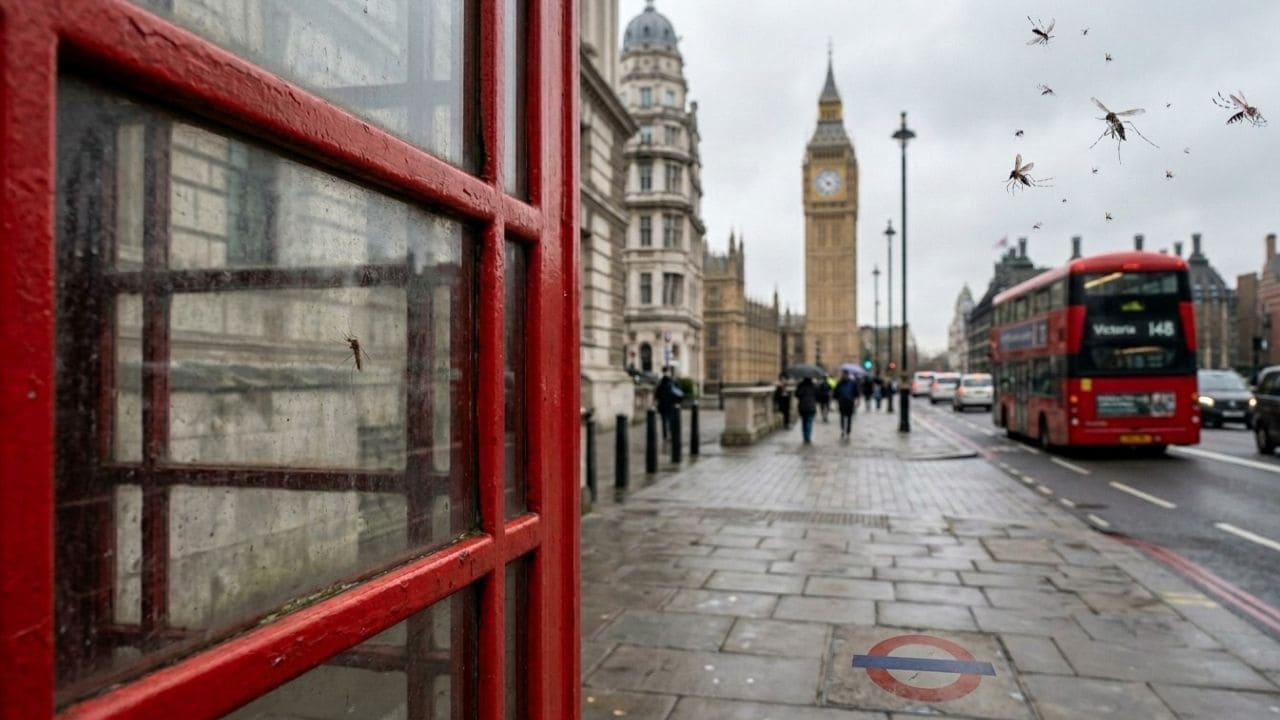
Should I Worry About West Nile Virus in UK?
Something quietly significant happened in May 2025. For the first time in recorded history, fragments of West Nile Virus were detected in mosquitoes on British soil. Not imported in a patient returning from abroad. Not flagged at a border. Found right here — in Nottinghamshire, England, in Aedes vexans mosquitoes collected from wetlands near the River Idle.
Headlines followed quickly. And so did the panic.
So — should you actually be worried about West Nile Virus in UK? Should Londoners start stockpiling DEET? The short answer is: not yet, but it is worth understanding what’s changed and why this matters over the coming years. Let’s break it down properly.
What Is West Nile Virus, Exactly?
West Nile Virus (WNV) belongs to the Flaviviridae family of viruses — the same broad group that includes dengue, yellow fever, and Zika. It circulates naturally between birds and mosquitoes. Humans are, in scientific terms, “dead-end hosts” — meaning we don’t typically pass the virus to other mosquitoes or people.
It was first identified in Uganda in 1937. Since then, it has spread across Africa, the Middle East, parts of Asia, North America, and increasingly into Europe. The US experienced one of the most significant outbreaks in 2002–2003, with thousands of neurological cases.
Most human infections — roughly 80% — cause no symptoms at all. Around 20% develop a mild illness: fever, headache, muscle aches, and fatigue. The concerning bit is the remaining 1 in 150 cases, approximately, where the virus crosses into the central nervous system, causing encephalitis, meningitis, or a polio-like paralysis called West Nile neuroinvasive disease.
There is currently no licensed human vaccine. No specific antiviral treatment either. Management is supportive.
What Was Actually Detected in UK Mosquitoes?
The UKHSA and the Animal and Plant Health Agency (APHA) have been running a sophisticated surveillance programme called Vector-Borne RADAR (Real-time Arbovirus Detection and Response) since 2023. It tests mosquitoes and birds for the presence of mosquito-borne viruses across England.
In March 2025, retrospective PCR testing of archived 2023 samples revealed WNV RNA in two pools of Aedes vexans mosquitoes — each pool containing ten insects. That’s a positive rate of 2 out of 200 pools tested from that site. The other 198 pools? All negative.
Phylogenetic analysis placed the virus as WNV lineage 1a, the same strain circulating across mainland Europe and the United States.
Importantly — these were genetic fragments. RNA traces. Not live, replicating virus in a biting mosquito that then bit a human. The distinction matters clinically.
Is West Nile Virus in UK, London a Real Risk Right Now?
Here’s where most of the public concern sits — and understandably so, given London’s density and its mosquito population around parks, canals, and the Thames corridor.
Honest answer? The immediate risk of West Nile Virus in UK, London is extremely low. The positive samples came from Nottinghamshire, not London. The mosquito species involved, Aedes vexans, tends to concentrate in river floodplain habitats — not urban parks.
The primary vector of concern for human transmission in Europe is actually Culex modestus — and this species has been expanding its range in southern England. It was rediscovered in Kent in 2010. By 2024, new populations had been detected in Cambridgeshire, West Sussex, and Hampshire.
So there are bridge vectors present, moving closer to London. But crucially, all Culex modestus samples tested to date have been negative for West Nile Virus.
Current risk factors for WNV transmission in UK, London specifically:
- No locally acquired human cases have occurred anywhere in the UK.
- The primary bridge vector (Culex modestus) has not been found as far north as London’s wetland areas.
- No evidence of ongoing viral circulation in birds or mosquitoes across London.
- UK temperatures do not reliably support completion of the virus’s extrinsic incubation period in mosquitoes — yet.
- The 7 UK cases reported since 2000 were all travel-associated.
How Does West Nile Virus Spread — and Can It Spread Person to Person?
The transmission cycle is worth understanding because it explains why risk of West Nile Virus in UK remains low despite the detection.
Infected migratory birds arrive in the UK from endemic areas in southern Europe or Africa. A mosquito bites the infected bird. The virus must then replicate inside the mosquito during what’s called the extrinsic incubation period — this typically requires warm temperatures sustained for 2–3 weeks. Then, and only then, can the mosquito transmit it to a new host through a bite.
UK summers are currently too short and too cool in most areas for this incubation cycle to complete reliably. That’s the main barrier. Climate change is chipping away at it slowly.
Non-mosquito transmission routes:
- Blood transfusion — screened for in UK blood donors who have travelled to endemic areas
- Organ transplantation — rare documented cases
- Mother to unborn child (transplacental) — documented in one WHO-reported case
- Breastfeeding — a very small number of cases documented by WHO
- No human-to-human casual contact transmission has ever been documented
West Nile Virus Symptoms: What to Watch For
If, hypothetically, you were bitten by an infected mosquito, symptoms would typically appear 2–14 days later. Here’s how the clinical picture breaks down:
1. Mild Illness (West Nile Fever) — ~20% of infections
- High fever
- Severe headache
- Fatigue and body aches
- Skin rash (occasionally, on the trunk)
- Swollen lymph nodes
- Eye inflammation
Most people recover fully within a few weeks, though fatigue can linger for months.
2. Severe Neurological Disease — ~1 in 150 cases
This is the serious end. Risk is highest in adults over 60 and those who are immunocompromised.
- West Nile encephalitis — inflammation of the brain
- West Nile meningitis — inflammation of the brain’s protective membranes
- West Nile acute flaccid paralysis — rapid-onset muscle weakness, similar to polio
- Potential for lasting neurological deficits, cognitive difficulties, or motor impairment
The UKHSA has now issued guidance to healthcare professionals: any patient presenting with unexplained encephalitis should be tested for West Nile Virus through the UKHSA’s Rare and Imported Pathogens Laboratory.
Why the Risk of West Nile Virus in UK Is Increasing — Even If It’s Low Right Now
This is the part that doesn’t get enough coverage. The detection was not a fluke. It was expected. And here’s why:
1. Climate Change and Mosquito Range Expansion
Warmer UK summers and milder winters are extending the mosquito activity season and allowing species to spread northward. Culex modestus — the primary WNV bridge vector in Europe — has expanded its range considerably in England since 2010. The UKHSA’s own 2023 climate report flagged that dengue-carrying mosquitoes could establish in southern England by mid-century.
2. WNV Is Already Moving North in Europe
The Netherlands reported its first locally acquired human case in 2020. Germany has seen WNV in birds and horses since 2018. France, Italy, Greece, and Romania all report annual cases. The northward march is documented and ongoing.
3. Migratory Birds as Entry Points
Birds are the main reservoir. They carry WNV silently, often without showing any signs of illness. When migratory species return to the UK from endemic areas in Africa or southern Europe, they can bring the virus with them. A local mosquito bites the bird. The chain begins.
4. Usutu Virus as a Warning Sign
Usutu virus — also a Flavivirus, with similar ecology to WNV — was first detected in UK birds in 2020. Since then, blackbird populations in Greater London have declined by an estimated 50%. APHA researchers note that where Usutu establishes, West Nile Virus often follows. London is, quite literally, watching a precedent unfold.
West Nile Virus and Travel: The Bigger Immediate Threat for UK Residents
Right now, the UKHSA is clear: the main risk of West Nile Virus infection for UK residents remains travel to endemic regions overseas.
High-risk destinations include:
- Southern and eastern Europe: Greece, Italy, Romania, Hungary, Serbia
- Parts of the Middle East and Central Asia
- Sub-Saharan Africa
- North America — particularly the US, where WNV is now endemic
- Australia (Kunjin virus strain)
Since 2000, seven UK residents have been diagnosed with West Nile Virus — every single one following international travel. If you’re heading to Greece in summer or the US Midwest in late summer, basic mosquito precautions are genuinely sensible, not paranoid.
How to Protect Yourself From Mosquito-Borne Illness in the UK and Abroad
No vaccine exists for West Nile Virus in humans. Prevention is entirely behavioural and environmental.
1. Personal Protective Measures
- Use insect repellent containing DEET (50% strength recommended for high-risk areas), picaridin, or IR3535.
- Wear long-sleeved, light-coloured clothing at dusk and dawn — peak biting hours for Culex species.
- Use bed nets or window screens in endemic regions.
- Avoid outdoor activities around wetland areas and standing water at peak mosquito activity times.
- Apply permethrin to clothing for added protection when travelling in endemic areas.
2. Reducing Mosquitoes Around Your Home
- Eliminate standing water — thorough check at plant pots, pool covers, AC outdoor units, clogged gutters, bird baths, etc.
- Ensure window and door screens have no tears.
- Keep grass cut short and clear fallen leaves from garden areas.
- Consider planting mosquito-deterring plants like lavender or citronella.
What UK Experts Are Actually Saying
Prof James Logan at the London School of Hygiene & Tropical Medicine put it plainly: the discovery “does not require public alarm, but it does call for vigilance and investment in long-term preparedness.” He added that this is “a moment to recognise that the UK is no longer immune to some diseases once considered tropical.”
Dr Arran Folly, lead of the Vector-Borne RADAR programme at APHA, framed it as part of a “widely changing landscape” driven by climate change. Prof Matthew Baylis from the University of Liverpool called for increased surveillance across mosquitoes, birds, and humans.
The consensus, then, is measured. Not dismissive. Not alarmist. The surveillance system is working, the risk is currently very low, and the long-term trajectory needs watching.
What Is the UK Government Doing About It?
Surveillance has been significantly enhanced following the 2025 announcement. UKHSA and APHA are continuing the Vector-Borne RADAR programme, expanding mosquito trapping to more sites across England. Testing now covers both newly collected and archived samples.
Specific actions underway:
- West Nile Virus is now a notifiable organism — all detected cases must be reported to UKHSA.
- Acute encephalitis is a notifiable disease, and healthcare professionals are advised to test for WNV where cause is unknown.
- NHS Blood and Transplant continues to screen blood donors who have travelled to affected regions.
- The European Centre for Disease Prevention and Control (ECDC) provides ongoing surveillance data that UKHSA references.
- The ZSL Institute of Zoology and British Trust for Ornithology collaborate on bird surveillance as an early warning system.
So — Should I Actually Worry?
If you’re living in London, going about your normal life, cycling through Victoria Park, sitting by the Serpentine — no. You do not need to worry right now.
West Nile Virus in UK at this stage is a public health surveillance story, not a public health emergency. The system detected a trace signal. That’s the whole point of surveillance — catching things early.
But here’s what you should hold onto: this is part of a bigger, slower trend. Dengue in Paris. WNV expanding north through Europe. Usutu virus quietly devastating blackbird populations in Greater London. The UK is no longer geographically protected from vector-borne diseases the way it once was.
You should be aware. You should use mosquito repellent when travelling to southern Europe in summer. You should know what symptoms to look for. And if you’ve been to an endemic region and develop unexplained fever and neurological symptoms, you should mention that travel history to your GP immediately.
That’s not alarm. That’s just being sensibly informed.
Frequently Asked Questions (FAQs)
Q. Has anyone in the UK caught West Nile Virus from a mosquito bite in Britain?
No. To date, no locally acquired case of West Nile Virus has been reported in a human or horse in the UK. All seven cases recorded since 2000 were in travellers returning from abroad.
Q. Are London mosquitoes dangerous?
London mosquitoes are a nuisance, not currently a significant disease risk. The species present in London are not the primary vectors for WNV transmission, and none tested to date have been positive for the virus. That could change over time with climate conditions.
Q. Is there a West Nile Virus vaccine available in the UK?
No licensed vaccine for humans exists anywhere globally. Veterinary vaccines are available for horses. Research into human vaccines is ongoing.
Q. What should I do if I think I have West Nile Virus symptoms?
If you have recently travelled to an endemic region and are experiencing fever, severe headache, confusion, or muscle weakness, contact your GP and mention your travel history explicitly. Testing is available through the UKHSA’s Rare and Imported Pathogens Laboratory. In the event of severe neurological symptoms, seek emergency care.
Q. Can I catch West Nile Virus from another person?
No. There is no documented human-to-human transmission through casual contact. The only non-mosquito routes are blood transfusion, organ transplantation, and very rarely, mother-to-child transmission.
Editorial Team & Contributors

Raashid Ansari, Founder, Content Researcher & Author - MosquiTalk
Not an entomologist — just a genuinely curious writer who started researching mosquitoes and couldn't stop. What began as casual reading about repellents and bite prevention gradually turned into a deep ongoing dive into vector biology, disease epidemiology, animal health impacts, and the real science behind mosquito control. Everything published here is carefully edited, and written with one purpose: giving readers accurate, accessible information they can actually trust and use to protect themselves, their families, and their pets, birds and cattle.
Active across social platforms, regularly publishes, and genuinely invested in spreading mosquito awareness where it matters most. Because informed readers make better decisions — and better decisions save lives.