
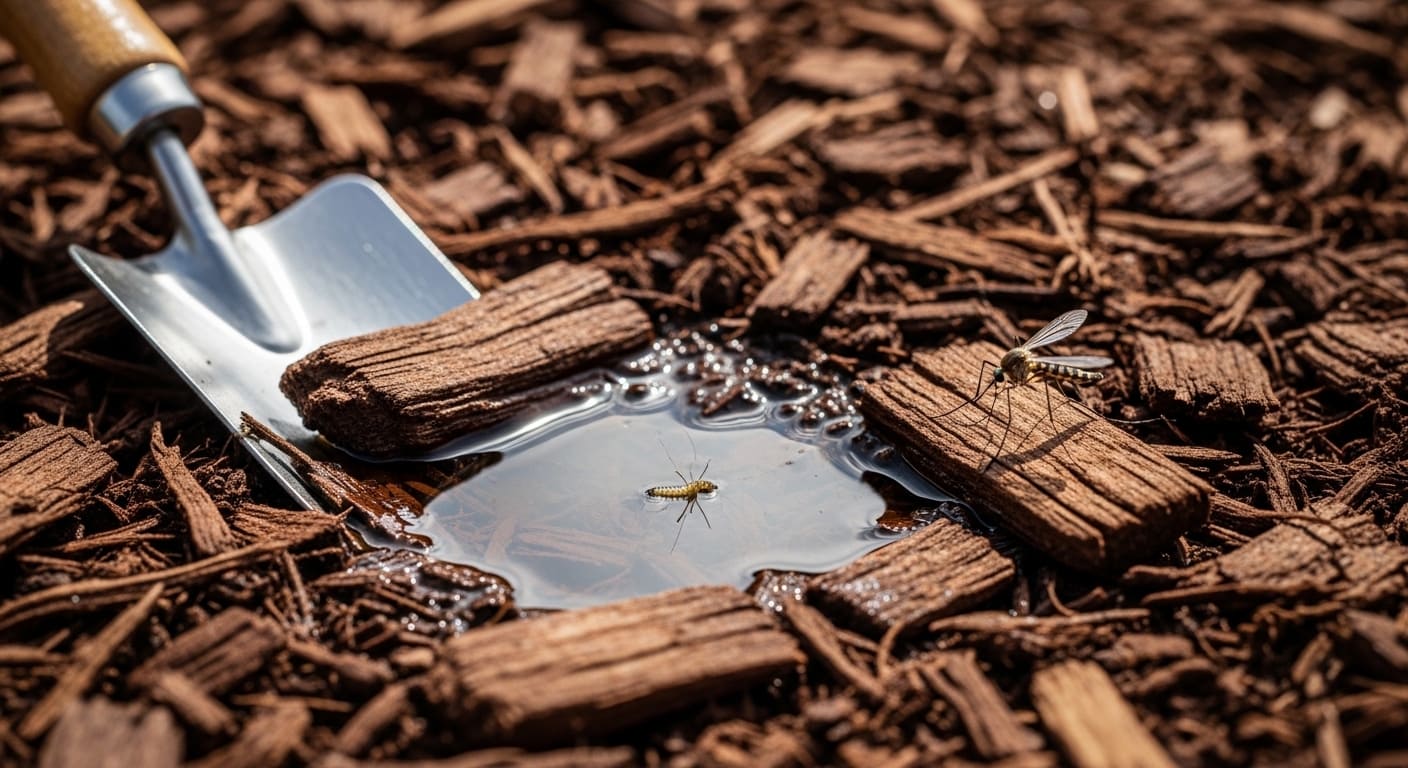
Yes — mulch absolutely does attract mosquitoes. If you’ve been slapping at your arms every time you step near your flower beds, your mulch isn’t just decorative ground cover anymore. It has quietly become a five-star breeding resort for one of the most annoying insects on the planet. Mosquitoes around mulch beds is a real, documented problem, and if you’re not addressing it directly, you’re going to keep losing the backyard battle all summer long.
Here’s the thing that nobody tells you when you’re loading up the truck at the garden center: that beautiful, fragrant layer of wood mulch you’re spreading around your hostas and hydrangeas is basically a welcome mat for Aedes and Culex mosquitoes. It holds moisture. It stays cool. It breaks down into rich organic matter. And it creates the exact microclimate these insects need to rest, breed, and thrive.
But before you rip it all out and concrete over your garden — don’t. There are smart fixes, better mulch choices, and simple maintenance habits that can dramatically reduce mosquito activity right around your beds. Let’s get into it.
Does Mulch Attract Mosquitoes? Here’s the Science Behind It
Mosquitoes don’t randomly wander into your yard. They actively seek out specific environmental conditions — and wood mulch checks almost every box. Understanding why requires a quick look at mosquito biology.
Female mosquitoes need standing or pooled water to lay eggs. But they also need a cool, humid, shaded resting spot between feeding — and that’s where mulch beds come in. A freshly watered mulch bed can retain moisture in the top layer for 24 to 48 hours. That’s long enough for water to pool in small pockets, depressions, and leaf litter caught in the mulch.
According to the CDC and various state health departments, eliminating standing water — even tiny amounts — is the single most effective way to reduce local mosquito populations. A mulch bed that holds moisture is essentially a distributed collection of micro-habitats.
What makes mulch specifically problematic:
- Moisture retention — mulch slows evaporation, keeping the soil damp longer than bare ground
- Shade and cool temperatures — mosquitoes rest in cool, dark spots during the heat of the day
- Decomposing organic matter — breaks down into nutrients that support mosquito larval food sources
- Dense cover — gives adult mosquitoes protection from wind and predators
- Leaf debris accumulation — catches water and creates standing pools within the bed itself
What Type of Mulch Attracts Mosquitoes the Most?
Not all mulches are created equal when it comes to mosquito attraction. The worst offenders are the ones that hold the most moisture and compact down over time — which unfortunately includes some of the most popular choices at garden centers.
High-Risk Mulch Types for Mosquito Activity
- Shredded hardwood mulch — dense, compacts easily, retains water like a sponge
- Straw and hay — lightweight but holds moisture between stalks, also traps leaf litter
- Grass clippings — break down fast, stay wet, and can even form a smothering mat
- Peat moss — extremely high moisture retention, stays wet for days after rain
- Cocoa shell mulch — stays moist and actually has a sweet scent that can attract various insects
Personal Experience
In my own yard, I made the mistake of going deep with shredded hardwood — a full four inches because I was tired of pulling weeds. That summer was brutal. I couldn’t sit on my back porch after 6 PM without a cloud of mosquitoes materializing out of nowhere. Took me a season to figure out the mulch was a major contributor.
What Kind of Mulch Repels Mosquitoes? Your Best Options
This is the question everyone eventually searches for — and the good news is, there are legitimate alternatives that don’t just reduce moisture but actually contain natural compounds mosquitoes dislike.
Cedar Mulch — The Top Choice for Mosquito Deterrence
Cedar is the most widely recommended mosquito-repelling mulch, and for good reason. Cedar wood contains natural oils — primarily thujone and cedrol — that act as natural insect deterrents. These oils are the same reason cedar closets repel moths. The scent isn’t just pleasant to humans; it’s actively off-putting to a wide range of insects, including mosquitoes.
Cedar mulch also drains better than hardwood and takes longer to break down, which means fewer moisture pockets over time. It’s not a silver bullet, but switching to cedar is one of the most impactful single changes you can make.
Other Mulches That Keep Mosquitoes Away
- Cypress mulch — similar natural oils to cedar, drains well, and resists compaction
- Eucalyptus mulch — contains eucalyptol, a known insect repellent; strong natural scent
- Pine straw (pine needles) — drains extremely well, doesn’t compact, allows soil to breathe
- Rubber mulch — completely inorganic, holds no moisture, offers no habitat — though it has its own tradeoffs like heat retention
- Gravel or river rock — not technically mulch, but the most mosquito-hostile ground cover option
How to Get Rid of Mosquitoes in Mulch Beds: 9 Practical Fixes
Swapping your mulch type is step one, but it won’t solve everything on its own. Mosquito control around mulch beds requires a layered approach. Here are the fixes that actually work — ranked roughly by effectiveness and ease of implementation.
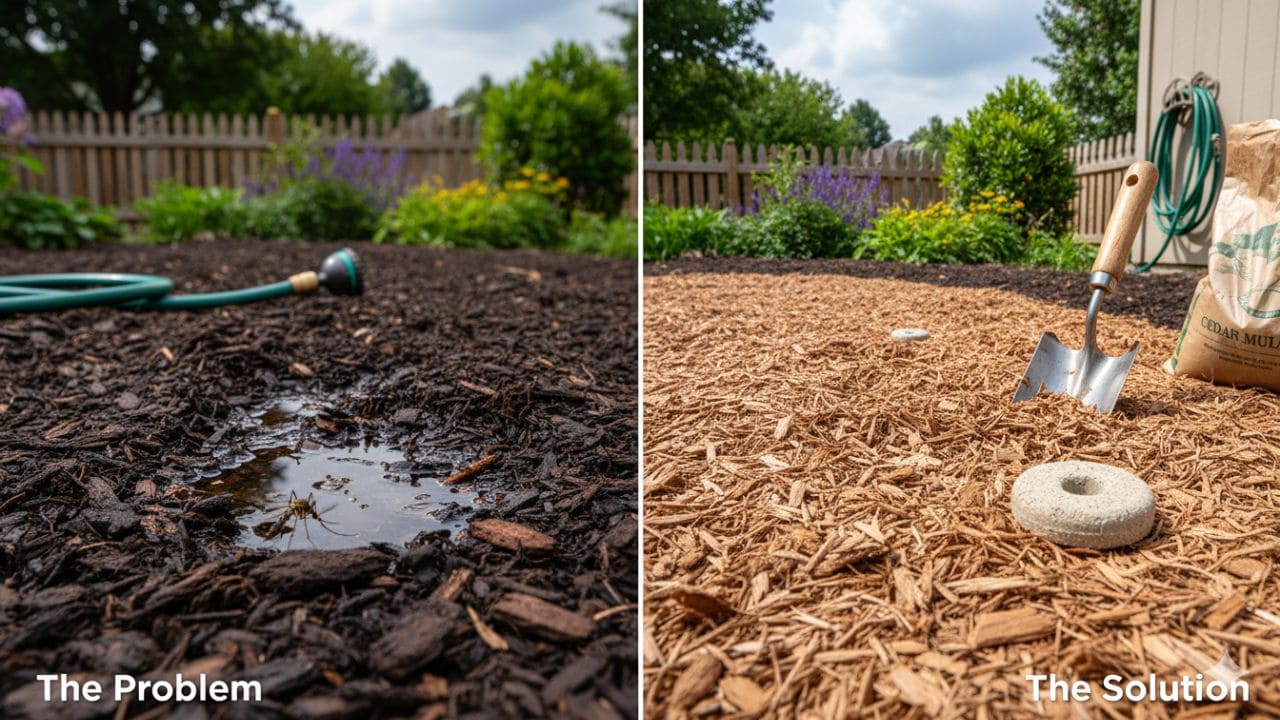
Image Credit: MosquiTalk
1. Switch to a Repellent or Well-Draining Mulch
As covered above — cedar, cypress, or pine straw should be your first call. If you’re not ready to replace everything, at least top-dress your existing mulch with a cedar layer. Even a one-inch topdressing can help release those natural oils across the bed.
2. Keep Mulch Bed Depth at Two to Three Inches Maximum
More is not better. A thick layer of mulch holds exponentially more moisture. The University of Florida IFAS Extension recommends two to three inches as the ideal depth for weed suppression without creating excessive moisture conditions. Deeper than that and you’re creating the exact microhabitat mosquitoes love.
3. Rake and Turn Mulch Bed Regularly
This is the most underrated tip. Raking your mulch once or twice a week breaks up the compacted surface, exposes the interior to air and sunlight, and disrupts any potential standing water. Takes five minutes. Makes a real difference.
4. Eliminate All Standing Water Near Mulch Beds
Check the perimeter of your beds after irrigation or rain. Look for low spots, indentations, overturned leaves, or any surface that holds even a bottle cap’s worth of water. The EPA emphasizes that mosquitoes can breed in as little as a half-inch of standing water — less than what collects in a folded leaf.
5. Apply Bacillus Thuringiensis Israelensis (BTI)
BTI is a naturally occurring soil bacterium that’s lethal to mosquito larvae but completely harmless to humans, pets, birds, and beneficial insects. It comes in granule or dunk form. Sprinkle granules across moist mulch beds and they’ll target any larval activity at the source. It’s the method many mosquito abatement districts use.
6. Use Diatomaceous Earth as a Dry Barrier
Food-grade diatomaceous earth (DE) sprinkled around the edges of mulch beds creates a desiccant barrier. Mosquitoes and other soft-bodied insects that cross it dehydrate rapidly. Reapply after rain.
7. Add Mosquito-Repelling Plants Alongside the Mulch Bed
Certain plants emit compounds that naturally deter mosquitoes. Incorporating citronella grass, lavender, lemon balm, marigolds, catnip, or basil around and within your mulch beds adds a biological layer of protection. Catnip in particular has been studied at Iowa State University and found to be more effective than DEET against mosquitoes in laboratory conditions.
8. Improve Drainage Under Mulch Beds
If your beds sit in a low area or on clay soil that doesn’t drain, even the best mulch will stay wet. Consider adding a layer of pea gravel or coarse sand beneath the mulch layer to promote faster drainage. You may also need to regrade low spots to direct water away.
9. Apply a Permethrin-Based Residual Spray to Mulch Beds
For serious infestations, a permethrin spray applied directly to mulch beds creates a residual barrier that kills adult mosquitoes on contact for up to several weeks. This is a more aggressive approach — always follow label directions and apply in the evening to minimize impact on pollinators. Many professional pest control operators use this as a first-response treatment.
Understanding Mosquito Breeding Habits Near Your Garden
It helps to know your enemy. Mosquito species that are most commonly associated with residential landscapes — Aedes albopictus (the Asian tiger mosquito) and Culex pipiens (the common house mosquito) — have slightly different habits, but both exploit the same mulch-bed conditions.
Aedes mosquitoes are container breeders and daytime biters. They’re the reason you get bitten in broad daylight. They’re not looking for large bodies of water — they want small, discrete pools. Your mulch is perfect for this.
Culex mosquitoes are dusk-and-dawn biters that breed in stagnant water with higher organic content — exactly what saturated, decomposing mulch can provide. They’re also the primary vector for West Nile Virus in the United States, according to the CDC.
The mosquito life cycle from egg to adult can be as short as eight to ten days in warm weather. That means a moist mulch bed that you ignore for a week and a half can theoretically go from zero to full adult population. That’s the urgency here.
Natural Mosquito Repellent Solutions for Mulch Beds
If you prefer to keep things organic — and a lot of gardeners with pets and kids in the yard absolutely do — there are effective natural approaches worth layering in alongside the physical fixes.
- Neem oil spray — diluted neem oil applied to mulch disrupts the mosquito life cycle and acts as a broad-spectrum natural insecticide; reapply every 7–10 days
- Essential oil deterrents — clove, lemongrass, rosemary, and peppermint oils diluted in water and sprayed around the bed perimeter create a scent barrier that discourages adult mosquitoes from resting
- Garlic spray — a garlic-water solution sprayed on mulch surfaces is a traditional remedy that has some evidence behind it; sulfur compounds in garlic are thought to repel mosquitoes
- Encourage natural predators — birds like purple martins and swallows eat flying insects in large numbers; installing a bat house near your garden can also dramatically reduce adult mosquito populations since a single bat can eat hundreds of insects per hour
- Keep flower beds well-trimmed — tall grass and dense low foliage adjacent to mulch beds creates additional resting habitat; eliminating this gives mosquitoes fewer places to shelter during the day
Does Wet Mulch Attract More Mosquitoes? (What Overwatering Does)
Without a doubt. Wet mulch is dramatically more attractive to mosquitoes than dry mulch. The moisture is what creates the breeding and resting conditions they’re seeking.
A lot of homeowners inadvertently make this worse by overwatering. If your irrigation system is running every day and you’ve got thick mulch on top, the soil beneath may never fully dry out — which means your mulch bed maintains a near-constant state of ideal mosquito habitat from spring through fall.
Simple adjustments to your watering routine:
- Water in the early morning (5–9 AM) so the sun can dry the surface before dusk when mosquitoes are most active
- Switch to deep, infrequent watering rather than light daily irrigation — this also promotes deeper root development in your plants
- Use soaker hoses or drip irrigation that delivers water directly to the root zone without saturating the surface mulch layer
- Check your irrigation coverage — are any heads over-spraying onto mulch beds?
Mosquito-Resistant Mulch Alternatives Worth Considering
Sometimes the best fix is rethinking whether traditional mulch is the right material for a given bed at all. If you have a chronically shaded, wet area that’s constantly a problem, there are alternatives that serve the same weed-suppression and soil-protection functions without creating mosquito habitat.
| Ground Cover | Mosquito Risk | Best Use Case |
|---|---|---|
| Shredded Hardwood | High — retains moisture heavily | Avoid in shaded/low areas |
| Cedar Mulch | Low — natural repellent oils | Most garden beds |
| Pine Straw | Low — drains quickly | Slopes and hillside beds |
| Rubber Mulch | Very Low — no organic matter | Playgrounds, paths |
| River Rock/Gravel | Very Low — no moisture retention | Xeriscape, borders |
| Cypress Mulch | Low — drains well, repellent | Most garden beds |
When Mosquitoes in Your Yard Become a Health Concern
Mosquitoes are more than annoying — in many regions of the United States, they are active disease vectors. The CDC identifies West Nile Virus, Eastern Equine Encephalitis (EEE), and in some coastal areas, dengue fever as legitimate risks transmitted by local mosquito species.
Most state health departments publish seasonal mosquito activity reports and often run community mosquito abatement programs. If you’re in a high-risk zone — Florida, Louisiana, Texas, coastal areas, or anywhere with regular standing water issues — it’s worth checking in with your county extension office or local health department for area-specific guidance.
The solutions in this article are appropriate for typical residential mosquito management. If you’re seeing unusually high activity or have immunocompromised family members, a licensed pest management professional can assess your property and recommend targeted treatment.
Mosquito Control in Mulch Beds: A Seasonal Maintenance Calendar
Spring (March–May)
- Rake out and remove old, compacted mulch that overwintered
- Assess drainage in all beds — regrade low spots before new mulch goes down
- Apply fresh cedar or cypress mulch at 2–3 inches depth
- Begin BTI applications if weather has been wet
Summer (June–August)
- Rake mulch weekly to break up compaction and expose moisture to air
- Clear leaf debris and any accumulated organic matter from mulch surfaces
- Reapply neem oil or essential oil spray every 7–10 days
- Adjust irrigation to morning-only, deep-and-infrequent schedule
- Monitor for standing water within 24 hours after rain
Fall (September–November)
- Remove fallen leaves from mulch beds promptly — this is a big one
- Reduce mulch depth going into winter — no need for thick insulating layers in warm climates
- Do a final BTI application before first frost in mosquito-heavy regions
Mulch vs. No Mulch: Is It Worth the Mosquito Risk?
Mulch is worth it. Bare soil has its own problems — erosion, soil temperature extremes, weed explosion, and moisture loss. The solution isn’t to abandon mulch altogether. It’s to use the right mulch, manage it properly, and combine it with the control strategies above.
The homeowners who struggle most with mosquitoes around their mulch beds are usually doing one or more of these things:
- using the wrong mulch type,
- applying it too thick,
- overwatering, and
- not clearing leaf litter.
Fix those four things alone and you’ll see a noticeable reduction.
Final Takeaway: Take Back Your Backyard This Season
Mosquitoes love mulch beds for the same reason we do — they’re cool, moist, and sheltered. But unlike us, they’re there to breed, not to relax. Understanding why mosquitoes around mulch beds is such a persistent problem is the first step. Acting on it is the second.
Switch to cedar or cypress. Keep depth at two to three inches. Rake regularly. Water smart. Add BTi to wet areas. Bring in repellent plants. These aren’t complicated changes — they’re just consistent ones.
I’ve been managing my yard in a region where mosquitoes are a genuine seasonal problem for over fifteen years. The summers I followed a consistent mulch-management routine were noticeably, measurably better than the ones I didn’t. Not perfect — you’re never going to eliminate every mosquito. But there’s a real difference between being ambushed every time you step outside and being able to sit on your porch with a drink at sunset without reaching for the bug spray.
You deserve that porch moment. Go make it happen.
Have you dealt with mosquitoes in your mulch beds? Which fix worked best for you — or what are you still struggling with? Drop your experience in the comments below. Real gardeners helping real gardeners is how we all get better yards.
Editorial Team & Contributors

Raashid Ansari, Founder, Content Researcher & Author - MosquiTalk
Not an entomologist — just a genuinely curious writer who started researching mosquitoes and couldn't stop. What began as casual reading about repellents and bite prevention gradually turned into a deep ongoing dive into vector biology, disease epidemiology, animal health impacts, and the real science behind mosquito control. Everything published here is carefully edited, and written with one purpose: giving readers accurate, accessible information they can actually trust and use to protect themselves, their families, and their pets, birds and cattle.
Active across social platforms, regularly publishes, and genuinely invested in spreading mosquito awareness where it matters most. Because informed readers make better decisions — and better decisions save lives.