
Introduction
Every summer the conversation comes back around. Mosquito dunks sitting on the shelf at Home Depot, the CDC warning about West Nile activity in Texas and Arizona, local health departments issuing advisories. People want to know: do those little donut-shaped things actually do anything? Or is it just wishful thinking in a beige packaging?
Short answer — yes, mosquito dunks and other larvicides genuinely work. But the longer answer is more interesting. Effectiveness of mosquito dunks and larvicides for West Nile virus prevention depends entirely on where you use them, how consistently you apply them, and whether you’re actually targeting the right stage of the mosquito life cycle. This guide breaks all of that down.
Understanding the West Nile Virus Threat in the U.S.
West Nile virus is the leading mosquito-borne disease in the continental United States, according to the Centers for Disease Control and Prevention (CDC). It’s transmitted primarily by Culex mosquitoes — not Aedes, the ones you usually think of with Zika or dengue. That distinction matters a lot when you’re choosing a control method.
The virus cycles between birds and Culex mosquitoes, with humans as accidental hosts. Most people who get infected never show symptoms. But roughly 1 in 5 develop fever and flu-like illness, and a smaller percentage — particularly older adults and immunocompromised individuals — can develop severe neurological complications.
States like California, Texas, Arizona, and those in the Mississippi River Valley tend to see the highest case counts seasonally. State health departments — including the Texas Department of State Health Services and the California Department of Public Health — track transmission data annually and issue prevention guidance when activity is elevated.
What Are Mosquito Larvicides?
Larvicides are products designed to kill mosquitoes at the larval stage — before they ever get a chance to fly, bite, or transmit anything. This is the core logic: interrupt the life cycle early. A dead larva never becomes an adult mosquito.
There are a few main categories used in both consumer and public health settings.
1. Biological Larvicides: Bacillus thuringiensis israelensis (Bti)
Bti is the active ingredient in Mosquito Dunks, the most widely recognized consumer product in this category. It’s a naturally occurring soil bacterium that produces proteins toxic to mosquito larvae when ingested. The toxin disrupts the larval gut lining, causing death — usually within 24 hours.
What makes Bti particularly compelling from a public health standpoint is its specificity. It targets mosquito larvae (and certain other fly larvae like fungus gnats) without harming fish, birds, amphibians, or beneficial insects like bees. That selectivity is backed by decades of research and regulatory review by the U.S. Environmental Protection Agency (EPA).
2. Methoprene: The Insect Growth Regulator
Methoprene works differently. Rather than killing larvae outright, it mimics a juvenile hormone that prevents them from maturing into adults. Mosquito larvae that are exposed to it can’t complete metamorphosis. They die before ever emerging from the water.
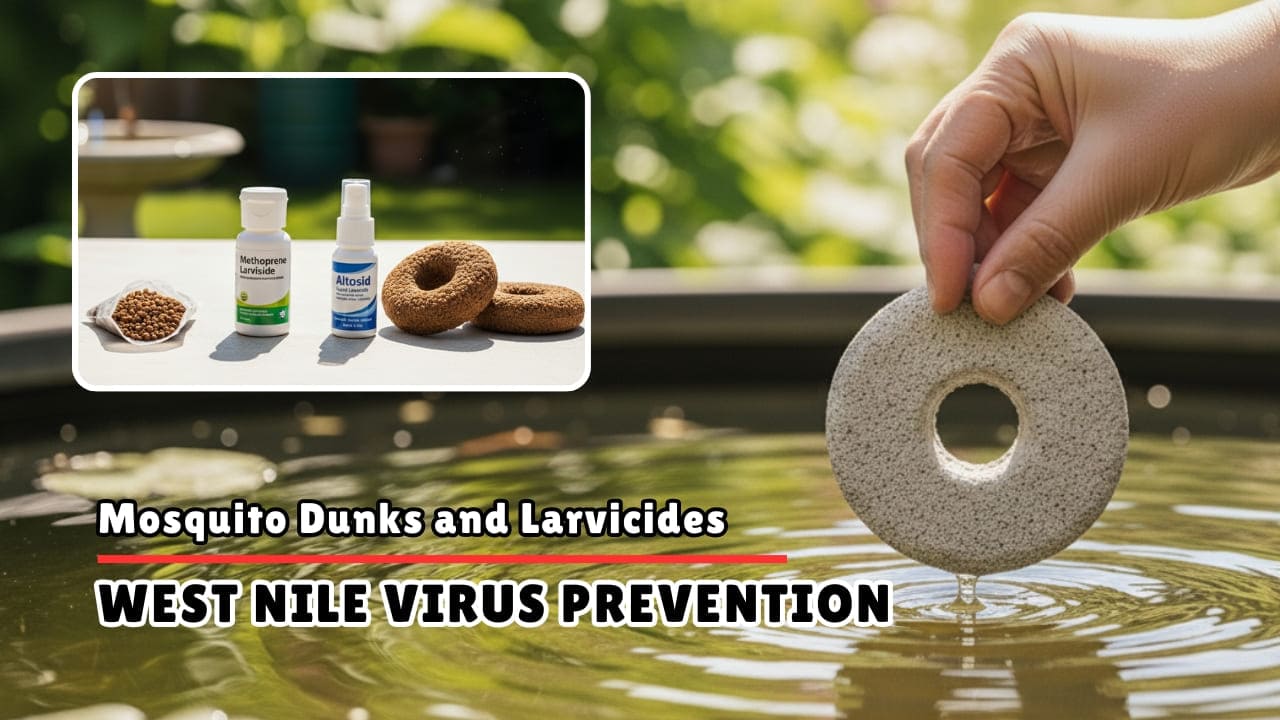
You’ll find methoprene in products like Altosid Pro-G Mosquito Larvicide, which is widely used by municipal mosquito control programs. It’s also available in some consumer briquettes and granules. EPA registration means it’s gone through formal safety review, though it should still be used as directed.
3. Spinosad: A Newer Option
Spinosad is a fermentation-derived insecticide also classified as biological. It’s effective against a broad range of mosquito species including Culex and Aedes. Some newer products like Natular combine spinosad with a slow-release formulation for extended residual control in water.
Mosquito Dunks: Specifically, How Do They Work?
Mosquito Dunks are those small, donut-shaped briquettes made by Summit Chemical. Each dunk contains a concentrated colony of Bti spores. When you drop one in standing water, it floats and slowly releases the Bti as it dissolves.
The label says one dunk treats up to 100 square feet of water surface for 30 days. Real-world results vary — direct sunlight, high temperatures, and water flow can degrade the product faster. In shaded, still water like a rain barrel, they hold up quite well.
Practical Note: Break dunks into smaller pieces for smaller containers — bird baths, clogged gutters, flower pot saucers. One full dunk in a tiny puddle is overkill and wasteful.
Mosquito dunks are widely stocked at hardware stores, garden centers, and online retailers. They’re one of the most cost-effective larviciding tools available to homeowners — typically around $8 to $10 for a pack of six.
Do Mosquito Dunks Actually Prevent West Nile Virus?
This is the real question. And the honest answer is: indirectly, yes — but they’re not a silver bullet.
West Nile is spread by Culex mosquitoes, which breed heavily in standing water. Storm drains, birdbaths, neglected pools, old tires, clogged gutters, tree holes, and anything else that holds stagnant water for more than a week can support a breeding population. Larviciding those sites reduces the adult mosquito population in the surrounding area.
Culex mosquitoes are particularly tied to artificial containers and urban water infrastructure. The L.A. County West Vector Control District and similar agencies across the country use truck-mounted and aerial larvicide applications specifically targeting storm drain systems — because that’s where huge numbers of Culex larvae live.
For homeowners, treating the breeding sites on your own property is a genuine, meaningful contribution. A single neglected rain barrel can produce hundreds of adult mosquitoes per week. Treating it with a dunk breaks that cycle completely.
Where to Use Larvicides: Priority Breeding Sites Around Your Home
Knowing the product is one thing. Knowing where to put it is what actually moves the needle.
Common backyard breeding sites for Culex mosquitoes include:
- Rain barrels and cisterns (treat with dunks; cover with fine mesh where possible)
- Bird baths — change water every 3 to 4 days or add Bti granules
- Clogged gutters with standing water
- Ornamental ponds and water features without active circulation
- Pool covers that collect rainwater
- Flower pot saucers — often overlooked but highly productive breeding sites
- Old tires (ideally drill holes to drain, or dispose of them)
- Low-lying areas in the yard that hold water after rain
Municipal larvicide programs typically handle storm drains, catch basins, and larger water bodies. Your local vector control district often offers free inspections or even free larvicide products for residents. It’s worth calling them.
Comparing Larvicide Products: What Actually Works Best?
Here’s a comparison of the most common larvicide types available to U.S. homeowners and municipalities.
| Product Type | Active Ingredient | Target Stage | Duration | Best Use |
|---|---|---|---|---|
| Mosquito Dunks | Bti | Larvae | ~30 days | Rain barrels, ponds, water features |
| Mosquito Bits | Bti | Larvae | ~2 weeks (fast release) | Soil, small containers, quick knockdown |
| Altosid Pro-G | Methoprene | Larvae/pupae | 30 days | Storm drains, catch basins, larger sites |
| Natular G30 | Spinosad | Larvae | 30 days | Catch basins, storm drains |
| Bti Granules (generic) | Bti | Larvae | 7–14 days | Birdbaths, gutters, small containers |
Note: Product availability, formulation, and efficacy can vary. Always read and follow EPA-registered label instructions.
Larvicides vs. Adulticides: Understanding the Difference
Adulticides — sprays like permethrin or pyrethrin-based foggers — get a lot of attention. They’re the ones being applied by municipal trucks driving through neighborhoods during an outbreak. But they’re not the same thing as larvicides, and conflating the two leads to a lot of confusion.
Adulticides kill adult mosquitoes on contact. They work fast. They can provide immediate relief during a West Nile surge. But they also degrade quickly and don’t address the source of the problem.
Larvicides address the source. They kill mosquitoes before they become biting adults, before they feed on infected birds, before they can transmit the virus to anyone. That’s why vector control specialists consistently talk about larviciding as the backbone of a long-term mosquito management program — not adulticides.
How to Apply Mosquito Dunks and Larvicides: Step-by-Step
- Identify all standing water sources on your property — don’t skip anything smaller than a bottle cap.
- Drain and scrub containers that can be emptied weekly (bird baths, pet water dishes). This alone reduces breeding significantly.
- For water you can’t drain — rain barrels, ponds, catch basins — apply an appropriate larvicide.
- Follow label rates. Dunks: one dunk per 100 sq ft of surface area. Granules: per label directions for container size.
- Reapply every 30 days (or sooner if rainfall events dilute the product significantly).
- Inspect after heavy rain — new standing water can appear quickly.
- Contact your local mosquito control district for treatment of public drains or larger water bodies near your property.
Timing Matters: When to Start Larviciding
Don’t wait for mosquitoes to be biting you before you act. Culex mosquito season in most of the southern U.S. begins in spring — April and May in states like Texas, Louisiana, and Florida. In northern states, June through August tends to be peak West Nile virus season.
The goal is to treat breeding sites before adult populations build up. Think of it like weeding before your garden gets overrun. Much easier to manage proactively.
Safety Profile: Are Larvicides Safe for People, Pets, and the Environment?
Bti-based products like Mosquito Dunks have an excellent safety record. The EPA has classified Bti as safe for use around humans, pets, fish, and wildlife when used as directed. The protein toxins produced by Bti are specific to certain dipteran larvae and are not active in mammalian systems.
Methoprene also carries EPA registration and is considered low-risk for non-target organisms at label rates. It does break down in sunlight and water, which actually limits its environmental persistence.
Spinosad has a similarly favorable profile — it’s even approved for use in organic farming contexts under OMRI (Organic Materials Review Institute) listing.
Important: Even low-risk products should be stored safely and kept out of reach of children. Always follow label directions and never apply more than the recommended rate.
No significant resistance has been documented to Bti in mosquito populations — an important point. Chemical insecticides have well-documented resistance issues. Bti’s mechanism of action is complex enough that resistance development has been extremely limited, which adds to its long-term value as a control tool.
What the Research Actually Says: Evidence for Larviciding Effectiveness
The evidence base for larviciding as a public health intervention is robust. Studies published in journals like the Journal of the American Mosquito Control Association have consistently demonstrated significant reductions in adult mosquito populations when larviciding programs are systematically implemented.
Real-world programs support this. The Greater Los Angeles County Vector Control District, for example, reports treating hundreds of thousands of catch basins annually with Bti and methoprene products as part of its West Nile virus prevention strategy. These programs are credited with helping manage Culex populations in heavily urbanized areas where breeding sites are pervasive.
That said — larviciding alone doesn’t eliminate West Nile virus risk entirely. The disease cycle is complex. Bird populations, human behavior, climate conditions, and adult mosquito control all play roles. Larviciding is one layer of a multi-layered strategy.
Common Mistakes People Make With Mosquito Dunks and Larvicides
- Treating only obvious water but missing small containers (saucers, tarps, tarps folded with puddles)
- Not reapplying after 30 days — the Bti degrades and stops working
- Using adulticide sprays alone and ignoring breeding site management
- Assuming one application per season is enough
- Purchasing products but not reading the label — overapplication wastes product, underapplication reduces efficacy
- Forgetting neighbor coordination — if your neighbor has a neglected pool, your yard is still at risk
Personal Protection: Larvicides Are Not the Whole Story
No single tool does everything. While larvicides address breeding sites, personal protection remains important — especially during peak Culex activity in the evening hours.
The CDC recommends EPA-registered insect repellents containing DEET, picaridin, IR3535, or oil of lemon eucalyptus for personal protection. Wearing long sleeves and pants during dawn and dusk when Culex mosquitoes are most active also significantly reduces bite risk.
Window and door screens in good repair are surprisingly effective and underrated. Eliminating indoor resting sites for mosquitoes matters more than most people think, especially in warm climates.
When to Call Your Local Vector Control District
If you have standing water on your property that you can’t drain or treat — large drainage ditches, retention ponds, storm-drain easements — call your county mosquito or vector control district. Most offer free inspections and treatment at no cost to residents.
In many states, these agencies are mandated to respond to complaints about mosquito breeding. They also often have data on local West Nile activity that can help you understand your actual risk level this season.
Find your local district through the American Mosquito Control Association (AMCA) at mosquito.org, or contact your state health department directly.
Final Verdict: Mosquito Dunks and Larvicides for West Nile Prevention
Yes — mosquito dunks and other larvicides genuinely work. They’re not snake oil. The science behind Bti is well-established, the EPA-registration process for these products is meaningful, and real-world mosquito control programs around the country rely on larviciding as a cornerstone of their West Nile prevention strategy.
But — and this is worth saying clearly — they work best as part of a broader approach. Source reduction, personal protection, community coordination, and timely reapplication all matter. A single dunk in your rain barrel while you’ve got three flower pot saucers sitting full of water in the garden is a half-measure.
The people who see results are the ones who do the survey, treat every standing water source consistently, and keep it up through the season. That’s not complicated. It’s just consistent.
Have you used Mosquito Dunks or other larvicides in your yard? Did you notice a difference in mosquito pressure that summer? Drop your experience in the comments — real-world observations from homeowners in different climates and regions are genuinely useful for others trying to figure out what to do.
Editorial Team & Contributors

Raashid Ansari, Founder, Content Researcher & Author - MosquiTalk
Not an entomologist — just a genuinely curious writer who started researching mosquitoes and couldn't stop. What began as casual reading about repellents and bite prevention gradually turned into a deep ongoing dive into vector biology, disease epidemiology, animal health impacts, and the real science behind mosquito control. Everything published here is carefully edited, and written with one purpose: giving readers accurate, accessible information they can actually trust and use to protect themselves, their families, and their pets, birds and cattle.
Active across social platforms, regularly publishes, and genuinely invested in spreading mosquito awareness where it matters most. Because informed readers make better decisions — and better decisions save lives.