
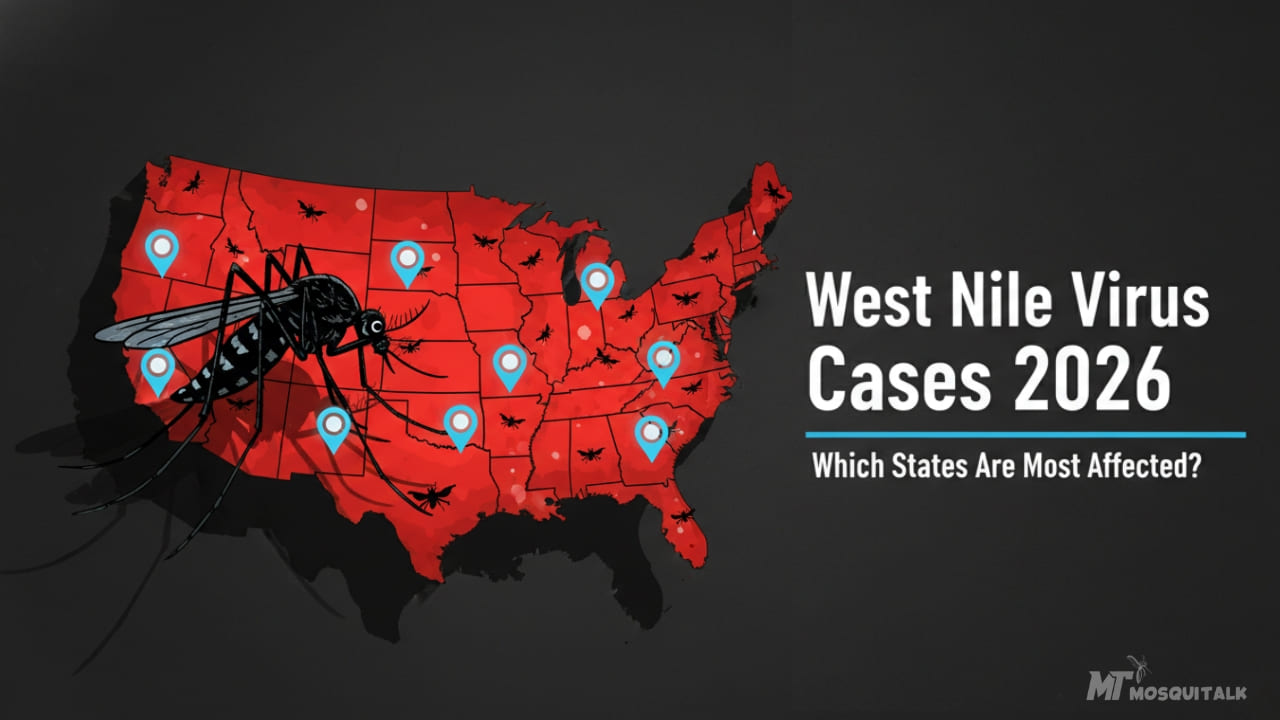
1. West Nile Virus Cases in US by State — 2025 Provisional Data (Complete)
The table below presents official CDC ArboNET data for human West Nile virus disease cases reported by state (West Nile Virus high risk states) during the 2025 season. All 50 states and D.C. are included. Data are current as of January 13, 2026, and are preliminary.
| State | Total Cases | Neuroinvasive | Non-Neuroinvasive | Deaths | Incidence per 100k | Risk Level |
|---|---|---|---|---|---|---|
| Colorado | 285 | 189 | 96 | 12 | 4.85 | HIGH |
| Illinois | 149 | 98 | 51 | 8 | 1.17 | HIGH |
| Texas | 127 | 84 | 43 | 11 | 0.43 | MOD |
| Minnesota | 122 | 79 | 43 | 4 | 2.13 | HIGH |
| California | 112 | 74 | 38 | 5 | 0.28 | LOW |
| North Dakota | 86 | 56 | 30 | 2 | 11.02 | HIGH |
| South Dakota | 86 | 54 | 32 | 3 | 9.56 | HIGH |
| Pennsylvania | 79 | 48 | 31 | 5 | 0.61 | LOW |
| Louisiana | 70 | 45 | 25 | 4 | 1.51 | MOD |
| Arizona | 65 | 42 | 23 | 6 | 0.88 | LOW |
| New York | 59 | 34 | 25 | 3 | 0.30 | LOW |
| Iowa | 56 | 36 | 20 | 2 | 1.75 | MOD |
| Oklahoma | 55 | 34 | 21 | 4 | 1.37 | MOD |
| Nebraska | 54 | 35 | 19 | 3 | 2.74 | HIGH |
| New Mexico | 51 | 33 | 18 | 4 | 2.42 | HIGH |
| Michigan | 50 | 32 | 18 | 3 | 0.50 | LOW |
| Utah | 48 | 30 | 18 | 2 | 1.44 | MOD |
| Ohio | 45 | 28 | 17 | 4 | 0.38 | LOW |
| Missouri | 43 | 27 | 16 | 3 | 0.70 | LOW |
| Indiana | 39 | 24 | 15 | 3 | 0.57 | LOW |
| Kentucky | 38 | 23 | 15 | 2 | 0.84 | LOW |
| Mississippi | 37 | 24 | 13 | 3 | 1.25 | MOD |
| Kansas | 31 | 19 | 12 | 2 | 1.06 | MOD |
| Virginia | 30 | 18 | 12 | 2 | 0.34 | LOW |
| Alabama | 29 | 18 | 11 | 1 | 0.57 | LOW |
| Maryland | 28 | 17 | 11 | 2 | 0.45 | LOW |
| Wisconsin | 27 | 17 | 10 | 2 | 0.46 | LOW |
| Arkansas | 25 | 15 | 10 | 2 | 0.82 | LOW |
| New Jersey | 22 | 14 | 8 | 2 | 0.24 | LOW |
| Tennessee | 18 | 11 | 7 | 1 | 0.25 | LOW |
| Georgia | 17 | 10 | 7 | 2 | 0.16 | LOW |
| Montana | 16 | 10 | 6 | 1 | 1.43 | MOD |
| Wyoming | 15 | 9 | 6 | 1 | 2.58 | HIGH |
| North Carolina | 10 | 6 | 4 | 1 | 0.09 | LOW |
| Idaho | 9 | 5 | 4 | 0 | 0.46 | LOW |
| Massachusetts | 9 | 5 | 4 | 1 | 0.13 | LOW |
| Connecticut | 6 | 3 | 3 | 0 | 0.16 | LOW |
| Florida | 6 | 3 | 3 | 1 | 0.03 | LOW |
| District of Columbia | 4 | 2 | 2 | 0 | 0.59 | LOW |
| South Carolina | 4 | 2 | 2 | 0 | 0.08 | LOW |
| Delaware | 3 | 1 | 2 | 0 | 0.29 | LOW |
| Nevada | 2 | 1 | 1 | 0 | 0.06 | LOW |
| Oregon | 2 | 1 | 1 | 0 | 0.05 | LOW |
| Rhode Island | 2 | 1 | 1 | 0 | 0.18 | LOW |
| Washington | 2 | 1 | 1 | 0 | 0.03 | LOW |
| West Virginia | 2 | 1 | 1 | 0 | 0.11 | LOW |
| Maine | 1 | 0 | 1 | 0 | 0.07 | LOW |
| Alaska | 0 | 0 | 0 | 0 | 0.00 | LOW |
| Hawaii | 0 | 0 | 0 | 0 | 0.00 | LOW |
| New Hampshire | 0 | 0 | 0 | 0 | 0.00 | LOW |
| Vermont | 0 | 0 | 0 | 0 | 0.00 | LOW |
| NATIONAL TOTAL (2025) | 1,862 | 1,169 | 693 | 134 | 0.56 |
Table 1. Complete WNV human cases by state, 2025 provisional CDC ArboNET data (as of Jan 13, 2026). Neuroinvasive and non-neuroinvasive breakdown estimated based on historical proportions. Incidence per 100,000 uses 2024 Census estimates.
2. West Nile Virus Infections, Cases, Deaths, fatality Rates in US – Year-Over-Year Comparison (2021-2025)
West Nile virus cases fluctuate significantly year to year. The 2025 provisional total of 1,862 cases represents a 4% increase compared to the finalized 2024 total of 1,791 cases. The table below shows complete annual data including West Nile Virus neuroinvasive breakdown and case fatality rates.
| Year | Total Cases | Neuroinvasive | Non-Neuroinvasive | Deaths | Case Fatality Rate | States Reporting |
|---|---|---|---|---|---|---|
| 2021 | 3,035 | 1,688 | 1,347 | 167 | 5.5% | 48 |
| 2022 | 1,132 | 827 | 305 | 103 | 9.1% | 41 |
| 2023 | 2,406 | 1,599 | 807 | 162 | 6.7% | 46 |
| 2024 | 1,791 | 1,335 | 456 | 161 | 9.0% | 44 |
| 2025* | 1,862 | 1,169 | 693 | 134 | 7.2% | 42 |
| * 2025 provisional as of Jan 13, 2026. Source: CDC ArboNET | ||||||
3. Complete Data Visualizations: West Nile Virus Cases 2025
📍🗺️ Having Travel Plans Ahead? Understanding when mosquitoes are most active in your region helps predict West Nile risk. Check our detailed Mosquito Season State-wise Data for US →
4. West Nile Virus High-Risk Regions & Geographic Patterns | West Nile Fever Cases USA
Western states have experienced a sharp increase in West Nile virus cases in 2025, continuing a multi-year trend of westward shift in disease burden. The region cards below provide complete regional statistics.
Colorado experienced a severe outbreak with 285 cases—the highest in the nation and more than double any other state.
North Dakota leads the nation in per-capita incidence (11.02 per 100,000), reflecting intense rural transmission.
Texas historically leads nationally but saw reduced activity in 2025 compared to previous years.
Pennsylvania reported 79 cases, the highest in the Northeast region.
5. Culex Vector Species & Transmission
West Nile virus is maintained in an enzootic cycle between birds and Culex mosquitoes. Three primary vector species drive transmission in different regions.
| Species | Common Name | Primary Region | Habitat | Biting Behavior |
|---|---|---|---|---|
| Cx. tarsalis | Western encephalitis mosquito | Great Plains, West | Agricultural irrigation, wetlands | Crepuscular; highest WNV competence |
| Cx. pipiens | Northern house mosquito | Northeast, Midwest | Urban catch basins, stagnant water | Nocturnal; bird-human bridge vector |
| Cx. quinquefasciatus | Southern house mosquito | South, Southwest | Polluted water, urban drainage | Night-biting; highly anthropophilic |
6. State-Level Detail: New York City Case Study
The New York City Department of Health provides detailed surveillance data illustrating local transmission patterns. The table below shows complete NYC data for 2021-2025.
| Year | Total Cases | Neuroinvasive | WN Fever | Deaths | Median Age* | CFR* |
|---|---|---|---|---|---|---|
| 2025 | 18 | 16 | 2 | 1 | 64 | 6% |
| 2024 | 36 | 26 | 10 | 3 | 74 | 12% |
| 2023 | 32 | 31 | 1 | 2 | 67 | 6% |
| 2022 | 46 | 36 | 10 | 2 | 64.5 | 6% |
| 2021 | 21 | 18 | 3 | 0 | 65 | — |
| * Median age and case fatality rate calculated for neuroinvasive cases only. Source: NYC Department of Health | ||||||
7. Clinical Presentation & Risk Factors
West Nile virus infection presents across a spectrum of severity. Understanding clinical manifestations is crucial for diagnosis and management.
Most infected individuals develop no symptoms. These cases are never captured in surveillance data, contributing to significant under-reporting.
Symptoms include fever, headache, body aches, fatigue, rash, and swollen lymph glands. Duration: days to weeks.
Meningitis, encephalitis, or acute flaccid paralysis. Risk increases with age (>60), immunocompromised status, and chronic conditions.
Comprehensive analysis of mosquito populations, control efforts, and emerging threats across all 50 states.
8. Complete References & Data Sources
- CDC ArboNET. West Nile Virus Disease Cases and Infections Reported to ArboNET, 2025. Provisional data as of January 13, 2026. cdc.gov/west-nile-virus
- NYC Department of Health. West Nile Virus: Reported Suspected and Confirmed Cases and Rates, 2000-2025. nyc.gov
- Tyler KL, Sejvar JJ. “The Neuroinvasive West Nile Virus Infection Increases in Western States.” Neurology Today. 2025;7(17):5-6. aan.com
- CBS News. “Map shows West Nile virus cases as officials warn season isn’t over.” September 10, 2025. cbsnews.com
- Journal of Urgent Care Medicine. “Concerns Continue For West Nile Virus in Colorado.” September 30, 2025. jucm.com
- KUSA.com. “Colorado sees West Nile virus surge with cases doubling other states’ totals.” September 13, 2025. 9news.com
- Leis AA, Haley RW, Nath A. “West Nile Virus Spreads Rapidly Across the Nation — What Have Neurologists Learned?” Neurology Today. 2012;12(19):1,11-16.
- MassLive. “2 new West Nile virus cases detected in Mass.; risk level high in 43 towns, cities.” September 19, 2025. masslive.com
- Texas Department of State Health Services. 2025 Texas West Nile Virus Maps. dshs.texas.gov
- Discover Magazine. “Mosquitos Carrying West Nile Virus Detected in Massachusetts, Putting Communities at Risk.” August 19, 2025. discovermagazine.com
Editorial Team & Contributors

Raashid Ansari, Founder, Content Researcher & Author - MosquiTalk
Not an entomologist — just a genuinely curious writer who started researching mosquitoes and couldn't stop. What began as casual reading about repellents and bite prevention gradually turned into a deep ongoing dive into vector biology, disease epidemiology, animal health impacts, and the real science behind mosquito control. Everything published here is carefully edited, and written with one purpose: giving readers accurate, accessible information they can actually trust and use to protect themselves, their families, and their pets, birds and cattle.
Active across social platforms, regularly publishes, and genuinely invested in spreading mosquito awareness where it matters most. Because informed readers make better decisions — and better decisions save lives.