
It’s 9p.m. on a July evening, you’re finally sitting outside with a cold drink, and within about ninety seconds you’re slapping at your ankle for the third time. Every single person reading this has had that exact moment. And every single person reading this has, at least once, thought some version of the same furious question: why do these things even exist?
Here’s where it gets uncomfortable. Mosquitoes kill more humans than any other animal on Earth, year after year, by a wide margin — malaria alone puts that death toll in the hundreds of thousands annually. So the instinct to just erase them feels obvious. Almost too obvious.
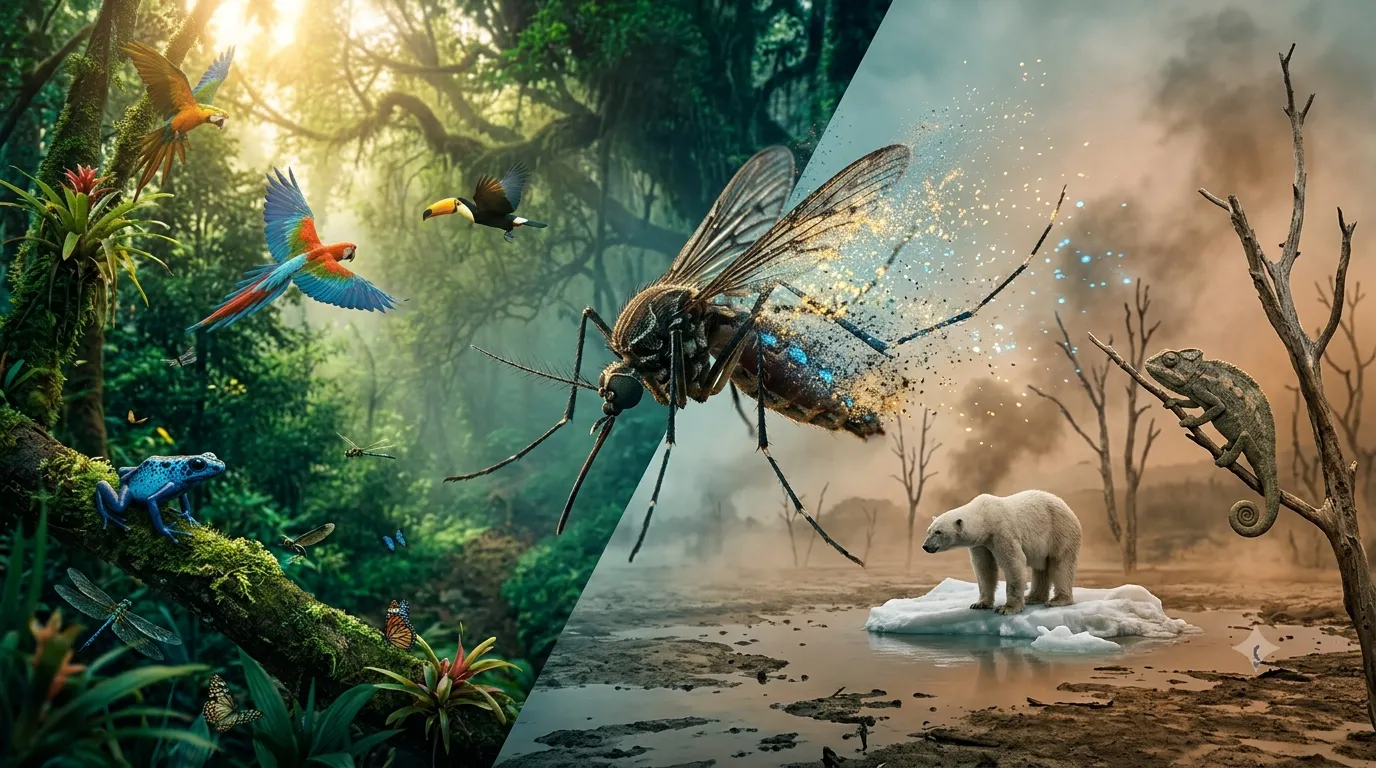
But actually what would happen if mosquitoes went extinct tomorrow? Would the planet throw a party, or would we accidentally break something we can’t put back together? I’ve spent the last few weeks digging through entomology research, CDC data, and interviews from public health researchers to answer that properly — not the surface-level version you’ll find in a listicle, but the real ecological math. Stick with me, because the answer is not what most people expect.
What Would Happen If Mosquitoes Went Extinct? Why this Questions Arises Now?
This isn’t just a fun thought experiment anymore. It’s a live policy conversation.
Mosquito-borne disease is genuinely expanding its footprint across the United States right now, driven largely by climate change. Warmer winters mean mosquitoes survive longer into the year. Wetter storms mean more standing water, which means more breeding grounds. Aedes aegypti and Aedes albopictus — the species behind dengue, Zika, and chikungunya — are pushing steadily northward into states that never used to worry about them.
Los Angeles County saw a sustained, weeks-long chain of locally acquired dengue transmission in recent years, something researchers had long treated as a tropical-only problem. West Nile virus has now turned up in nearly every state in the continental U.S. Eastern equine encephalitis, rare but brutal — it carries something close to a 30% fatality rate in severe cases — keeps flaring in the Northeast.
So yes. The extinction fantasy makes more sense than ever. It’s also more complicated than ever.
How Many Mosquito Species Are We Even Talking About
This is where a lot of articles get sloppy, so let’s be precise.
There are roughly 3,500 known mosquito species worldwide. Of those, only about 200 species bite humans at all. And of that 200, a small handful — mainly the genera Anopheles, Culex, and Aedes — are responsible for essentially all the disease transmission we actually worry about.
That distinction matters enormously, because it changes the entire framing of the question. “Mosquitoes going extinct” isn’t really one event. It’s really two very different scenarios stacked together:
- Total global extinction of all 3,500 species, including the harmless, non-biting ones.
- Targeted elimination of the tiny fraction of disease-carrying species that actually threaten humans.
Most of the ecological chaos people worry about applies to scenario one. Most of the public health benefit applies to scenario two. Conflating them is where a lot of the internet gets this topic wrong.
What We’d Gain If Mosquitoes Disappeared
Let’s not undersell this part, because it’s genuinely staggering.
Mosquitoes are, by a wide margin, the deadliest animal on the planet to humans. Not sharks. Not snakes. Not lions. Mosquitoes carry:
- Malaria — still kills roughly 600,000 people a year, mostly children under five in sub-Saharan Africa.
- Dengue fever — over 500 confirmed U.S. cases reported so far in 2026 alone, per CDC data.
- West Nile virus — detected in nearly 40 states, with over a thousand infected mosquito pools in New York in a single recent year.
- Eastern equine encephalitis (EEE) — rare, but roughly one in three severe cases is fatal.
- Zika virus — linked to devastating birth defects when contracted during pregnancy.
- Yellow fever, chikungunya, and several forms of encephalitis.
Wipe out the disease-carrying species and you’re looking at one of the single biggest public health wins in human history. Full stop. No asterisk needed there.
Fewer deaths. Lower healthcare costs. Entire regions of the world freed up for agriculture and safe outdoor living that mosquito-borne illness currently makes brutal. That’s the honest, straightforward upside, and it’s a big one.
What Mosquitoes Actually Do for the Planet?
Now for the part that complicates everything.
Mosquitoes aren’t just floating pests with no job. They’re wired into food webs in ways most people never think about, because, well, nobody sits around admiring a mosquito.
1. A Food Source for a Surprising Number of Animals
In their larval stage — living in ponds, puddles, tree holes, wherever water sits still — mosquito larvae are a major protein source for fish, amphibians, and aquatic insects. Adult mosquitoes get eaten by bats, birds, dragonflies, and spiders in huge volume.
Some species lean on this food source more heavily than others. Certain bat species, for instance, can eat their body weight in insects nightly, and mosquitoes make up a real chunk of that. Take mosquitoes away suddenly, and some of these predators would genuinely struggle, at least locally, at least at first.
Arctic ecosystems are actually one of the more dramatic examples here. In the brief Arctic summer, mosquito swarms get so dense that caribou change their migration routes to avoid them — which, oddly, protects fragile tundra vegetation from overgrazing. Meanwhile migratory birds flock to those same mosquito-dense areas to feed, and their droppings fertilize an otherwise nutrient-poor landscape. Pull mosquitoes out of that picture and you’re tugging on multiple threads at once.
2. The Pollinator Role Nobody Talks About
Here’s a fact that surprises almost everyone: male mosquitoes don’t drink blood at all. Ever. Only females do, and only because they need the protein for egg production.
Males survive on nectar. In doing so, they pollinate a range of plants — certain orchid species in particular depend heavily on mosquito pollination. It’s a small role in the grand scheme of global pollination compared to bees, but it’s not zero, and in some fragile wetland and bog ecosystems, it’s more important than people assume.
3. Quiet Work as Decomposers
Mosquito larvae also break down organic debris in standing water, which helps keep small aquatic ecosystems cycling nutrients properly. It’s unglamorous work. Somebody has to do it, though, and right now, that somebody is largely mosquitoes.
So What Would Actually Happen to the Food Chain?
Honestly? Nobody can give you a perfectly confident answer here, and any article that claims otherwise is overselling its certainty.
Ecologists generally agree on a few things:
- The disruption would be real but probably not catastrophic on a global scale
- Specialist predators tied heavily to mosquitoes would face short-term local declines
- Generalist predators — most birds, most bats, most fish — would likely adapt and shift to other insects
- Aquatic ecosystems that rely heavily on mosquito larvae as a food base would feel it hardest and fastest
The honest answer is that we don’t fully know. Nature is more tangled than any single model can capture, and a change this size would ripple outward in ways we can’t fully predict in advance.
Could Other Insects Just Fill the Gap?
Probably, at least partially. This has happened before in evolutionary history — a niche opens up, and something else expands into it.
Other insects that lay eggs in standing water, or that fill a similar prey-size role for birds and bats, would likely see population growth as competition eases and predators get hungrier. Midges are the most commonly cited candidate; they’re already ecologically similar to mosquitoes in several ways and exist in massive numbers.
But “probably fine eventually” and “fine immediately” are two very different things. And that gap between the two is basically the whole debate.
Fast Extinction vs. Slow Decline: Why the Timeline Changes Everything
This is, in my opinion, the single most underrated piece of this whole question, and most articles skip right past it.
A sudden, overnight extinction would be far more damaging than a gradual one. Predators that rely on mosquitoes wouldn’t have time to shift their diets or migrate to new food sources. Local extinctions of predator species could cascade, especially in isolated ecosystems like Arctic wetlands or small island habitats.
A slow decline — over decades, say — gives ecosystems room to breathe. Predators adapt. Other insects expand into the vacated niche. Food webs reroute gradually instead of snapping all at once. It’s the difference between slowly letting air out of a tire and just stabbing it.
This is actually closer to how real-world mosquito control works anyway. Nobody is proposing an instant, planet-wide extinction event. What’s actually being researched and piloted is much narrower.
Winners and Losers
If it happened, who comes out ahead, and who doesn’t?
Likely winners:
- Humans, overwhelmingly — fewer deaths, less disease, lower medical costs globally.
- Livestock and pets currently vulnerable to mosquito-borne illness like heartworm or EEE.
- Regions where malaria and dengue currently limit agriculture, tourism, and daily outdoor life.
Likely losers, at least short term:
- Specialist insectivorous bats and birds in mosquito-heavy habitats
- Fish and amphibians in ponds where mosquito larvae are a primary early food source
- Arctic ecosystems where mosquito swarms shape caribou migration and bird feeding patterns
- A handful of plant species, orchids especially, that lean on mosquitoes for pollination
Net-net, most researchers I’ve come across land somewhere similar: the human health upside would likely outweigh the ecological cost, but the ecological cost is not nothing, and it wouldn’t be evenly distributed. Some places would barely notice. Others would feel it hard.
So Should We Actually Try to Eradicate Mosquitoes?
This is where science and ethics collide, and reasonable people land in different places.
Researchers have already developed genetic tools capable of doing real damage to mosquito populations — techniques that skew offspring heavily male, for instance, which crashes reproduction rates over a few generations. The technology to attempt something close to targeted eradication of the worst disease-carrying species already exists, at least in early form.
Whether we should pull that trigger is a different question entirely. Most public health researchers I’ve seen weigh in on this favor a narrower, more surgical approach: target the handful of dangerous species — Anopheles, Aedes aegypti, Aedes albopictus, Culex — while leaving the other roughly 3,300 harmless species alone. That preserves most of the ecological function while removing most of the human cost. It’s a more defensible middle path than an all-or-nothing extinction event, and it’s the direction most current research is actually heading.
What’s Actually Happening Right Now, Not Hypothetically
While the extinction debate stays theoretical, mosquito control is not. It’s happening at your local level right now, and it’s expanding.
Cities and counties across the U.S. are ramping up mosquito abatement programs as climate-driven disease risk grows. Some are piloting Wolbachia-infected mosquitoes, which reduce a population’s ability to transmit disease without wiping out the species. Others are testing sterile-insect and gene-drive techniques in limited trials, aimed squarely at the two or three worst offenders rather than the entire mosquito family tree.
That’s really the practical version of this whole question. Nobody credible is trying to erase all 3,500 species from the planet. What’s actually on the table is smarter, narrower, and honestly a lot less dramatic than the extinction headline suggests — reduce the mosquitoes that hurt us, leave the rest of the web intact.
Frequently Asked Questions (FAQs)
Q. Would humans survive if all mosquitoes disappeared?
Yes, easily. Humans don’t depend on mosquitoes for food, pollination, or any critical service. If anything, human health would likely improve significantly.
Q. Which animals would be hit hardest by mosquito extinction?
Specialist insect-eating bats, certain birds, and aquatic species like fish and amphibians that rely heavily on mosquito larvae as an early food source would feel it most, particularly in wetland and Arctic habitats.
Q. Do mosquitoes pollinate any plants?
Yes. Male mosquitoes feed on nectar and pollinate a range of plants, including several orchid species, though their overall contribution to global pollination is small compared to bees.
Q. Is mosquito extinction actually being planned anywhere?
Not total extinction. Current research and pilot programs focus on targeted reduction of a small number of disease-carrying species, not the elimination of all 3,500 mosquito species.
Q. Why does mosquito-borne disease risk keep rising in the U.S.?
Warmer temperatures, longer mosquito seasons, and shifting rainfall patterns tied to climate change are expanding the range of disease-carrying species like Aedes aegypti and Aedes albopictus into regions that previously saw little to no risk.
The Bottom Line
So, what would happen if mosquitoes went extinct? The honest answer sits somewhere between “celebration” and “caution.”
Human health would almost certainly improve, and improve substantially. Millions of lives, over time, saved from malaria, dengue, West Nile, and EEE alone. That part isn’t really in dispute.
But the ecosystem side isn’t a clean win. Some predators would struggle. Some food webs would need real time to reroute. Some corners of the planet — Arctic tundra, certain wetlands — would feel the loss more sharply than others.
The most likely real-world path forward isn’t total extinction anyway. It’s targeted, careful reduction of the handful of species that actually threaten us, while the other 3,300-plus keep doing their quiet, unglamorous ecological work in the background. Not as satisfying as a clean apocalypse-for-mosquitoes headline, maybe. But it’s the version most of the actual science is pointing toward.
Next time one lands on your arm at dusk, you’ll at least know the full, complicated truth behind the fantasy of swatting the entire species out of existence.
Editorial Team & Contributors

Raashid Ansari, Founder, Content Researcher & Author - MosquiTalk
Not an entomologist — just a genuinely curious writer who started researching mosquitoes and couldn't stop. What began as casual reading about repellents and bite prevention gradually turned into a deep ongoing dive into vector biology, disease epidemiology, animal health impacts, and the real science behind mosquito control. Everything published here is carefully edited, and written with one purpose: giving readers accurate, accessible information they can actually trust and use to protect themselves, their families, and their pets, birds and cattle.
Active across social platforms, regularly publishes, and genuinely invested in spreading mosquito awareness where it matters most. Because informed readers make better decisions — and better decisions save lives.