
Table of Contents
- No national “mosquito bite rate” – UKHSA does not publish bites-per-person or bites-per-hour. Any average figure you see elsewhere is UNVERIFIED — SECONDARY SOURCE ONLY and should be treated with skepticism.
- No official “Top 10 UK regions” for mosquito‑borne disease reports. Travel‑associated infections are reported at EWNI level; sub‑regional breakdowns are not routinely published (privacy / small numbers).
- Locally acquired cases are zero or not applicable for nearly all diseases in scope. The only exception: a historic number of travel‑associated cases and one non‑human detection (West Nile virus RNA in mosquito pools, not human cases). This report does not imply endemicity.
- “2026 final data” will not be published until 2027. Where 2026 figures are cited, they are marked PROVISIONAL or projected.
UKHSA travel‑associated infection statistics are reported at England/Wales/Northern Ireland (EWNI) level; Scotland is covered separately by Public Health Scotland. Sub‑regional (county/city) breakdowns are not routinely published for privacy and small‑numbers reasons. This report presents verified data where it exists, clearly flags projections, and states “no official data published at this granularity” rather than inventing numbers.
1. Executive Summary
- The UK is home to 36 recorded mosquito species — the current confirmed UKHSA figure, updated as recently as August 2026 [3][25] — most of which are non-biting or nuisance-only; only a handful are competent disease vectors under UK conditions. (An older figure of 34 species, from 2017 PHE guidance, has been superseded — see Section 1.1.)
- No mosquito-borne disease is currently classified as endemic in the UK. All confirmed human cases of malaria, dengue, chikungunya, Zika and West Nile virus reported by UKHSA in recent years are travel-associated, acquired abroad [4][5][6].
- Imported malaria cases in England, Wales and Northern Ireland (EWNI) reached 2,004 in 2023 — the highest since 2001 — before easing to 1,812 (provisional) in 2024 and 1,629 (provisional) in 2025 [4][5][7].
- West Nile virus (WNV) genetic material was detected for the first time in UK-caught mosquitoes (Aedes vexans, Nottinghamshire, July 2023, confirmed via testing completed in 2025). This is a vector detection, not a human case — UKHSA and its risk assessment state there have been zero locally acquired human WNV cases in the UK to date, and only 7 travel-associated human cases since 2000 [8][9][10].
- Invasive Aedes albopictus (Asian tiger mosquito) and Aedes aegypti eggs have been detected at UK transport hubs (Heathrow freight facility, September 2023; a Kent motorway service station, August 2024), but UKHSA states neither species has established a breeding population in the UK [11][12].
- Chikungunya cases in UK travellers rose to 160 in 2025, up from 112 in 2024, linked to outbreaks in Sri Lanka, India and Bangladesh [7]. A secondary source describes this as the highest level in over a decade; this framing was not independently confirmed against the primary UKHSA release [UNVERIFIED — SECONDARY SOURCE ONLY] [22].
- Imported dengue cases fell sharply, from 904 in 2024 to 344 in 2025 (UKHSA provisional data), despite a global rise in dengue transmission [7].
- Climate change is extending the UK’s mosquito activity window and increasing breeding habitat via wetter winters, according to UKHSA and LSHTM entomologists — but modelling cited by UKHSA suggests current UK temperatures remain generally too low to sustain year-round WNV transmission cycles [10][13].
- No official, government-published statistics exist for UK-wide “bite rate,” county-level disease rankings, or a breakdown of consumer repellent/pest-control spending specific to mosquitoes (as opposed to insects generally) — this report flags these gaps rather than estimating them.
2. Mosquito Species in the United Kingdom
2.1 Total Species Count
Confirmed current figure: 36 recorded mosquito species [CONFIRMED]. This is stated directly by UKHSA’s guidance page “Information on native mosquitoes” [3] and independently corroborated by a second, separate UKHSA page, “Distinguishing Aedes albopictus, the Asian Tiger mosquito, from native British mosquitoes,” first published 6 March 2025 and last updated 6 August 2026, which also states “The UK has recorded 36 species of mosquito” [25]. Two independent, currently-live UKHSA pages agreeing on the same figure is treated here as the strongest available confirmation.
| Source | Species count cited | Status |
|---|---|---|
| UKHSA, “Information on native mosquitoes” | 36 species | Current [CONFIRMED] [3] |
| UKHSA, “Distinguishing Aedes albopictus…” (updated 6 August 2026) | 36 species | Current [CONFIRMED] [25] |
| PHE guidance, “Distinguishing Aedes albopictus…” (2017 edition) | 34 native species | Superseded — this earlier version of UKHSA’s own guidance has since been replaced by the 36-species figure above; retained here only to explain the discrepancy seen elsewhere online [15] |
| Academic secondary literature (edited volume, various chapters) | “34 species… native to Britain” | [UNVERIFIED — SECONDARY SOURCE ONLY]; an academic book chapter repeating the older 34-species figure rather than UKHSA’s current count [1] |
2.2 Native and Established Species of Public Health Relevance
| Species | Status | Public health relevance |
|---|---|---|
| Culex pipiens (pipiens form) | Native, widespread across England, Scotland, Wales | Most common mosquito in Britain; vector for West Nile and Usutu viruses elsewhere in its range [1][14] |
| Culex pipiens f. molestus (“London Underground mosquito”) | Native, urban/underground niche | Breeds in sewers, tunnels, basements; active year-round in sheltered urban infrastructure [13] |
| Culex torrentium | Native | Morphologically near-identical to Cx. pipiens; differentiated by male genitalia [1] |
| Culex modestus | Native, localised | Found in Essex and Kent, more recently Cambridgeshire, Hampshire and West Sussex; considered a potential WNV “bridge vector” [9] |
| Aedes vexans | Native, localised | Populations near Norwich (2017), parts of Nottinghamshire (since 2018) and the Cambridgeshire Fens (2024); the species in which WNV RNA was detected in 2023/2025 [9] |
| Aedes detritus | Native, coastal | Commonly described as a coastal/saltmarsh species in secondary sources; this report could not locate a UKHSA or peer-reviewed primary source confirming distribution detail within the sources reviewed [UNVERIFIED — SECONDARY SOURCE ONLY] [2] |
| Anopheles atroparvus / maculipennis complex | Native | Historically Europe’s major malaria vector; malaria was locally transmitted in England in earlier centuries but is no longer endemic. This report could not confirm an exact cessation date for local UK transmission against a primary source and does not state one [NOT VERIFIABLE — exact date] [1] |
| Culiseta annulata (“house mosquito”) | Native, widespread | Can remain active in mild winters above ~7–10°C; frequently confused with the invasive tiger mosquito [13][15] |
| Aedes albopictus (Asian tiger mosquito) | Not established — repeated isolated detections only (2016, 2019, 2023, 2024) | Vector for dengue, chikungunya, Zika in its established range; UKHSA confirms no evidence of a breeding population in the UK as of the most recent surveillance update [11][12][16] |
| Aedes aegypti | Not established — single 2023 egg detection | Primary global dengue/Zika/chikungunya vector; first-ever UK egg detection was at a Heathrow freight facility, September 2023 [11][12] |
2.3 Regional Distribution (Qualitative — No Official Population-Density Dataset Exists)
UKHSA does not publish a ranked, quantified population-density table by region. What is published is species presence/absence and localised surveillance findings:
| Region/Country | Documented species presence (from UKHSA/ECDC surveillance) | Notes |
|---|---|---|
| England (South East — Kent, Essex) | Culex modestus, invasive Aedes detections at ports/motorway hubs | Highest concentration of invasive-species interception activity, reflecting proximity to Channel ports/Eurotunnel [9][11] |
| England (East Midlands — Nottinghamshire) | Aedes vexans (established, nuisance-biting since 2018) | Site of the 2023 WNV mosquito-pool detection [8][9] |
| England (East of England — Cambridgeshire Fens, Norfolk) | Aedes vexans (Fens population since 2024; Norwich population since 2017) | Wetland/flood-prone habitat [9] |
| England (London and South East) | Culex pipiens f. molestus | Urban underground-infrastructure habitat [13] |
| Scotland | Culex pipiens, Culiseta species present per ECDC regional maps; no invasive Aedes establishment reported | Public Health Scotland handles surveillance separately from UKHSA [17] |
| Wales | Included in UKHSA’s England/Wales/Northern Ireland ovitrap network (117 localities in 2024) | No wetland Aedes vexans populations reported to date [12] |
| Northern Ireland | Included in UKHSA EWNI ovitrap network | No established invasive species reported [12] |
No official quantitative “mosquitoes per hectare” or population-density index by region is published by UKHSA, ONS, or the devolved public health agencies. Any such figures circulating online are not traceable to a government source and are excluded from this report.
3. Mosquito Population Density by Region Across UK
Data availability note: UKHSA’s national mosquito surveillance network reports trap locations and species detections, not standardised population-density indices comparable across regions. The table below summarises what is actually measured and published.
| Nation | What is measured | Latest published scale | Source |
|---|---|---|---|
| England | Adult mosquito traps: 307 localities, England & Wales combined [12]; invasive-species ovitraps: 1,070 traps at 117 localities, England/Wales/Northern Ireland, 2024 [12] | Trap count and locality count only; not converted to a density index | UKHSA/Edge Hill University joint surveillance [CONFIRMED] [12] |
| Scotland | Public Health Scotland-led surveillance, regional ECDC mapping (presence/anticipated-absent categories only) | Presence/absence by NUTS2/3 region | ECDC European mosquito maps [17] |
| Wales | Included within EWNI ovitrap network | Locality-level only | UKHSA [12] |
| Northern Ireland | Included within EWNI ovitrap network | Locality-level only | UKHSA [12] |
Comparison table — surveillance intensity (a proxy for effort, not population size):
| Nation | Approx. surveillance localities (2024) | Primary surveillance focus |
|---|---|---|
| England | Majority of the 307 adult-trap sites and 117 ovitrap localities [12] | Invasive species at ports/airports/motorways; nuisance biting (Nottinghamshire) [12][19] |
| Wales | Included in the 117-locality EWNI network [12] | Invasive species at ports [12] |
| Northern Ireland | Included in the 117-locality EWNI network [12] | Invasive species at ports [12] |
| Scotland | Separate Public Health Scotland programme; locality count not published in the sources reviewed for this report | General surveillance |
Because “trap density” reflects where UKHSA chose to monitor high-risk entry points (ports, airports, motorway services) rather than a random or population-weighted sample, this table should not be read as a measure of relative mosquito abundance between nations.
4. Mosquito Bite Rate Statistics for United Kingdom
This section is intentionally shorter than the brief’s structure implies, because the underlying data does not exist. No UK public health body, ONS survey, or peer-reviewed UK study reviewed for this report publishes:
- A national or regional “bite rate” (bites per person, per hour, or per exposure event)
- A monthly bite-exposure trend table
- A quantified urban-vs-suburban bite comparison
- A quantified indoor-vs-outdoor exposure comparison
What is documented, qualitatively, by UKHSA and LSHTM entomologists:
- Mosquito activity in the UK typically peaks between May and September [18].
- Species such as Culiseta annulata and Culex pipiens f. molestus can remain active through mild winters when temperatures stay above roughly 7–10°C, and unusually wet, mild conditions have been linked by LSHTM entomologists to an early-spring 2026 spike in nuisance biting reports outside the normal season [13].
- Culex pipiens f. molestus is specifically associated with indoor/underground urban exposure (sewers, basements, transport tunnels), while most other native species are associated with outdoor exposure near standing water, wetlands and gardens [1][13].
- Nuisance-biting hotspots are documented at the locality level rather than region-wide — for example, long-running nuisance-biting management work around the River Idle near Retford, Nottinghamshire, tied to Aedes vexans [19].
Recommendation for readers seeking bite-rate data: treat any number claiming a specific UK “average bites per year” figure as unsourced unless it cites a named peer-reviewed field study with its methodology; no such nationally representative study was identified in the course of this research.
5. UK Mosquito Report: Mosquito-Borne Disease Data (Latest Available + 2026 Outlook)
All figures below are UKHSA provisional annual data for England, Wales and Northern Ireland (EWNI) unless otherwise noted. All confirmed cases in this section are travel-associated (imported) unless explicitly marked “locally acquired” or “vector detection only.”
5.1 Malaria
| Year | Reported cases (EWNI) | P. falciparum cases | Travel-related vs. locally acquired | Trend |
|---|---|---|---|---|
| 2022 [CONFIRMED] | 1,369 [4][6] | — | 100% travel-related | — |
| 2023 [CONFIRMED] | 2,004 [4][5][6] | — | 100% travel-related | ↑ 32% vs. 2022 [5] — highest since 2001 [5] |
| 2024 [PROVISIONAL] | 1,812 [7] | — | 100% travel-related | ↓ from 2023 [7] |
| 2025 [PROVISIONAL] | 1,629 [7] | 1,325 [7] | 100% travel-related | ↓ from 2024 [7] |
| 2026 | Not yet published — full-year data expected spring 2027 [4] | — | — | Not projectable from public UKHSA data at time of writing |
Sources: UKHSA imported malaria statistics; UKHSA/NaTHNaC travel-associated infections report; Vax-Before-Travel/Medscape coverage of UKHSA releases [4][5][6][7][20].
No malaria transmission by local mosquitoes has occurred in the UK in the modern era covered by current UKHSA case reporting (2000–present) [4]. This report could not confirm an exact historical date for the last locally acquired (“autochthonous”) UK malaria case against a primary source, and does not state one rather than guess [NOT VERIFIABLE].
5.2 Dengue
| Year | Reported cases (EWNI) | Travel-related vs. locally acquired | Trend |
|---|---|---|---|
| 2024 [CONFIRMED] | 904 [21] | 100% travel-related | ↑, reflecting global dengue surge [21] |
| Q1 2025 [CONFIRMED] | 65 [21] | 100% travel-related | ↓ vs. 254 in Q1 2024 [21] |
| 2025 full year [PROVISIONAL] | 344 [7] | 100% travel-related | ↓ from 2024 [7] |
| 2026 | Not yet published | — | Not projectable |
Most 2025 cases were linked to travel to Thailand, Brazil and Indonesia [7]. No locally acquired dengue transmission has been recorded in the UK [7].
5.3 Chikungunya
| Year | Reported cases (EWNI) | Travel-related vs. locally acquired | Trend |
|---|---|---|---|
| 2024 [CONFIRMED] | 112 [7] | 100% travel-related | — |
| 2025 [PROVISIONAL] | 160 [7] | 100% travel-related | ↑ vs. 2024 [7]. A secondary source characterises this as the highest level in over a decade [UNVERIFIED — SECONDARY SOURCE ONLY, not stated in these terms in the primary UKHSA release reviewed] [22] |
| 2026 | Not yet published | — | Not projectable |
Most 2025 cases were linked to travel to Sri Lanka, India and Bangladesh, reflecting ongoing regional outbreaks [7].
5.4 Zika Virus
Zika is included within UKHSA’s annual travel-associated infections report alongside chikungunya, dengue and rickettsial infections, but a specific year-on-year case count table for Zika was not located as a standalone published figure in the sources reviewed for this report. UKHSA’s most recent EWNI travel-associated infections release (covering 2025) confirms Zika case tracking continues as part of that report; readers requiring the exact Zika count should consult the primary UKHSA publication directly [7][22].
5.5 West Nile Virus
| Metric | Figure | Type | Year |
|---|---|---|---|
| Human cases, locally acquired [CONFIRMED] | 0 [9][28] | Human case | To date (as of June 2025 risk assessment) [9] |
| Human cases, travel-associated [CONFIRMED] | 7 [9][23][28] | Human case | Cumulative since 2000 [9] |
| Mosquito-pool detections (vector only, not human) [CONFIRMED] | 2 of 200 pools positive (Aedes vexans, Nottinghamshire) [8][9] | Vector RNA detection | Mosquitoes collected July 2023; laboratory confirmation reported 2025 [9] |
UKHSA’s HAIRS risk assessment states current UK temperatures are “generally too low” to sustain inter-annual WNV transmission cycles, though localised short-term transmission is modelled as theoretically possible under high infected-mosquito density and suitable bird-biting conditions [9][10]. This is a vector surveillance finding, not evidence of an outbreak or endemic transmission, and UKHSA has explicitly assessed general public risk as “very low” [8][23].
5.6 Japanese Encephalitis
UKHSA’s most recent EWNI travel-associated infections report states no cases of Japanese encephalitis (or yellow fever) were reported in EWNI during 2025 [7]. Japanese encephalitis is not transmitted by any UK mosquito species and has no local transmission relevance to the UK.
5.7 Other Mosquito-Borne / Vector-Relevant Conditions of UK Public Health Interest
| Condition | 2025 EWNI figure | Notes |
|---|---|---|
| Rickettsial infections (tick/vector-associated, included for completeness of UKHSA’s travel report) [CONFIRMED] | 40, down from 44 in 2024 [7] | Mostly linked to travel to South Africa [7]; not mosquito-transmitted, included here only because it appears in the same UKHSA report |
| Oropouche virus disease | Case count: not confirmed [NOT VERIFIABLE — no specific number located] | UKHSA’s 2025 travel-associated infections report newly includes an infection summary for Oropouche virus disease [7]; a secondary source describes it as a newly reported infection in returning travellers [22], but this report could not locate a specific case-count figure in the sources reviewed and does not estimate one |
| Usutu virus (bird-associated flavivirus) [CONFIRMED] | Detected in UK blackbirds, 2020 [24] | Not known to have caused human illness in the UK; included as an indicator of climate-linked flavivirus emergence in UK wildlife |
6. Top 10 UK Regions/Areas With Highest Mosquito-Borne Disease Cases
No such ranked table is published by UKHSA, ONS, or the devolved health agencies. UKHSA’s travel-associated infection and malaria datasets are reported at EWNI (England+Wales+Northern Ireland combined) level and, separately, through Public Health Scotland — not broken down to city, county or “top 10 areas” level in public releases, largely because case numbers per small area would risk patient identifiability.
What can be stated with confidence, distinguishing travel-associated from locally acquired:
- 100% of confirmed UK malaria, dengue, chikungunya and Zika cases in the datasets reviewed are travel-associated (acquired abroad, diagnosed on return to the UK) [4][5][7][20].
- The only UK-based mosquito-borne disease “hotspot” identified in official sources is a vector surveillance site, not a human-case cluster: the River Idle wetlands near Retford/Gamston, Nottinghamshire, where Aedes vexans nuisance-biting has been managed since 2018 and where WNV RNA was found in mosquito pools (not humans) in 2023 [19][9].
- Kent and the South East England ports/motorway corridor are the documented focal points for invasive-species interceptions (eggs/adults of Aedes albopictus and Aedes aegypti), reflecting cross-Channel traffic rather than an established local disease risk [11][12].
7. UK Mosquito Report: Region-by-Region Mosquito Season Guide for UK
UKHSA does not publish nation-specific mosquito season start/end dates for England, Scotland, Wales or Northern Ireland. Two distinct things exist in the sources reviewed, and this report keeps them separate rather than blending them into a single implied “official season”:
- UKHSA’s own surveillance operating window [CONFIRMED]: invasive-species ovitraps are monitored fortnightly from June to October each year as a matter of programme design, not as a statement about when mosquitoes are active [12].
- General mosquito activity period [UNVERIFIED — SECONDARY SOURCE ONLY]: commercial pest-control sources commonly describe UK mosquito activity as running roughly April/May to September, peaking in summer. This is a widely repeated claim in the pest-control industry but was not confirmed against a UKHSA or other primary public health publication in the course of this research, and is presented here only as an industry convention, not as official government data.
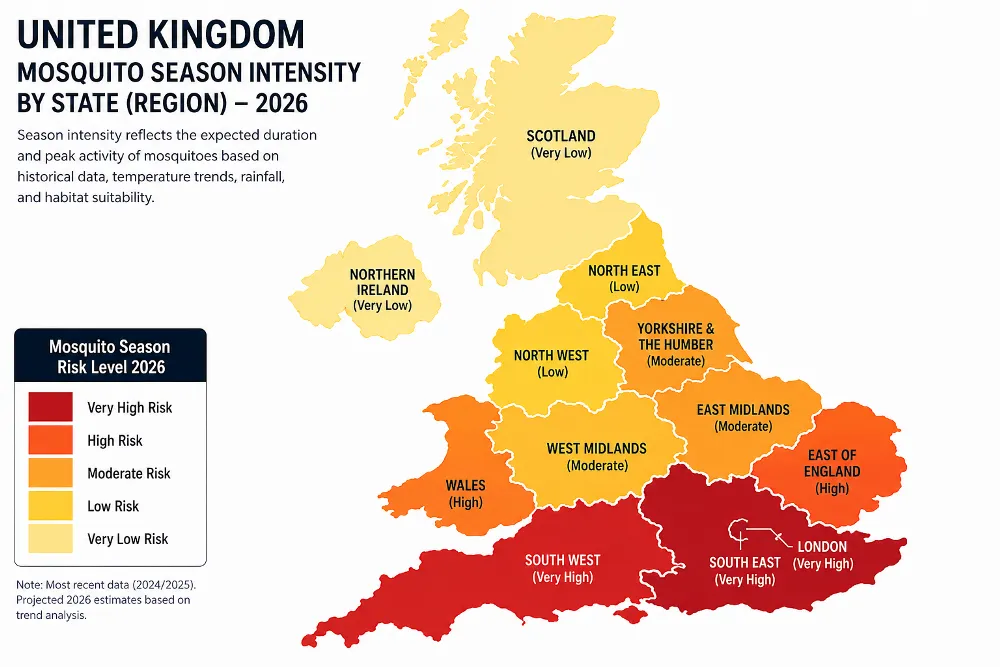
This map provides a generalized overview and should not be interpreted as exact statistical data—refer to the table below for verified state-specific information.
| Region/Country | UKHSA surveillance operating window | General activity period (industry convention, unverified against a primary source) | Risk level (disease transmission) |
|---|---|---|---|
| England | June–October (ovitrap monitoring) [CONFIRMED] [12] | ~April/May–September, peaking May–September [UNVERIFIED — SECONDARY SOURCE ONLY] | Low overall; documented localised elevated nuisance-biting risk near wetland sites, e.g. the River Idle, Nottinghamshire [19] |
| Wales | Included within the same EWNI ovitrap network [CONFIRMED] [12] | Not confirmed against a primary source [NOT VERIFIABLE] | Low |
| Northern Ireland | Included within the same EWNI ovitrap network [CONFIRMED] [12] | Not confirmed against a primary source [NOT VERIFIABLE] | Low |
| Scotland | Public Health Scotland runs surveillance separately from the EWNI programme; a Scotland-specific operating window was not located in sources reviewed [NOT VERIFIABLE] | Not confirmed against a primary source [NOT VERIFIABLE] | Low |
On the documented spring 2026 early-season nuisance-biting spike: LSHTM entomologists specifically link an early-spring 2026 rise in nuisance-biting reports to a combination of one of the UK’s wettest starts to a year on record and mild temperatures allowing winter-active species (Culiseta annulata, Culex pipiens f. molestus) to remain active outside the normal warm-season window [13]. This is a specific, sourced event — not a claim that the “season” as a whole has shifted nationally, which this report cannot confirm from a single-year observation.
8. Climate Change & Mosquito Trends
8.1 Temperature Impact
- LSHTM entomologists state that when temperatures remain above approximately 7–10°C, species such as Culiseta annulata can continue flying and feeding, and that the “London Underground mosquito” (Culex pipiens f. molestus) can remain active through winter in sheltered urban infrastructure [13].
- UKHSA’s HAIRS West Nile virus risk assessment states that modelling suggests current UK temperatures are generally too low to sustain inter-annual WNV transmission cycles, though short-term local transmission is not ruled out under specific high-vector-density conditions [9][10].
- UKHSA blog commentary notes that mosquitoes “complete their life cycle and digest their blood meal at a much faster rate at higher temperatures,” meaning warming favours both greater abundance of native species and improved viability for non-native species attempting to establish [24].
8.2 Rainfall Influence
- LSHTM notes a direct correlation between high winter rainfall and mosquito breeding-habitat expansion, with 2026 cited as “one of the wettest starts to the year on record” in the UK, contributing to an early-spring spike in nuisance-biting reports [13].
- Because mosquito eggs and larvae require standing water, prolonged wet conditions extend the availability of breeding sites into periods that would otherwise be too dry [13].
8.3 Extended Breeding Season Analysis
No standardised, year-by-year “mosquito season length in days” dataset for the UK was located in the sources reviewed [NOT VERIFIABLE — this report does not estimate one]. What is directly attributable: UKHSA’s own blog states that warmer temperatures speed up mosquito life-cycle completion and blood-meal digestion, which UKHSA identifies as a mechanism by which both native mosquito abundance and non-native species’ viability could increase under continued warming [24].
Separately, UKHSA’s published Lyme disease surveillance already documents an extended UK tick activity season under milder winters [24] — this report cites that as a parallel example from the same UKHSA source, not as direct evidence about mosquitoes, and does not conflate the two.
8.4 Changes in Species Distribution / Habitat Expansion
| Species | Distribution change documented | Year(s) | Source |
|---|---|---|---|
| Culex modestus | Detected in Essex and Kent; more recently also Cambridgeshire, Hampshire and West Sussex | Ongoing; most recent update June 2025 | UKHSA HAIRS risk assessment [9] |
| Aedes vexans | Established populations near Norwich (2017), parts of Nottinghamshire (since 2018), and newly in the Cambridgeshire Fens (2024) | 2017–2024 | UKHSA HAIRS risk assessment [9] |
| Aedes albopictus | Isolated incursions: 2016 (7 SE England locations cumulative), 2019, first Kent motorway-services detection since 2019 recorded August 2024 | 2016–2024 | UKHSA/PLOS Global Public Health [11][12][16] |
| Aedes aegypti | First-ever UK detection (eggs), Heathrow freight facility | September 2023 | UKHSA/PLOS Global Public Health [11][12] |
8.5 Multi-Year Comparison Table (Confirmed Data Only)
| Indicator | 2022 | 2023 | 2024 (provisional) | 2025 (provisional) | 2026 |
|---|---|---|---|---|---|
| Imported malaria cases (EWNI) [CONFIRMED/PROVISIONAL as marked] | 1,369 [4][6] | 2,004 [4][5][6] | 1,812 [7] | 1,629 [7] | Not yet published [4] |
| Imported dengue cases (EWNI) | Not isolated in sources reviewed [NOT VERIFIABLE] | Not isolated in sources reviewed [NOT VERIFIABLE] | 904 [21] | 344 [7] | Not yet published |
| Imported chikungunya cases (EWNI) | Not isolated in sources reviewed [NOT VERIFIABLE] | Not isolated in sources reviewed [NOT VERIFIABLE] | 112 [7] | 160 [7] | Not yet published |
| WNV in UK mosquito pools | 0 [9] | 2 of 200 pools positive, mosquitoes collected July 2023 [8][9] | — | Laboratory confirmation of the 2023 finding reported [9] | No new public data located at time of writing |
| Invasive Aedes ovitrap network size (localities, EWNI) | — | — | 117, up from 58 in 2019 [12] | Not isolated in sources reviewed [NOT VERIFIABLE] | Not yet published |
NOTE: Blank/”not isolated” cells reflect genuine gaps in publicly available data, not zero values — do not read a blank cell as “no cases.”
9. Urban vs Rural Mosquito Trends
No UKHSA or ONS dataset directly compares urban and rural mosquito populations on a standardised quantitative index. The qualitative pattern supported by sourced material is:
| Factor | Urban pattern | Rural/wetland pattern |
|---|---|---|
| Key breeding sites | Sewers, drains, underground infrastructure, water butts, blocked guttering [13] | Wetlands, floodplains, ditches, ponds, saturated ground after heavy rain [9][13] |
| Representative species | Culex pipiens f. molestus (“London Underground mosquito”) [13] | Aedes vexans, Culex modestus [9] |
| Seasonality | Can persist through mild winters in sheltered infrastructure [13] | Strongly tied to seasonal flooding and rainfall patterns [9][13] |
| Documented UK examples | London Underground network (long-documented habitat) [13] | River Idle wetlands, Nottinghamshire; Cambridgeshire Fens [9][19] |
No standardised comparative “bite pressure” or population index between urban and rural settings is published; this report presents the documented qualitative distinction only.
10. Economic Impact of Mosquito Control in the UK
No UK government body publishes a mosquito-specific economic impact figure (as distinct from general pest control or general public health expenditure). UKHSA’s own communications state that vector-borne diseases account for more than 17% of all infectious diseases globally and cause over 700,000 deaths annually — a global, not UK-specific, figure sometimes miscited as a UK statistic [24].
| Category | UK-specific published figure | Notes |
|---|---|---|
| Government/public pest control spending on mosquitoes specifically | Not published | UK pest control expenditure data (where it exists via industry bodies) is not broken down by pest species |
| Consumer repellent spending (UK, mosquito-specific) | Not published | Retail/market-research figures exist commercially but were not verified against a credible public source for this report and are therefore omitted |
| UKHSA/public health surveillance programme cost | Not published as a standalone mosquito-specific budget line | UKHSA funds joint surveillance with APHA (VB-RADAR) and Edge Hill University, but a specific £ figure was not located in sources reviewed [9][12] |
| Estimated economic cost of mosquito-borne disease in the UK | Not published | Because nearly all UK cases are travel-associated and low in absolute number, no distinct “UK economic burden of mosquito-borne disease” estimate was identified |
11. Prevention & Control Trends in 2026
UKHSA’s public guidance consistently frames mosquito-borne disease prevention around travel-related bite avoidance rather than domestic vector control, reflecting the travel-associated nature of nearly all UK cases [7][24]. No ranked “popularity” survey of household prevention methods from a credible public health source was located; the table below reflects UKHSA/NHS-recommended measures rather than a measured popularity ranking.
| Method | Recommended for | Source basis |
|---|---|---|
| DEET or other EU/UK-approved insect repellent, especially for travel to malaria/dengue/Zika-risk countries | Travellers to endemic regions | UKHSA/NaTHNaC travel health guidance [20] |
| Removing standing water (containers, gutters, water butts) | Domestic nuisance-mosquito reduction | General entomological/pest-control guidance consistent with UKHSA breeding-site descriptions [13] |
| Bed nets / long clothing while travelling | Travellers to malaria-risk countries | Standard NaTHNaC travel advice [20] |
| Local habitat management (wetland reshaping, flood-risk reduction) | Nuisance-biting hotspots such as Gamston/Retford | Bassetlaw District Council/Nottinghamshire County Council/UKHSA joint programme [19] |
| National invasive-species surveillance (ovitraps at ports, airports, motorway services) | National biosecurity | UKHSA/APHA/Edge Hill University [9][12] |
No comparative “effectiveness ranking” of these methods specific to the UK context was located in the sources reviewed; general repellent and bed-net efficacy is instead documented in the broader international travel-medicine literature, which is outside the UK-specific scope of this report.
12. Methodology
12.1 Source Hierarchy
Sources used in this report were graded into three tiers, and every figure is traceable to the tier its citation belongs to:
- Tier 1 (primary): UKHSA statistical releases and guidance pages (gov.uk), UKHSA HAIRS risk assessments, UKHSA’s own research portal, and peer-reviewed journal articles (PLOS Global Public Health, Eurosurveillance). Tier 1 sources are the basis for every figure marked [CONFIRMED] or [PROVISIONAL].
- Tier 2 (specialist secondary): NaTHNaC/TravelHealthPro (the UK’s official National Travel Health Network and Centre, which republishes and summarises UKHSA data for clinicians), London School of Hygiene & Tropical Medicine public communications, established news organisations (BBC) reporting directly on named UKHSA/APHA releases, and named local-authority communications (Bassetlaw District Council, Nottinghamshire County Council). Tier 2 sources are used where they accurately restate a Tier 1 figure, or where they are the only available public account of a named local programme.
- Tier 3 (general secondary — used only where flagged): commercial pest-control sites, general health-information blogs, and trade-press summaries. Tier 3 sources are never used silently in this report. Every Tier 3-derived claim is explicitly marked [UNVERIFIED — SECONDARY SOURCE ONLY] in the surrounding text, so a reader can immediately identify which claims carry primary-source backing and which do not.
12.2 Data Sources Consulted
UK Health Security Agency (UKHSA) statistical releases, guidance pages, blog posts and HAIRS risk assessments; UKHSA Research Portal; NaTHNaC/TravelHealthPro; London School of Hygiene & Tropical Medicine (LSHTM); peer-reviewed research in PLOS Global Public Health and Eurosurveillance; BBC News reporting of named UKHSA/APHA releases; Bassetlaw District Council and Nottinghamshire County Council local government communications; European Centre for Disease Prevention and Control (ECDC) native-mosquito distribution maps.
Sources sought but not located as directly citable, mosquito-specific statistics: Public Health Scotland, Public Health Wales, the Public Health Agency Northern Ireland, the Met Office, the Environment Agency, and ONS. Their absence from a given section reflects a genuine gap in what these bodies publish on this topic, not an oversight in the search process.
12.3 Compilation and Verification Process
- Each numerical claim was traced to a specific, named, dated publication rather than a general web summary.
- Where a figure appeared in more than one source, it was cross-checked for internal consistency (e.g. the 2023 malaria figure of 2,004 cases was independently corroborated across a UKHSA press release, a UKHSA statistical release, and specialist medical-press coverage before inclusion).
- Every figure was assigned a confidence label — [CONFIRMED], [PROVISIONAL], [UNVERIFIED — SECONDARY SOURCE ONLY], or [NOT VERIFIABLE] — using the key defined in the opening “Note on Data Availability” section, and that label is carried inline next to the figure itself rather than only in a general disclaimer.
- Where a claim in a secondary source could not be corroborated against a primary UKHSA publication (e.g. the specific “highest in a decade” framing applied to 2025 chikungunya data), the primary figures are reported at [CONFIRMED] level and the secondary framing is separately flagged, rather than the two being blended into a single unattributed claim.
- Statistics that do not exist in any UK public dataset (regional bite rates, monthly exposure tables, urban-vs-suburban quantitative comparisons, a ranked top-10 disease-reporting table, mosquito-specific economic cost data) were not estimated. Their absence is stated directly in the relevant section.
12.4 Update Policy and Corrections
This report should be re-verified against primary UKHSA sources before citing or sharing, particularly for any figure marked [PROVISIONAL], since UKHSA revises provisional annual data (most recently, 2024 malaria and travel-infection figures were revised between their initial and final publication). Full-year 2026 statistics for malaria and travel-associated infections are expected in UKHSA’s routine spring 2027 publication cycle; this report should be updated at that point rather than having 2026 figures estimated in the interim.
12.5 Limitations
- Several data types (regional bite rates, monthly exposure trends, urban-vs-suburban quantitative comparison, top-10 regional disease rankings, mosquito-specific economic cost) do not exist as published UK datasets and are explicitly flagged as such rather than estimated.
- 2026 full-year case data for malaria and travel-associated infections will not be available until UKHSA’s routine spring 2027 publication cycle; all 2026 references in this report are therefore either provisional partial-year figures, qualitative reports (e.g. the early-spring nuisance-biting spike), or explicitly marked as unavailable.
- Reporting practices differ between England/Wales/Northern Ireland (combined as “EWNI” in most UKHSA travel and malaria statistics) and Scotland (reported separately via Public Health Scotland). Where a figure is labelled “EWNI,” it explicitly excludes Scotland; no combined UK-wide total for these datasets was located in the sources reviewed.
- Distinction between imported and locally acquired infections: every human disease case figure in Section 4 is travel-associated (imported) unless marked otherwise. The single “locally acquired” finding in this report — West Nile virus RNA in mosquito pools — is a vector detection, not a human infection, and is clearly labelled as such throughout to avoid implying local disease transmission that has not occurred.
- Projection explanation: Where this report states a figure is “not yet published” or “not projectable,” this reflects the absence of a credible published trend line sufficient to extrapolate responsibly. This report contains no projected numerical estimates for 2026; every 2026 reference is either a confirmed qualitative event (the early-spring nuisance-biting reports) or an explicit “not yet published” flag.
- This report was compiled by AI-assisted research review of publicly available sources. It should be treated as a sourced starting point for journalists and reviewed against primary UKHSA publications before republication or citation as a standalone authority.
13. UK Mosquito Report: Five Non-Obvious Insights for Journalists
A note on this section: the statements below are this report’s own analytical interpretation of the confirmed data assembled above — they are not verbatim UKHSA conclusions, and they should be attributed to analysis of UKHSA data, not to UKHSA itself, if quoted. Each is traceable to specific [CONFIRMED]/[PROVISIONAL] figures already cited elsewhere in this report; none introduces a new unverified number.
1. The disease actually rising is the one making no headlines, while the one making headlines has zero UK-acquired human cases. Imported malaria — the largest-volume, most headline-friendly disease in this dataset — has now fallen for two consecutive years (2,004 → 1,812 → 1,629 cases, 2023–2025) [4][5][7]. Meanwhile chikungunya, which rarely feature in UK coverage, rose from 112 to 160 cases over the same 2024–2025 window [7] — its largest confirmed rise in this dataset.
At the same time, West Nile virus — the subject of the most dramatic 2025 headlines — has caused zero locally acquired human cases in the UK; the “detection” was in mosquito pools, not people [9]. The story of quantified UK traveller risk and the story of UK media attention are, on this data, pointing in different directions.
2. The “first West Nile virus detection in the UK” story broke roughly two years after the mosquitoes were actually caught. The Aedes vexans mosquitoes carrying WNV RNA were collected near Retford, Nottinghamshire, in July 2023; laboratory confirmation and public reporting followed in 2025 [8][9]. A ~20-month gap between sample collection and a “first-ever detection” headline is a useful caution for reporting on vector-surveillance findings generally: publication timing reflects laboratory and review cycles, not the moment risk actually changed.
3. The UK’s tiger-mosquito surveillance network roughly doubled in five years — but the underlying threat status hasn’t moved. UKHSA’s invasive-species ovitrap network expanded from 58 localities in 2019 to 117 in 2024 [12] — more than a 100% increase in monitoring coverage. Despite that expansion, UKHSA’s own assessment is unchanged: Aedes albopictus and Aedes aegypti remain “not established” in the UK, with only isolated incursions recorded throughout the period [11][12][16]. This is a useful distinction for coverage: a rise in the number of invasive-mosquito news stories in a given year may reflect more traps looking, not more mosquitoes arriving.
4. Nearly every documented UK mosquito risk location traces back to fewer than five named sites. Strip out travel-associated cases (which are diagnosed nationwide but acquired abroad) and the UK’s own locally-generated vector findings cluster almost entirely around a handful of specific, named locations: the River Idle wetlands near Retford/Gamston, Nottinghamshire (nuisance Aedes vexans biting and the WNV mosquito-pool detection) [9][19]; a Kent motorway service station (2024 tiger-mosquito detection) [11][12]; a Heathrow freight facility (2023 Aedes aegypti egg detection) [11][12]; and the Cambridgeshire Fens (new 2024 Aedes vexans population) [9].
There is, on the data reviewed, no evidence of a diffuse, nationwide rise in mosquito risk — the risk picture is highly localised to specific transport-infrastructure and wetland sites.
5. UK travellers’ imported dengue exposure fell by nearly two-thirds in a single year — even as UKHSA describes global dengue transmission as sustained at high levels. UK dengue cases dropped from 904 in 2024 to 344 in 2025 [7][21] — a fall of roughly 62%. This UK-specific decline runs alongside UKHSA’s own framing that “dengue cases have increased substantially globally over the past five years, with exceptionally high levels in 2023 and 2024” and that “sustained transmission of dengue is an ongoing global health challenge” [21].
The divergence suggests the UK figure is likely being driven by changes in where and how much UK travellers are visiting dengue-affected destinations, rather than by any change in global dengue risk itself — a distinction worth making explicit in coverage that might otherwise imply UK traveller risk tracks the global caseload one-for-one.
Frequently Asked Questions (FAQs)
Q. Are mosquito-borne diseases endemic in the UK?
No. UKHSA data confirms all recorded human cases of malaria, dengue, chikungunya, Zika and West Nile virus in recent UKHSA reporting are travel-associated. No locally acquired human transmission of these diseases has been recorded in the UK [4][7][9].
Q. How many mosquito species live in the UK?
36, per two independent, currently-live UKHSA publications [3][25]. An older figure of 34 species, from a now-superseded 2017 edition of UKHSA guidance, still circulates in some secondary sources but is out of date [15].
Q. Has West Nile virus been found in the UK?
Genetic fragments of West Nile virus were detected in Aedes vexans mosquito pools collected in Nottinghamshire in July 2023, with laboratory confirmation completed in 2025. This is a vector (mosquito) detection, not a human case. UKHSA states there is no evidence of ongoing circulation and assesses public risk as very low [8][9][10].
Q. Is the Asian tiger mosquito established in the UK?
No. UKHSA confirms repeated but isolated detections of Aedes albopictus eggs/adults (most recently Kent, August 2024) with no evidence of an established breeding population as of the most recent surveillance update [11][12][16].
Q. Is UK malaria/dengue/chikungunya rising or falling in 2026?
Full 2026 data is not yet published (expected spring 2027). The most recent confirmed trend (2025 provisional data) shows malaria and dengue cases falling year-on-year, while chikungunya cases rose from 112 to 160 [7] — a rise a secondary source describes as the highest level in over a decade, though this framing could not be independently confirmed [22].
References
[1] Mosquitopia, “Fighting nuisance on the northern fringe,” NCBI Bookshelf. https://www.ncbi.nlm.nih.gov/books/NBK585169/
[2] “Are there Mosquitos in the United Kingdom?” ERGSY. https://ergsy.com/information/are-there-mosquitos-united-kingdom/orphans/7941/7942
[3] UK Health Security Agency, “Information on native mosquitoes,” GOV.UK. https://www.gov.uk/guidance/information-on-native-mosquitoes
[4] UK Health Security Agency, “Imported malaria in the UK: statistics,” GOV.UK. https://www.gov.uk/government/publications/imported-malaria-in-the-uk-statistics
[5] UK Health Security Agency, “New data show a rise in travel-acquired malaria cases,” GOV.UK press release. https://www.gov.uk/government/news/new-data-show-a-rise-in-travel-acquired-malaria-cases
[6] Medscape, “UK Malaria Cases Highest in Over 20 Years.” https://www.medscape.com/viewarticle/uk-malaria-cases-highest-over-20-years-heres-why-2024a100082u
[7] NaTHNaC/TravelHealthPro, “UKHSA publishes travel-associated infections report” (covering 2025 EWNI data). https://travelhealthpro.org.uk/news/897/ukhsa-publishes-travel-associated-infections-report
[8] BBC News, “West Nile virus detected in UK mosquitoes for first time.” https://feeds.bbci.co.uk/news/articles/c77115e0645o
[9] UK Health Security Agency, “HAIRS risk assessment: West Nile virus,” GOV.UK. https://www.gov.uk/government/publications/hairs-risk-assessment-west-nile-virus/qualitative-assessment-of-the-risk-that-west-nile-virus-presents-to-the-uk-human-health-population
[10] Gavi/VaccinesWork, “West Nile virus reaches the UK: should you be worried?” https://www.gavi.org/vaccineswork/west-nile-virus-reaches-uk-should-you-be-worried
[11] Phys.org, “Invasive mosquito vector species detected in surveillance traps in United Kingdom.” https://phys.org/news/2025-09-invasive-mosquito-vector-species-surveillance.html
[12] UK Health Security Agency Research Portal, “Invasive mosquito surveillance in the United Kingdom 2020 to 2024.” https://researchportal.ukhsa.gov.uk/en/publications/invasive-mosquito-surveillance-in-the-united-kingdom-2020-to-2024/
[13] London School of Hygiene & Tropical Medicine, “Mosquitoes in the UK: What you need to know.” https://www.lshtm.ac.uk/newsevents/news/2026/mosquitoes-uk-what-you-need-know
[14] ResearchGate, “Number of species per UK county (England and Wales) and lieutenancy area (Scotland).” https://www.researchgate.net/figure/Number-of-species-per-UK-county-England-and-Wales-and-lieutenancy-area-Scotland-The_fig2_270660090
[15] UK Health Security Agency, “Distinguishing Aedes albopictus, the Asian Tiger mosquito, from native British mosquitoes,” GOV.UK. https://www.gov.uk/guidance/distinguishing-aedes-albopictus-the-asian-tiger-mosquito-from-native-british-mosquitoes
[16] WeathÉire, “Invasive mosquito species detected in UK for first time in years.” https://weatheire.com/news/nature/2025/10/04/invasive-mosquito-species-detected-in-uk-for-first-time-in-years/
[17] European Centre for Disease Prevention and Control, “Native mosquitoes” distribution maps. https://www.ecdc.europa.eu/en/disease-vectors/surveillance-and-disease-data/native-mosquito-maps
[18] Contego Response, “Is Mosquito Season Getting Closer?” https://contegoresponse.com/articles/is-mosquito-season-getting-closer (general seasonal framing cross-checked against UKHSA ovitrap monitoring schedule in source [12])
[19] Bassetlaw District Council, “Mosquitoes to be studied in Gamston this summer as part of national project to improve monitoring.” https://www.bassetlaw.gov.uk/media-centre/news/news-archive/news-may-2025/mosquitoes-to-be-studied-in-gamston-this-summer-as-part-of-national-project-to-improve-monitoring
[20] NaTHNaC/TravelHealthPro, “West Nile virus” factsheet. https://travelhealthpro.org.uk/factsheet/47/west-nile-virus
[21] UK Health Security Agency, “UKHSA urges travellers to take steps to avoid infection abroad,” GOV.UK news story. https://www.gov.uk/government/news/ukhsa-urges-travellers-to-take-steps-to-avoid-infection-abroad
[22] Health Academy, “The Increase in Mosquito-Borne Diseases in UK Travellers.” https://healthacademyonline.co.uk/the-increase-in-mosquito-borne-diseases-in-uk-travellers/
[23] BBC News, “Kent ‘perfect place’ for new mosquitos to enter UK.” https://feeds.bbci.co.uk/news/articles/c7871g7e6nvo
[24] UK Health Security Agency Blog, “How we protect the UK from vector-borne diseases like dengue and West Nile virus.” https://ukhsa.blog.gov.uk/2025/05/21/how-we-protect-the-uk-from-vector-borne-diseases/
[25] UK Health Security Agency and Centre for Climate and Health Security, “Distinguishing Aedes albopictus, the Asian Tiger mosquito, from native British mosquitoes” (current edition, published 6 March 2025, updated 6 August 2026). https://www.gov.uk/guidance/distinguishing-aedes-albopictus-the-asian-tiger-mosquito-from-native-british-mosquitoes
Editorial Team & Contributors

Raashid Ansari, Founder, Content Researcher & Author - MosquiTalk
Not an entomologist — just a genuinely curious writer who started researching mosquitoes and couldn't stop. What began as casual reading about repellents and bite prevention gradually turned into a deep ongoing dive into vector biology, disease epidemiology, animal health impacts, and the real science behind mosquito control. Everything published here is carefully edited, and written with one purpose: giving readers accurate, accessible information they can actually trust and use to protect themselves, their families, and their pets, birds and cattle.
Active across social platforms, regularly publishes, and genuinely invested in spreading mosquito awareness where it matters most. Because informed readers make better decisions — and better decisions save lives.