
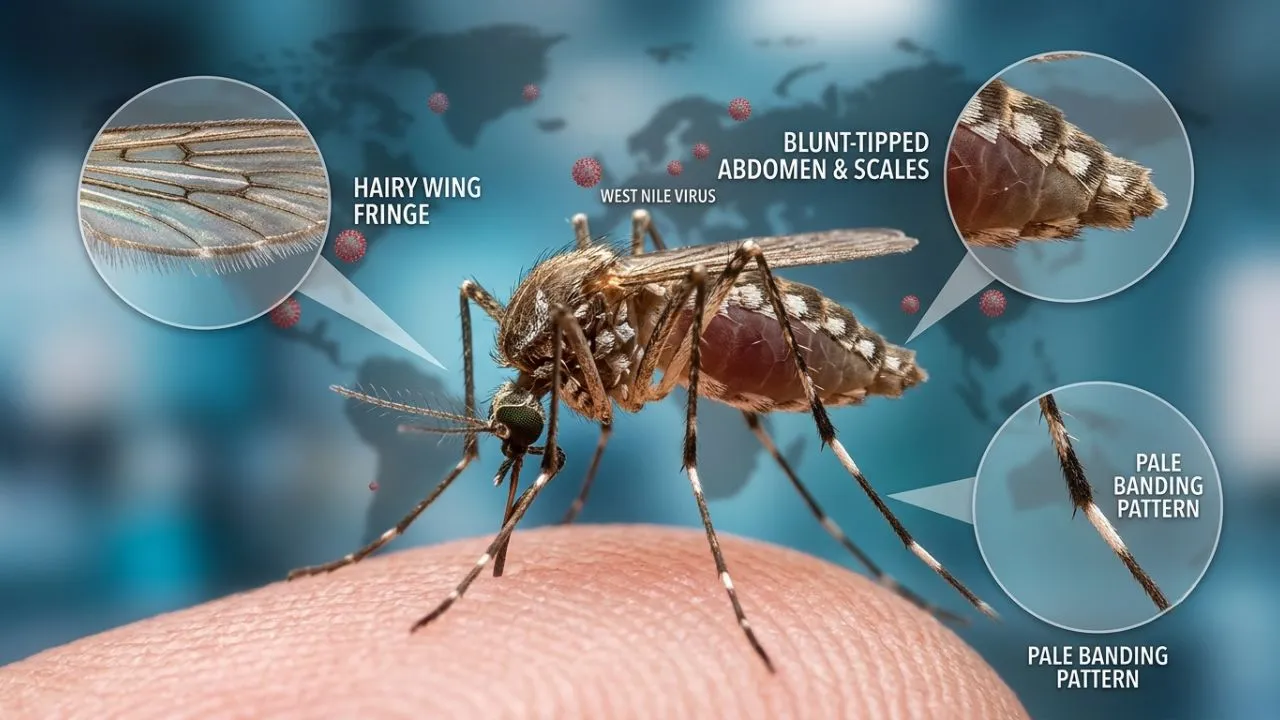
Most people who get bitten by a mosquito never think twice about which species just fed on them. Fair enough — why would they?
But if you work in vector control, public health, or you’re just the person your neighborhood HOA elected to “look into the standing water problem,” that question actually matters. A lot. Because not all mosquitoes carry West Nile virus. Most, in fact, don’t. The ones that do belong almost entirely to one genus, and knowing how to tell them apart is the difference between an accurate surveillance report and a guess.
This guide breaks down the Culex mosquito species responsible for the overwhelming majority of West Nile virus transmission in the United States — how to identify Culex mosquito species by sight, where they breed, when they bite, and why some are more dangerous vectors than others. I’ve pulled from CDC surveillance data, peer-reviewed vector competence studies, and standard entomological identification keys, so this isn’t guesswork. It’s the same information field technicians and mosquito control districts actually use.
Why Culex Mosquitoes Matter for West Nile Virus
West Nile virus (WNV) doesn’t spread through just any mosquito bite. It moves through a specific transmission cycle — bird to mosquito, mosquito to bird, round and round — and the mosquitoes best adapted to sustain that cycle happen to belong overwhelmingly to one genus: Culex.
These mosquitoes are ornithophilic, meaning they strongly prefer feeding on birds. That preference is exactly why they’re such efficient amplifying vectors — they keep the virus circulating in wild bird populations, building up viral load in the environment. When a Culex mosquito shifts to biting a mammal instead, sometimes it’s carrying enough virus to spill the infection over into humans and horses.
Three species do most of the transmission work in the U.S.: Culex pipiens, Culex quinquefasciatus, and Culex tarsalis. A few secondary players — Culex restuans, Culex salinarius, and Culex nigripalpus — round out the list depending on region. Every one of them matters, and every one of them looks just different enough to tell apart if you know what to look for.
Culex Mosquito Species Characteristics: What Sets the Genus Apart
Before diving into individual species, it helps to know what Culex mosquitoes have in common. This is your baseline. Once you know the genus-level traits, spotting the differences between species gets a lot easier.
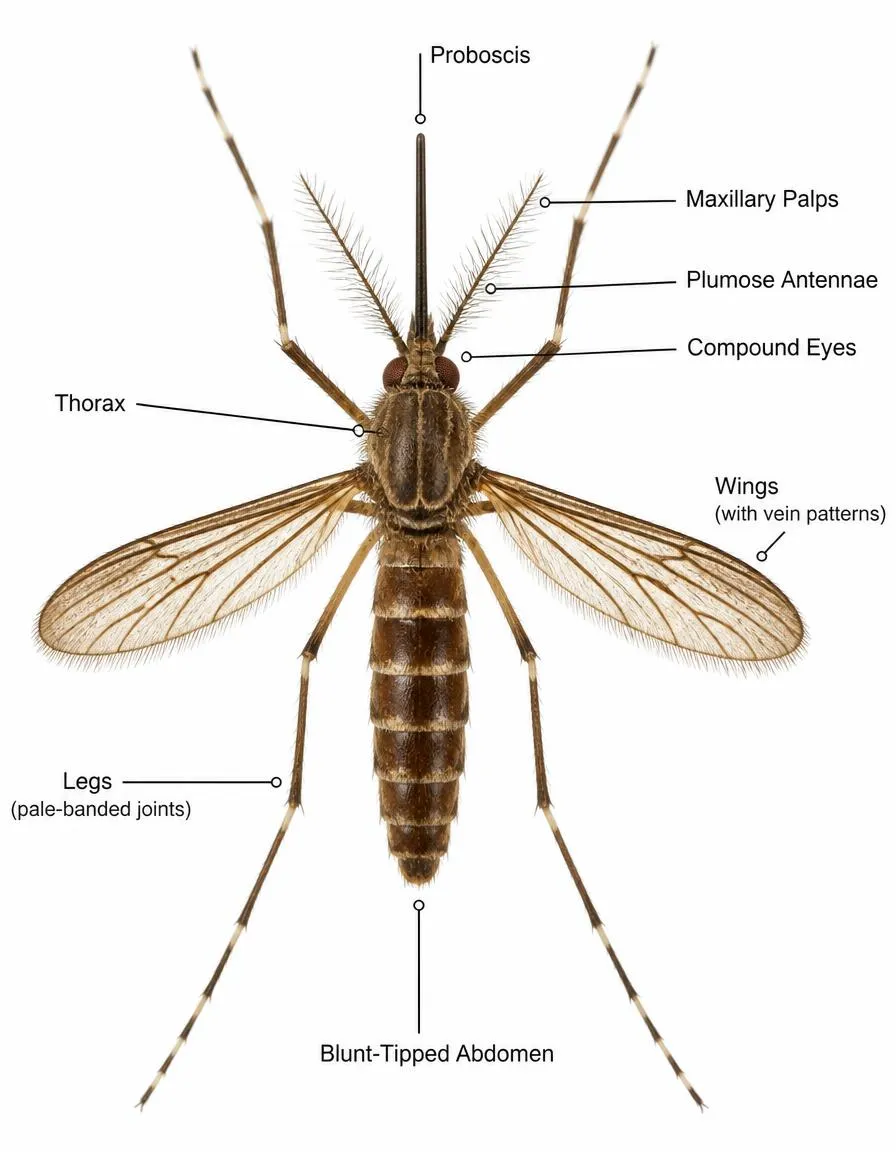
1. General Physical Traits of Culex Mosquitoes
- Body length: typically 4–10 mm, depending on species and larval nutrition.
- Overall coloring: light brown to dull brown — plain, not flashy.
- No bold black-and-white leg or body striping — this is the biggest visual difference from Aedes species like the Asian tiger mosquito.
- Wing scales: uniformly brown, no white spots or patches.
- Abdomen: pale, blunt-tipped at the rear — not pointed like Aedes or Psorophora.
- Proboscis: long, slender, dark, with no distinctive pale banding in most species.
That plainness is genuinely useful diagnostically. If you’re looking at a heavily patterned, contrasty mosquito, you’re probably not looking at Culex. Save the magnifying glass for something more subtle.
2. Resting Posture — A Fast Field Clue
This one’s almost embarrassingly simple, and it works before you even get close enough to check wing scales. Culex mosquitoes rest with their bodies roughly parallel to the surface they’ve landed on. Anopheles mosquitoes, by contrast, tilt up at a noticeable angle — sometimes close to 45 degrees, rear end raised.
If you see a mosquito sitting flat against a wall or screen, that’s a decent early signal you’re dealing with a culicine mosquito — Culex, Aedes, or a related genus — not Anopheles.
3. Palp Length: The Anopheles Elimination Test
Maxillary palps are the small, antenna-like appendages flanking the proboscis. In female Anopheles mosquitoes, the palps run nearly the full length of the proboscis. In Culex females, the palps are noticeably shorter — roughly a quarter the length of the proboscis. This single check rules out Anopheles almost instantly.
How to Identify Culex Mosquito Species: Adult Identification Key
Getting to genus is the easy part. Getting to species is where it gets genuinely tricky — a few of these are so morphologically similar that entomologists still lean on genetic tools to separate them with full confidence. Still, there’s a lot you can determine visually and behaviorally in the field. Here’s how.
1. Culex pipiens (Northern House Mosquito)
The most widespread WNV vector in the Northeast and Midwest. This is probably the Culex species you’ve personally dealt with, whether you knew it or not.
Key identification points:
- Light brown body with no distinctive leg or proboscis markings.
- Females show pale, basal abdominal bands that are broadly rounded in the middle and pinch inward before meeting large lateral scale patches.
- Males and hybrids require genitalia examination (the DV/D ratio) to reliably separate from Culex quinquefasciatus — visual ID alone isn’t always reliable at this level.
- Strongly ornithophilic — prefers birds, occasionally bridges to mammals late season.
Habitat: catch basins, storm drains, polluted standing water, discarded containers, underground infrastructure. It thrives in exactly the kind of neglected urban water you’d expect — a clogged gutter, an old tire, a drainage ditch nobody’s checked in weeks. Culex pipiens undergoes winter reproductive diapause, which is a fancy way of saying it goes dormant in cold months rather than dying off completely.
2. Culex quinquefasciatus (Southern House Mosquito)
The dominant WNV vector across the southern United States. Basically the southern counterpart to Culex pipiens, and genetically part of the same species complex.
- Visually near-identical to Culex pipiens — light brown, plain, pale abdominal banding.
- Feeds on both birds and mammals, which makes it a more effective “bridge vector” than the more strictly bird-feeding Culex pipiens.
- Does not undergo winter diapause — stays active year-round in warmer southern climates.
- Common in urban and suburban catch basins, septic systems, and stagnant residential water.
There’s a rough latitude split worth knowing: Culex pipiens dominates north of about 39°N, Culex quinquefasciatus dominates south of about 36°N, and the zone in between sees overlap and hybridization. Field identification in that overlap band is genuinely difficult without lab confirmation.
3. Culex tarsalis (Western Encephalitis Mosquito)
The primary WNV vector across the western and midwestern U.S. — and arguably the most efficient laboratory vector of the group.
- Small brown mosquito with a distinctive pale median band across the proboscis — a marking most other Culex species lack.
- Pale bands at the tarsal joints (leg segments).
- White stripes or spots on the outer surface of the hind femur and hind tibia.
- A strong flier — capable of dispersing 2 to 10 miles from its breeding site, far more mobile than most Culex species.
Habitat: agricultural irrigation ditches, poorly drained pastures, any standing water in rural or semi-rural western landscapes. Culex tarsalis is often singled out in surveillance literature as the single most important WNV vector in the western U.S., partly because of its efficiency as a laboratory vector and partly because of long-term surveillance data linking it directly to regional outbreak patterns.
4. Culex restuans
An early-season player that shows up before its relatives. Often overlooked, but increasingly recognized as an important early amplifier of WNV in bird populations.
- Visually very similar to Culex pipiens — distinguishing the two reliably often requires molecular tools
- Emerges earlier in spring than Culex pipiens or Culex salinarius, sometimes by mid-May in the eastern U.S.
- Breeds in ground pools and container habitats, often alongside Culex pipiens in the same water sources
- Some research suggests Culex restuans may be an equal or even better WNV vector than Culex pipiens on a per-mosquito basis
Its early emergence matters more than it sounds. Getting ahead of the transmission cycle before peak summer populations build up is a real public health advantage, and Culex restuans is often the first indicator species surveillance programs watch for.
Reference:
https://fmel.ifas.ufl.edu/mosquito-guide/mosquito-genera-and-species/genus-culex/culex-restuans/
5. Culex salinarius
A suspected bridge vector in the Northeast. Less abundant than Culex pipiens in most areas, but its feeding habits make it disproportionately relevant to human risk.
- Morphologically similar to other Culex pipiens-group members; molecular identification is often needed for certainty.
- Feeds more frequently on mammals than Culex pipiens or Culex restuans, which strengthens its role as a bridge vector between birds and humans.
- Found in a range of aquatic habitats, from woodland pools to organically enriched water near sewage treatment areas.
- Confirmed source of WNV isolates during the original New York outbreak investigations in 2000.
In Connecticut and parts of the Northeast, Culex salinarius populations and WNV infection rates have at times approached those seen in Culex pipiens, even though it’s generally the less abundant species regionally.
Reference:
https://fmel.ifas.ufl.edu/mosquito-guide/mosquito-genera-and-species/genus-culex/culex-salinarius/
6. Culex nigripalpus
The dominant Culex species across Florida and the Gulf Coast. Better known as the primary vector of St. Louis encephalitis, but also a confirmed, moderately efficient WNV vector.
- Widespread throughout central and southern Florida, with a transition zone into Culex salinarius territory further north.
- Feeding and breeding activity tightly tied to seasonal rainfall patterns — populations surge after heavy rain events.
- Competent but only moderately efficient WNV vector compared to Culex tarsalis or Culex pipiens in laboratory studies.
- Also implicated in eastern equine encephalitis (EEE) transmission in south Florida.
Reference:
https://fmel.ifas.ufl.edu/mosquito-guide/mosquito-genera-and-species/genus-culex/culex-nigripalpus/
Culex Species Comparison Table
A quick-reference summary for identification and risk assessment purposes:
| Species | Primary Region | Key Visual Marker | Host Preference | Vector Efficiency |
|---|---|---|---|---|
| Culex pipiens | Northeast, Midwest | Pale, rounded abdominal bands | Birds (ornithophilic) | High |
| Culex quinquefasciatus | South | Near-identical to Cx. pipiens | Birds and mammals | Moderate–High |
| Culex tarsalis | West, Midwest | Pale band on proboscis; leg stripes | Birds and mammals | Very High |
| Culex restuans | Widespread, eastern U.S. | Near-identical to Cx. pipiens | Birds (ornithophilic) | High |
| Culex salinarius | Northeast | Pipiens-group similarity | Mammals-leaning bridge vector | Moderate |
| Culex nigripalpus | Florida, Gulf Coast | Dark palps, rainfall-linked activity | Birds and mammals | Moderate |
Larval Identification: Culex Mosquitoes Before They Take Flight
Adult identification isn’t the only useful skill here. Catching Culex populations at the larval stage is arguably more useful for control purposes, since that’s when a breeding site can still be treated before it produces biting adults.
1. Egg Rafts — The First Giveaway
Female Culex mosquitoes lay their eggs in floating rafts of 100 to 400 eggs, glued together and floating directly on the water’s surface. From a short distance, they look like tiny grayish-brown rafts, almost like a scrap of debris.
This is a genuinely reliable field marker. Aedes mosquitoes lay individual eggs on damp surfaces above the waterline, not rafts. Anopheles lays individual eggs with small lateral floats. If you see a cohesive floating raft, you’re looking at Culex.
2. Larval Posture and the Siphon
Culex larvae hang from the water’s surface at a distinct angle, breathing through a siphon tube. That siphon is your key identification tool at this stage — it’s moderately long, with 6 to 13 pecten teeth on the basal third, and four-branched siphonal tufts, one of which sits out of alignment with the other three. Compare that to Aedes larvae, whose siphons are shorter and darker in color.
- Instar stage can be estimated by color and size: first instars are small and pale gray, fourth instars are noticeably darker with visible body hairs.
- The anal saddle darkens and enlarges with each instar, eventually covering most of the anal segment by the fourth stage.
- Double-branched lateral setae on abdominal segments III–IV are another diagnostic marker for the Culex pipiens complex specifically.
Larval identification down to species — separating Culex pipiens from Culex quinquefasciatus, for instance — isn’t always reliable through morphology alone, especially in hybrid zones. Most vector control programs now supplement visual keys with PCR-based molecular identification when species-level precision actually matters for surveillance data.
Habitat and Breeding Site Preferences
Culex mosquitoes are, frankly, not picky. That’s part of what makes them such persistent public health targets.
- Storm drains, catch basins, and underground infrastructure — a major, often-overlooked urban breeding source.
- Discarded tires, buckets, and any container capable of holding stagnant water for more than a few days.
- Roadside ditches and poorly drained agricultural land, especially favored by Culex tarsalis.
- Polluted or organically enriched water, including areas near septic systems and sewage treatment facilities.
- Natural ground pools and woodland puddles, more common for Culex restuans and Culex salinarius.
The common thread is standing water that sits undisturbed for roughly a week or more — enough time for the full larval development cycle to complete. Eliminate that, and you eliminate the breeding site.
Behavioral Traits That Aid Field Identification
1. Feeding Time
Culex mosquitoes are primarily crepuscular and nocturnal feeders — most active at dusk, dawn, and throughout the night. That’s a meaningful contrast to Aedes aegypti and Aedes albopictus, both aggressive daytime biters. If you’re getting bitten well after sunset near standing water, Culex is a strong candidate.
2. Host-Seeking Behavior
Most Culex species locate hosts using a combination of carbon dioxide detection, body heat, and skin odor compounds, same general mechanism as other mosquito genera. What differs is the target preference — the strong pull toward avian hosts in species like Culex pipiens and Culex restuans, versus the broader mammal-inclusive feeding of Culex quinquefasciatus and Culex salinarius.
3. Seasonal Activity Patterns
- Culex restuans emerges earliest in spring, often by mid-May in the eastern U.S.
- Culex pipiens and Culex salinarius follow later in the season as temperatures rise.
- Culex quinquefasciatus and Culex nigripalpus remain active essentially year-round in the warmer southern range where winter diapause doesn’t occur.
- Culex nigripalpus populations spike sharply following heavy rainfall events in Florida and the Gulf Coast.
Geographic Distribution Across the United States
Regional dominance among WNV-vector Culex species roughly maps like this, based on CDC and peer-reviewed vector surveillance data:
- Northeast and Midwest: Culex pipiens, with Culex restuans and Culex salinarius as important secondary contributors
- South: Culex quinquefasciatus as the dominant vector, sharing habitat with Culex pipiens in transition zones
- West and parts of the Midwest: Culex tarsalis as the primary vector, especially in agricultural and rural landscapes
- Florida and Gulf Coast: Culex nigripalpus dominant in the south, giving way to Culex salinarius further north
This isn’t a hard boundary system — overlap zones exist everywhere, and hybridization between Culex pipiens and Culex quinquefasciatus complicates the picture in the transitional latitude band roughly between 36°N and 39°N. Regional vector control districts typically track local dominant species directly rather than relying on national generalizations.
Why Accurate Identification Matters for Public Health
This isn’t just an academic exercise. Getting species identification right shapes real surveillance and control decisions.
- Vector competence varies meaningfully between species — Culex tarsalis and Culex pipiens are highly efficient laboratory vectors, while Culex nigripalpus and Culex quinquefasciatus are only moderately efficient.
- Host-feeding patterns determine bridge-vector risk — species that feed on both birds and mammals, like Culex salinarius and Culex quinquefasciatus, pose a more direct spillover risk to humans.
- Seasonal emergence timing informs when surveillance and control efforts should ramp up in a given region.
- Misidentifying a non-vector species as a WNV risk — or vice versa — wastes control resources and skews public health data.
The CDC’s ArboNET surveillance system relies on accurate species-level mosquito pool data specifically because these differences aren’t cosmetic. They directly affect how a region models and responds to WNV risk each season.
Common Identification Mistakes to Avoid
A few errors show up constantly, even among people who’ve done this a while. Worth flagging before you’re out in the field.
1. Confusing Culex with Culiseta
Culiseta mosquitoes, particularly Culiseta inornata, are often mistaken for Culex at a glance — similar dull coloring, similar size range. The giveaway is wing scale pattern and leg proportions, which take a closer look than most field checks allow. If you’re not sure, don’t guess; bag the specimen and confirm under magnification.
2. Assuming All Pipiens-Group Mosquitoes Are the Same Risk
It’s tempting to lump Culex pipiens, Culex quinquefasciatus, and Culex restuans together since they’re visually near-identical. Don’t. Their host preferences and vector efficiency differ enough that surveillance data treats them as separate risk profiles, even when a quick field ID can’t always tell them apart.
3. Relying on Color Alone
Coloring shifts with age, diet, and how long a specimen has been stored or preserved. A freshly caught mosquito and one that’s been sitting in a trap for two days can look noticeably different in tone. Structural markers — banding pattern, siphon shape, palp length — hold up far better than color as a standalone identifier.
4. Skipping the Habitat Context
Identification doesn’t happen in a vacuum. Where you found the specimen is itself evidence. A mosquito pulled from a rural irrigation ditch in California is a lot more likely to be Culex tarsalis than one pulled from an urban catch basin in Newark. Use habitat as a supporting clue, not a replacement for morphological ID, but don’t ignore it either.
Frequently Asked Questions (FAQs)
Q. What are the main Culex mosquito species that transmit West Nile virus?
The three primary U.S. vectors are Culex pipiens, Culex quinquefasciatus, and Culex tarsalis. Culex restuans, Culex salinarius, and Culex nigripalpus play significant secondary roles depending on region.
Q. How do you tell Culex mosquitoes apart from Aedes mosquitoes?
Culex mosquitoes are plain brown with no bold black-and-white markings, rest with their bodies parallel to surfaces, and lay eggs in floating rafts. Aedes species show distinctive white leg and body striping, have pointed abdomens, and lay individual eggs on damp surfaces rather than rafts.
Q. What is the easiest visual way to identify Culex tarsalis specifically?
Look for the pale median band across the proboscis combined with white stripes on the hind femur and tibia — this combination is fairly distinctive among Culex species and doesn’t require lab confirmation in most cases.
Q. Can Culex pipiens and Culex quinquefasciatus be told apart visually?
Not reliably in females. The two are part of the same species complex and look nearly identical. Males can sometimes be separated using genitalia measurements, but hybrid zones make even that approach imperfect without molecular testing.
Q. Where do Culex mosquitoes typically breed?
Standing water is the common requirement — storm drains, catch basins, discarded containers, roadside ditches, and organically enriched water near septic systems all serve as breeding sites, depending on species and region.
Final Takeaways
Culex identification isn’t a one-glance task, and honestly, anyone who tells you it is hasn’t spent much time squinting at abdominal banding under a hand lens.
But the core system holds up: check resting posture and palp length to confirm genus, then look at proboscis and leg markings, abdominal banding pattern, habitat, and seasonal timing to narrow down species. For the trickiest cases — separating Culex pipiens from Culex quinquefasciatus or Culex restuans in overlap zones — molecular tools remain the gold standard, and there’s no shame in needing them.
What matters most for public health purposes isn’t perfect species-level certainty on every single specimen. It’s understanding which species dominate your region, when they’re active, and how their feeding behavior shapes real West Nile virus risk. Get that right, and the rest of the surveillance work gets a whole lot more useful.
Editorial Team & Contributors

Raashid Ansari, Founder, Content Researcher & Author - MosquiTalk
Not an entomologist — just a genuinely curious writer who started researching mosquitoes and couldn't stop. What began as casual reading about repellents and bite prevention gradually turned into a deep ongoing dive into vector biology, disease epidemiology, animal health impacts, and the real science behind mosquito control. Everything published here is carefully edited, and written with one purpose: giving readers accurate, accessible information they can actually trust and use to protect themselves, their families, and their pets, birds and cattle.
Active across social platforms, regularly publishes, and genuinely invested in spreading mosquito awareness where it matters most. Because informed readers make better decisions — and better decisions save lives.