
Mosquito larvae can survive in a bucket of soapy water, but only under certain conditions. A weak or diluted soap solution may not kill them quickly, while a sufficiently concentrated detergent or washing-up liquid solution can reduce surface tension, interfere with breathing and kill many larvae. [1][3]
That said, soapy water is not a reliable or officially recommended mosquito-control treatment. Results vary with the type of soap, concentration, water volume, organic matter and mosquito species. The most dependable way to stop larvae developing is to empty, scrub and store the bucket dry. [1]
Why Mosquito Larvae Use Standing Water
Mosquitoes lay eggs in still or very slow-moving water. A bucket left outside after rain, a watering can, plant saucer, tire, clogged gutter or uncovered water barrel can become a breeding site within days. [1]
Eggs hatch into larvae, often called wrigglers. The larvae live in the water, feed on micro-organisms and organic particles, then develop into pupae before emerging as flying adults. Removing standing water interrupts this mosquito life cycle before adults can emerge. [1]
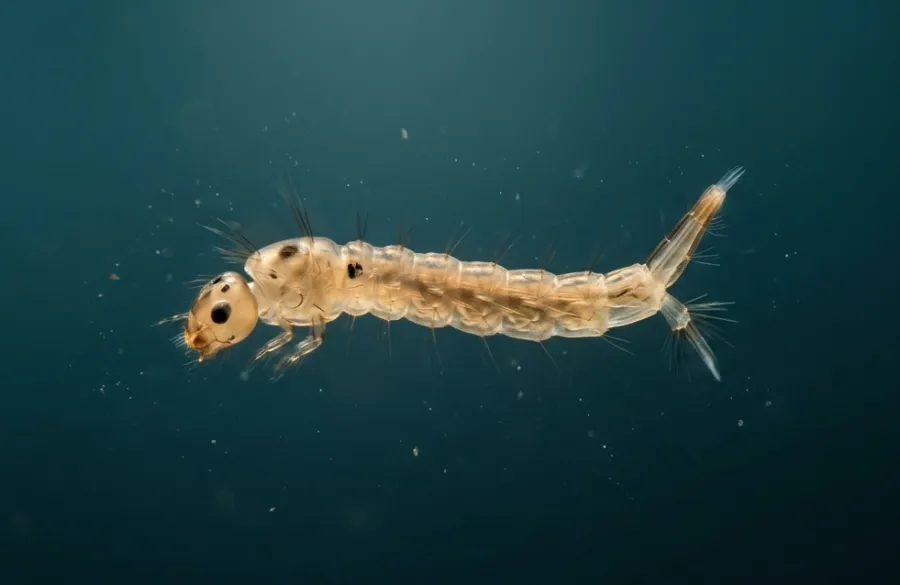
A bucket is a classic container-breeding habitat because it holds water, is sheltered from wind and often contains leaves, soil or algae. Even a small amount of water can be enough for mosquitoes such as Aedes and Culex species. [1]
Can Larvae Survive in Soapy Water?
Yes. Mosquito larvae can survive in soapy water, particularly if the soap is highly diluted or the bucket contains a large volume of water. Soap is not a registered larvicide, and its effect is inconsistent. [1][2]
Research findings are mixed. A study of Aedes aegypti in Surabaya found that larvae survived better in antiseptic soapy water than in several other water sources, with live larvae still present after seven days. In contrast, laboratory research using controlled soap concentrations found a clear dose-response relationship between soap concentration and larval mortality. [2][3]
The practical point is simple: “soapy” does not automatically mean “lethal”. A few drops in a full bucket may change the surface only slightly. A stronger concentration is more likely to affect larvae, but it still cannot be relied upon in the way that emptying the bucket can. [1][3]
How Soap Affects Mosquito Larvae
Soap and detergent contain surfactants. These compounds lower the surface tension of water, allowing liquid to spread and wet surfaces more easily. [1]
Mosquito larvae normally hang just beneath the water surface and breathe atmospheric air through a breathing tube, or siphon, at the rear of the body. A surfactant film can make it harder for them to maintain their position at the surface and can interfere with this air-breathing process. [1]
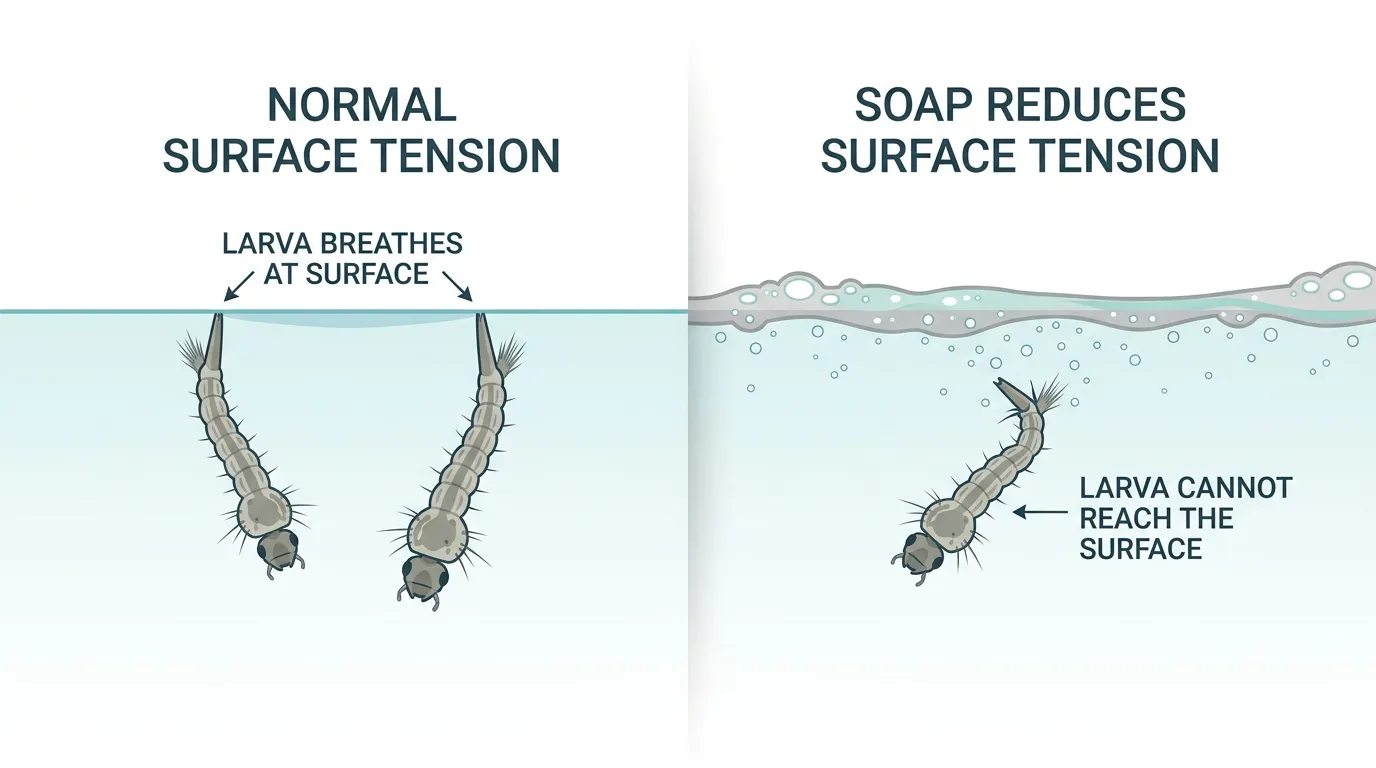
Soap may also coat the larval body and breathing structures. At higher concentrations, this can cause suffocation, loss of movement and death. But the effect depends heavily on dose: too little soap may have little measurable impact, while a strong solution may kill larvae more reliably. [1][3]
Water chemistry matters too. Hard water can cause fatty acids in soap to precipitate, reducing the effectiveness of the solution. Dirt, leaves, algae and other organic material can further alter how soap behaves in a bucket. [1]
What Concentration Makes a Difference?
There is no single safe, universally effective household ratio for killing mosquito larvae with soap. Studies use different products, formulations and exposure times, so their results cannot be transferred directly to a garden bucket. [1][3]
In a laboratory study of Anopheles gambiae sensu lato larvae, researchers exposed third-instar larvae to several soap concentrations for 24 hours. They recorded a significant positive relationship between soap dose and mortality, with an estimated LC50 of 320.1 mg/litre and LC95 of 651.3 mg/litre. [3]
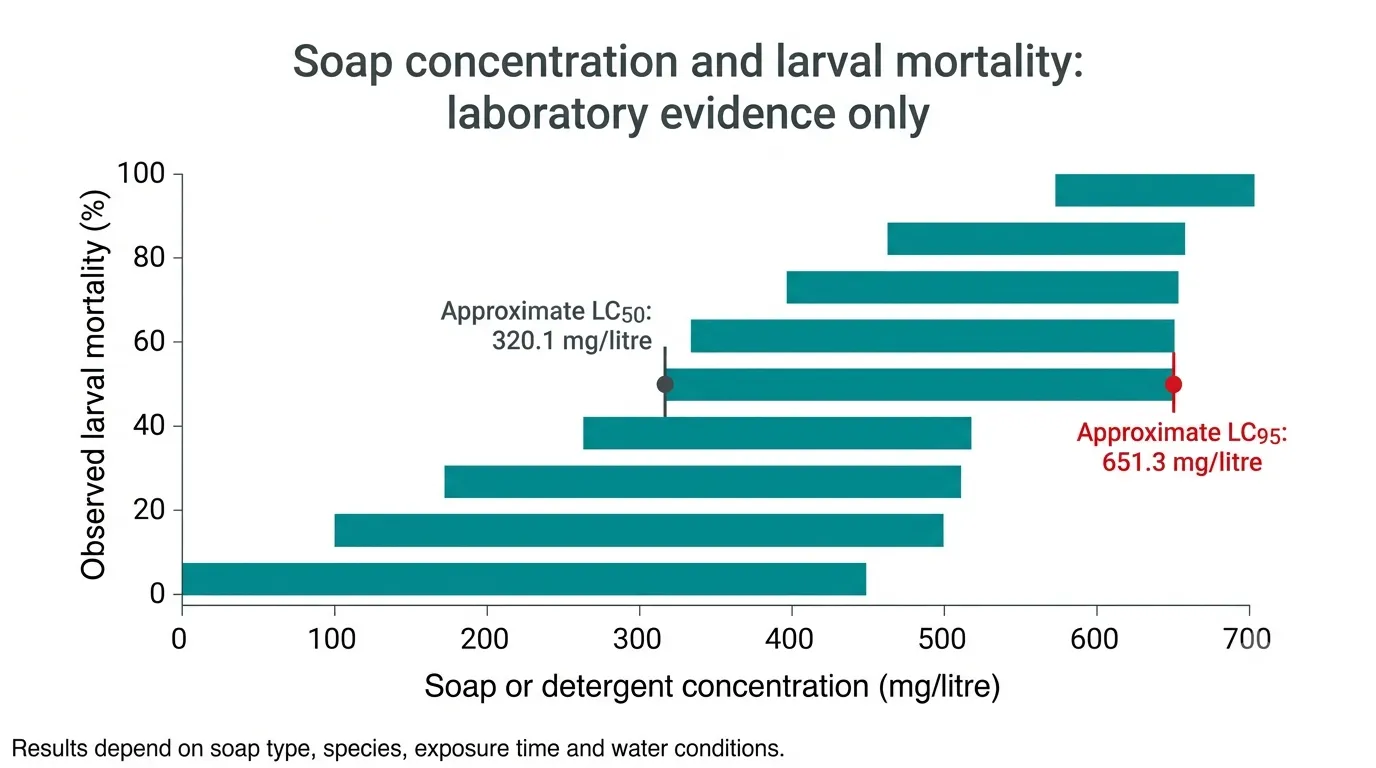
Those figures show why concentration matters, but they do not justify dosing a bucket with detergent. Household washing-up liquids differ widely in surfactant strength and additives. Adding enough soap to make the water reliably lethal could also create unnecessary chemical pollution, harm other aquatic insects and leave a slippery residue. [1][3]
For routine mosquito prevention, it is better to treat soapy water as a possible short-term deterrent rather than a proven larvicide. [1]
Why Soapy Water Is Not a Recommended Control Method
Public-health guidance does not generally recommend soap or soapy water for mosquito control. Hong Kong’s Food and Environmental Hygiene Department notes that the World Health Organization does not suggest using soap or soapy water to combat mosquito problems, and that there is little field research supporting the practice. [1]
Soap is also non-selective. It can affect other insects and small aquatic organisms that come into contact with it. Pouring detergent into drains, ponds, water butts or natural water bodies can contribute to pollution and may harm wildlife. [1]
There is another limitation: soap does not prevent re-colonisation. Rain can dilute it, organic matter can bind it, and mosquitoes can lay new eggs once the solution weakens. A bucket that remains outdoors will need repeated treatment, which makes it an impractical long-term solution. [1]
The Best Way to Deal with Mosquito Breeding in a Bucket
If a bucket contains mosquito larvae, the simplest and most effective response is physical removal. Source reduction—eliminating standing-water breeding sites—is regarded as the first-choice method for controlling mosquito breeding. [1]
- Empty the bucket completely; do not simply tip the water onto nearby soil where it may pool again.
- Scrub the inside to remove eggs, biofilm and organic residue that can shelter larvae or attract egg-laying females.
- Turn the bucket upside down or store it under cover so rain cannot collect.
- Drill small drainage holes in buckets that must remain outdoors, provided the bucket is not needed to hold water.
- Check weekly during the mosquito-breeding season, especially after rainfall.
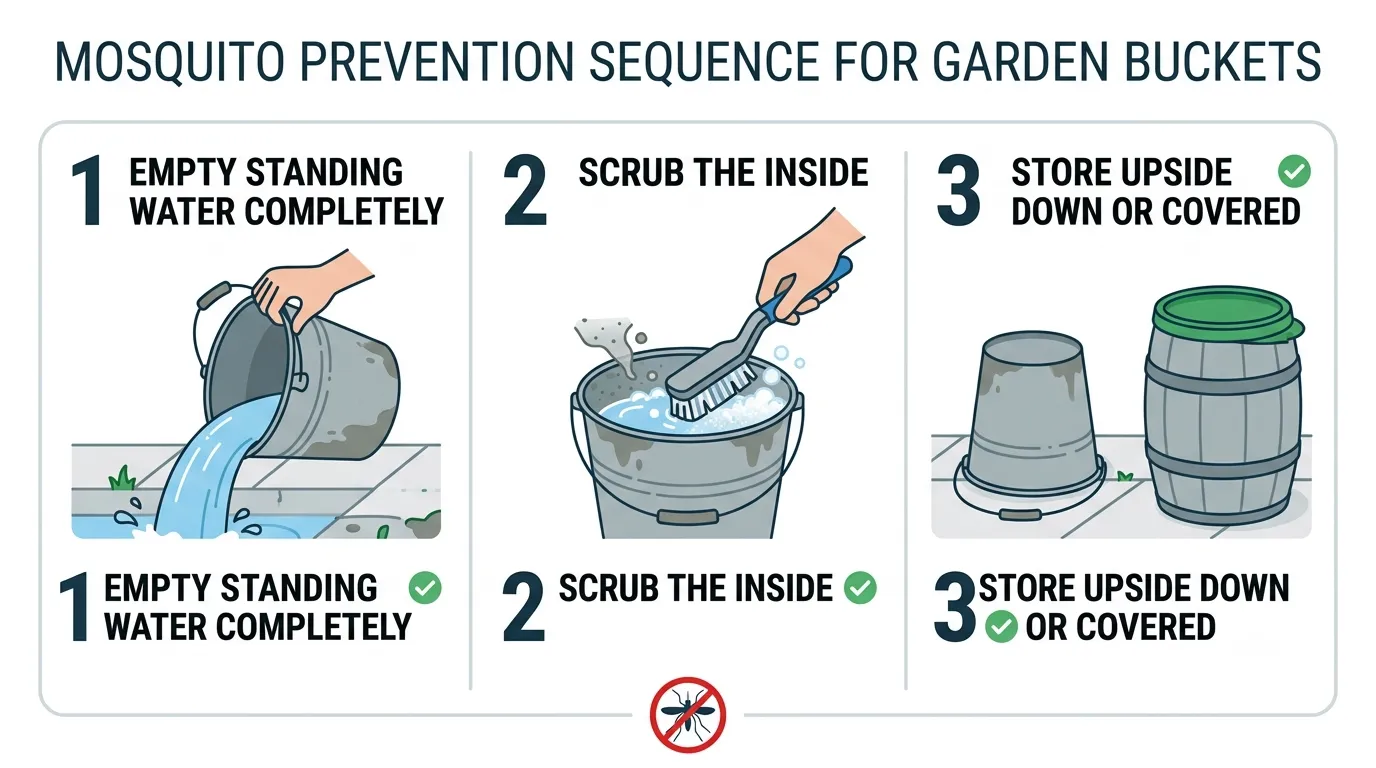
Emptying works because mosquitoes need standing water to complete development. Without it, larvae and pupae cannot survive to adulthood. [1]
If the Water Must Be Kept
Sometimes a bucket, water barrel or container must hold water. In that case, prevention should focus on excluding egg-laying mosquitoes rather than relying on soap. [1]
- Fit a tight-fitting lid to water butts and rain barrels.
- Use fine mesh over openings so mosquitoes cannot enter but rainwater can still be collected.
- Keep gutters clear so water does not stagnate.
- Empty plant saucers, pet bowls and drip trays regularly.
- Use a commercially approved mosquito larvicide where appropriate and follow the product label exactly.
For garden ponds, moving water through a pump or fountain can help because mosquito larvae prefer still water. Appropriate pond management is usually more sustainable than adding household detergent. [1]
Do Soap Bubbles Trap Adult Mosquitoes?
Soapy water can trap and kill some adult mosquitoes or other small insects that land on it, because the reduced surface tension prevents them from escaping. This is different from controlling larvae. [1]
A bowl or pan of soapy water may catch a few insects, but it is not an effective population-control method. Mosquitoes are not strongly attracted to plain soapy water in the first place, so it will not draw in enough adults to make a meaningful difference around a garden. [4]
Common Misconceptions
“A little washing-up liquid kills all larvae.” Not necessarily. Low concentrations may have little effect, especially in a large or dirty bucket. [1][3]
“Soapy water is a natural mosquito treatment.” Soap is still a chemical surfactant mixture and can harm non-target organisms. [1]
“If larvae stop moving, the problem is solved.” Pupae and eggs may still be present. Emptying and cleaning the container is more reliable. [1]
“Bleach, oil or soap all work equally well.” None of these household additions should be used as a substitute for proper container management or approved products.[1]
It is also worth remembering that larvae are easier to spot than eggs. A bucket can look clean while still holding eggs or newly hatched larvae around the rim, beneath debris or in a thin film of water. [1]
When to Use an Approved Larvicide
If standing water cannot be removed and mosquitoes are breeding repeatedly, use a product specifically labelled for mosquito larvae control. Follow the label for dose, safety precautions, environmental restrictions and reapplication intervals. [1]
Approved larvicides are formulated and tested for this purpose. Household soap, shampoo, bleach, oil and other improvised additives are not reliable substitutes and can create avoidable risks. [1][3]
In the UK, mosquito problems are usually local and seasonal, but persistent breeding in the same containers should still be addressed. Local authority environmental health teams can offer advice where breeding is difficult to control or where there is a larger-scale issue.
Practical Checklist
- Tip out stagnant water at least once a week.
- Scrub buckets before reuse.
- Store containers upside down or covered.
- Cover rainwater storage with a secure lid or fine mesh.
- Avoid pouring soap, bleach or oil into ponds, drains or natural water.
- Use a labelled larvicide only when water cannot be removed and the label permits that use.
Conclusion
Mosquito larvae may survive in a bucket of soapy water, especially if the solution is weak. Higher concentrations of soap or detergent can kill larvae by disrupting surface tension and breathing, but the outcome is unpredictable and the method is not recommended by public-health authorities. The reliable solution is not to make the water soapy. It is to remove the water, clean the bucket and prevent it from refilling. That single action removes the habitat mosquitoes need to breed.
References
1. Food and Environmental Hygiene Department, Hong Kong. “Can soapy water be used against mosquito infestation?” Pest Control Newsletter, Issue No. 39, July 2015. https://www.fehd.gov.hk/english/pestcontrol/images/Pestnews_39e.pdf
2. Wijayanti, N. et al. “The Longevity of Aedes aegypti Larvae in Several Water Sources in Surabaya.” Indonesian Journal of Tropical and Infectious Disease 10(1), 2022, pp. 18–26.
https://e-journal.unair.ac.id/IJTID/article/view/32209/17713
3. Antonio-Nkondjio, C. et al. “Exposure to disinfectants (soap or hydrogen peroxide) increases tolerance to permethrin in Anopheles gambiae populations from the city of Yaoundé, Cameroon.” Malaria Journal 13, 2014, Article 296.
https://link.springer.com/article/10.1186/1475-2875-13-296
4. Iowa State University Extension and Outreach. “Mosquito Control: A Summary of What Works (and What Doesn’t!).” Yard and Garden.
https://yardandgarden.extension.iastate.edu/encyclopedia/mosquito-control
5. Xue, R.-D. and Qualls, W. A. “Larvicidal activity of synthetic disinfectants and antibacterial soaps against mosquito, Culex quinquefasciatus (Diptera: Culicidae).” Journal of Medical Entomology 50(1), 2013, pp. 137–139.
https://academic.oup.com/jme/article-abstract/50/1/137/893216
6. Subra, R., Service, M. and Mosha, F. “The effect of domestic detergents on the population dynamics of the immature stages of two competitor mosquitoes, Culex cinereus Theobald and Culex quinquefasciatus Say (Diptera: Culicidae).” Acta Tropica 41(1), 1984, pp. 69–75.