
Table of Contents
Introduction to Male Mosquitoes and Their Purpose in Nature
I’ve spent years managing mosquito population around my property — running traps, testing repellents, pulling water sources. And one question keeps coming up from neighbors, from family, from basically everyone who sits on a porch at dusk: do male mosquitoes bite? It’s a fair question, and honestly the answer surprises most people. Understanding male mosquitoes — what they eat, what they look like, and what role they actually play — changes how you think about mosquito control entirely.
Short answer: male mosquitoes do not bite humans. They can’t. But there’s a lot more to the story than that, and knowing it will make you a smarter, more effective homeowner when mosquito season rolls around.
Do Male Mosquitoes Bite Humans — or Anyone?
Male mosquitoes do not bite humans, animals, or birds. Not once. Not ever. This isn’t a behavioral preference — it’s a hard anatomical limitation. The female mosquito has a specialized proboscis (that needle-like mouthpart) designed to pierce skin, locate blood vessels, and draw blood. The male’s mouthparts are simply not built for that.
Male mouthparts are weaker, shorter, and lack the saw-like stylets that females use to cut through skin. Structurally, they cannot perform what scientists call “blood feeding.” So when someone says a male mosquito bit them — that was a female. Always.
Why Don’t Male Mosquitoes Bite?
The biological reason is actually tied to reproduction. Female mosquitoes need blood protein — specifically the amino acids in blood — to develop viable eggs. Males don’t produce eggs. They have zero physiological need for blood, so evolution never gave them the tools to get it.
According to CDC entomologists and published research from the Journal of Medical Entomology, blood feeding in female mosquitoes is driven by the gonotrophic cycle — a reproductive loop that requires blood protein to complete. Males are entirely outside this cycle.
What Do Male Mosquitoes Eat? (Hint: No Blood Involved)
Male mosquitoes eat nectar, plant sap, and sugary plant secretions — basically the same things that many beneficial insects consume. They’re pollinators in a minor sense, though not nearly as efficient as bees.
This is one of the more underappreciated facts about mosquito biology. Both males and females can survive on plant sugars. Sugar gives them the energy to fly, mate, and function. But only females need the additional blood meal to complete egg development.
Plant Sugar Sources, Males Feed On
- Flower nectar (various plant species)
- Aphid honeydew — a sticky excretion found on leaves
- Rotting fruit and plant exudates
- Tree sap and stem secretions
- Sugar-rich fluids from decomposing plant matter
Male mosquitoes are actually somewhat dependent on floral resources. Research published in Parasites & Vectors has shown that access to sugar sources significantly extends male lifespan — from a few days up to around a week or more in lab conditions.
Male vs. Female Mosquito: Key Differences at a Glance
| Characteristic | Male Mosquito | Female Mosquito |
|---|---|---|
| Diet | Plant nectar and sugars only | Plant sugars + blood (for eggs) |
| Biting ability | Cannot bite | Bites humans and animals |
| Mouthparts (proboscis) | Weak, not adapted for skin piercing | Strong, saw-like, adapted for blood feeding |
| Antennae | Bushy / feathery (plumose) | Sparse / hair-like (pilose) |
| Body size | Smaller than females | Larger (especially when gravid) |
| Lifespan | ~1 week | 2–8 weeks (species-dependent) |
| Role in reproduction | Mate with females | Lay eggs after blood meal |
| Sound / buzz | Higher pitch hum | Lower pitch hum |
| Disease transmission | None | Transmits malaria, dengue, Zika, WNV |
What Do Male Mosquitoes Look Like? Identifying Them in the Field
Most people have never consciously looked at a male mosquito. That’s understandable — they’re tiny, they don’t land on you, and they don’t cause the immediate irritation that makes you pay attention. But once you know what to look for, they’re pretty easy to distinguish.
1. The Most Reliable Feature: The Antennae
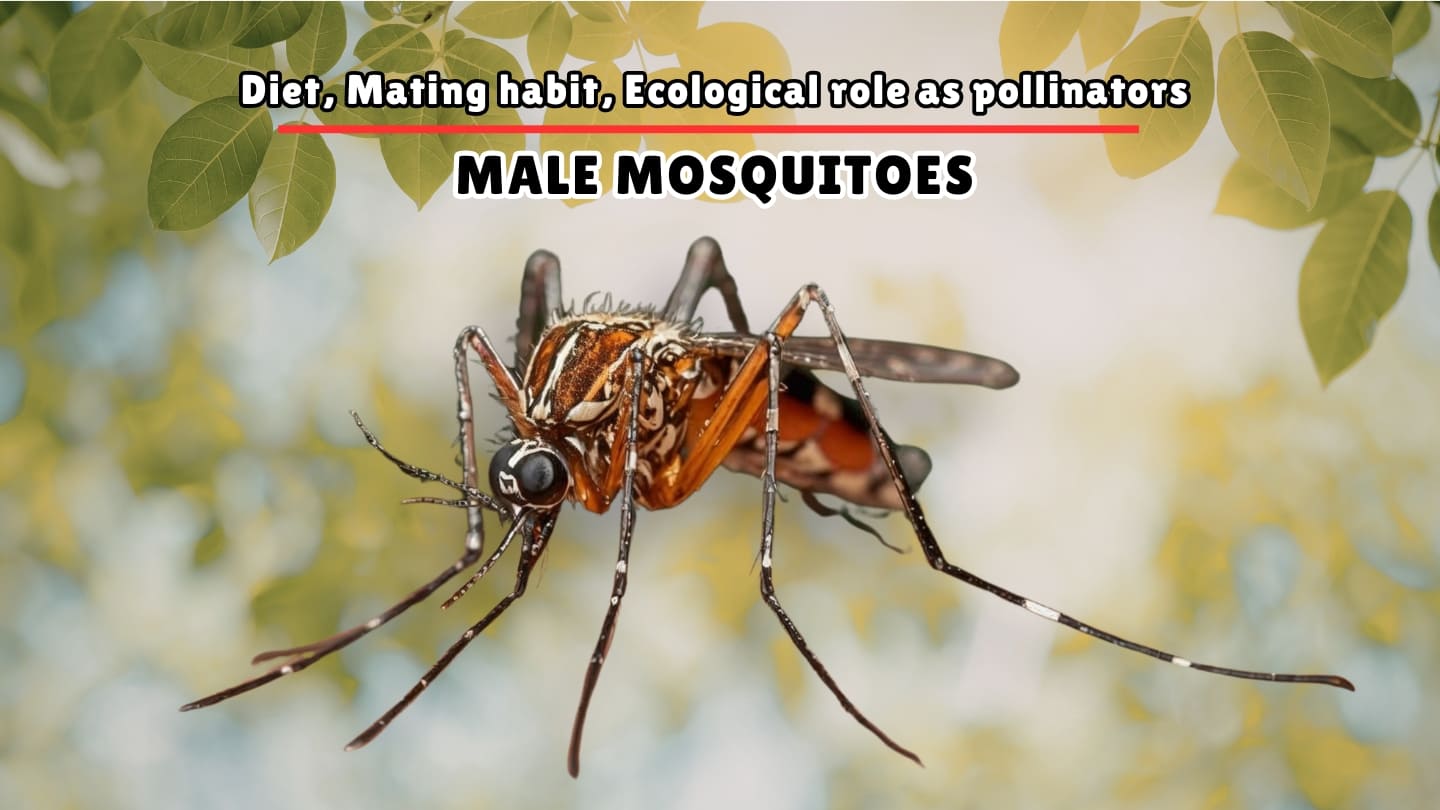
Male mosquitoes have distinctly bushy, feathery antennae — technically called plumose antennae. They look almost fluffy under a magnifying glass. These antennae are packed with Johnston’s organs, sensory cells that detect the wing-beat frequency of females so males can locate mates in flight.
Female antennae are sparse and hair-like by comparison (pilose). If you catch a mosquito on a window screen and look at its head, this is the fastest way to tell.
2. Are Male Mosquitoes Bigger or Smaller Than Females?
Male mosquitoes are smaller than females, as a general rule. Female mosquitoes — especially gravid females (carrying eggs after a blood meal) — are noticeably larger and heavier. The size difference is consistent enough across species that entomologists use it as a quick field indicator.
That said, size alone can be tricky for untrained observers. The antenna check is more reliable.
3. Body Shape and Other Visual Clues
- Males tend to have a more slender abdomen
- The abdomen tip in males has claspers — reproductive organs visible under magnification
- Wing venation is identical between sexes — not a useful field marker
- Color patterns vary by species, not sex — not reliable for sex identification
If you’re trying to get a visual ID, searching for pictures of male mosquitoes alongside images from university entomology departments (like Purdue Extension or University of Florida IFAS) will give you accurate photographic comparisons.
Do Male Mosquitoes Buzz? Yes — and It’s Actually Their Dating Strategy
Male mosquitoes do buzz, though most people never associate the sound with males because they’re not the ones hovering near your ear. The buzz you hear at 2am in your bedroom is almost certainly a female looking for a blood meal.
Male mosquitoes produce a wing-beat frequency that is slightly higher in pitch than females. Research — including classic work by Göpfert and Robert published in Nature — showed that male antennae are tuned to detect the specific hum of female wings. When a male and female fly close together, they actually modulate their wing beats to converge on a shared harmonic frequency. It’s one of the more remarkable examples of acoustic communication in insects.
So yes, males buzz. You just rarely hear them because they have no reason to approach you.
What Do Male Mosquitoes Actually Do? Their Role in the Ecosystem
This is where it gets interesting from an ecological standpoint. Male mosquitoes occupy a specific, limited, but real role in nature.
1. Primary Role: Reproduction
The male’s main job is to find and mate with females. After emerging from pupae, males typically form swarms — often at dusk, near landmarks like treetops, bushes, or streetlights — and wait for females to fly through. Mating happens quickly, often mid-air.
Males generally mate once or a few times before dying. Their lifespan is short — roughly a week in the wild — compared to the several weeks a female can survive.
2. Minor Pollination Role
Because males feed on flower nectar, they occasionally transfer pollen. Their contribution to pollination is minimal compared to bees and butterflies, but it’s not zero. A few plant species — particularly some orchids and bog plants — have been documented with mosquito pollinators.
3. Food Source in the Food Web
Male mosquitoes are prey. Bats, dragonflies, swallows, purple martins, spiders, and aquatic insects all consume mosquitoes — males included. They form part of the base layer of many wetland and suburban food webs.
Male Mosquitoes and Disease: Zero Transmission Risk
Male mosquitoes cannot transmit any mosquito-borne disease. Dengue fever, malaria, Zika virus, West Nile virus, chikungunya — all of these require a blood feeding vector. Since males don’t bite, they are not part of the disease transmission chain.
This is clinically important. All public health concern, all vector control, all repellent use is aimed at female mosquitoes. The male is epidemiologically irrelevant from a disease standpoint.
This biological fact is also why some modern mosquito control programs — including sterile insect technique (SIT) and Wolbachia-based programs — specifically release modified male mosquitoes. Males mate with wild females but cause no biting nuisance and no disease risk to humans.
Male Mosquitoes in the Lifecycle: A Quick Breakdown
Understanding the lifecycle helps contextualize where males fit in.
- Egg — Females lay eggs on or near water after a blood meal.
- Larva — Both male and female larvae develop in standing water. No way to tell sex at this stage visually without microscopy.
- Pupa — Also aquatic. Pupae are mobile but don’t feed.
- Adult — Males emerge first, typically. They form swarms near the emergence site and wait for females.
- Mating — Happens quickly, often within the first day or two after emergence.
- Male death — Males typically die within a week. Females go on to blood feed and lay multiple egg batches.
What This Means for Mosquito Control at Home
Knowing the male’s role changes how you approach control — at least conceptually.
1. Targeting Breeding Sites Hits Both Sexes
Since male and female larvae develop in the same standing water, eliminating breeding sites (birdbaths, clogged gutters, buckets, tarps, plant saucers) reduces the entire population. This is still the single most effective home control measure.
2. Repellents Are Only Necessary Against Females
DEET, picaridin, IR3535, and oil of lemon eucalyptus (OLE) all work by making you undetectable or unattractive to biting female mosquitoes. Males have no interest in you to begin with. So repellent use is correctly targeted at females by default.
3. Male-Based Biological Control Programs
Sterile male release programs (used by programs like EPA-approved Oxitec OX513A in the US) release genetically modified males that mate with wild females but whose offspring don’t survive. This suppresses the biting female population without introducing any new bite or disease risk.
Wolbachia-infected male releases work similarly — males mate with females and reduce egg hatch rates. Both approaches leverage the male’s non-biting nature as a safety feature.
Quick Reference: Common Questions About Male Mosquitoes
| Question | Answer |
|---|---|
| Do male mosquitoes bite? | No. They lack the mouthpart anatomy to bite. |
| Do male mosquitoes drink blood? | No. They drink plant nectar and sugars only. |
| Can male mosquitoes bite if provoked? | No. It’s anatomically impossible, not behavioral. |
| Do male mosquitoes buzz? | Yes, at a slightly higher frequency than females. |
| Are male mosquitoes bigger than females? | No. Females are larger, especially gravid ones. |
| Do male mosquitoes transmit disease? | No. Zero disease transmission capacity. |
| How long do male mosquitoes live? | Approximately 1 week in natural conditions. |
| What do male mosquitoes eat? | Flower nectar, plant sap, honeydew, plant sugars. |
| Do female or male mosquitoes bite? | Only females bite — always. |
Conclusion: Male Mosquitoes — The Half of the Population That Won’t Bother You
After years of dealing with mosquitoes as a homeowner and studying their biology closely, the clearest thing I can say is this: male mosquitoes are not your enemy. They don’t bite, they don’t drink blood, they can’t transmit disease. They’re short-lived, nectar-feeding insects whose main purpose is to mate and die within a week.
The ones wrecking your summer evening? Always female. When you ask do male mosquitoes bite — the answer is a clean, definitive no. Not sometimes. Not if they’re hungry. Never.
What this tells you as a homeowner is that all your control energy should go toward eliminating standing water (where both sexes breed), using proven repellents against females, and understanding seasonal patterns that drive female activity.
Male mosquitoes are one of those things that, once you understand them, actually make the whole mosquito problem feel a bit more manageable. Half the population is completely harmless to you. Focus on the females, eliminate their breeding sites, and your exposure drops dramatically.
Editorial Team & Contributors

Raashid Ansari, Founder, Content Researcher & Author - MosquiTalk
Not an entomologist — just a genuinely curious writer who started researching mosquitoes and couldn't stop. What began as casual reading about repellents and bite prevention gradually turned into a deep ongoing dive into vector biology, disease epidemiology, animal health impacts, and the real science behind mosquito control. Everything published here is carefully edited, and written with one purpose: giving readers accurate, accessible information they can actually trust and use to protect themselves, their families, and their pets, birds and cattle.
Active across social platforms, regularly publishes, and genuinely invested in spreading mosquito awareness where it matters most. Because informed readers make better decisions — and better decisions save lives.