

Why Mosquitoes are Worse in Suburbs?
If you’ve moved from a city apartment to a suburban home with a yard, you already know the difference. Suddenly, evening cookouts come with a swarm. You slap your arms, reapply repellent, wonder why your neighbor with the same size yard seems unbothered. Mosquitoes are worse in suburbs than cities — and that’s not just an impression. There are real, measurable biological and environmental reasons behind it.
I’ve lived both lifestyles. Downtown, I barely thought about mosquitoes. Then we bought a house in a leafy suburb with a decent backyard, a rain garden, mature trees — all the things you want. By mid-June that first summer, we were losing the battle. I started digging into the entomology, and honestly, what I found changed how I think about suburban landscaping entirely.
The Urban Heat Island Effect and Why It Actually Helps City Dwellers | Suburbs vs Cities
Cities are hot. Concrete, asphalt, and dense building clusters trap heat — a phenomenon well-documented as the urban heat island (UHI) effect. Surface temperatures in dense urban cores can run 5–10°F higher than surrounding suburban and rural areas, according to the EPA’s urban heat island research program.
That extra heat reduces standing water through faster evaporation. Less standing water means fewer mosquito breeding sites. It also desiccates larvae before they can mature. The same heat that makes city summers miserable is actually working as a passive mosquito control mechanism.
Suburbs, on the other hand, have moderate temperatures, more green cover, and more shade. That sounds nice. For mosquitoes, it’s ideal. Shaded areas stay cooler and retain soil moisture longer — extending the window during which standing water persists.
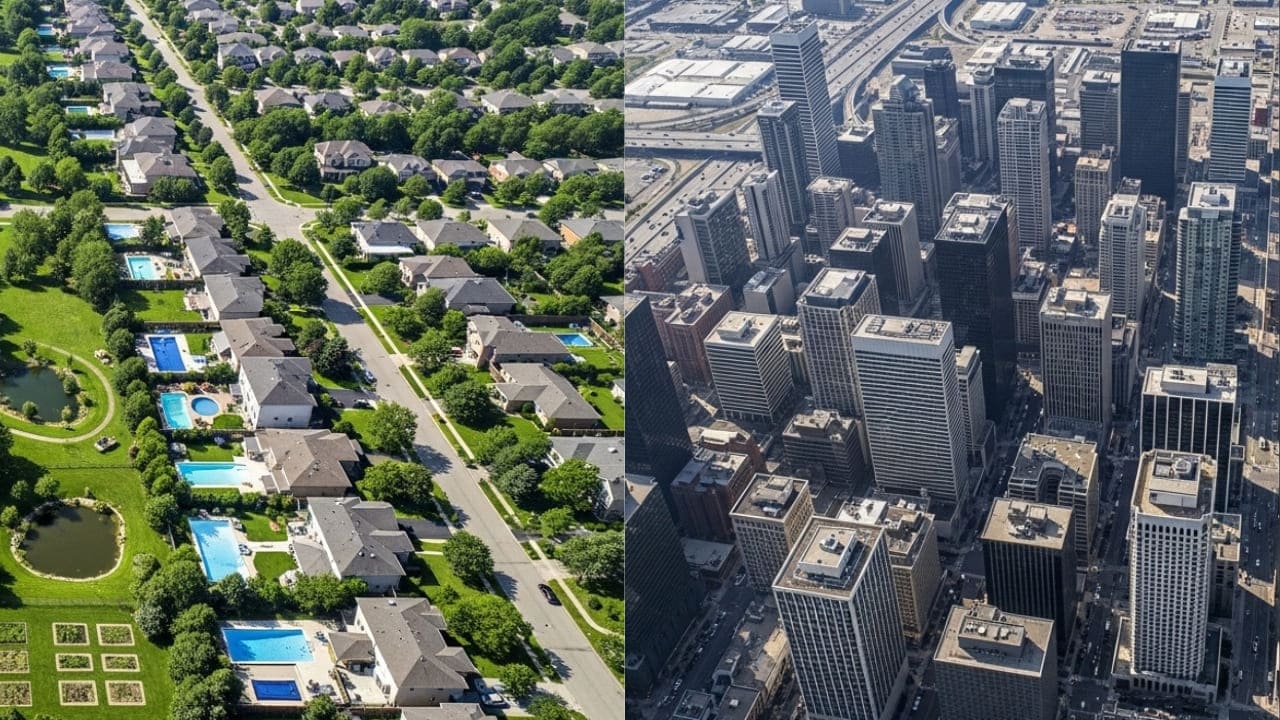
Image Credit: Illustration by Author
Suburban Landscaping Creates the Perfect Mosquito Breeding Habitat
This is the part most homeowners don’t want to hear. The very things we spend money on — gardens, birdbaths, decorative pots, dense shrubs, mulch beds, rain barrels — are what Aedes and Culex mosquito species need to complete their life cycle.
Common Suburban Breeding Sites and How Long They Take to Produce Adult Mosquitoes
| Breeding Site | Water Needed | Time to Adult Mosquito | Control Method |
| Birdbath | Any standing water | 7–10 days | Change water every 3 days |
| Clogged gutters | Small pooled volume | 5–7 days | Clear debris, check slope |
| Plant pot saucers | < 1 oz | 7–10 days | Dump or drill drainage holes |
| Rain barrels | Any volume | Under 7 days if open | Screen all openings tightly |
| Ornamental ponds | Larger volume | Continuous | Add Bti or mosquito fish |
| Mulch / leaf litter | Moisture retention | Indirect — resting habitat | Rake and reduce depth |
| Tree holes / stumps | Collect rainwater | 7–10 days | Fill with sand or remove |
Aedes albopictus — the Asian tiger mosquito — needs less than a bottle cap of water to breed. It’s established across most of the continental US. It doesn’t need a pond. It needs your kid’s forgotten sandbox lid.
Green Corridors, Tree Canopy, and Resting Humidity
Adult mosquitoes are fragile. Wind desiccates them. Full sun kills them. They rest during peak heat hours in cool, humid microenvironments — dense shrubs, tall grass, shaded leaf litter, the underside of broad leaves. Suburbs provide all of this in abundance.
A study published in the Journal of Medical Entomology found that mosquito abundance was significantly higher in residential areas with higher vegetation density compared to more impervious, developed urban cores. The green infrastructure we value aesthetically — the mature oaks, the privacy hedges, the ornamental grasses — doubles as perfect daytime shelter for Aedes and Culex species.
Cities, especially older dense ones, have far less of this. Hard surfaces don’t retain humidity. Building corridors create wind tunnels. The structural environment itself is inhospitable to mosquito survival between blood meals.
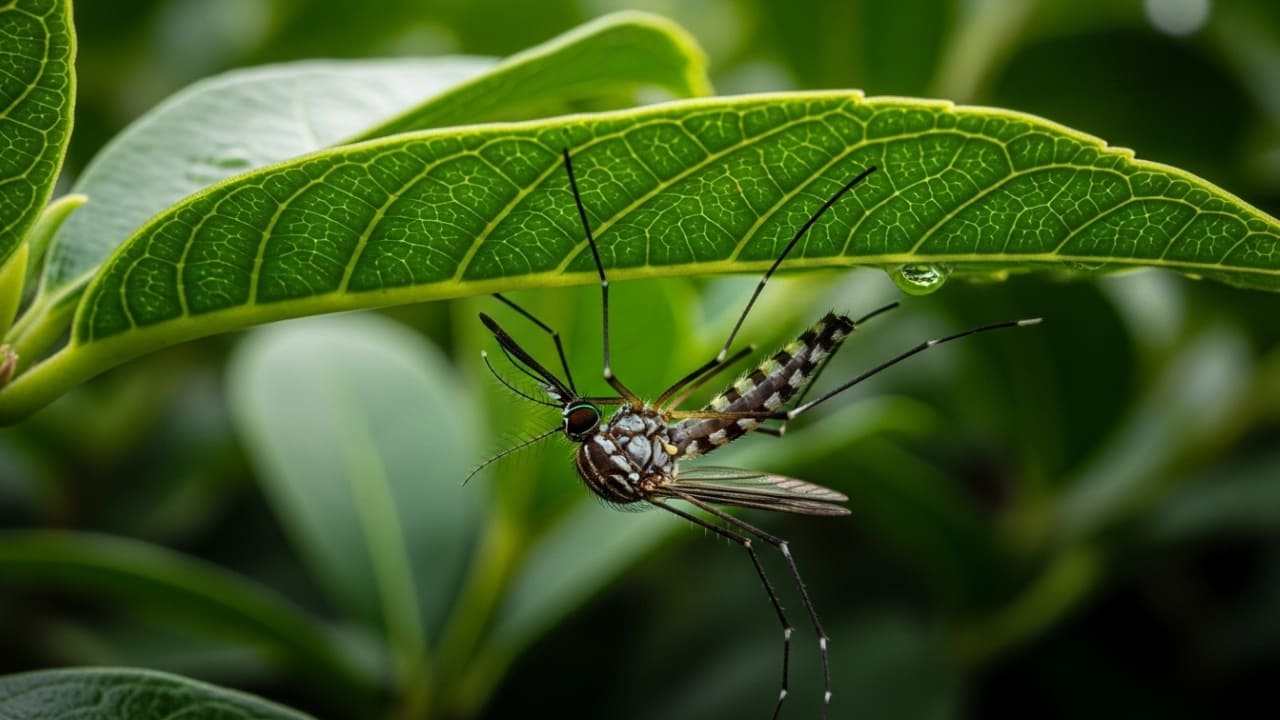
Image Credit: MosquiTalk.com
Stormwater Management Failures in Residential Neighborhoods
Urban centers tend to have engineered stormwater systems — catch basins, underground drains, sealed surfaces — that move water rapidly off-site. Suburbs often rely on shallow drainage swales, retention ponds, and poorly graded lots.
Those retention ponds are everywhere. They’re sold as an amenity. ‘Community pond,’ the listing says. Entomologists call them mosquito production factories. One productive retention pond in a subdivision can generate thousands of adult mosquitoes per acre per week during warm months, depending on species composition and larval control efforts.
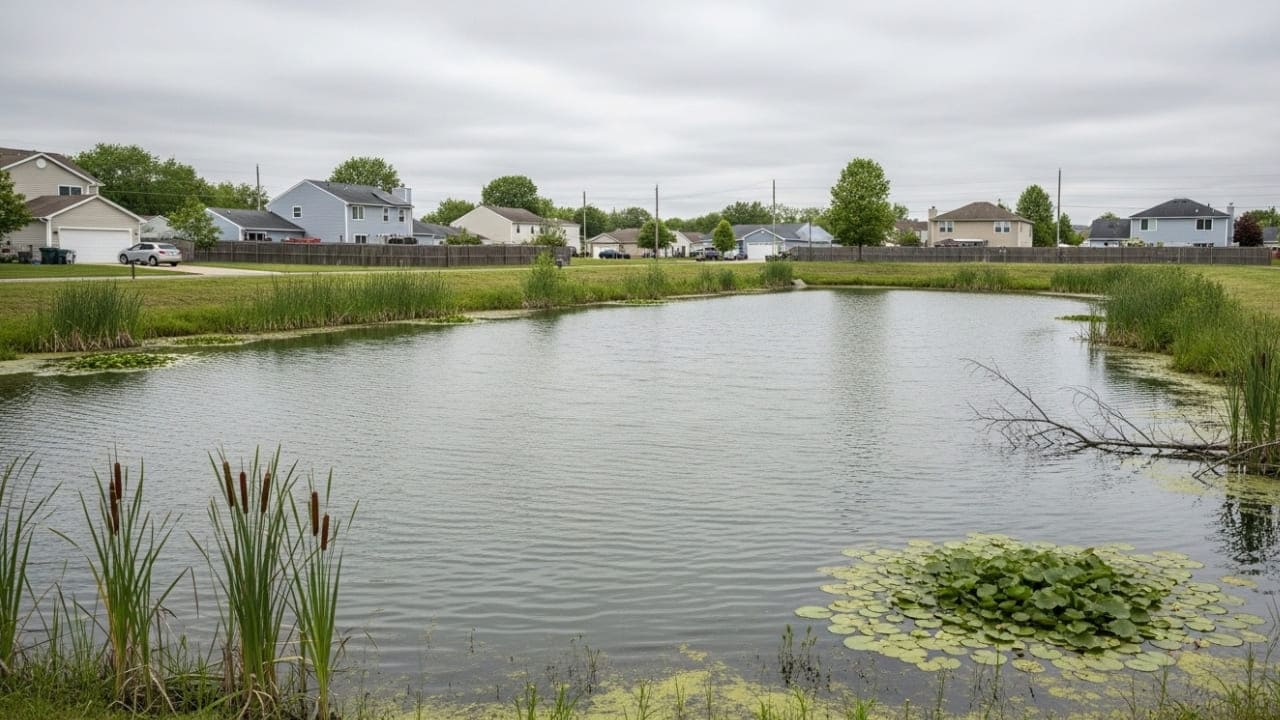
Image Credit: MosquiTalk.com
Retention Pond Mosquito Risk: Key Variables
- Shallow, warm, stagnant water = maximum larval productivity
- Emergent vegetation along margins = resting and oviposition habitat
- Absence of larval predators (fish, dragonfly larvae) = no biological control
- No regular larvicide application = unmanaged population growth
- Proximity to homes (under 300 feet) = higher human exposure risk
The Irrigation Factor: How Lawn Watering Creates Mosquito Breeding Conditions
Suburban lawns get watered. A lot. Automated irrigation systems often run at 2–4 AM — nobody notices if the system is creating puddles on a low spot, pooling around a downspout, or saturating a mulch bed for days after a rain event.
Overwatering is one of the most underappreciated contributors to residential mosquito problems. Culex quinquefasciatus — the southern house mosquito and a significant vector of West Nile virus — breeds readily in organically enriched, stagnant water. Irrigation runoff collecting in low areas, especially near organic matter, is premium breeding habitat.
I fixed a lot of my own mosquito problem by adjusting my irrigation zones to avoid saturation around the back fence, clearing a clogged downspout extension, and swapping out three decorative pots that had been quietly farming mosquitoes all summer. It made a measurable difference within two weeks.
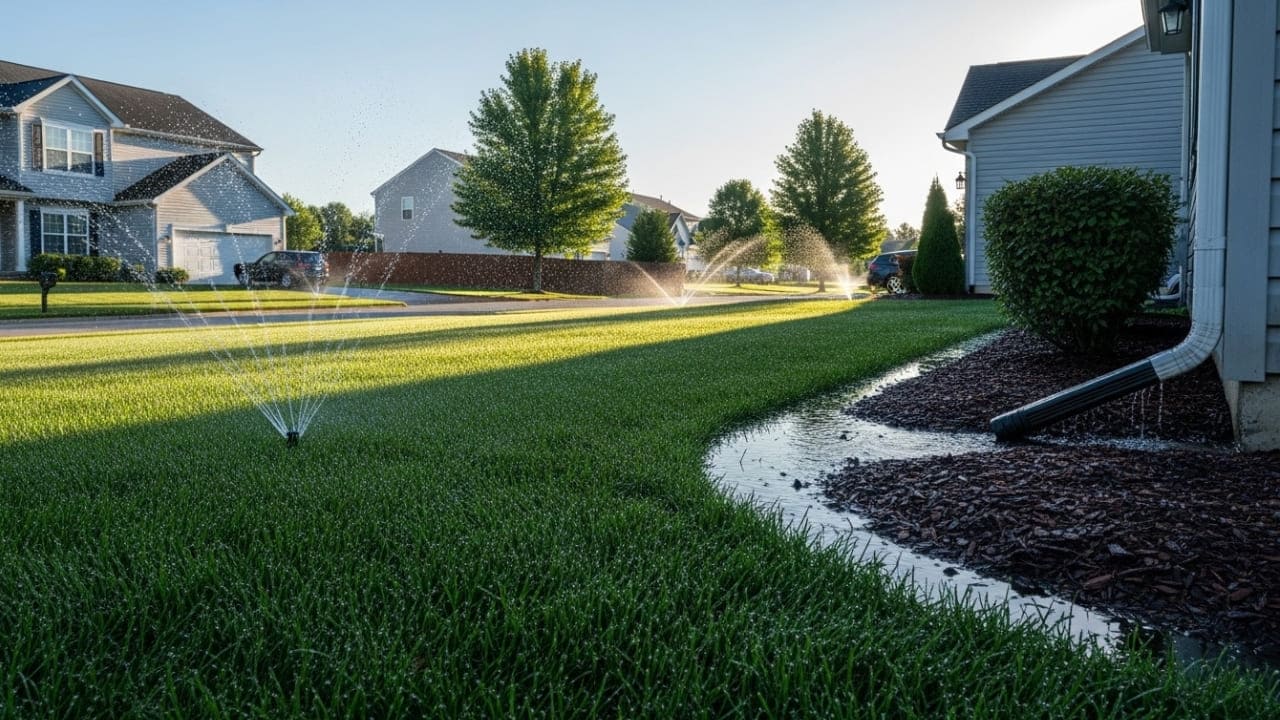
Image Credit: MosquiTalk.com
Species Composition: The Mosquitoes Thriving in Suburbs Are the Aggressive Biters
Not all mosquitoes bite with the same intensity. The species dominating suburban habitats happen to be the most aggressive, most day-active, and most persistent of all North American mosquito species.
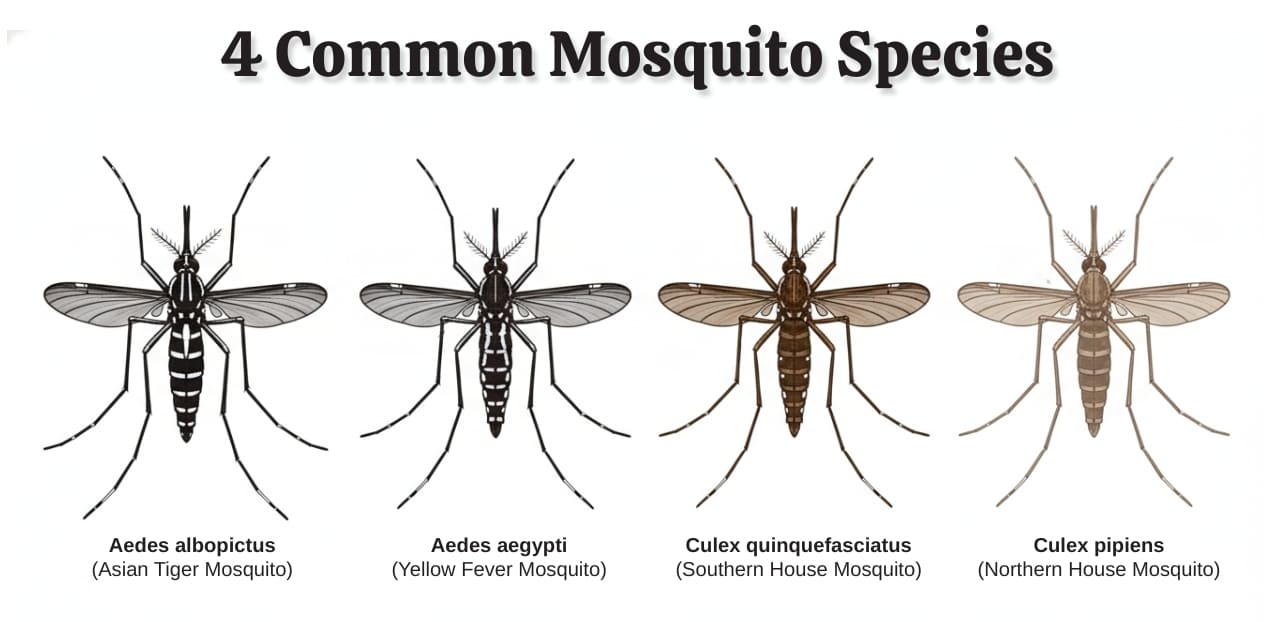
Image Credit: Illustration by Author
| Species | Common Name | Biting Behavior | Primary Habitat | Disease Risk |
| Aedes albopictus | Asian Tiger Mosquito | Day-active, aggressive | Container water, yards | Dengue, Chikungunya, Zika (vector) |
| Aedes aegypti | Yellow Fever Mosquito | Day-active, feeds on humans | Indoor/outdoor containers | Dengue, Zika, Yellow Fever |
| Culex quinquefasciatus | Southern House Mosquito | Dusk/dawn, evening | Stagnant, organic water | West Nile Virus |
| Culex pipiens | Northern House Mosquito | Dusk/dawn | Catch basins, retention ponds | West Nile Virus |
| Aedes vexans | Inland Floodwater Mosquito | Dusk, aggressive | Floodplains, wet areas | Dog Heartworm (vector) |
Aedes albopictus, in particular, has exploded across US suburbs over the past two decades. It’s a container breeder. It’s day-active, which means repellent timing habits built around dusk-biting species don’t work. It’s aggressive and persistent — it will follow you indoors given the chance. It’s practically custom-built for the modern suburban backyard.
Why Impervious Surface Coverage Actually Reduces Mosquito Pressure
Dense urban development — parking structures, sealed sidewalks, rooftops, commercial pavement — is essentially hostile to container-breeding species. There’s nowhere for water to collect and sit. Downspouts drain to storm sewers. The physical infrastructure eliminates microhabitats.
Research from urban ecology studies has consistently found an inverse relationship between impervious surface coverage and Aedes mosquito abundance. More concrete = fewer containers = lower mosquito pressure. That’s a bitter irony for people who moved to the suburbs specifically for the green space.
Evidence-Based Mosquito Control Strategies for Suburban Homeowners
Understanding the suburban mosquito problem makes the control strategy obvious: eliminate water, reduce resting habitat, and deploy targeted larvicides where water can’t be eliminated.
1. Source Reduction: The Most Effective Intervention
Dr. Jonathan Day, medical entomologist at the University of Florida, has consistently emphasized that source reduction — eliminating breeding sites — is far more effective than adulticiding (spraying for adult mosquitoes). Adult spray treatments provide relief measured in hours to days. Source elimination removes production capacity for the entire season.
Conduct a weekly source reduction audit of your property:
- Walk the perimeter and check every container, low spot, and object that holds water.
- Flush and scrub birdbaths every 72 hours — remove the biofilm that mosquitoes use as a chemical cue to oviposit.
- Clear gutters in spring and after every major wind event.
- Check and adjust irrigation to eliminate standing puddles within 72 hours.
- Drill drainage holes in pot saucers you can’t be bothered to dump.
- Treat ornamental ponds and rain barrels with Bacillus thuringiensis israelensis (BTI) dunks or granules — it’s a larvicide with no toxicity to vertebrates.
- Mow grass short and trim shrubs to reduce adult resting habitat along the perimeter.
2. Biological Mosquito Control Options
- BTI (Bacillus thuringiensis israelensis): EPA-registered biological larvicide; kills larvae in standing water; safe for pollinators, fish, and birds; available as dunks, bits, or granules.
- Gambusia affinis (mosquito fish): Voracious larval predators; appropriate for ponds and water features; available through many municipal mosquito control districts free of charge.
- Attract natural predators: Purple martins, dragonflies, and bats are often overstated as controls, but dragonfly larvae in ponds do provide measurable larval suppression.
3. Personal Protection During Peak Mosquito Activity
- DEET (10–30%) remains the gold standard; effective, safe, and recommended by CDC for disease-risk areas
- Picaridin (20%) comparable efficacy to DEET with less skin feel; gaining adoption among outdoor workers
- IR3535: Lower efficacy but appropriate for lower-risk environments and sensitive skin
- Permethrin-treated clothing: Highly effective for Aedes species; binds to fabric fibers and lasts through multiple washes
- Fans on patios: The simplest, most underutilized control — mosquitoes can’t fly in > 1 mph sustained airflow
What Municipal Mosquito Control Does — and Doesn’t Do
Many suburban municipalities run mosquito abatement programs. These typically include adulticiding (truck-mounted or aerial pyrethrin/permethrin applications) and, in better-funded districts, larviciding of catch basins and retention areas. Public health departments track West Nile and other vector-borne diseases and adjust spray schedules accordingly.
But municipal programs can’t treat private property without permission, can’t identify every residential breeding site, and can’t compensate for individual homeowner neglect. The adulticiding truck driving through your neighborhood at dusk gives maybe 48–72 hours of relief if the timing and weather conditions are right. It does nothing to your neighbor’s blocked gutter or the abandoned kiddie pool three houses down.
The responsibility — and the opportunity — sits with the individual homeowner more than most people realize.
The Bottom Line: Why Mosquitoes Are Worse in Suburbs Than Cities
Suburbs are worse for mosquitoes because they’re better for mosquitoes:
- more standing water,
- more vegetation,
- more humidity retention,
- more container habitat,
- moderate temperatures, and
- the most aggressive biting species in North America happen to be container breeders perfectly adapted to the residential landscape.
Cities are impervious, hot, and dry. Suburbs are the opposite. That gap explains most of what you’re experiencing on your back patio while your downtown friends don’t think about mosquitoes at all.
The fix isn’t complicated. It just requires consistent attention. Eliminate the water. Reduce the vegetation clutter at ground level. Treat what you can’t eliminate. Protect yourself during active hours. That combination, applied consistently, genuinely works — and it works better than anything a spray truck can do.
Editorial Team & Contributors

Raashid Ansari, Founder, Content Researcher & Author - MosquiTalk
Not an entomologist — just a genuinely curious writer who started researching mosquitoes and couldn't stop. What began as casual reading about repellents and bite prevention gradually turned into a deep ongoing dive into vector biology, disease epidemiology, animal health impacts, and the real science behind mosquito control. Everything published here is carefully edited, and written with one purpose: giving readers accurate, accessible information they can actually trust and use to protect themselves, their families, and their pets, birds and cattle.
Active across social platforms, regularly publishes, and genuinely invested in spreading mosquito awareness where it matters most. Because informed readers make better decisions — and better decisions save lives.