
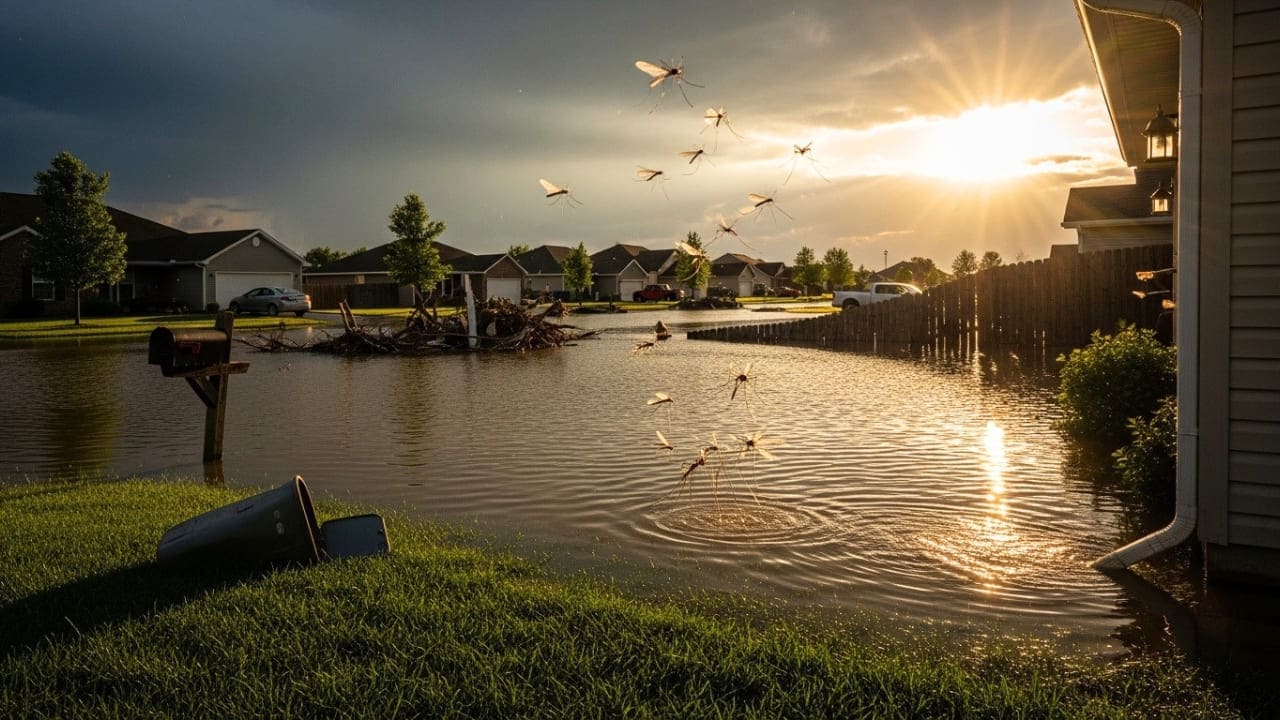
Introduction to Mosquito Issues After a Flash Flood
Flash floods don’t just damage property. They reset the mosquito clock. Within 72 hours of floodwater receding, the conditions for an explosive mosquito population surge are already locked in — billions of eggs dormant in the soil activate the moment standing water returns, and the warm, organic-laden floodwater left behind is exactly what the worst biting species need to complete their larval cycle in under a week.
Mosquito Issues After a Flash Flood:
- Explosive Breeding: Stagnant water pools in debris, potholes, containers → rapid mosquito population surge
- Hidden Breeding Sites: Floodwater recedes but leaves water trapped in tires, buckets, rooftops, drains
- Disease Risk Spike: Increased chances of dengue, malaria, chikungunya outbreaks
- Delayed Impact: Mosquito boom typically occurs 5–10 days after flooding (breeding cycle)
- Poor Drainage Problems: Blocked drains and sewage overflow create long-term breeding zones
- Increased Human Exposure: Damaged homes, outdoor cleanup → more mosquito bites
- Waste Accumulation: Flood debris (plastic, cans) becomes ideal water-holding containers
- Vector Shift: Different mosquito species may emerge depending on water type (clean vs polluted)
- Control Challenges: Spraying is less effective if breeding sources remain widespread
- Public Health Burden: Sudden rise in cases can overwhelm local healthcare systems
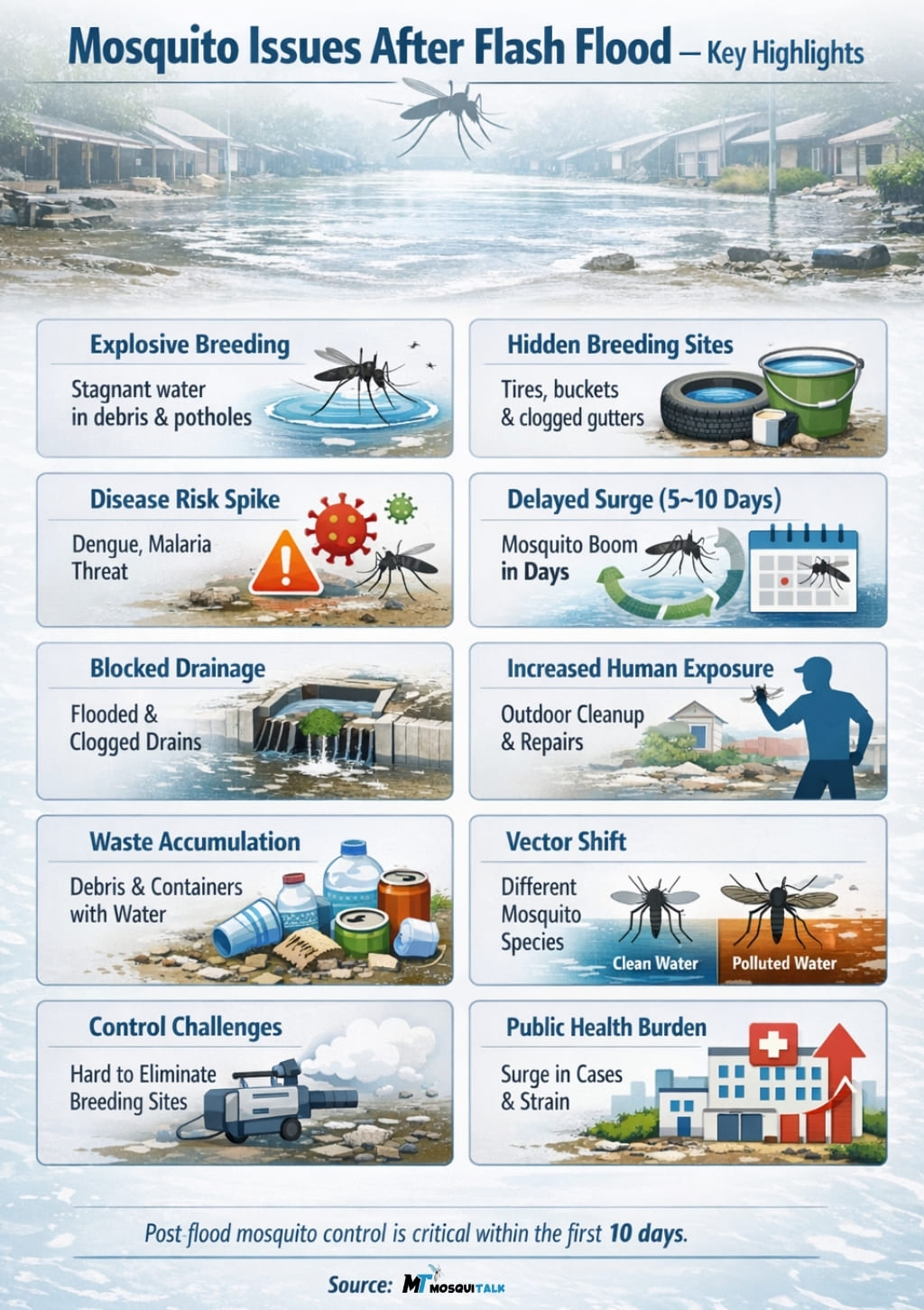
Image Credit: MosquiTalk.com
I’ve dealt with this firsthand after back-to-back storms left standing water across my property for nearly two weeks. The mosquitoes that followed were relentless, day and night. What I learned — and what the science backs up — is that the window between flood recession and adult mosquito emergence is narrow. Act in that window, and you can knock down the surge significantly. Miss it, and you’re dealing with a full-scale infestation for weeks.
Below is a step-by-step emergency mosquito control guide for preventing mosquitoes after a flash flood, starting with the most critical intervention — larval control — and working through every layer of population suppression available to a homeowner.
Step 1: Conduct an Immediate Post-Flood Mosquito Breeding Site Survey
The first thing to do — before any treatment — is map every standing water source on your property. This sounds obvious. It isn’t. Floodwater creates breeding sites you’ve never noticed before: low spots in the lawn that never held water, containers that migrated downstream, debris piles that now trap water underneath, upturned trash can lids, gutters clogged with flood debris.
You’re looking for any water that will still be standing 72 hours from now. That’s the threshold. Mosquito eggs hatch within 24-48 hours in warm conditions. Larvae need 5-14 days to reach adulthood depending on temperature and species. If you eliminate water before larvae mature, you break the cycle before it produces a single biting adult.
Post-Flood Survey Checklist
- Walk the full perimeter of the property — front, back, side yards, fence lines
- Check under decks, porches, and crawl spaces for trapped water
- Inspect all gutters, downspout extensions, and splash blocks
- Look for flood debris (leaves, branches, tarps) that may pool water
- Check low spots in lawns, garden beds, and driveways
- Inspect every container — pots, buckets, kiddie pools, tarps, tires
- Document locations — photograph and note areas you cannot drain immediately
Post-Flood Survey Checklist
Step 2: Emergency Physical Drainage and Standing Water Elimination
Drain everything you can. This is the single most effective action available to a homeowner. No chemical treatment, no trap, no repellent matches the effectiveness of physically removing breeding water.
For large standing pools on lawn areas, rent a submersible pump if needed. A standard 1/3 HP utility pump can move 2,000 gallons per hour. A flooded low section of lawn can be drained in hours with the right equipment — hours versus the 5-7 days it would otherwise take to evaporate or absorb. In that time, the first generation of larvae can mature entirely.
Physical Elimination Priority Order
- Pump or manually drain any pooled water deeper than 1/2 inch that will not absorb within 48 hours
- Flip, empty, or remove all portable containers — buckets, pots, toys, tarps, wheelbarrows
- Clear gutters of all flood-deposited debris and flush with a hose
- Break up debris piles and spread to allow drying
- Grade or rake low lawn areas to encourage drainage toward existing grade
- Check that downspout extensions are directing water away from the foundation, not pooling against it
- Unblock any clogged drainage swales or French drains that may be holding floodwater
What you cannot drain completely — retention areas, decorative ponds, rain barrels, tree holes, large debris-blocked low spots — moves to the next step.
Step 3: Apply Larvicides to All Standing Water You Cannot Eliminate
Larviciding is the cornerstone of emergency mosquito control after flooding. Treating larvae before they emerge as adults is roughly 10 to 20 times more cost-effective than adulticiding, according to the American Mosquito Control Association (AMCA). You’re eliminating the population at its source, before it can reproduce or bite.
1. BTI (Bacillus thuringiensis israelensis) — The Primary Larvicide for Homeowners
BTI is a naturally occurring soil bacterium that produces proteins toxic specifically to mosquito and black fly larvae. It has no toxicity to humans, pets, birds, fish, bees, or other non-target organisms. It’s EPA-registered, widely available at garden centers, and should be your first-line treatment for any standing water you cannot drain.
Available as dunks (for larger water volumes), bits (for smaller containers and broadcast over lawn areas), and granules (for broadcasting over flooded areas). After flooding, use bits and granules broadly over any area of the lawn still holding water.
| Product Form | Application Site | Coverage | Residual Activity |
| Bti Dunks | Rain barrels, ponds, large containers | 1 dunk per 100 sq ft of water surface | 30 days |
| Bti Bits (granules) | Small containers, clogged gutters, lawn pools | 1 tsp per 25 sq ft | 7-14 days |
| Bti Granules (broadcast) | Flooded lawn areas, debris zones | Per label rate per 1,000 sq ft | 7-14 days |
| Liquid Bti concentrate | Large-scale application, ponds, swales | Per label dilution rate | 7-14 days |
2. Methoprene — Insect Growth Regulator (IGR) for Persistent Standing Water
Methoprene is a synthetic insect growth regulator that mimics juvenile hormone in mosquito larvae, preventing them from maturing into adults. It does not kill larvae outright but blocks the pupal-to-adult transition. It’s available as Altosid XR briquettes or granules.
Methoprene is particularly useful for catch basins, retention areas, and drainage swales that will hold water for extended periods after flooding. It has a longer residual than BTI in some formulations — up to 150 days for slow-release briquettes — making it appropriate where re-treatment is difficult.
It is low toxicity to non-target species when used as directed, and is approved for use in standing water including water that may reach aquatic environments.
3. Temephos (Abate) — Where Available and Warranted
Temephos is an organophosphate larvicide used by municipal mosquito control programs, particularly for floodwater Aedes species in large inundated areas. It is not typically available over the counter to homeowners but may be applied by licensed pest control operators or provided by county mosquito control programs following declared flood emergencies.
If your area has been significantly flooded and local mosquito control is unresponsive, contact your county health department — many operate aggressive post-flood larviciding programs at no cost to residents.
Step 4: Target High-Risk Larval Habitats Specific to Flood Conditions
Standard residential breeding sites — birdbaths, pot saucers, gutters — are well-known. Flooding creates additional sites most homeowners don’t think to treat.
| Flood-Specific Breeding Site | Why It’s High Risk | Control Action |
| Lawn depressions and tire tracks | Warm, organically enriched shallow water — ideal for Aedes and Culex larvae | Broadcast Bti bits; rake to grade after water recedes |
| Debris piles and leaf litter | Trap moisture, provide shade; secondary oviposition sites | Remove or spread to dry; apply Bti bits if water present |
| Flooded crawl spaces | Enclosed, warm, standing water — extended breeding environment | Pump out; treat with Bti; improve drainage and ventilation |
| Clogged stormwater swales | High volume, slow-draining, warm water with organic load | Clear blockages; treat with Bti dunks or methoprene briquettes |
| Tree holes filled by floodwater | Container-like; warm; used by Aedes albopictus | Fill with sand; apply Bti bits if open and holds water |
| Tarps and plastic sheeting | Folds hold water; easily overlooked | Remove or hang to dry; check weekly |
| Overflowing septic or grey water areas | Highly organically enriched; Culex preferred breeding site | Repair drainage; contact municipal mosquito control |
Step 5: Apply Residual Vegetation Treatment to Reduce Adult Mosquito Resting Sites
Even with aggressive larval control, some adults will emerge — from neighboring properties, from untreated municipal sites, from water you simply couldn’t access. Adult mosquitoes rest during daylight hours in cool, humid microenvironments: dense shrubs, tall grass, ground-level vegetation, shaded leaf litter along fence lines.
Treating resting habitats with a residual pyrethroid significantly reduces adult populations in the immediate area. This is not a broadcast yard spray — targeted application to vegetation and shaded margins is the correct approach.
Residual Adulticide Options for Homeowners
- Permethrin concentrate (0.5% dilution applied to vegetation margins): Binds to plant surfaces; residual activity 2-4 weeks; low mammalian toxicity; highly toxic to aquatic invertebrates and bees — apply only to vegetation, never directly to water or flowering plants
- Bifenthrin granules (broadcast along fence lines and lawn perimeter): Useful where vegetation density is high and spray application is difficult; activates with moisture
- Ready-to-use pyrethrin + piperonyl butoxide sprays: Short residual (24-72 hours) but fast knockdown of adults present at time of application; useful for immediate relief before residual treatment takes effect
Dr. Roxanne Connelly, extension entomologist (University of Florida IFAS), emphasizes that adulticide applications should always be secondary to larval source reduction — adulticiding without addressing breeding sites provides short-term relief only, and post-flood populations will rebound quickly without upstream larval control.
Step 6: Deploy Mosquito Traps as Population Monitoring and Supplemental Control
Traps are not a standalone control method. After flooding, they function best as a monitoring tool — they tell you which species are present, which direction they’re coming from, and whether your larval control efforts are working. As a secondary tool, they contribute to adult population reduction.
Trap Types and Post-Flood Application
- CO₂-baited traps (Mosquito Magnet, SkeeterVac): Most effective for floodwater Aedes species; require propane or dry ice CO₂ source; placed upwind of breeding areas and resting habitat; effective for surveillance and high-volume capture
- Autocidal gravid oviposition traps (AGO traps): Target gravid Culex females looking to oviposit; use water infused with hay or organic material as attractant; highly species-selective; excellent for West Nile virus risk monitoring
- BG-Sentinel traps with lure: Highly effective for Aedes aegypti and Aedes albopictus; recommended by CDC for arboviral surveillance; UV + CO₂ + chemical lure combination
Place traps at the boundary of your property closest to flood-affected areas, not at the center of activity. You want to intercept mosquitoes before they reach living and recreation areas.
Step 7: Implement Structural and Personal Protection During Peak Surge Period
The 2-4 week period following a major flood event represents peak exposure risk. Larval control is working, but it takes time. Adult populations from the first post-flood generation will be active. Personal and structural protection must be layered on top of environmental control during this period.
Structural Protection
- Inspect all window and door screens for tears, gaps, or loose frames — repair immediately
- Seal gaps around utility penetrations, pipes, and AC lines entering the structure
- Use door sweeps on exterior doors
- Deploy oscillating fans on patios and outdoor seating areas — 1+ mph airflow prevents mosquito flight and host location
- Install outdoor patio fans or misting systems if extended outdoor time is planned
Personal Repellent Protocol During Flood-Season Peak Activity
| Repellent Active Ingredient | Concentration | Protection Duration | Best For |
| DEET | 20-30% | 4-6 hours | All species; gold standard; CDC recommended |
| Picaridin | 20% | 8-12 hours | Aedes species; no plastic degradation |
| IR3535 | 20% | 4-8 hours | Sensitive skin; children; lower-risk environments |
| Oil of Lemon Eucalyptus (OLE) | 30%+ | 3-6 hours | Plant-based; CDC-approved; not for children under 3 |
| Permethrin (clothing treatment) | 0.5% | 6-8 washes | Tick and Aedes species; apply to clothing only, never skin |
Step 8: Coordinate With Your Local Mosquito Control District
After a significant flood event, most county mosquito abatement districts ramp up operations — aerial or truck-mounted larviciding of retention areas, drainage channels, and floodplains, and adulticiding passes through residential areas. These operations are far more effective at the landscape scale than anything a single homeowner can do.
How to Work With Your Mosquito Control District
- Report your address for priority treatment — most districts take resident requests post-flood.
- Request larviciding of nearby retention ponds, drainage swales, or municipal catch basins on your street.
- Ask if free Bti dunks or larvicide products are available to residents — many districts provide these post-disaster.
- Report large-scale standing water on public land (parks, road medians, ditches) that your district may not have mapped.
- Check your county health department website for mosquito-borne disease advisories — West Nile, Eastern Equine Encephalitis, and other arboviruses spike following flood events.
The American Mosquito Control Association (AMCA) recommends that homeowners contact their local district within 48 hours of flood recession, not after mosquitoes are already biting. Coordination at this stage has the greatest impact.
Step 9: Maintain a 2-Week Post-Flood Monitoring and Re-Treatment Schedule
Mosquito control after flooding is not a one-time event. Floodwater Aedes species — particularly Aedes vexans and Aedes sticticus — lay drought-resistant eggs in soil that hatch with successive inundations. A second rainfall event 10-14 days after initial flooding will trigger a second emergence wave. Container-breeding species like Aedes albopictus will continue populating any water left standing on your property.
2-Week Post-Flood Monitoring Schedule
| Day Post-Flood | Action Required |
| Day 1-2 | Survey + physical drainage + first Bti/IGR application to all remaining water |
| Day 3-4 | Re-check all drainage work; re-treat any re-accumulated standing water; apply residual adulticide to vegetation margins |
| Day 5-7 | Second Bti application to persistent water; check trap catches if deployed; reapply repellents and review screen integrity |
| Day 8-10 | Re-survey for new breeding sites from any subsequent rainfall; contact mosquito district if adult pressure remains high |
| Day 12-14 | Full re-assessment; reapply Bti dunks in persistent water features; note any new disease advisories from county health |
Mosquitoes After a Flash Flood: The Control Window That Matters Most
Mosquitoes after a flash flood follow a predictable timeline — and that predictability is your advantage. The larval window between flood recession and adult emergence is where the leverage is. Miss that window, and you’re reacting to a surge already in progress. Hit it with the right tools — physical drainage, Bti, IGR, vegetation management, and structural protection — and you can blunt most of what the flood generates.
The steps in this guide work together as a system. Physical drainage first. Larvicides on everything that remains. Residual adulticide on resting habitat. Personal protection through the peak period. Coordination with your local mosquito control district. Monitoring and re-treatment through the full two-week emergence cycle.
Post-flood mosquito control is genuinely manageable if you start early. It demands attention and consistency, but the biology is on your side if you act within the first 48 hours of water receding. That window is real. Use it.
Editorial Team & Contributors

Raashid Ansari, Founder, Content Researcher & Author - MosquiTalk
Not an entomologist — just a genuinely curious writer who started researching mosquitoes and couldn't stop. What began as casual reading about repellents and bite prevention gradually turned into a deep ongoing dive into vector biology, disease epidemiology, animal health impacts, and the real science behind mosquito control. Everything published here is carefully edited, and written with one purpose: giving readers accurate, accessible information they can actually trust and use to protect themselves, their families, and their pets, birds and cattle.
Active across social platforms, regularly publishes, and genuinely invested in spreading mosquito awareness where it matters most. Because informed readers make better decisions — and better decisions save lives.