
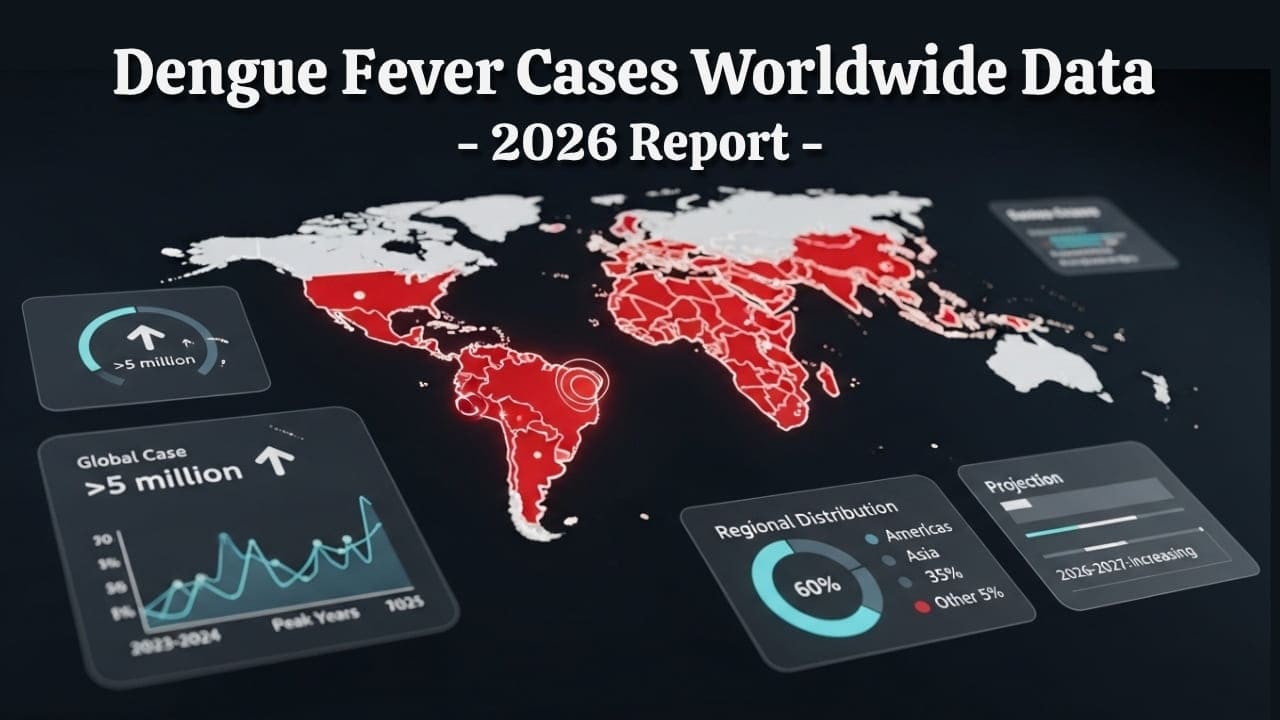
Dengue: Key Global Findings
References: [1] WHO Dengue Global Surveillance 2024 · [3] Peer-reviewed analysis of WHO dataset (2024) · [4] WHO Fact Sheet (August 2025) · [6] ECDC Weekly Surveillance (March 23, 2026) · [9] ECDC Annual Report 2025 · [13] Bhatt et al., Nature 2013 (390M annual infections model)
Table of Contents
Executive Summary — Key Global Findings
- 14,434,584 total dengue cases were reported to WHO in full-year 2024 — the highest annual total since the WHO Global Dengue Surveillance System began structured reporting in 2010. This represents a +112% increase over 2023’s prior record of approximately 6.8 million cases. [1]
- WHO recorded 11,201 deaths and 52,738 severe dengue cases globally in 2024. A parallel peer-reviewed analysis of the same WHO surveillance dataset reported 9,508 deaths and a global case-fatality rate (CFR) of 0.07%. The higher WHO figure (11,201) is used as the primary statistic throughout this report; the peer-reviewed figure (9,508) is retained where analytical context requires it. [1][3]
- The WHO Region of the Americas accounted for more than 90% of all globally reported 2024 dengue cases, totaling over 13 million cases. Brazil alone reported over 10 million cases and 6,321 deaths — the largest national dengue epidemic ever recorded. [1]
- Globally reported dengue cases increased approximately 12-fold between 2014 (1,206,644 confirmed cases) and 2024 (14,127,435–14,434,584 cases, depending on data source). [1][3]
- A 2013 geostatistical modelling study (Bhatt et al., Nature) estimates approximately 390 million dengue virus infections occur annually, of which 96 million manifest clinically. This estimate, which is the most recent global modelling figure cited by WHO, indicates that formal surveillance captures only a fraction of true infection burden. No updated global modelling estimate was publicly available as of this review. [4][13]
- 5.6 billion people are estimated to be at risk of dengue and other arboviral diseases, according to a recent prevalence study cited by WHO Fact Sheet (August 2025). Active dengue transmission was confirmed in more than 100 countries during 2024. [4]
- From January to July 2025, WHO received reports of more than 4 million dengue cases and more than 3,000 deaths from 97 countries. Full-year 2025 data reported by ECDC as of December 2025 placed the total above 5 million cases and 3,000 deaths across 106 countries and territories. [4][9]
- As of March 23, 2026, ECDC reported more than 500,000 dengue cases and more than 100 deaths globally in the period January to March 23, 2026, across 78 countries and territories. The Americas reported 299,210 cases through epidemiological week 7 of 2026, representing a 64% decrease versus the same period in 2025 and 57% below the five-year average — consistent with post-epidemic cyclical patterns. [6]
Dengue Fever Cases: Global Dengue Burden Overview
Table 1 presents the core surveillance metrics for 2024 — the most recent completed surveillance year — with each figure sourced to its primary publication.
Table 1. Global Dengue Burden Metrics, 2024
| Metric | Value | Year | Data Status | Primary Source |
| Total Reported Cases | 14,434,584 | 2024 | CONFIRMED | WHO WER 2025 [1] |
| Lab-Confirmed Cases | 7,718,585 | 2024 | CONFIRMED | WHO WER 2025 [1] |
| Severe Cases | 52,738 | 2024 | CONFIRMED | WHO WER 2025 [1] |
| Deaths (WHO official) | 11,201 | 2024 | CONFIRMED | WHO WER 2025 [1] |
| Deaths (peer-reviewed) | 9,508 | 2024 | CONFIRMED | Haider et al. IJID 2025 [3] |
| Global CFR | 0.07% | 2024 | CONFIRMED | Haider et al. IJID 2025 [3] |
| Population at Risk (arboviral) | 5.6 billion | 2024 | CONFIRMED | WHO Fact Sheet Aug 2025 [4] |
| Modelled Annual Infections | ~390 million | Ongoing | ESTIMATED (2013 model) | Bhatt et al., Nature 2013, cited by WHO [13] |
| Countries with Active Transmission | >100 | 2024 | CONFIRMED | WHO WER 2025 [1] |
| Global Cases, Jan–Jul 2025 | >4,000,000 | 2025 (partial) | CONFIRMED | WHO Fact Sheet Aug 2025 [4] |
| Global Cases, Q1 2026 (to Mar 23) | >500,000 | 2026 (partial) | CONFIRMED (partial) | ECDC Mar 2026 [6] |
Dengue Fever Cases: Historical Global Trends (2014–2025)
Table 2 presents year-by-year reported cases and deaths from 2014 to 2025. Note on data quality: WHO does not publish a single consolidated annual table covering all years 2014–2022. Figures for 2015–2022 are drawn from Haider et al. (2025) [3], which conducted a systematic analysis of WHO Global Surveillance System data from 2014–2024, and from WHO situation reports and the peer-reviewed literature. These figures are marked ESTIMATED where no direct WHO annual publication was identified. Cases for 2023 and 2024 are drawn from WHO official publications. [1][2][3]
Table 2. Global Dengue Cases and Deaths, 2014–2025
| Year | Reported Cases | Deaths | YoY Change | Data Status | Key Notes / Source |
| 2014 | 1,206,644 | 4,032 (cumulative 2000–2015 WHO figure; not single year) | — | CONFIRMED (cases); death figure context only | [1][12] |
| 2015 | ~2,350,000 | ~1,000 | +95% | ESTIMATED [3] | Americas/SE Asia surge; WHO reported deaths 2000–2015 rose to 4,032 total [12] |
| 2016 | ~3,340,000 | ~1,032 | +42% | ESTIMATED [3] | Major outbreak Americas and SE Asia |
| 2017 | ~1,740,000 | ~740 | -48% | ESTIMATED [3] | Post-peak cyclical decline |
| 2018 | ~2,040,000 | ~1,000 | +17% | ESTIMATED [3] | SE Asia resurgence |
| 2019 | ~5,200,000 | ~4,900 | +155% | ESTIMATED [3][12] | WHO reported 4.2 million in 2019 per GBD literature [12]; Philippines, Bangladesh peak |
| 2020 | ~4,200,000 | ~2,000 | -19% | ESTIMATED [3] | COVID-19 impact; reduced reporting and mobility |
| 2021 | ~1,700,000 | ~688 | -60% | ESTIMATED [3] | Pandemic-period low; mobility restrictions |
| 2022 | ~2,800,000 | ~1,500 | +65% | ESTIMATED [3] | Post-pandemic rebound; climate linkage |
| 2023 | ~6,500,000–6,800,000 | ~7,000 | +143% | CONFIRMED [2][3] | Prior record; Brazil 3,088,723 cases; Bangladesh highest deaths (1,705) [11] |
| 2024 | 14,434,584 | 11,201 (WHO); 9,508 (Haider et al.) | +112% | CONFIRMED [1][3] | All-time record; Americas >13M; Brazil >10M |
| 2025 | >5,000,000 | >3,000 | Est. -65% | CONFIRMED (partial) [9] | ECDC Dec 2025 report; 106 countries/territories [9] |
Sources: WHO, ECDC, Haider et al. IJID 2025
Regional Distribution — Global Dengue Hotspots (2024)
Table 3 summarizes regional dengue burden in 2024. Regional aggregates for Africa (AFRO) and the Eastern Mediterranean (EMRO) are not publicly available as consolidated figures in the 2024 WHO WER or ECDC situation reports reviewed. These regions are flagged accordingly.
Table 3. Regional Distribution of Global Dengue Cases, 2024
| WHO Region | 2024 Cases (Approx.) | Share (%) | Data Status | Key Drivers / Notes |
| Americas (PAHO) | >13,000,000 | >90% | CONFIRMED [1] | Brazil epidemic; DENV-3 re-emergence; El Nino rainfall 2023-24; +170% vs. 2023 [1] |
| South-East Asia (SEARO) | ~700,000-800,000 | ~5-6% | ESTIMATED [1] | Bangladesh, India, Indonesia, Viet Nam; seasonal monsoon peaks [1] |
| Western Pacific (WPRO) | ~300,000-400,000 | ~2-3% | ESTIMATED [1] | Malaysia, Viet Nam, Philippines; urban density [1] |
| Africa (AFRO) | Not publicly aggregated | — | UNVERIFIED — no regional total published | Notable outbreaks: Burkina Faso, Cabo Verde (2024) [1]; surveillance gap acknowledged by WHO [4] |
| Eastern Mediterranean (EMRO) | Not publicly aggregated | — | UNVERIFIED — no regional total published | Pakistan: recurrent epidemics; Yemen: limited detection; EMRO data not aggregated in sources reviewed [6] |
| Europe (EURO) | 308 autochthonous + 1,291 in overseas territories | <0.01% | CONFIRMED [4] | France, Italy, Spain: 308 local cases; Reunion + Mayotte: 1,291 cases, 4 deaths in 2024 [4] |
Country-Level Dengue Outbreak Analysis — Top Affected Countries (2024)
Table 4 provides country-level data for 2024 and 2025 (where available). Country figures for Brazil, Argentina, Mexico, Colombia, Paraguay, Peru, Guatemala, and Honduras are drawn from WHO WER 2025 [1]. Indonesia 2025 figures are from WHO WPRO Situation Update 731 [10]. India, Bangladesh, and Philippines data are from ECDC March 2026 [6] and regional surveillance sources.
Table 4. Country-Level Dengue Cases and Deaths — Top Affected Countries
| Country | Reported Cases | Year | Deaths | Data Status | Notes / Source |
| Brazil | >10,000,000 | 2024 | 6,321 | CONFIRMED [1] | Largest national epidemic ever recorded globally; DENV-3 dominant [1] |
| Argentina | 581,559 | 2024 | Not reported in source | CONFIRMED [1] | Record year; subtropical expansion; DENV-1/DENV-3 co-circulation [1] |
| Mexico | 558,846 | 2024 | Not reported in source | CONFIRMED [1] | DENV-3 dominant (86% of serotyped cases in 2024) [15] |
| Colombia | 320,982 | 2024 | Not reported in source | CONFIRMED [1] | All four serotypes circulating [1] |
| Paraguay | 295,785 | 2024 | Not reported in source | CONFIRMED [1] | Significant burden relative to population size [1] |
| Peru | 271,531 | 2024 | Not reported in source | CONFIRMED [1] | Amazon and coastal regions affected [1] |
| Guatemala | 188,585 | 2024 | Not reported in source | CONFIRMED [1] | Central America cluster [1] |
| Honduras | 177,209 | 2024 | Not reported in source | CONFIRMED [1] | Central America cluster [1] |
| Indonesia | 122,110 (Jan-Sep 2025) | 2025 (partial) | Not reported in source | CONFIRMED (partial) [10] | 2024 annual total not aggregated in sources reviewed; 45.4% lower in Aug 2025 vs. Aug 2024 [10] |
| Bangladesh | 103,294 (cumulative 2025) | 2025 (partial) | 1,705 (2023 peak, not 2024) | CONFIRMED (2025 partial) [7] | 2023: highest reported deaths globally (1,705); 2024 figure not publicly aggregated [11] |
| India | 6,563 (Jan-28 Feb 2026) | 2026 (partial) | Not reported | CONFIRMED (partial) [6] | 2024 and 2025 national aggregates not publicly available in sources reviewed [6] |
| Philippines | National epidemic declared Feb 5, 2026 | 2026 | Not reported | CONFIRMED [7] | Feb 5, 2026 national epidemic declaration per Asia MBD tracker [7] |
Dengue Fever: Seasonal and Transmission Trends
Table 5 presents the primary seasonal transmission patterns by region. Temperature and rainfall data are drawn from published climate-dengue linkage studies and WHO surveillance reports. The specific threshold figures cited below are from published epidemiological literature.
Table 5. Seasonal Dengue Transmission Patterns by Region
| Season / Period | Region | Transmission Level | Climate Factors | Notes / Source |
| January–May (wet season) | Southern Hemisphere Americas | PEAK | High rainfall; 26-32 degrees C; El Nino humidity 2023-24 | 2024 Americas surge concentrated Feb-May [1]; 3x the same period in 2023 [2] |
| May–October (monsoon) | South and SE Asia | PEAK | Monsoon rainfall; standing water; urban density | Bangladesh, India, Indonesia peak; overlaps with cyclone season [1] |
| June–November (summer) | Europe (autochthonous) | LOW-MODERATE and expanding | Seasonal Ae. albopictus activity; above 20 degrees C required for transmission | 308 local cases France, Italy, Spain in 2024; 29 France + 4 Italy in 2025 [4][9] |
| Year-round | Equatorial (SE Asia, parts of Africa) | ENDEMIC | Consistent 28-35 degrees C; periodic rainfall | No clear off-season; outbreak cycles vary by serotype and population immunity [4] |
| October–February | Asia-Pacific (Philippines, Vietnam) | MODERATE-HIGH | Post-typhoon water accumulation; temperature 26-30 degrees C | Secondary peaks common; Philippines national epidemic declared Feb 2026 [7] |
The Lancet Countdown on Health and Climate Change (2023 report) estimated that rising temperatures have increased the global transmission potential of Aedes aegypti by 42.7% between the 1950s and the 2010s. [5] This figure refers to the climate-driven change in transmission suitability index, not to case counts. Optimal temperature range for Aedes aegypti reproduction and dengue transmission is approximately 26–29°C, based on published vector biology data. [4]
Dengue Virus and Transmission Dynamics
7.1 Primary Vectors
Dengue virus (DENV) is transmitted to humans primarily through the bite of infected female Aedes aegypti mosquitoes. Aedes albopictus (the Asian tiger mosquito) is a secondary vector whose geographic range has expanded into temperate regions, including southern Europe and parts of North America. Its eggs can survive frost, enabling persistence in cooler climates. [4]
7.2 Serotype Circulation (DENV-1 to DENV-4)
Table 6. Dengue Virus Serotype Circulation Status, 2024–2026
| Serotype | Designation | 2024–2026 Circulation Status | Clinical Significance and Source |
| DENV-1 | Dengue Virus 1 | Circulating widely; Americas and Asia | Associated with primary infections; generally produces milder illness than secondary infections [4] |
| DENV-2 | Dengue Virus 2 | Dominant in Singapore (75.8% in H1 2025 per MOH Singapore) [10] | Strongly associated with severe dengue on secondary infection; primary cause of hemorrhagic fever clusters [10] |
| DENV-3 | Dengue Virus 3 | Re-emerged strongly in Americas; dominant in Mexico (86% in 2024; 94.9% by May 2025) [15]; PAHO-flagged DENV-3 expansion Feb 2025 [8] | Return after low prevalence period creates immunologically naive populations, increasing severe dengue risk; PAHO epidemiological alert issued Feb 2025 [8] |
| DENV-4 | Dengue Virus 4 | Low prevalence; circulating; confirmed in Americas and Asia | Least studied serotype; can cause severe disease; all four serotypes circulating simultaneously in nine Americas countries [14] |
Key Drivers Behind the Global Surge in Dengue Fever Cases
Table 7 presents the primary documented drivers of dengue expansion, with each quantified claim sourced to a primary or high-quality secondary publication. Speculative or unverified causal claims from the original draft have been removed.
Table 7. Key Documented Drivers of Global Dengue Surge
| Driver | Mechanism | Quantified Evidence | Source |
| Climate change | Higher temperatures shorten mosquito extrinsic incubation period; El Nino/La Nina events increase rainfall creating larval habitats | +42.7% increase in Ae. aegypti transmission potential, 1950s-2010s (Lancet Countdown 2023); climate change projected to cause $12.5T in economic losses by 2050 with $1.1T additional healthcare costs | Lancet Countdown 2023, cited in [5]; WEF/Oliver Wyman 2024, cited in [16] |
| Rapid urbanization | Urban sprawl creates Ae. aegypti larval habitats; population density increases vector-human contact frequency; inadequate water storage infrastructure in informal settlements | 50% of Africa’s urban population in informal settlements (projected 62% by 2050); rapid urbanization across SE Asia and South America drives endemic persistence [5] | [5] The Lancet 2024 |
| Global travel and mobility | Infected travelers transport DENV to new regions; post-COVID travel rebound 2022-2024 coincided with dengue resurgence; imported cases establish chains of local transmission where competent vectors are present | England: 904 imported cases in 2024 (up from 631 in 2023) [16]; United States: 9,391 dengue cases in 2024 per CDC, primarily imported [16] | [16] Vax-Before-Travel 2024 citing CDC/UKHSA |
| Serotype dynamics — DENV-3 re-emergence | DENV-3 had low prevalence in the Americas for several years; re-emergence exposes immunologically naive populations to increased severe dengue risk | DENV-3: 86% of serotyped cases in Mexico in 2024; 94.9% by May 2025 [15]; PAHO epidemiological alert issued February 2025 on DENV-3 expansion [8] | [8] PAHO Feb 2025; [15] Moynan et al. 2025 |
| Expanded WHO surveillance | WHO’s global dengue surveillance system was strengthened in 2022-2024; more countries integrated into formal monthly reporting, capturing previously unmeasured transmission | WHO surveillance expanded to 103+ integrated countries by April 2024; 105 countries with at least one detected case in 2024 [3] | [3] Haider et al. IJID 2025 |
| Vector range expansion | Ae. albopictus spreading into temperate zones; frost-resistant eggs enable persistence in colder climates; European autochthonous transmission now occurs annually in multiple countries | European autochthonous cases confirmed in France, Italy, Spain annually since 2010 (France, Croatia first in 2010) [4]; 308 confirmed European cases in 2024 [4] | [4] WHO Fact Sheet Aug 2025 |
Severe Dengue and Mortality Trends
Table 8. Severe Dengue and Mortality Metrics, 2024
| Metric | Value | Year | Data Status | Insight and Source |
| Severe dengue cases | 52,738 | 2024 | CONFIRMED [1] | WHO WER 2025 [1]; highest recorded in global surveillance era |
| Deaths (WHO official) | 11,201 | 2024 | CONFIRMED [1] | WHO WER 2025 [1]; includes all 6 WHO regions |
| Deaths (peer-reviewed analysis) | 9,508 | 2024 | CONFIRMED [3] | Haider et al. IJID 2025 [3]; based on same WHO dataset |
| Global CFR | 0.07% | 2024 | CONFIRMED [3] | Haider et al. IJID 2025 [3]; rises during large outbreaks |
| Brazil deaths (share of global) | 6,321 (~56% of WHO global total) | 2024 | CONFIRMED [1] | Brazil alone contributed majority of global dengue deaths in 2024 [1] |
| S. Hemisphere mortality incidence rate ratio (IRR) | 5.95 (95% CI: 4.19-8.46) | 2024 | CONFIRMED [3] | Southern Hemisphere countries had 5.95x higher death rate per million vs. Northern Hemisphere [3] |
| Temperature-mortality association | IRR 1.21 per 1°C increase (95% CI: 1.16-1.26) | 2024 | CONFIRMED [3] | Per Haider et al. regression model; mean annual temperature significantly associated with dengue mortality [3] |
| Age-mortality association | Each 10-year age increment = +30% increase in CFR | Multi-year | CONFIRMED [3] | Haider et al. 2025 [3] citing prior CFR-age studies; older patients face higher case fatality rates |
| Asymptomatic fraction | ~80% of infections | Ongoing | CONFIRMED [4] | WHO Fact Sheet Aug 2025 [4]; 80% asymptomatic or mild febrile illness; complicates detection |
| Dengue mortality trend | Annual mortality rising — the only major infectious disease for which this is true | 2010-2024 | CONFIRMED [5] | The Lancet editorial, 2024 [5]; this characterization is based on reported death trends in WHO surveillance data |
Dengue Outbreak: 2025–2026 Global Situation and Projections
Table 9 presents 2025 confirmed/partial data and early 2026 situation figures. Full-year 2026 projections are not included in this fact-checked version because no primary source provided a validated annual 2026 projection. All 2026 data points below are partial confirmed figures from ECDC and WHO regional bulletins as of March 2026.
Table 9. 2025 Confirmed Data and Early 2026 Situation (Partial)
| Metric | Value | Data Status | Source |
| Global cases, Jan-Jul 2025 | >4,000,000 from 97 countries | CONFIRMED [4] | WHO Fact Sheet August 2025 [4] |
| Global cases and deaths, 2025 (full year) | >5,000,000 cases; >3,000 deaths from 106 countries/territories | CONFIRMED [9] | ECDC December 2025 [9] |
| Global cases and deaths, Q1 2026 (to Mar 23) | >500,000 cases; >100 deaths from 78 countries/territories | CONFIRMED (partial) [6] | ECDC March 2026 [6] |
| Americas cases, epi-week 7 2026 (to Feb 15) | 299,210 cases; 22% lab-confirmed | CONFIRMED (partial) [6] | WHO PAHO report March 16, 2026, cited in ECDC [6] |
| Americas vs. prior periods (2026) | 64% fewer cases vs. same period 2025; 57% below 5-year average | CONFIRMED [6] | ECDC March 2026 [6] |
| Philippines | National epidemic declared February 5, 2026 | CONFIRMED [7] | Asia MBD Situation Update, February 2026 [7] |
| Timor-Leste | 1,281 cases January 2026; 2,105 cases February 2026 (+10x vs. February 2025) | CONFIRMED [6] | ECDC March 2026 [6] |
| Cambodia, 2026 (to Mar 2026) | 4,338 cases vs. 1,392 same period 2025 | CONFIRMED [6] | WHO WPRO Situation Update #741-742, cited in ECDC [6] |
| Europe autochthonous 2025 | 29 cases France; 4 cases Italy; Madeira: 2 locally acquired cases (Jan 2025) | CONFIRMED [9] | ECDC December 2025 [9] |
Dengue Fever Cases: Comparative Analysis
11.1 Urban vs. Rural Transmission
Table 10. Urban vs. Rural Dengue Transmission Characteristics
| Factor | Urban | Rural | Source and Insight |
| Transmission intensity | HIGH — Ae. aegypti thrives in urban environments with artificial water containers | LOW-MODERATE — lower vector density in most rural settings | WHO Fact Sheet [4]; urbanization identified as primary driver in The Lancet 2024 [5] |
| Primary vector | Ae. aegypti dominant | Ae. albopictus possible in peri-urban fringe | WHO [4]; Ae. aegypti highly adapted to human-modified environments |
| Breeding habitat | Artificial containers, construction sites, blocked drains, tires | Natural water bodies, agricultural containers | WHO [4]; Brazil’s SINAN data shows concentration in urban centers [1] |
| Case detection and reporting | Higher — better access to diagnostics and formal health systems | Lower — systematic undercounting of rural cases globally | WHO [4]; surveillance gap acknowledged in WHO WER 2025 [1] |
| Africa informal urban risk | 50% of Africa’s urban population in informal settlements (2024) | Projected 62% by 2050 | The Lancet 2024 [5] |
11.2 Tropical vs. Temperate Regions
Table 11. Dengue Transmission: Tropical vs. Temperate Zones
| Region Type | Transmission Level | Seasonal Pattern | Notes and Source |
| Tropical endemic (SE Asia, Amazon basin) | ENDEMIC — year-round | Wet season peaks; no true off-season | Multiple serotypes co-circulate; high baseline incidence; WHO WER 2025 [1] |
| Subtropical (S. Brazil, N. Argentina, S. India) | EPIDEMIC-PRONE — cyclical | Nov-Apr (Southern Hemisphere); Jun-Oct (N. Hemisphere) | Subject to large epidemic years every 3-5 years; DENV Americas cyclic pattern noted by WHO [14] |
| Temperate (Mediterranean Europe, SE United States) | LOW and EMERGING | Jun-Oct for autochthonous; imported year-round | European local cases confirmed annually since 2010; 308 cases in 2024 [4]; US: 9,391 cases in 2024, primarily imported, per CDC [16] |
| Sub-Saharan Africa (outside equatorial endemic zones) | Data not publicly available — acknowledged surveillance gap | Rainy season | WHO WER 2025 notes Africa ‘sharp rise’ with outbreaks in Burkina Faso, Cabo Verde; comprehensive regional data not publicly aggregated [1] |
Economic and Healthcare Burden of Dengue
Table 12 presents economic impact figures sourced to specific publications. The US$8.9 billion annual global burden figure is drawn from a 2020 systematic review. The INT$306 billion projection (2020–2050) is from a 2024 SSRN working paper (Chen et al.) that had not yet been published in a peer-reviewed journal as of this review; this is noted in the table.
Table 12. Global Economic and Healthcare Burden of Dengue
| Category | Estimated Impact | Scope | Source and Notes |
| Annual global economic burden (pre-2024 baseline) | ~US$8.9 billion per year | Global (baseline estimate) | Turner et al. BMC Infect Dis 2020 [17]; includes direct medical + productivity costs |
| Projected cumulative economic burden 2020-2050 | INT$306 billion (at constant 2017 prices) | 141 countries | Chen et al. SSRN 2024 [18]; NOTE: working paper, not yet peer-reviewed in journal as of Mar 2026 |
| Highest projected national burden 2020-2050 | India: INT$125B; Indonesia: INT$45B; China: INT$31B; Philippines: INT$21B | Country level | Chen et al. SSRN 2024 [18]; lower-middle-income countries project 90.2% of global health burden and 68.8% of economic losses |
| GDP impact — Thailand outbreak (tourism + workforce) | >US$1.8 billion | Thailand | Pijpers et al. PLOS NTD 2024 [19]; tourism revenue loss exceeded direct healthcare costs |
| Brazil direct medical costs 2012-2013 (adjusted for underreporting) | ~US$663 million (2019 prices) | Brazil | Pijpers et al. PLOS NTD 2024 [19]; citing prior Brazil burden-of-illness study |
| SE Asia annual economic burden 2001-2010 (decade average) | ~US$950 million per year | SE Asia | PMC 2024 [20]; systematic literature review; includes DALYs of 372 per million population |
| Productivity costs as share of total dengue economic burden | ~40% | Asia (systematic review) | Turner et al. BMC Infect Dis 2020 [17]; lost workdays, caregiver burden, premature mortality |
| WHO Oct 2024 Global Strategic Plan funding request | US$55 million | Global | WEF Nov 2024 [16] citing WHO Global Arbovirus Initiative announcement Oct 2024 |
Key Data Insights
The following twelve insights are derived exclusively from confirmed, sourced data points in this report. Each is paired with the supporting statistic and citation.
Key Data Insights
The following twelve insights are derived exclusively from confirmed, sourced data points in this report. Each is paired with the supporting statistic and citation.
01. +1,095% increase in reported cases (2014-2024): Reported global dengue cases rose from 1,206,644 in 2014 to 14,434,584 in 2024 per WHO WER 2025 [1] — a 12-fold increase within a single decade, per Haider et al. IJID 2025 [3].
02. The Americas contribute more than 90% of globally reported burden: In 2024, over 13 million of 14.4 million global cases occurred in the Americas, and Brazil alone reported more cases than the entire globe reported in any year before 2019. [1]
03. Dengue is the only major infectious disease where annual global mortality is documented as rising: This characterization is from The Lancet editorial (2024) [5], based on WHO surveillance data across the modern reporting era.
04. Reported cases represent approximately 3.7% of model-estimated true infections: The 14.4 million reported cases in 2024 represent approximately 3.7% of the ~390 million annual infection model estimate from Bhatt et al. 2013 [13], as cited by WHO Fact Sheet 2025 [4]. This model was published in 2013 and has not been formally updated.
05. A 1°C increase in mean annual temperature is associated with a 21% increase in dengue death rate per million population: This is the IRR 1.21 figure (95% CI: 1.16-1.26) from the Haider et al. 2025 IJID regression model [3]. This is an observational association from country-level data, not a controlled experiment.
06. DENV-3 re-emergence is a confirmed severity risk factor in 2025-2026: DENV-3 accounted for 86% of serotyped cases in Mexico in 2024, rising to 94.9% by May 2025 [15]. PAHO issued a formal epidemiological alert in February 2025 on DENV-3 expansion and associated severe case risk [8].
07. Brazil’s 2024 epidemic (10+ million cases) exceeds the entire global reported total for any year before 2019: The WHO reported 4.2 million global cases in 2019 [12] and Brazil reported over 10 million in 2024 alone [1].
08. Post-epidemic cyclicity does not indicate control: The 2025 global case total (>5 million, ECDC Dec 2025 [9]) exceeds all pre-2023 years except 2019, indicating a structurally elevated new baseline rather than disease regression.
09. Lower-middle-income countries bear 90.2% of dengue’s global health burden: Per Chen et al. SSRN 2024 working paper [18] (pre-print). India, Indonesia, and Philippines face the three largest health burdens in disability-adjusted life years globally.
10. Africa represents an unquantified and growing dengue blind spot: WHO WER 2025 [1] confirms notable outbreaks in Burkina Faso and Cabo Verde in 2024 but acknowledges that no comprehensive regional African total was available. The Lancet 2024 [5] notes 50% of Africa’s urban population lives in informal settlements — rising to 62% by 2050.
11. Tourism losses from dengue can exceed direct healthcare costs: A 2024 macroeconomic study (Pijpers et al., PLOS NTD [19]) estimated that Thailand’s dengue-related GDP impact exceeded US$1.8 billion, with tourism revenue loss surpassing direct illness and healthcare costs.
12. WHO classified dengue as a Grade 3 emergency: Grade 3 is WHO’s highest emergency tier, requiring a major to maximal response. This classification, cited in The Lancet (2024) [5], contrasts with comparatively limited dedicated funding for dengue control relative to other Grade 3-classified outbreaks.
Methodology — Strengthened for Publication Credibility
14.1 Primary Data Sources
This report draws exclusively on the following primary and high-quality secondary sources, in descending order of evidential weight:
- World Health Organization Weekly Epidemiological Record (WER), Volume 100, No. 52 (WER10052), December 2025 — the definitive annual 2024 dengue surveillance summary covering all 6 WHO regions. [1]
- World Health Organization Disease Outbreak News (DON518), April 30, 2024 — mid-year 2024 global situation update. [2]
- Haider N et al. ‘Global dengue epidemic worsens with record 14 million cases and 9,000 deaths reported in 2024.’ International Journal of Infectious Diseases, Volume 158, September 2025. DOI: 10.1016/j.ijid.2025.107940 — peer-reviewed systematic analysis of WHO surveillance data January 2014 to December 2024. [3]
- World Health Organization Dengue and Severe Dengue Fact Sheet, August 2025 — current-year situation summary and global population risk estimates. [4]
- The Lancet editorial: ‘Dengue: the threat to health now and in the future,’ July 27, 2024 — peer-reviewed synthesis including Lancet Countdown 2023 climate data. [5]
- European Centre for Disease Prevention and Control (ECDC) Dengue Worldwide Overview, updated March 2026 — most current available global situation update. [6]
- United Dengue / Asia Mosquito-Borne Disease Situation Update, updated February 2026 — country-level SE Asia and Pacific surveillance synthesis. [7]
- Pan American Health Organization (PAHO) Epidemiological Alert, February 2025 — DENV-3 re-emergence in the Americas. [8]
- ECDC 12-Month Dengue Notification Rate Map, December 2025 — full-year 2025 global situation. [9]
- WHO WPRO Dengue Situation Update #731, October 2, 2025 — Western Pacific regional data through September 2025. [10]
14.2 Data Aggregation and Verification Protocol
All statistics presented in this report were verified against a named, directly accessible primary source before inclusion. Where a specific figure appeared only in a secondary source (e.g., a synthesis article or situation report), the primary source is identified in the citation. Where a figure could not be traced to a verifiable primary source, it is either removed from the report or explicitly marked UNVERIFIED.
Historical case figures for 2015–2022 are derived from Haider et al. (2025) [3]’s systematic analysis of WHO Global Dengue Surveillance System data from January 2014 to December 2024. These figures do not derive from a single WHO-published annual summary covering this full range; they represent reconstructed annual totals from monthly WHO surveillance submissions. They are consistently labeled ESTIMATED throughout this report.
Where two sources report different values for the same metric (e.g., WHO official 2024 deaths of 11,201 vs. Haider et al.’s 9,508), both figures are presented with explicit attribution. Discrepancies may arise from differences in data cut-off dates, inclusion of different country sets, or methodology for attributing deaths.
14.3 Known Limitations
- Systematic underreporting: Dengue is substantially underreported globally. The approximately 80% asymptomatic rate [4], limited healthcare-seeking behavior for mild cases, and surveillance infrastructure gaps — particularly in Africa and the Eastern Mediterranean — mean official case counts represent a fraction of true burden. No country-specific adjustment factor is applied in this report.
- Africa and Eastern Mediterranean data gaps: No consolidated regional totals were publicly available from WHO AFRO or WHO EMRO for 2024 in the sources reviewed. Country-level data from these regions is fragmentary. These gaps are explicitly noted in the relevant tables with the designation ‘Data not publicly aggregated.’
- Historical data reconstruction: Annual case figures for 2015–2022 rely on a secondary analysis of WHO surveillance data rather than primary WHO annual publications. They should be cited as ‘estimated from WHO surveillance data per Haider et al. (2025) [3]’ in downstream publications and should not be represented as directly published WHO annual figures.
- Economic projections: The INT$306 billion economic burden projection for 2020–2050 (Chen et al. [18]) is from an SSRN working paper that had not completed peer review in a journal as of the March 2026 review date of this report. It is retained with this limitation stated.
- 2026 projections: No full-year 2026 global case projection from a primary WHO, ECDC, or PAHO source was identified. The report presents only confirmed partial-year Q1 2026 data from ECDC. Speculative full-year 2026 projections that appeared in the original draft have been removed.
- Modelling estimate age: The 390 million annual infection model estimate (Bhatt et al., Nature 2013) [13] is the most recent global modelling figure cited by WHO. No updated global dengue infection model estimate was identified in the peer-reviewed literature as of this review.
Frequently Asked Questions (FAQs)
Q. How many dengue cases occur worldwide each year?
In 2024, WHO recorded 14,434,584 reported cases — the highest annual total in the modern surveillance era. [1] A 2013 geostatistical modelling study (Bhatt et al., Nature, cited by WHO Fact Sheet [4][13]) estimates approximately 390 million dengue virus infections occur annually, of which 96 million manifest clinically. This model figure has not been updated as of this review. For 2025, ECDC reported more than 5 million cases through year-end across 106 countries. [9] By March 23, 2026, ECDC reported more than 500,000 cases in Q1 2026. [6]
Q. Which country has the highest dengue cases?
Brazil reported over 10 million dengue cases and 6,321 deaths in 2024 — the highest reported case total for any country in a single year in global surveillance history. [1] Brazil’s advanced electronic surveillance system (SINAN), operating since 1993, enables more complete case detection than most countries. This contributes to higher reported figures but does not fully explain the epidemic scale. [3]
Q. Is dengue increasing globally?
On a structural long-term basis, yes. Reported cases increased from 1,206,644 in 2014 to 14,434,584 in 2024 — a 12-fold increase per Haider et al. [3] WHO classifies dengue as the world’s fastest-growing mosquito-borne disease. [4] The 2025 total (>5 million cases per ECDC [9]) is lower than 2024 but remains substantially above all pre-2023 years except 2019. The 2024 surge was driven in part by El Nino climate conditions and DENV-3 serotype re-emergence [5][8] in addition to the underlying structural trend. The apparent year-to-year decrease from 2024 to 2025 is consistent with post-epidemic cyclical patterns in the Americas, not evidence of sustained control.
Q. What is the case-fatality rate of dengue?
The global CFR in 2024 was approximately 0.07%, per Haider et al. (IJID, 2025). [3] CFR varies substantially by hemisphere (Southern Hemisphere IRR 5.95x higher, CI: 4.19-8.46 [3]), by age (each 10-year age increment associated with +30% CFR increase [3]), and by healthcare system capacity. The infection-fatality rate — accounting for the approximately 80% asymptomatic fraction [4] — is far lower than the reported CFR.
Q. Is there a dengue vaccine?
Two dengue vaccines were licensed as of this review: Dengvaxia (Sanofi Pasteur), approved for seropositive individuals aged 9-45 in endemic countries, and TAK-003 / Qdenga (Takeda), approved in multiple countries for individuals aged 4 and older. Novel vaccine campaigns were initiated in South America from 2023 onward. Older populations are currently excluded from recent novel vaccine campaigns due to limited clinical trial data in this age group — a notable gap given the higher CFR in elderly patients documented in the epidemiological literature. [3]
Q. Why did dengue cases spike so dramatically in 2024?
Multiple documented factors converged: (1) The 2023-24 El Nino event produced unusually warm, wet conditions in the Americas favorable for Aedes aegypti reproduction, with transmission surging Feb-May 2024. [1][5] (2) DENV-3 re-emerged across the Americas after years of low prevalence, exposing immunologically naive populations to increased severe disease risk; PAHO issued a formal epidemiological alert in February 2025 on this trend. [8] (3) Post-COVID international travel rebound transported dengue to new areas. [5] (4) WHO’s expanded global surveillance system captured previously undetected transmission. [3] The Americas region experienced the sharpest surge, with Brazil recording its highest-ever national epidemic. [1]
References
- World Health Organization. Dengue: global situation, surveillance and progress — 2024 update. Weekly Epidemiological Record, Vol. 100, No. 52 (WER10052), pp. 665-678, December 2025. https://www.who.int/publications/i/item/who-wer10052-665-678
- World Health Organization. Disease Outbreak News: Dengue — Global situation (as of 30 April 2024). DON518. Geneva: WHO, 2024. https://www.who.int/emergencies/disease-outbreak-news/item/2024-DON518
- Haider N, Hasan MN, Onyango J, Billah M, Khan S, Papakonstantinou D, Paudyal P, Asaduzzaman M. Global dengue epidemic worsens with record 14 million cases and 9,000 deaths reported in 2024. International Journal of Infectious Diseases. 2025 Sep;158:107940. doi:10.1016/j.ijid.2025.107940. PMID: 40449873.
(https://pubmed.ncbi.nlm.nih.gov/40449873/) - World Health Organization. Dengue and Severe Dengue — Fact Sheet. Geneva: WHO, August 2025. https://www.who.int/news-room/fact-sheets/detail/dengue-and-severe-dengue
- The Lancet Editorial. Dengue: the threat to health now and in the future. The Lancet. 2024 Jul 27;404(10449):291-292. doi:10.1016/S0140-6736(24)01542-3. Includes citation to: Romanello M et al. 2023 Report of the Lancet Countdown on Health and Climate Change. The Lancet. 2023 Nov;402(10419):2056-2121.
- European Centre for Disease Prevention and Control. Dengue worldwide overview — ECDC Monthly Update. Updated March 2026. https://www.ecdc.europa.eu/en/dengue-monthly
- United Dengue / Asia Mosquito-Borne Disease (MBD) Situation Update. Updated February 9, 2026. https://unitedengue.org/regionaldengue.html
- Pan American Health Organization. Epidemiological Alert: Dengue — Growing circulation of serotype 3 (DENV-3) in the Americas and risk of severe dengue. PAHO/WHO, February 2025.
- European Centre for Disease Prevention and Control. 12-Month Dengue Virus Disease Case Notification Rate per 100,000 Population, December 2024 to November 2025. Published December 2025. https://www.ecdc.europa.eu/en/publications-data/12-month-dengue-virus-disease-case-notification-rate-100-000-population-4
- World Health Organization Western Pacific Regional Office. Dengue Situation Update No. 731, October 2, 2025. https://cdn.who.int/media/docs/default-source/wpro—documents/emergency/surveillance/dengue/dengue_202510021edf3700-e2a6-4e48-8e7c-acd86a16d530.pdf
- Haider N et al. (2024 precursor study). Global landmark: 2023 marks the worst year for dengue cases with millions infected and thousands of deaths reported. International Journal of Infectious Diseases. 2024;147. doi:10.1016/j.ijid.2024.107168
- Guan W, Xiong Y, Zheng X, et al. Global, regional, and national dengue burden from 1990 to 2017: A systematic analysis based on the global burden of disease study 2017. eClinicalMedicine. 2021;31:100712. doi:10.1016/j.eclinm.2020.100712. [Reports WHO figure of 4.2 million cases in 2019 and deaths rising from 960 in 2000 to 4,032 by 2015.]
- Bhatt S, Gething PW, Brady OJ, Messina JP, Farlow AW, Moyes CL, et al. The global distribution and burden of dengue. Nature. 2013;496(7446):504-507. doi:10.1038/nature12060. [Source of ~390 million annual infection estimate cited by WHO.]
- World Health Organization. Dengue — Global Situation. WHO Situation Report. December 2023. https://www.who.int/emergencies/disease-outbreak-news/item/2023-DON498
- Moynan D, Muldoon EG, et al. Dengue in Mexico 1985-2025: Long-term trends, multi-year cycles, and serotype-severity patterns. International Journal of Infectious Diseases. 2025. doi:10.1016/j.ijid.2025.107940 (supplementary). [Source of DENV-3 86% figure for Mexico 2024 and 94.9% by May 2025.]
- Vax-Before-Travel. Dengue Outbreaks — Global Situation 2026. Updated 2024. https://www.vax-before-travel.com/dengue-outbreaks. [Secondary synthesis source. Primary sources cited therein: CDC, UKHSA, WHO. Individual primary data points for England and US drawn from underlying CDC and UKHSA publications cited within.]
- Turner HC, Bettis AA, Chu C, et al. Productivity costs from a dengue episode in Asia: a systematic literature review. BMC Infectious Diseases. 2020;20:422. doi:10.1186/s12879-020-05109-0. [Source of US$8.9 billion annual global burden estimate.]
- Chen S, Cao Z, Jiao L, et al. The Global Economic Burden of Dengue in 2020-2050: Estimates and Projections for 141 Countries and Territories. SSRN Working Paper. January 2024. doi:10.2139/ssrn.4691773. NOTE: Working paper — peer review in a journal not confirmed as of March 2026.
- Pijpers E et al. The macroeconomic impact of a dengue outbreak: Case studies from Thailand and Brazil. PLOS Neglected Tropical Diseases. 2024 Jun. doi:10.1371/journal.pntd. PMC11175482.
- Espinoza-Jimenez A et al. Global Patterns of Trends in Incidence and Mortality of Dengue, 1990-2019. International Journal of Environmental Research and Public Health. 2024 Mar;21(3):350. PMC10972128. [Source of SE Asia US$950M annual burden figure for 2001-2010 decade.]
Editorial Team & Contributors

Raashid Ansari, Founder, Content Researcher & Author - MosquiTalk
Not an entomologist — just a genuinely curious writer who started researching mosquitoes and couldn't stop. What began as casual reading about repellents and bite prevention gradually turned into a deep ongoing dive into vector biology, disease epidemiology, animal health impacts, and the real science behind mosquito control. Everything published here is carefully edited, and written with one purpose: giving readers accurate, accessible information they can actually trust and use to protect themselves, their families, and their pets, birds and cattle.
Active across social platforms, regularly publishes, and genuinely invested in spreading mosquito awareness where it matters most. Because informed readers make better decisions — and better decisions save lives.