
Introduction
You swat a mosquito. Three minutes later, another one appears. You swat that one too. By the end of the evening you’ve killed six and still can’t sit outside in peace. If mosquitoes live such short lives, why does it feel like there are always more?
That frustration makes perfect sense — but it’s based on a misunderstanding of how mosquito populations actually work. Lifespan and lifecycle are two completely different things, and confusing the two leads people to focus on the wrong control strategies.
This guide explains exactly how long mosquitoes live, why females live far longer than males, what the four-stage lifecycle actually looks like, and — most importantly — why a short-lived insect can maintain what feels like an endless population.
Mosquito Lifespan — Why They Live Short but Never Disappear.
Dietary needs contribute to the role differences both male and female mosquitoes play in their species reproduction. It becomes evident that female mosquitoes can survive anywhere between one to two months while male counterparts live much shorter lives wasting away within a maximum of two weeks.
Male mosquitoes play only one unique role which is to mate and thereafter fade into non-existence within a maximum of two weeks and eighteen days to be precise.
There is a need for energy and nutrition for the female mosquitoes as they reproduce and so they seek out hosts for meals. It should be made clear at this point that only female mosquitoes bite as males are only consistently content to be nourishing their plant based diets of nectar and other moist nutrients provided by the earth.
Understanding the mosquito lifecycle will assist you in looking for the elements that either favor or inhibit the survival of mosquitoes. Mosquito populations should always be regulated using appropriate methods and strategies as those mosquito-related diseases and viruses are dreadful.
What Is the Life Expectancy of a Mosquito?
How Long Does a Mosquito Live? (Quick Answer)
The honest answer is: it depends on sex and species. But here are the reliable baseline numbers:
- Male mosquitoes — 5 to 10 days on average. They do not bite, do not feed on blood, and die shortly after mating.
- Female mosquitoes — 2 to 8 weeks, with some species surviving up to 2 months under favorable conditions.
- Full lifecycle (egg to adult death) — approximately 1 to 4 weeks for the complete cycle, depending on temperature.
These numbers represent typical conditions. Temperature, humidity, food availability, and predation all compress or extend these ranges significantly — which is why the same species can live two weeks in tropical conditions and up to two months in a cooler, sheltered indoor environment.
Male vs Female Mosquito Lifespan — Why the Difference Matters
The lifespan gap between male and female mosquitoes isn’t incidental — it’s driven by their fundamentally different biological roles.
Male mosquitoes exist for one purpose: mating. They emerge, locate a female, mate, and die. They feed exclusively on plant nectar for energy. They play no role in disease transmission. Their short lifespan is a biological byproduct of a short mission.
Female mosquitoes have a far more complex role. They need blood — not for energy, but for the protein required to develop eggs. After a blood meal, a female rests for a few days while her eggs mature, then locates standing water and lays up to 200 eggs at a time. Then she feeds again. This cycle repeats multiple times during her lifespan.
Table 1: Male vs Female Mosquito — Lifespan and Biology Comparison
| Characteristic | Male Mosquito | Female Mosquito |
|---|---|---|
| Average lifespan | 5–10 days | 2–8 weeks (up to 2 months in some species) |
| Bites humans? | No — feeds only on plant nectar and sugars | Yes — requires blood meal to produce eggs |
| Primary purpose | Mating only | Mating + blood feeding + egg laying |
| Number of bites | Zero | Multiple — bites, lays eggs, repeats cycle |
| Post-mating survival | Dies within days of mating | Continues living for weeks, laying multiple egg batches |
| Food source | Plant nectar, fruit sugars | Plant nectar (energy) + vertebrate blood (egg development) |
| Role in disease transmission | None | Primary vector — all mosquito-borne disease is transmitted by females |
The practical implication: When you kill a mosquito, you’ve eliminated one female that could have laid 400–600 eggs over her lifetime across multiple breeding cycles. That’s meaningful — but only if there isn’t an endless supply of new females hatching from larvae in nearby water.
Mosquito Lifecycle Overview
Understanding why mosquitoes never seem to go away requires understanding the lifecycle of mosquitoes, not just the adult lifespan. Mosquitoes pass through four distinct stages — and the first three stages are entirely aquatic. They have different form and function but poses no health risks and dangers at these development stages.
The time and duration of each stage varies and they undergo 4 instar molting processes at larval stage. The rate of growth and development depends on many external factors.
Only the adult form of mosquitoes poses great risk and threat to humans as they are the carriers of many fatal and deadly diseases – Malaria, dengue fever, Zika virus, Chikungunya, West Nile virus, etc.
Table 2: Mosquito Life Cycle — Four Stages at a Glance
| Stage | Duration | Environment | Key Facts |
|---|---|---|---|
| Egg | 24–72 hours | Surface of standing water or moist soil | Aedes eggs can survive desiccation for months; hatch when re-wetted — a key reason standing water control works |
| Larva | 4–14 days | Entirely aquatic — breathes at water surface | Four instars (growth stages); feeds on organic matter; most vulnerable stage for larvicide intervention |
| Pupa | 1–4 days | Aquatic — near water surface | Does not feed; transformation stage; still aquatic and therefore still controllable by water management |
| Adult | 5 days to 8 weeks | Terrestrial — rests in vegetation | Males: 5–10 days. Females: 2–8 weeks. Only females bite. Full reproductive cycle repeats every few days. |
Duration ranges reflect typical temperature conditions (20–28°C). At higher temperatures, the entire cycle from egg to adult can compress to 7–10 days. At lower temperatures, development slows or halts entirely.
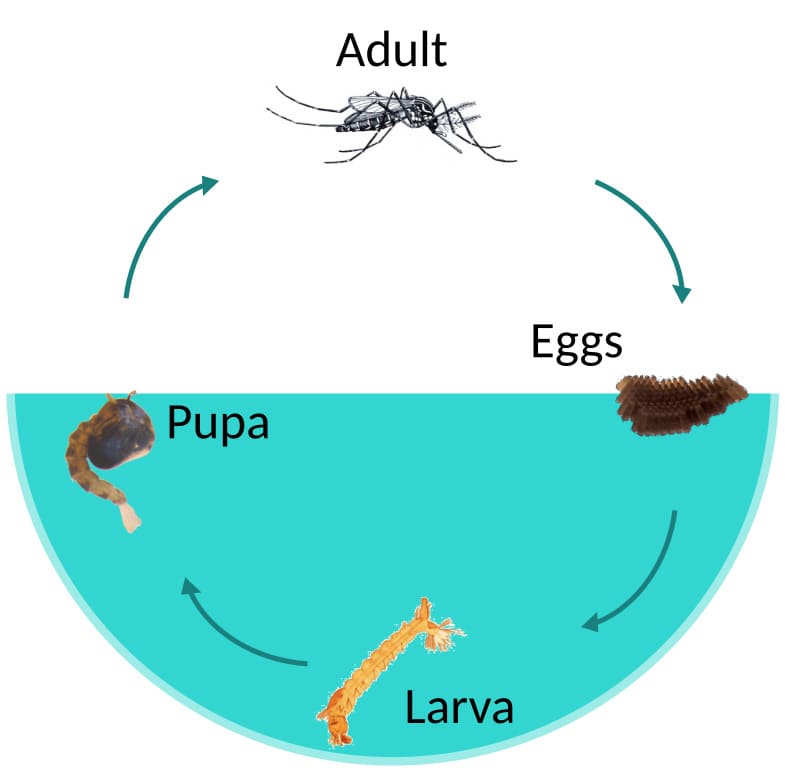
Image Credit: Wikimedia Commons by Chiswick Chap | Content License
1. Egg Stage
The life of a mosquito starts from an egg. The female mosquito lays eggs in or near water, typically around 300 eggs, either in batches called rafts, sometimes individually depending on species. The location of water body and its type, whether its a pond, or water tank, or a seepage/leakage, puddles, marsh, etc. decides the survival of these eggs.
Aedes mosquitoes, which include dengue and Zika vectors, lay eggs on moist surfaces just above the water line rather than directly on water.
Eggs typically hatch within 24–72 hours in warm conditions. The critical biological fact about Aedes eggs specifically: they can survive complete desiccation for months or even years and hatch when water returns. This is why eliminating standing water works — and why it needs to be done consistently, not just once.
2. Larva Stage
Once the eggs hatch, they enters into a larva stage. These larvae have a long, segmented body that is tapered at the end. Larvae — sometimes called wrigglers — live entirely in water, surfacing regularly to breathe through a siphon tube.
These are called as wrigglers because of their characteristic movement and behavior in water. They moves side to side and hang upward down with their tail outwards in the air from the surface of water.
This stage lasts 4 to 14 days and involves four growth phases called instars. Larvae feed on microorganisms and organic matter in the water.
The larval stage is the most vulnerable point in the mosquito’s development from a control standpoint. Larvicides — biological agents like Bacillus thuringiensis israelensis (BTI) and chemical alternatives — target this stage specifically. Disrupting the water surface with oil or agitation also kills larvae.
3. Pupa Stage
After the final molt, the larva turns into a pupa. Pupae — sometimes called tumblers — remain aquatic and mobile. In this stage, the pupa don’t feed they are enclosed in a casing, where they actually are in resting and transformation period.
At this stage they are preparing to become an adult. This pupa stage typically lasts for 1 to 4 days. Though they don’t eat, they’re still vulnerable to water surface disruption and can be controlled by removing their aquatic habitat.
Many people don’t realize that the pupa stage, despite being non-feeding, is still fully controllable through water management. Once a mosquito completes this stage and emerges as an adult, your control options narrow to repellents, traps, and sprays.
4. Adult Stage
At this stage, the final fully developed insect emerges out of the pupal casing. The adult mosquito emerges at the water surface and rests briefly while its wings dry and harden. Males form mating swarms within the first day or two. Females begin host-seeking within a few days of emergence.
At this point the mosquito is airborne, mobile, and far harder to target than during the aquatic stages. Adult lifespan from emergence is 5 days for males, 2–8 weeks for females. This is when biting, disease transmission, and egg production all occur.
Average Lifespan of a Mosquito (Male and Female)
The life span of an adult mosquito depends on many factors – species, sex (male or female), temperature, humidity, access to food, etc. which has been distinguished in detail below:
- Male mosquitoes: Male mosquitoes don’t depends on bloodmeals. They feed only on plant juices, sap and nectar from flowers. Their main purpose is mating and allowing female mosquitoes to reproduce. After mating season, once they are done with their reproductive role, they soon die. The lifespan of male mosquitoes last for 1 to 2 weeks.
- Female mosquitoes: They need blood meals to get energy for developing and laying eggs. They are potentially more active in seeking hosts for blood, and thus live longer than males. After mating, they lay multiple batches of eggs and have multiple blood meals, during their lifetime. Thus, they typically lives around 30 days or even more under favorable conditions.
Factors That Affect Mosquito Lifespan and Reproduction Rate
The two internal factors, mainly sex and species, are also responsible for their different lifespan. But since we are learning the factors that surprisingly change the lifespan of mosquitoes, we will consider the external factors. The following are the major external factors that affect the lifespan of a mosquito.
1. Temperature
Mosquitoes are cold blooded insects, and are devoid of a constant body temperature, it means that their body can’t generate heat. And so their body temperature and growth process completely depends on surrounding’s temperature.
Higher temperature can accelerate their development process and thus ultimately their lifespan gets shortened. While cooler temperatures can slow down their metabolic processes and increase their lifespan.
At optimal temperatures (25°C to 27°C or 77°F to 81°F) female mosquitoes can survive for about a month whereas in warmer temperatures (above 30°C or 86°F), the female mosquito’s lifespan is reduced significantly which is a consequence of their fast growth rate.
2. Humidity
Humidity is one of the major requirements for their growth and survival. The population of mosquitoes tends to be higher in areas with high moisture levels because water loss by evaporation is minimized and their needs are met. In regions with low rainfall, the lifespan of mosquitoes is considerably shorter because they are unable to find means of rehydration and subsequently die from dehydration.
3. Stagnant Water
Still water is very much important for laying eggs. But if there is agitation or motion within water body than the eggs can’t survive. After mating, female mosquitoes must lay eggs and if they don’t get water they will die soon. Even after getting water as required for their survival, the mosquito density decides their lifespan as there may be limited resources like organic matter to feed larvae. And many larvae may don’t survive due to lack of food in water.
4. Predators
Natural mosquito predators like mosquitofish, goldfish, purple martin, bluebirds, wrens, dragonflies, spiders, bats, etc. eat mosquitoes and their larvae. These predators specially the mosquitofish are the most effective in controlling mosquito populations.
Many mosquito control programs and strategies make use of certain predators to control mosquitoes population. In environments and surroundings where these predators are large in population, the mosquitoes may have a shorter lifespan.
5. Availability of food
Female mosquitoes needs blood meals to support the developing eggs, while the male mosquitoes as well as female ones can survive on nectar and plant sources, but this will affect their lifespan differently. As female mosquitoes needs blood to reproduce and if they fail to get blood, they will end up consuming feeding on nectar which will give them a shorter lifespan as those of male mosquitoes.
6. Mosquito control measures by humans
Humans take number of actions to get rid of mosquitoes. Many activities involves use of mosquito nets, mosquito traps, use of insecticides, use of mosquito repellents, etc. Such similar activities can drastically affect the lifespan of mosquitoes, by restricting them away from food sources, by starving them or killing them.
Using chlorine or certain larvicides, in water bodies can kill the eggs and larvae, thus reducing their population. While using insecticidal spray in surrounding can reduce the adult mosquito population in that region thereby considerably affecting their lifespan.
After mating, female mosquitoes seeks hosts for blood meals to nourish their developing eggs. This process of finding hosts and biting them for blood meals, exposes them to various risks and so they endanger their lives in order to lay eggs. They are most likely killed or repelled by these repellents and traps. The most successful female mosquitoes obtain blood meal and lay their eggs and live longer.
Table 3: Environmental Factors and Their Effect on Mosquito Lifespan and Population
| Factor | Effect on Lifespan | Effect on Reproduction Speed | Control Implication |
|---|---|---|---|
| High temperature (30°C+) | Shortens lifespan slightly — metabolic burnout | Dramatically accelerates — egg to adult in 7–10 days | Summer = population explosions despite individual short lives |
| Moderate temperature (20–27°C) | Optimal — females survive longest | Standard 14–21 day cycle | Peak season conditions — sustained large populations |
| Cold temperature (<10°C) | Adults die or enter dormancy; eggs survive | Halted — no development below threshold | Winter pause — eggs overwinter and hatch in spring |
| High humidity | Extends adult lifespan — reduces desiccation | Supports faster larval development | Tropical and monsoon climates sustain year-round populations |
| Standing water availability | No direct effect on adult lifespan | Critical — removes breeding sites and breaks lifecycle entirely | Most impactful single control measure available |
| Predators (birds, dragonflies, bats) | Directly reduces adult and larval survival | Reduces egg-laying success per female | Ecological control — supports natural population balance |
| Indoor environment | Extends lifespan — no weather, few predators | Slower — less optimal temperature and humidity usually | Indoor mosquitoes bite longer and more persistently than outdoor ones |
Control implications are based on integrated vector management principles from WHO and CDC guidelines. Temperature data reflects research on Aedes aegypti and Culex pipiens — the most studied species globally.
Temperature is the single most powerful environmental variable. A 10-degree temperature increase can cut the egg-to-adult development time almost in half. This is why mosquito seasons have been expanding — not because individual mosquitoes are living longer, but because warmer temperatures are extending the window during which they can breed and develop.
Indoor environments are particularly worth understanding. A mosquito that gets inside your home encounters no predators, stable temperature, reliable humidity, and usually a resting blood-meal host. Indoor females frequently outlive their outdoor counterparts by weeks. That’s why the mosquito buzzing around your bedroom at 2am seems so persistent — it may genuinely be the same individual returning night after night.
Common Mosquito Species and Their Life Span Variations
The 3 common mosquito species that spreads or transmits major vector borne diseases in humans, are:
1. Aedes Mosquitoes
The Aedes mosquitoes typically have a lifespan of around 2 to 3 weeks. They are mainly found in tropical and sub tropical regions where temperature throughout the year remains warm. These are even active at day time, and bites aggressively. These Aedes mosquitoes are responsible for spreading many dreadful diseases like chikungunya, dengue, zika, and yellow fever.
2. Anopheles Mosquitoes
The average life cycle of the Anopheles mosquito is averaged to be about two weeks. But this duration may be extended as the weather drops or cools down. These are crepuscular in nature, i.e., they are generally active from evening to sunrise. This Anopheles mosquito causes malaria which is the most widespread mosquito-borne disease across the globe. They are the primary vectors for malaria.
3. Culex Mosquitoes
Life span of Culex mosquitoes usually varies between 2 weeks and 1 month, Mostly found in more temperate cold zones, this Culex mosquitoes are more active during night. They carry pathogens responsible for West Nile virus, Lymphatic filiariasis and Japanese encephalitis.
Impact of Mosquito Lifespan on Transmission of Diseases
The transmission of most diseases is dependent on a mosquito’s life span. For any mosquito that lives for a longer period, there will always be more time to get other hosts and spread the infection and virus. But there are certain diseases, which do require an incubation period, within the mosquito, before they can be disseminated to other hosts.
1. Incubation Period
Many mosquito borne-diseases like Malaria, Dengue and Zika require an incubation period within the mosquito. After biting the infected host, the mosquito develops pathogens inside their body, this is required; than only the mosquito can transmit disease on next bite to another non-infected host. This incubation period can vary from few days to over a week, depending on the disease and environmental conditions.
If the mosquito may not able to survive or dies due to any reason, maybe due to starvation or due to human interventions like insecticides, traps, nets, natural repellents, smoke fire pits, etc. Because of which mosquito bearing the disease pathogens dies off before it bites and transmits the disease.
So, if the mosquito does not lives long enough to complete the incubation period, it may not be able to transmit the disease. On the other hand, if the incubation period is very small, than it will get sufficient time for more bites and transmit disease at a higher rate.
2. Multiple Opportunities to Bite
If the mosquito gets an opportunity to bite multiple times it will transmit diseases to higher number of hosts. If there is not much biting opportunity like consistent use of repellents, using mosquito nets and traps that keep mosquitoes away, burning coffee grounds, use of firepits, citronella candles, using Pine Sol at homes, Camphor mosquito repellent, etc. — mosquitoes will seek other areas.
Any of these attempts can keep mosquitoes away for a considerable time and thus humans can escape mosquito bites. And so the number of biting events remains lower, as a result the rate of transmission of diseases is very slow.
3. Disease Control Interventions
As we know that incubation period and opportunity for multiple bites, both can directly affects the rate of transmission of diseases. Now, if stringent control measures and effective mosquito control programs from public health departments are followed than their population will be reduced to larger extent. As a result their lifespan will be very much shorter, and so their ability to transfer the disease can be reduced to a minimum.
How Many Times Can a Mosquito Bite in Its Lifetime?
There’s no hard limit. A female mosquito’s biting behavior follows her reproductive cycle — blood meal, egg development (2–3 days), egg laying, then host-seeking again. This cycle repeats as many times as her lifespan allows.
Under typical conditions, a female lives long enough to complete three to five gonotrophic cycles — meaning she can take three to five blood meals and lay three to five batches of eggs. That’s potentially 500 to 1000 eggs from one mosquito, and up to five separate biting events during her life.
In practice, most mosquitoes don’t survive to complete all their potential cycles due to predation and weather. But the biology supports it — the mosquito that bit you last Tuesday may bite you again this weekend.
How Long Do Mosquitoes Live Indoors vs Outdoors?
- Outdoors: Female mosquitoes in typical outdoor environments face predators, weather variability, and reduced resting opportunities. Average real-world adult lifespan outdoors is often closer to 2–3 weeks rather than the maximum 8 weeks, even for species capable of longer survival.
- Indoors: A mosquito that enters a home encounters almost none of these mortality factors. Stable temperature, no predators, available blood meal hosts, and shelter from wind and rain all extend survival. Indoor mosquitoes commonly outlive outdoor counterparts by weeks. In some documented cases, female mosquitoes have survived up to two months in sheltered indoor conditions.
This explains a pattern many people notice — that a single mosquito in the bedroom seems to persist for an unreasonably long time. It’s not replacing itself. It’s the same insect, surviving longer than it would have in the garden.
Seasonal Lifespan and Population Differences
1. Summer
Peak season for mosquito activity, biting, and reproduction. Warm temperatures accelerate development, shorten the egg-to-adult cycle, and allow rapid population growth. Adult lifespan is actually slightly shorter in peak heat due to metabolic stress — but population size is vastly larger due to accelerated breeding.
2. Spring and Fall
Cooler temperatures slow development and extend adult lifespan slightly. Population growth is slower but individual mosquitoes may live longer. These transitional seasons are when control efforts have the greatest impact per action taken.
3. Winter
In temperate climates, adult mosquitoes die with the first sustained cold. But the species doesn’t disappear — Aedes eggs survive in soil through winter and hatch with spring rains. Some Culex and Anopheles species overwinter as adult females in sheltered locations like basements, hollow trees, and animal burrows. They re-emerge in spring and immediately begin the next season’s population.
What Mosquito Lifespan Means for Effective Control
Understanding the lifecycle fundamentally changes how you should approach mosquito control. Most people focus entirely on adult mosquitoes — sprays, zappers, swatting. These address the symptom, not the source.
✔ Remove standing water — the highest-impact single action. Any container holding water for more than 72 hours is a potential breeding site. Flower pot saucers, bird baths, clogged gutters, old tires, tarpaulin puddles — all of these. Empty them or treat them.
✔ Target the larval stage — BTI-based larvicide products (like Mosquito Dunks) kill larvae without harming birds, fish, or pets. Treat water features, rain barrels, and any water you can’t eliminate.
✔ Use repellents for adults — DEET and picaridin protect you personally during peak hours. They do not reduce the population but they break the blood-feeding cycle for that female.
✔ Time your outdoor activity — Avoiding dawn and dusk reduces exposure to peak biting windows without any chemical intervention.
✔ Think in cycles, not individuals — Killing adult mosquitoes without addressing breeding sites is like bailing a boat without plugging the hole. The population regenerates within days.
Common Mosquito Lifespan Myths — Corrected
❌ Mosquitoes live for months everywhere — False. Most outdoor adults live 2–3 weeks. Only sheltered indoor females approach 2 months.
❌ They die after biting — False. Completely. They bite multiple times across their reproductive lifecycle.
❌ Killing adult mosquitoes solves the problem — Insufficient. Without targeting breeding sites, the population replenishes itself within a single development cycle.
❌ Mosquitoes disappear in cold weather permanently — False. Eggs overwinter and adults of some species hibernate. The species persists through winter.
❌ One mosquito doesn’t matter — Misleading. One female can produce hundreds of offspring across her lifespan.
Conclusion: Mosquito Lifespan and What Really Matters
The mosquito lifespan is short. Males live less than two weeks. Females live 2 to 8 weeks at most. But the lifecycle is fast, continuous, and self-reinforcing — and that’s what makes mosquitoes feel permanent despite their brief individual existence.
A female mosquito that escapes your swatter today may lay 200 eggs tomorrow, producing a new generation of biting adults within 10 days. That cycle repeats constantly, across overlapping generations, as long as standing water and warm temperatures exist within her range.
The practical solution: If you want fewer mosquitoes, focus on where they breed, not just on the ones you can see. Remove standing water. Treat what you can’t remove. Use repellents during high-exposure periods. Think about the lifecycle, not just the lifespan.
It’s not how long mosquitoes live — it’s how fast they multiply.
Frequently Asked Questions (FAQs)
Q. What is the average life span of a mosquito?
A male mosquito’s life span lasts one to two weeks while females can live for about 30 days if conditions are favorable which again varies as per the context, these include the environment, geographical locations, food availability, species etc.
Q. What is the lifespan of mosquito larvae?
The eggs after hatching, transforms into larvae. These larvae undergoes multiple molting process to transform into pupae. These multiple molting process takes around 4 to 10 days, sometimes up to 14 days. Thus mosquito larvae has a lifespan of around 4 to 14 days. Again depending on environmental conditions, where the warmer temperatures may accelerate their growth.
Q. Can mosquito live longer in indoors than outdoors?
Yes, mosquito can live longer in indoors as there is a stable environment, with consistent temperature and humidity and without any predator. There are leakages, spilled waters and wet floors, around that provides sufficient moisture and humid climate favorable for their growth and houseplants, pets and humans for blood meals. This are the most desirable conditions for mosquitoes, so they live longer in indoors
Q. What happens to mosquitoes in winter?
Many mosquito species have the ability to go dormant (state of hibernation) and during this their growth is paused. And once the winter passed they again come out. Other mosquitoes get die off after laying eggs, and once the favorable conditions are met in spring season, the eggs starts hatching.
Q. Do male mosquitoes live as long as females?
No. Male mosquitoes live only for 1 to 2 weeks. While female mosquitoes have to reproduce and lay eggs for which they need blood meals, so female mosquitoes typically leaves around 30 days or more.
Q. How does temperature affects mosquito’s life span?
Warmer temperatures accelerate their growth process and so the eggs hatch and develops into adult mosquitoes in a shorter span of time. And so their overall life span is shorter in warmer temperatures.
In colder temperatures their growth process gets slowed down and so their lifespan is longer.
Editorial Team & Contributors

Raashid Ansari, Founder, Content Researcher & Author - MosquiTalk
Not an entomologist — just a genuinely curious writer who started researching mosquitoes and couldn't stop. What began as casual reading about repellents and bite prevention gradually turned into a deep ongoing dive into vector biology, disease epidemiology, animal health impacts, and the real science behind mosquito control. Everything published here is carefully edited, and written with one purpose: giving readers accurate, accessible information they can actually trust and use to protect themselves, their families, and their pets, birds and cattle.
Active across social platforms, regularly publishes, and genuinely invested in spreading mosquito awareness where it matters most. Because informed readers make better decisions — and better decisions save lives.