
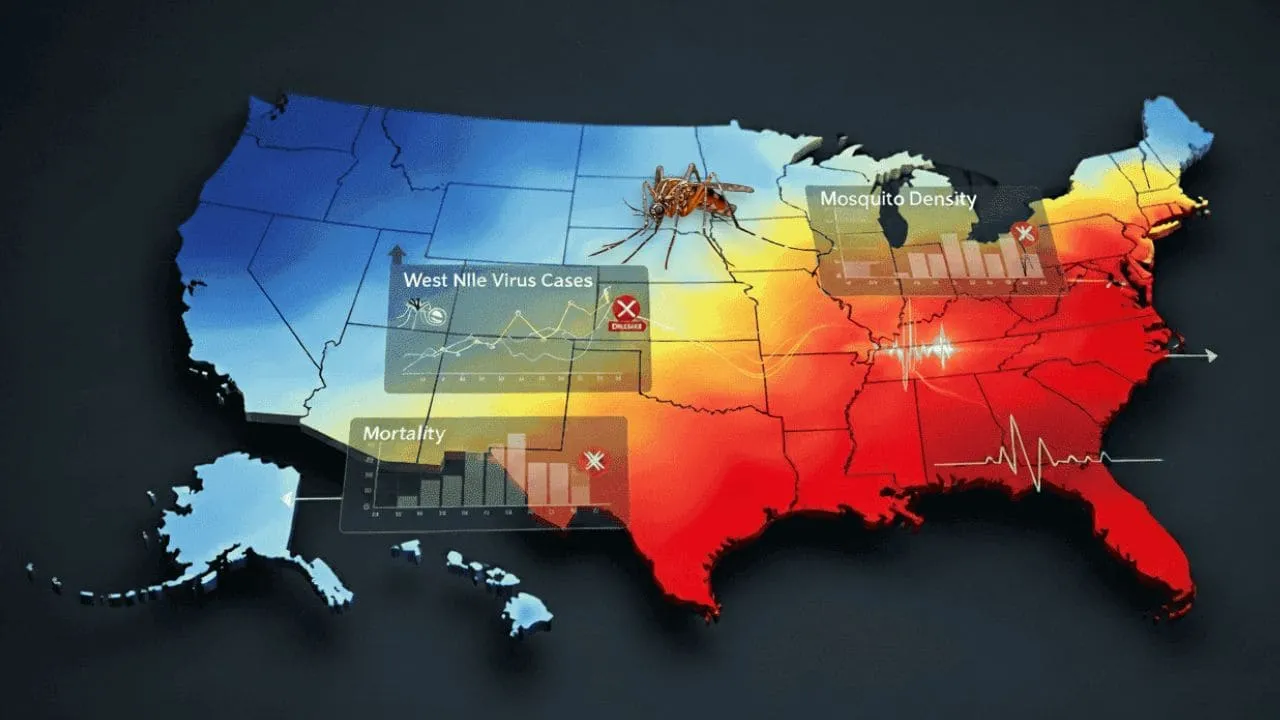
I’ve lived through a Louisiana summer. And let me tell you — the distribution of mosquitoes in the US is not something you learn from a map. You learn it from your ankles. From swatting the air while standing in your own backyard. From wondering how an insect that weighs about 2.5 milligrams can ruin a perfectly good evening.
But beyond the annoyance, mosquitoes in the US represent a genuine public health concern. They carry pathogens. They transmit disease. And in rare but real cases, they kill. This article breaks down where mosquitoes are worst in the US, where you’ll find almost none, what diseases they carry, and what the actual mortality numbers look like — no hype, just science.
Distribution of Mosquitoes in the US: A Geographic Overview
There are approximately 176 mosquito species found across the United States. That number comes from the American Mosquito Control Association (AMCA), and it’s worth sitting with for a moment. Nearly 200 species. Each with its own habitat preference, biting behavior, and disease vector potential.
Mosquito distribution in the US tracks closely with three environmental variables:
- temperature,
- standing water availability, and
- humidity
This is why the Southeast dominates every worst-states ranking you’ve ever seen. The Gulf Coast states — Florida, Louisiana, Texas, Alabama, Mississippi — offer warm temperatures for most of the year, regular rainfall, and wetlands or coastal marshes that create ideal breeding habitat.
But the distribution extends further than people think. Mosquitoes are present in every single US state, including Alaska. Yes, Alaska. During summer months, the tundra thaws and creates shallow standing water across vast areas, producing mosquito swarms that entomologists describe as among the densest in North America. The species are different — primarily Aedes and Culiseta — and the season is short, but the density is staggering.
Mosquito Activity by Region
Here’s a rough regional breakdown of mosquito activity and peak season:
| Region | Peak Season | Key Species | Activity Level |
|---|---|---|---|
| Gulf Coast / Southeast | March – November | Aedes aegypti, Cx. quinquefasciatus | Extreme |
| Mid-Atlantic / Northeast | May – September | Aedes albopictus, Culex pipiens | High |
| Midwest | June – August | Culex pipiens, Aedes vexans | Moderate–High |
| Pacific Northwest | June – September | Culex pipiens, Aedes spp. | Moderate |
| Southwest / Desert | July – October (monsoon) | Aedes aegypti, Culex tarsalis | Moderate |
| Mountain West | July – August | Aedes vexans, Culex tarsalis | Low–Moderate |
| Alaska / Arctic | June – July | Aedes punctor, Culiseta spp. | Extreme (brief) |
The Worst States for Mosquitoes in the US
Multiple indices rank mosquito pressure by state — the Mosquito Control Association data, pest control company treatment records, and academic entomology surveys all point to the same cluster at the top.
Top 10 Worst States for Mosquitoes in United States
| Rank | State | Why It’s Bad |
|---|---|---|
| 1 | Florida | Year-round warmth, coastal wetlands, 80+ species present, subtropical climate |
| 2 | Louisiana | Bayous, high humidity, standing water everywhere — legendary mosquito pressure |
| 3 | Texas | Massive geographic diversity; Houston and Gulf Coast areas especially severe |
| 4 | Mississippi | Hot, humid, poorly drained landscapes; high Culex and Aedes activity |
| 5 | Alabama | Gulf access, wetlands, warm springs through late fall |
| 6 | Georgia | Coastal plains and piedmont wetlands; Atlanta suburbs included |
| 7 | South Carolina | Low-country marshes; aggressive Aedes albopictus populations |
| 8 | North Carolina | Coastal areas and piedmont; strong Culex population vectors for WNV |
| 9 | Arkansas | River lowlands, rice fields, extensive standing water after rains |
| 10 | Missouri | Mississippi River floodplain; Culex density drives West Nile concerns |
Florida is consistently at the top. As a homeowner who spent two years near Tampa, I can confirm that even in January you’re not fully safe. The species active in Florida include Aedes aegypti (dengue, Zika, chikungunya vector), Culex quinquefasciatus (West Nile, St. Louis encephalitis vector), and the salt marsh species Aedes taeniorhynchus — which bites aggressively and in enormous numbers after tidal floods.
Louisiana deserves special mention. Historically, New Orleans had some of the worst yellow fever outbreaks in US history — all mosquito-transmitted. The infrastructure has improved dramatically, but the ecological conditions haven’t changed. During summer, parts of the bayou region have mosquito densities that entomologists measure in thousands per trap per night.
Where Are There No Mosquitoes in the US — and Where Has the Least
Complete absence of mosquitoes in any US state is essentially a myth. But some places come close enough that it matters practically.
States and Areas in US with the Fewest Mosquitoes
The driest, highest, coldest parts of the continental US have the lowest mosquito pressure. That means:
- Nevada — particularly Las Vegas and the Mojave Desert. Extremely arid, minimal standing water outside irrigated areas. Some Culex activity near the Colorado River corridor but overall very low density.
- Arizona — Phoenix metro is surprisingly low-pressure outside of monsoon season (July–September), when standing water briefly accumulates.
- Wyoming and Montana — high altitude, cold winters, short summers. Not zero mosquitoes, but meaningfully fewer. The wind also helps.
- Utah — especially southern Utah near the canyon country. The combination of altitude, aridity, and sparse vegetation reduces breeding habitat.
- New Mexico — similar to Arizona. High desert conditions outside the Rio Grande valley.
Some pest control firms rank Hawaii favorably for low mosquito exposure — and that’s partially true for certain islands and elevations. But Hawaii actually has significant Aedes albopictus presence and has experienced dengue outbreaks. The mix of tourism and ecological sensitivity makes this complicated.
If you’re specifically looking for where in the US there are essentially no mosquitoes: high-altitude towns in the Rockies above 8,000 feet during the shoulder season (spring and fall) come closest. At that elevation, temperatures drop below the 50°F threshold that limits mosquito flight, and standing water freezes quickly.
What Diseases Do Mosquitoes Carry in the US?
This is where the conversation shifts from annoyance to serious public health. Mosquitoes in the US are active vectors for several viral and parasitic diseases — some rare, some increasingly common.
Primary Mosquito-Borne Diseases in the United States
| Disease | Mosquito Vector | US Distribution | Severity |
|---|---|---|---|
| West Nile Virus (WNV) | Culex species (mainly Cx. pipiens, Cx. tarsalis) | All 48 contiguous states | Mild to fatal (neuroinvasive) |
| Eastern Equine Encephalitis (EEE) | Culiseta melanura, Aedes spp. | Eastern US, Gulf Coast | High fatality (~30%) |
| St. Louis Encephalitis (SLE) | Culex quinquefasciatus, Cx. pipiens | Southeast, Midwest | Moderate; severe in elderly |
| La Crosse Encephalitis (LAC) | Aedes triseriatus | Midwest, Appalachia | Primarily affects children |
| Dengue Fever | Aedes aegypti, Ae. albopictus | Florida, Texas, Hawaii, territories | Moderate to severe |
| Zika Virus | Aedes aegypti, Ae. albopictus | Florida, Texas (sporadic) | Severe in pregnancy (microcephaly) |
| Chikungunya | Aedes aegypti, Ae. albopictus | Florida, Texas (sporadic) | Severe joint pain, rarely fatal |
| Malaria | Anopheles species | Mostly travel-associated; rare local TX, FL, MD cases | Potentially fatal if untreated |
West Nile Virus is by far the most widespread mosquito-borne disease in the US right now. The CDC has tracked human WNV cases in every continental state. Most people infected — roughly 80% — experience no symptoms. But about 1 in 150 infected individuals develops neuroinvasive disease: encephalitis, meningitis, or acute flaccid paralysis. This form can be fatal, especially in adults over 60.
Eastern Equine Encephalitis (EEE) is rarer but brutally severe. The CDC reports a case fatality rate of approximately 30%, and many survivors have permanent neurological damage. Cases are concentrated in freshwater hardwood swamp habitats along the Atlantic Coast and Gulf Coast. There’s no approved vaccine for humans.
Dengue deserves more attention than it currently gets in American media. Local transmission — meaning caught from a mosquito in the US, not while traveling — has been documented in Florida and Texas with increasing frequency. The 2023 Florida dengue outbreak involved dozens of locally acquired cases. As Aedes aegypti range expands northward with warming temperatures, this is not a static risk.
How Many People Die from Mosquitoes in the US Each Year?
This question has a complicated answer, and I want to give you the honest version rather than alarming numbers pulled out of context.
Globally, mosquitoes kill an estimated 725,000 to 1 million people per year — primarily through malaria in sub-Saharan Africa. The United States is not that situation. We have vector control infrastructure, healthcare access, and a different disease profile. But mosquito-related deaths in the US are real.
US Mosquito-Related Mortality by Disease
- West Nile Virus: The CDC reports an average of 100–200 deaths per year from WNV in the US, with peak years considerably higher. In 2012 — one of the worst outbreak years on record — there were 286 WNV-related deaths. From 1999 to 2023, WNV killed more than 2,500 Americans.
- Eastern Equine Encephalitis: Fewer cases but higher mortality. Typically 4–15 deaths per year. In 2019, an unusually severe outbreak caused 38 human cases and 15 deaths across 10 states.
- La Crosse Encephalitis: Fewer than 5 deaths per year on average, primarily in children in the Appalachian region.
- Dengue, Zika, Chikungunya: Fatalities from locally acquired cases are rare in the continental US. Most severe outcomes are in returning travelers or in US territories (Puerto Rico, USVI).
So how many people die from mosquitoes in the US each year? A defensible estimate, combining all mosquito-borne diseases, is approximately 150–200 deaths annually in recent years, dominated by West Nile Virus fatalities. That number does not include deaths in US territories, where dengue causes additional mortality.
To put that in perspective: bee and wasp stings kill roughly 60–70 Americans per year. Dog bites, about 30–50. Mosquitoes, through the diseases they transmit, are significantly more lethal than most people realize within the domestic context.
(recent years)
(2012 outbreak)
(1999–2023)
rate (avg.)
How Many Mosquitoes Are There in the US?
No one has counted. The honest answer is that estimating mosquito populations is methodologically nightmarish — populations fluctuate with rainfall, temperature, and land use on a weekly basis. Surveillance programs like those run by county vector control districts use standardized CO₂ traps to track local density trends, but national aggregation doesn’t happen in any meaningful way.
What we do know from entomological field surveys and population modeling:
- 176+ species are present across the US, with regional species assemblages varying by latitude and humidity.
- A single female Culex mosquito can lay 100–300 eggs per batch, and complete development from egg to adult in as little as 7–10 days under warm conditions.
- In high-density coastal marsh habitats — Louisiana, Florida, the Chesapeake Bay area — trap counts of several thousand mosquitoes per night per trap are not unusual during peak season.
- A single acre of salt marsh can produce several million mosquitoes over the course of a breeding season.
Nationally? We’re almost certainly talking about hundreds of billions of individuals at peak summer, across all species combined. That’s not a precise number, and anyone who gives you one is guessing.
Are Mosquitoes Dangerous in the US — The Real Answer
Yes, but with context.
The risk profile for the average American adult is real but relatively low compared to tropical disease-endemic regions. Most mosquito bites in the US result in itching and localized inflammation — nothing more. The disease risk exists on a spectrum, and it’s shaped by geography, time of year, species present, and individual vulnerability.
Mosquitoes in the US: Who Is Most at Risk
- Older adults (65+): At elevated risk for severe West Nile neuroinvasive disease. This is the demographic that accounts for the largest share of WNV fatalities.
- Immunocompromised individuals: HIV, organ transplant recipients, and those on immunosuppressive therapies face higher risk of severe outcomes from WNV and other arboviruses.
- Pregnant women: Zika virus, even from limited local transmission areas, carries serious fetal risk. The risk of teratogenic outcomes from Zika makes this a legitimate concern for pregnant individuals in Florida and South Texas.
- Children in endemic areas: La Crosse Encephalitis disproportionately affects children under 16 in Appalachian and upper Midwest regions.
- Outdoor workers and residents in high-density mosquito states: Simply higher cumulative exposure, higher statistical risk.
The practical danger is real. Public health agencies recommend DEET-based or picaridin-based repellents, wearing long sleeves during peak biting hours (dusk and dawn), and eliminating standing water around the home. These aren’t just suggestions — they’re backed by decades of vector control evidence.
Practical Mosquito Control Tips (Evidence-Based)
- EPA-registered repellents containing DEET (20–30%), picaridin, or IR3535 are the most effective for skin application.
- Permethrin-treated clothing provides significant bite reduction — studies show 73–99% reduction in landings.
- Eliminate standing water: birdbaths, clogged gutters, tarps, planters, and water-collecting containers are primary larval habitat.
- In high-risk areas, larviciding with Bacillus thuringiensis israelensis (BTI) in standing water is safe and effective — approved for organic use.
- Screens on windows and doors: simple, effective, underutilized.
- Consider local mosquito abatement district services if you’re in a high-risk zone — many counties provide free larval inspections.
Conclusion About Mosquitoes in the US
The distribution of mosquitoes in the US is not uniform, and understanding where mosquitoes are worst — and why — matters for anyone making decisions about where to live, travel, or spend time outdoors. The worst states for mosquitoes in the US are concentrated in the Southeast, led by Florida and Louisiana, where ecology and climate combine to create near-ideal breeding conditions.
Completely escaping mosquitoes in the US is unlikely unless you’re in the high desert or at elevation in the Rockies. But understanding the landscape helps. The diseases mosquitoes carry in the US — particularly West Nile Virus and EEE — are real threats, not abstractions. Roughly 150–200 Americans die from mosquito-transmitted diseases each year. That number is small relative to global mosquito mortality, but it’s not zero, and it’s not trivial for the families affected.
The science of vector control has given us real tools. Use them. Know your region’s species. Pay attention to local health department advisories during peak season. And take the precautions seriously — not out of fear, but out of informed respect for what these insects are actually capable of.
Editorial Team & Contributors

Raashid Ansari, Founder, Content Researcher & Author - MosquiTalk
Not an entomologist — just a genuinely curious writer who started researching mosquitoes and couldn't stop. What began as casual reading about repellents and bite prevention gradually turned into a deep ongoing dive into vector biology, disease epidemiology, animal health impacts, and the real science behind mosquito control. Everything published here is carefully edited, and written with one purpose: giving readers accurate, accessible information they can actually trust and use to protect themselves, their families, and their pets, birds and cattle.
Active across social platforms, regularly publishes, and genuinely invested in spreading mosquito awareness where it matters most. Because informed readers make better decisions — and better decisions save lives.