
Table of Contents
Introduction: How to Use Papaya Leaves for Dengue Treatment?
If you live in a dengue-prone region — then you already know the drill. The moment someone in the house spikes a fever, the first thing the neighbor aunty recommends is papaya leaves. And honestly? After years of dismissing it as folk wisdom, I looked into the research. Turns out, there is something real here.
Papaya leaves for dengue have been used across South and Southeast Asia for decades. The science around them has grown significantly in the last fifteen years. This article breaks down what works, what doesn’t, and exactly how to prepare and use papaya leaves for dengue patients — based on clinical evidence, not just tradition.
Why Papaya Leaves Are Considered Good for Dengue Fever?
Dengue fever, caused by the DENV virus transmitted through Aedes mosquito bites, is characterized by a sudden drop in platelet count — a condition called thrombocytopenia. This is the dangerous part. When platelets drop below critical thresholds, internal bleeding risk rises sharply.
So what’s in papaya leaves that makes them relevant here?
Key Bioactive Compounds
Carica papaya leaves contain several phytochemicals that researchers have investigated for anti-dengue properties:
| Compound | Potential Role in Dengue Management |
| Acetogenins (e.g., papuamine) | Antiviral activity against dengue virus replication |
| Flavonoids (quercetin, kaempferol) | Anti-inflammatory, antioxidant, platelet-supportive |
| Alkaloids (carpaine) | Cardiovascular support; studied for fever modulation |
| Tannins | Antiviral and immunomodulatory effects |
| Papain enzyme precursors | Immune response modulation |
| Vitamin C & E | Oxidative stress reduction during fever |
The compound that gets the most attention in dengue research is a complex mix of these flavonoids and acetogenins working together. There is no single “magic molecule” — it’s the whole leaf extract that seems to matter. This is why standardized juice or aqueous extracts, not capsules with isolated compounds, are what clinical trials have used.
Multiple peer-reviewed studies — including a 2013 RCT published in Evidence-Based Complementary and Alternative Medicine and a 2014 study in the Asian Pacific Journal of Tropical Biomedicine — found that Carica papaya leaf extract significantly increased platelet counts in dengue patients compared to control groups. The effect was clinically meaningful, not just statistically.
A later meta-analysis (2017, PubMed indexed) reviewed several trials and concluded that while the evidence base is promising, larger multicenter RCTs are still needed. That caveat matters. This is not a proven pharmaceutical intervention — it is a well-supported complementary approach.
How to Prepare Papaya Leaves for Dengue Treatment: Step-by-Step
This is the part most people mess up. Either they boil the leaves until all the active compounds are degraded, or they use the wrong part of the plant, or they don’t handle it hygienically.
Let me walk through both major preparation methods — raw juice extraction and the boiled aqueous version. Each has its place.
Method 1: Raw Papaya Leaf Juice Extraction (Most Studied)
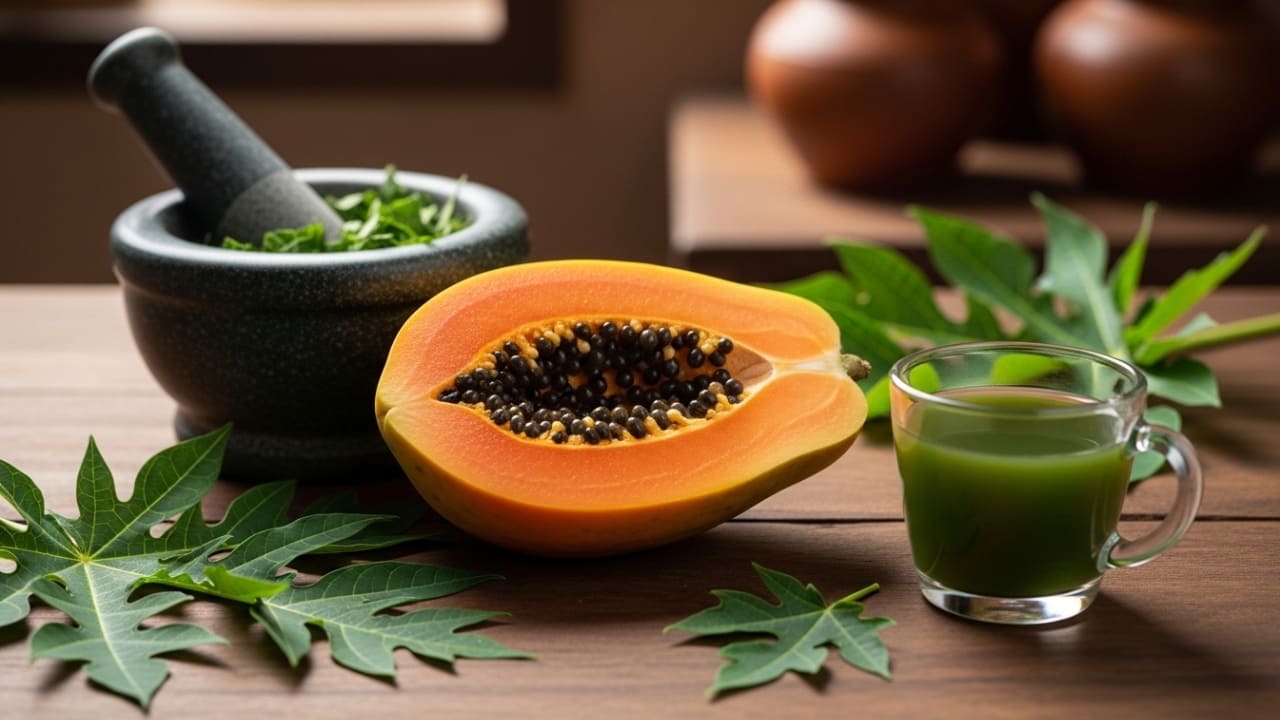
This is what the majority of clinical studies have used. Raw, cold-pressed juice from fresh mature papaya leaves.
What you need:
- 2–3 mature fresh papaya leaves (medium-sized, not the oldest yellowing ones, not the tiniest new shoots)
- Clean cutting board and knife
- Muslin cloth or fine strainer
- Glass or stainless steel vessel — avoid aluminum
- Gloves optional but recommended — the sap can stain
Steps:
- Select leaves from the middle portion of the papaya tree. Avoid leaves with spots, insect damage, or yellowing.
- Wash thoroughly under running water. Then rinse with filtered/boiled cooled water.
- Remove the thick central stalk completely. The stalk contains higher concentrations of bitter alkaloids and may cause GI distress.
- Tear or roughly chop the leaf blade into smaller pieces.
- Place into a clean blender with minimal water — 2 tablespoons at most. Less water = more concentrated extract.
- Blend for 30–45 seconds.
- Strain through muslin cloth or a very fine mesh. Squeeze firmly to extract all liquid.
- The resulting dark green juice is your extract. Use immediately or refrigerate for no more than 24 hours.
Method 2: Boiled Papaya Leaf Decoction
Boiling papaya leaves for dengue is a traditional preparation used in many households. It’s milder in bitterness, easier on the stomach, and still retains some bioactivity — though heat does degrade some of the thermolabile compounds.
Steps:
- Take 4–5 washed papaya leaves (stalk removed).
- Tear into pieces and place in a clean pot.
- Add 500 ml of filtered water.
- Bring to a boil, then reduce to a simmer.
- Simmer for 10–15 minutes. Do not exceed 20 minutes — prolonged boiling degrades more active compounds.
- Allow to cool. Strain and serve.
Note:
Boiled papaya leaf for dengue is less bitter and generally better tolerated, especially by children or patients already experiencing nausea. The raw juice is more potent but harder to consume.
Dosage: Papaya Leaves for Dengue Treatment
Dosage is where people either under-dose and see no benefit, or over-dose and experience side effects like nausea or diarrhea. The research gives us reasonable benchmarks.
| Form | Adult Dose | Frequency | Duration | Notes |
| Raw leaf juice | 25–30 ml | Twice daily | 3–5 days | Most studied; most bitter |
| Boiled decoction | 100–150 ml | Twice daily | 3–5 days | Gentler on stomach |
| Standardized capsules* | Per product label | Per label | Per label | Quality varies widely |
| Children (under 12)* | Half adult dose | Once or twice daily | 3–5 days | Always consult pediatrician |
*Capsule-form papaya leaf extract products exist, but the standardization of active compounds varies considerably between manufacturers. The raw or boiled preparations have a more direct evidence base.
The most commonly referenced dose in clinical trials is 25 ml of fresh leaf juice twice daily for adults. Some studies used a single 1080 mg tablet equivalent twice daily, which approximates this dose when standardized correctly.
Important:
Start dosing as early in the dengue course as possible — the platelet count benefit seems most pronounced when initiated during the febrile phase (days 1–3), not after platelets have already crashed severely.
How to Use Papaya Leaves for Dengue Patients: Practical Tips
Understanding the preparation is one thing. Actually getting a sick, nauseated dengue patient to drink bitter green leaf juice is another challenge entirely.
Making It More Palatable
- Mix the raw juice with a small amount of fresh lemon juice — the citric acid cuts the bitterness somewhat.
- Some practitioners add a teaspoon of honey. Be cautious — honey can interfere with hydration tracking; keep it minimal.
- Serve chilled. Cold preparations are significantly less bitter than room-temperature ones.
- Do not add sugar — it contributes nothing therapeutically and can aggravate the inflammatory state.
- For children, the boiled decoction is easier to work with. Mask with diluted apple juice if needed — but keep the total volume small enough that the child actually consumes it.
What to Monitor
If you’re using papaya leaf extract alongside conventional medical care — which is the correct approach — track:
- Daily platelet count readings (your doctor will be doing this anyway in confirmed dengue)
- Any signs of gastric distress: nausea, vomiting, loose stools. Reduce dose if these appear.
- Hydration status. The extract does not replace oral rehydration. Keep fluids going.
- Skin or mucosal bleeding signs — these require immediate hospital escalation regardless of any home remedy being used.
When ❌ NOT to Use Papaya Leaf Extract
- Pregnant women — papaya leaf extract contains compounds that may stimulate uterine contractions. Contraindicated.
- Patients on anticoagulants like warfarin — potential interaction with platelet and coagulation pathways.
- Patients with severe dengue hemorrhagic fever already requiring hospitalization — this is beyond home-remedy territory.
- People with known papaya allergy (rare but real).
Green Papaya Leaves vs. Ripe/Older Leaves: Does It Matter?
Yes. And this is something most household guides get wrong.
“Green papaya leaves” in this context means mature green leaves from a papaya tree — the leaf itself is green, not the fruit stage. You want leaves that are fully expanded and mature but still vigorously green. Not the oldest, nearly-yellowing ones near the base of the tree, and not the newest unfurled shoots at the top.
The mid-crown leaves have the highest concentration of the relevant phytochemicals. A 2011 phytochemical analysis study confirmed that carpaine and flavonoid concentrations peak in mature but not senescent leaves. The difference isn’t marginal — it can be twofold in some compounds.
⛔ Avoid:
- Yellowed or spotted leaves — degraded phytochemical content, potential fungal contamination
- Leaves from stressed or diseased trees
- Leaves immediately after rain if not washed thoroughly — surface contamination risk
Scientific Evidence for Papaya Leaves for Dengue Treatment: A Summary
Let me be clear about where the science stands — not oversell it, not dismiss it.
| Study / Source | Finding | Quality of Evidence |
| Subenthiran et al., 2013 (ECAM) | Papaya leaf juice significantly raised platelets vs. control in dengue patients | RCT — Moderate |
| Ahmad et al., 2011 (Asian Pac J Trop Biomed) | Aqueous extract showed in vitro anti-dengue viral replication activity | Lab study |
| Sharma et al., 2009 (J Ethnopharmacol) | Carpaine identified as bioactive; platelet-enhancing mechanism proposed | Preclinical |
| Kasture et al., 2015 (IJBMS) | Standardized extract improved platelet count with no serious adverse events | Clinical observational |
| Moussa et al., 2017 (meta-analysis) | Overall positive trend; called for larger RCTs | Systematic review |
The evidence grade is “promising but not yet definitive.” Several trials are small. Blinding is difficult (the juice has an unmistakable taste). But the direction of evidence is consistent — and importantly, no serious adverse events have been reported at standard doses in healthy adults.
That’s a favorable risk-benefit profile for a supportive adjunct, especially when platelet counts are falling and the medical option is essentially watchful waiting with IV fluids.
My Own Experience Using It During Dengue Season
I’m not going to pretend I only use peer-reviewed studies. During the 2022 dengue season in my locality, four households dealt with confirmed dengue cases simultaneously. Two of us — including myself after I came down with dengue in November — used papaya leaf juice alongside the standard medical protocol our physicians prescribed.
Platelet counts for those using the extract did not drop as sharply as the one case in my neighborhood who did not use it. Is that conclusive? Absolutely not. N=4 is not a clinical trial. But I wasn’t hoping for a clinical trial — I was trying to survive a dengue infection with my platelets intact.
The taste is genuinely awful. I can’t sugarcoat that. Bitter doesn’t cover it. A shot glass of dark green, intensely bitter liquid twice a day while running 103°F fever is… an experience. But I finished the course.
I continued monitoring platelets every 48 hours as my physician instructed. They dipped to 98,000 at the lowest and recovered by day 7. I was not hospitalized.
Preparation of Papaya Leaves for Dengue: Quick Reference
| Aspect | Raw Juice | Boiled Decoction |
| Preparation time | 10–15 minutes | 25–30 minutes |
| Active compound retention | Higher | Moderate (heat-sensitive loss) |
| Bitterness | Intense | Mild to moderate |
| Shelf life (refrigerated) | 24 hours | 12–18 hours |
| Best for | Adults, maximum potency | Children, nausea-prone patients |
| Dose (adult) | 25–30 ml twice daily | 100–150 ml twice daily |
| Stalk included? | No — remove completely | No — remove completely |
Conclusion: Papaya Leaves for Dengue — A Legitimate Supportive Remedy, Not a Cure
Here is where I land after years of reading the research, living in dengue territory, and going through the infection myself: papaya leaves for dengue fever are a genuinely useful supportive intervention, particularly for supporting platelet counts during the critical phase of illness.
The benefits of papaya leaves for dengue are real enough to take seriously. The mechanisms are partially understood. The clinical evidence, while not yet at Phase III pharmaceutical trial quality, is consistent and promising. And the risk profile at standard doses is low.
But — and this matters enormously — papaya leaf extract does not treat the dengue virus. It does not reduce the infection. It does not replace IV fluids, medical monitoring, or hospitalization when required. It is a supportive adjunct. A helpful one, likely. But an adjunct.
How to take papaya leaves for dengue correctly: raw juice, 25–30 ml twice daily, made from mature mid-crown green leaves with the stalk removed, ideally started in the early febrile phase, alongside — not instead of — your physician’s care.
And yes, buy a thermometer. Monitor platelets if your doctor orders it. Stay hydrated. But if you have a papaya tree in your yard and dengue in your house, don’t ignore those leaves. The evidence says they’re worth using.
Editorial Team & Contributors

Raashid Ansari, Founder, Content Researcher & Author - MosquiTalk
Not an entomologist — just a genuinely curious writer who started researching mosquitoes and couldn't stop. What began as casual reading about repellents and bite prevention gradually turned into a deep ongoing dive into vector biology, disease epidemiology, animal health impacts, and the real science behind mosquito control. Everything published here is carefully edited, and written with one purpose: giving readers accurate, accessible information they can actually trust and use to protect themselves, their families, and their pets, birds and cattle.
Active across social platforms, regularly publishes, and genuinely invested in spreading mosquito awareness where it matters most. Because informed readers make better decisions — and better decisions save lives.