
Introduction
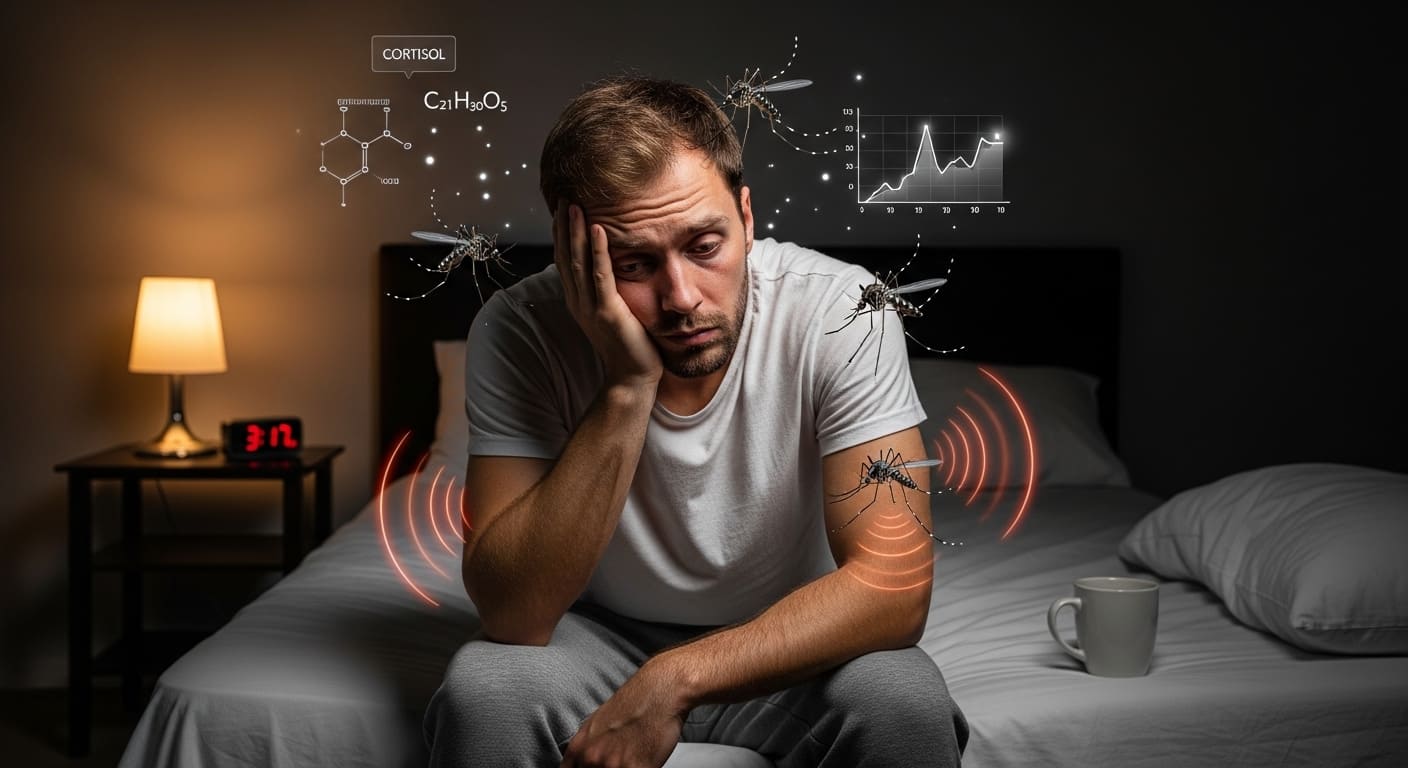
You step outside for five minutes. Everyone else seems fine. But you? You’re already slapping your arms, watching welts rise, and wondering what invisible signal your body keeps broadcasting to every mosquito in the zip code.
Here’s something most people never consider: it might not just be your blood type or the color of your shirt. It might be your stress level. Yes. It’s possible. Stress make you more attractive to mosquitoes and you will learn how it happens.
The science connecting stress hormones and mosquito attraction is newer than you’d think — and honestly, a little unsettling. Because if stress does make you more attractive to mosquitoes, that’s a loop with no obvious exit. You go outside stressed. Mosquitoes find you. You get more stressed. They find you again.
Keep reading. By the end, you’ll understand exactly what’s happening in your body — and what you can actually do about it.
Why Some People Get Bitten More Than Others?
Mosquito preference is real. Scientists have studied it for decades. Some people really do attract more bites, and it goes beyond the obvious stuff like body heat or CO₂ output.
There’s a whole cocktail of factors: skin bacteria, lactic acid, uric acid, body temperature, blood type (type O seems to attract more, for what it’s worth), even pregnancy. The variables stack up.
But one factor that’s been getting serious research attention lately? Cortisol. And related stress hormones. Turns out, what’s happening inside you emotionally may be broadcasting outward in ways mosquitoes can detect.
Stress Hormones Bring Birds, Pathogens and Mosquitoes
It sounds like a strange grouping — birds, pathogens, mosquitoes — but they’re connected by the same biochemical thread.
When animals (including humans) experience stress, they release a cascade of hormones. The most well-known is cortisol. But adrenaline, norepinephrine, and other stress-related compounds also flood the system. These hormones are detectable — in sweat, in breath, even in microscopic volatiles released through the skin.
Research in wildlife ecology has shown that stressed hosts — birds under predator pressure, for instance — experience significantly higher parasite loads. Parasites, including mosquito-borne pathogens, seem to exploit the chemical signatures of stress. A stressed host is often immunologically compromised and chemically distinct. Easy pickings, essentially.
The same principle applies to human hosts. When you’re stressed, you’re not just mentally different. You’re chemically different. And mosquitoes are extraordinarily sensitive chemical detectors.
Host Stress Hormones Alter Vector Feeding Preferences
“Vector” is the technical term for disease-carrying insects — mosquitoes, ticks, sandflies. Research into how stress hormones alter vector feeding preferences is still emerging, but the early data is striking.
A key study published in PLOS ONE found that mosquitoes showed altered feeding behavior when exposed to hosts with elevated cortisol. The researchers noted that stress-hormone-rich blood appeared to influence both feeding duration and frequency. Mosquitoes weren’t just attracted — they fed more aggressively.
The mechanism isn’t entirely clear yet. But one hypothesis is that cortisol and related compounds alter the chemical makeup of sweat and skin secretions in ways that mosquitoes interpret as favorable signals. There’s also evidence that stressed hosts have slightly elevated skin temperatures and higher lactic acid output — both of which are independently known mosquito attractants.
What Changes in Your Body When You’re Stressed
When the stress response fires, here’s what shifts:
- Cortisol spikes — affecting metabolism and inflammation
- Adrenaline increases heart rate and body temperature
- Sweat production increases, changing skin chemistry
- Lactic acid output rises with physical stress or tension
- Skin microbiome can shift under chronic stress
Each of these changes, individually, has been linked to increased mosquito attraction. Stacked together? The effect compounds.
Mosquitoes Are Attracted to Stress: What the Research Actually Says
Let’s be direct: the research isn’t completely settled. This isn’t like CO₂ attraction, which is rock-solid science. But the evidence is accumulating in an interesting direction.
Multiple studies have now documented that animals under physiological stress attract more insect vectors. Research from the University of Nebraska found that deer mice with elevated stress hormones had significantly higher tick and mosquito feeding rates. The authors speculated that stress-induced changes in scent profiles were a key driver.
In humans, the evidence is more correlational at this stage. People with chronically elevated cortisol — due to anxiety disorders, sleep deprivation, high-pressure jobs — tend to report more bites. That’s observational, not controlled. But it tracks with what we know about animal studies.
There’s also the sweat factor. Stressed people sweat more. And sweat is basically a mosaic of mosquito attractants: lactic acid, ammonia, urea, carboxylic acids. More sweat means a stronger signal. It’s not subtle.
One entomologist put it plainly: “A mosquito is essentially a flying nose. Whatever changes what you smell — emotionally, physiologically — potentially changes how attractive you are to them.”
These Hormones Drive Bloodlust in Mosquitoes
Here’s where it gets fascinating on the mosquito side of the equation.
Mosquitoes carry a pair of hormones that regulate their own feeding behavior. One drives the urge to feed — a kind of bloodlust, for lack of a better word — while the other signals satiation and suppresses that urge. This system is mediated by neuropeptides in the mosquito’s brain.
1. The Feeding Drive Hormone
The hormone that drives mosquito feeding behavior is primarily controlled by a neuropeptide called Aedes aegypti Head Peptide (AaHP). When this peptide is active, the mosquito is in hunt mode — actively seeking a blood meal, responsive to CO₂, heat, and volatile chemical cues.
Interestingly, this “bloodlust” state makes mosquitoes more sensitive to ALL attractant cues — including the stress-related volatiles your body releases when your cortisol is elevated.
2. The Satiation Signal
On the flip side, a hormone called Neuropeptide F (NPF) acts as a satiation signal. When a mosquito has fed sufficiently, NPF suppresses further feeding behavior. Think of it as the “I’m full, stop” signal.
Research from Rockefeller University published in Cell made headlines when scientists identified that manipulating these two neuropeptide systems could essentially turn mosquito hunger on and off. It’s groundbreaking from a pest control standpoint — but it also tells us how sensitive and hormonally-driven mosquito feeding behavior really is.
The takeaway: mosquitoes have their own hormonal drives pushing them toward or away from feeding. When those drives are in the “on” state, they’re vastly more responsive to the chemical signatures that stressed humans produce.
The Hormone That Attracts Mosquitoes: Is It Really Cortisol?
Cortisol gets most of the attention in this conversation, and there’s good reason for that. It’s the primary stress hormone, it’s measurable in sweat, and it’s been detected by several insect species as a chemical signal.
But “the hormone that attracts mosquitoes” isn’t a single molecule. It’s a cascade effect.
Here’s how the chain works:
- Stress triggers cortisol and adrenaline release
- These hormones change metabolism and sweating
- Sweat composition shifts — more lactic acid, more ammonia, more acetone
- Skin microbiome responds to the hormonal change, producing additional volatile compounds
- Body temperature rises slightly due to adrenaline
- All of these signals reach the mosquito simultaneously
So it’s not that cortisol itself is the mosquito magnet. It’s that cortisol sets off a chain of physical changes that alter your scent profile in ways that are detectable — and apparently favorable — to mosquitoes.
Norepinephrine is another stress compound that may play a role. Some insect research suggests it can influence host detection. The full picture is still being mapped.
Stress Can Trigger the Release of Hormones That Attract Mosquitoes: The Sweat Connection
Let’s talk about sweat, because it’s really the delivery mechanism here.
When stress hormones spike, the eccrine sweat glands (the ones covering most of your body) ramp up production. Sweat itself isn’t just water — it’s a complex fluid containing metabolic byproducts, skin bacteria metabolites, and yes, compounds that mosquitoes actively seek out.
Key Compounds in Stress-Sweat That Attract Mosquitoes
Research has identified several specific compounds that increase in stress-related sweating:
- Lactic acid — a top mosquito attractant, produced heavily during physical and emotional stress
- Ammonia — increases with sweat output; mosquitoes detect it from a distance
- Carboxylic acids (like butyric and propionic acid) — part of skin bacteria metabolism, elevated under stress
- Acetone — a metabolic byproduct that spikes with certain stress responses
- Octenol — a compound in breath and sweat strongly linked to mosquito attraction
The interaction between stress hormones and skin bacteria is particularly interesting. Chronic stress alters the skin microbiome — the community of bacteria living on your skin surface. These bacteria metabolize skin compounds and produce volatile byproducts. Under stress, this microbial activity can shift in ways that intensify attractant signals.
In one controlled study, participants under psychological stress showed measurably different skin volatile profiles compared to their own baseline. The differences were detectable by insect olfactory systems.
Do Pheromones Attract Mosquitoes? Clearing Up the Confusion
When people ask “do pheromones attract mosquitoes,” they’re usually conflating two different things.
Pheromones, technically speaking, are chemical signals used for intraspecies communication — they’re how animals signal to members of their own species. Mosquitoes do use pheromones to communicate with each other (for mating, for aggregation behavior, even as warning signals when a feeding attempt fails).
What mosquitoes detect from humans isn’t pheromones in the strict sense — it’s kairomones. These are chemical signals that benefit the receiver (the mosquito) rather than the producer (you). They’re not signals you’re intentionally sending. They’re just metabolic byproducts that mosquitoes have evolved to detect and exploit.
So the short answer is: no, your “pheromones” don’t attract mosquitoes. But the volatile chemicals your body produces — especially under stress — absolutely can.
What Mosquitoes Are Actually Detecting?
Mosquitoes have two primary sensory tools for locating hosts: their antennae and their maxillary palps. Both are covered in olfactory receptors tuned to specific compounds.
- CO₂ from breath — detected from up to 50 meters
- Heat and moisture — close-range detection
- Skin volatiles — detected within a few meters
- Visual cues (dark clothing, movement) — very close range
Stress affects primarily the third category — skin volatiles. But it also increases CO₂ output slightly (stressed breathing is faster and shallower) and raises body temperature, hitting multiple detection systems simultaneously.
Chronic Stress vs. Acute Stress: Does the Type Matter?
Yes. And this distinction is important.
Acute stress — a sudden scare, a tense moment, a difficult conversation — causes a sharp cortisol and adrenaline spike that subsides relatively quickly. The chemical changes to your skin profile are temporary.
Chronic stress is different. When cortisol stays elevated for weeks or months — due to ongoing work pressure, relationship strain, financial anxiety — the body’s chemistry shifts in more persistent ways. Skin microbiome changes accumulate. Metabolic patterns alter. The volatile profile of your sweat can become durably different from what it was before the stress began.
People dealing with chronic stress may genuinely have a persistently higher mosquito attraction baseline, not just temporary spikes. That’s an uncomfortable thought, but it does explain why some people seem to be bitten constantly regardless of season or location.
What You Can Actually Do About It
Understanding the stress-mosquito link is useful, but only if it translates to action. Here’s what the science suggests:

Short-Term Strategies
- Shower after stressful events — reducing skin bacterial activity and washing away volatile compounds helps.
- Use unscented products — fragrances can interact with skin volatiles in unpredictable ways.
- Wear light-colored, loose clothing — removes visual cues.
- Use proven repellents — DEET, picaridin, and oil of lemon eucalyptus remain the most effective.
- Avoid peak mosquito hours (dawn and dusk) when you’re already keyed up.
Long-Term Strategies
- Managing chronic stress reduces cortisol baseline — exercise, sleep hygiene, and mindfulness have documented effects on cortisol levels
- Improve sleep quality — sleep deprivation alone spikes cortisol significantly
- Watch your diet — certain foods (high-glycemic, inflammatory) can elevate stress hormones
- Vitamin B1 (thiamine) is sometimes cited as a repellent when secreted through sweat — evidence is mixed, but it’s low-risk
Expert Perspectives and Current Research
Dr. Conor McMeniman, an assistant professor at Johns Hopkins Bloomberg School of Public Health, has studied how mosquitoes locate human hosts in complex environments. His work using virtual reality tracking of Aedes aegypti found that mosquitoes integrate multiple sensory cues simultaneously — and that disrupting any one of them (CO₂, heat, odor) reduces host-finding efficiency significantly.
The implication for stress? If stress amplifies multiple cues at once — odor profile and body temperature and CO₂ output — the mosquito’s ability to locate you improves on all axes simultaneously.
Researchers at the Rockefeller University have continued mapping the neuropeptide systems governing mosquito hunger. Their work suggests that mosquito feeding behavior is highly modulated — not simply “on” or “off” but calibrated against environmental signals including host chemical profiles. The richer the attractant signal from a host, the more strongly the feeding-drive hormones activate.
In other words: a stressed, high-cortisol host doesn’t just attract mosquitoes — they trigger a stronger feeding response in the mosquitoes that find them.
📰 Must Read,
✔️ Foods That Attract Mosquitoes: What to Avoid And Why?
✔️ Mosquito Bites: A Complete Guide to Mosquito Bite Prevention
The Bottom Line: Yes, Stress Likely Makes You More Attractive to Mosquitoes
Not because of one single mechanism. Because of many overlapping ones.
Stress can trigger the release of hormones that attract mosquitoes by altering sweat composition, raising body temperature, changing your skin’s microbial output, and producing a more complex and detectable volatile profile. None of these effects are dramatic in isolation — but they add up.
And on the mosquito side, the hormones that drive bloodlust in mosquitoes make them more sensitive to exactly the kinds of signals stressed humans produce. It’s a feedback loop that nobody asked for.
The good news is that this connection also points toward intervention. Managing stress isn’t just good for your mental health — it may genuinely reduce how many times you get bitten this summer.
That’s a small but real motivation to take a breath.
We Want to Hear From You
Do you notice that you get bitten more when you’re stressed or anxious? Have you found any stress-management tricks that also seemed to reduce mosquito bites? Drop your experience in the comments below — real-world observations help everyone, and this is one of those areas where personal data actually matters.
And if you know someone who swears they’re a mosquito magnet no matter what they do — maybe it’s not their imagination. Maybe it’s their cortisol. Share this article with them.
Editorial Team & Contributors

Raashid Ansari, Founder, Content Researcher & Author - MosquiTalk
Not an entomologist — just a genuinely curious writer who started researching mosquitoes and couldn't stop. What began as casual reading about repellents and bite prevention gradually turned into a deep ongoing dive into vector biology, disease epidemiology, animal health impacts, and the real science behind mosquito control. Everything published here is carefully edited, and written with one purpose: giving readers accurate, accessible information they can actually trust and use to protect themselves, their families, and their pets, birds and cattle.
Active across social platforms, regularly publishes, and genuinely invested in spreading mosquito awareness where it matters most. Because informed readers make better decisions — and better decisions save lives.