
Introduction
You finish a run feeling great — legs a little tired, heart rate coming down. Then it starts. The itching. One bite, two, five. By the time you’re stretching, you look like you lost a fight with a swarm.
Sound familiar? It’s not in your head. There’s a real, physiological reason why exercise and mosquito bites seem to go hand in hand — and it has everything to do with what your body is doing during and right after physical activity.
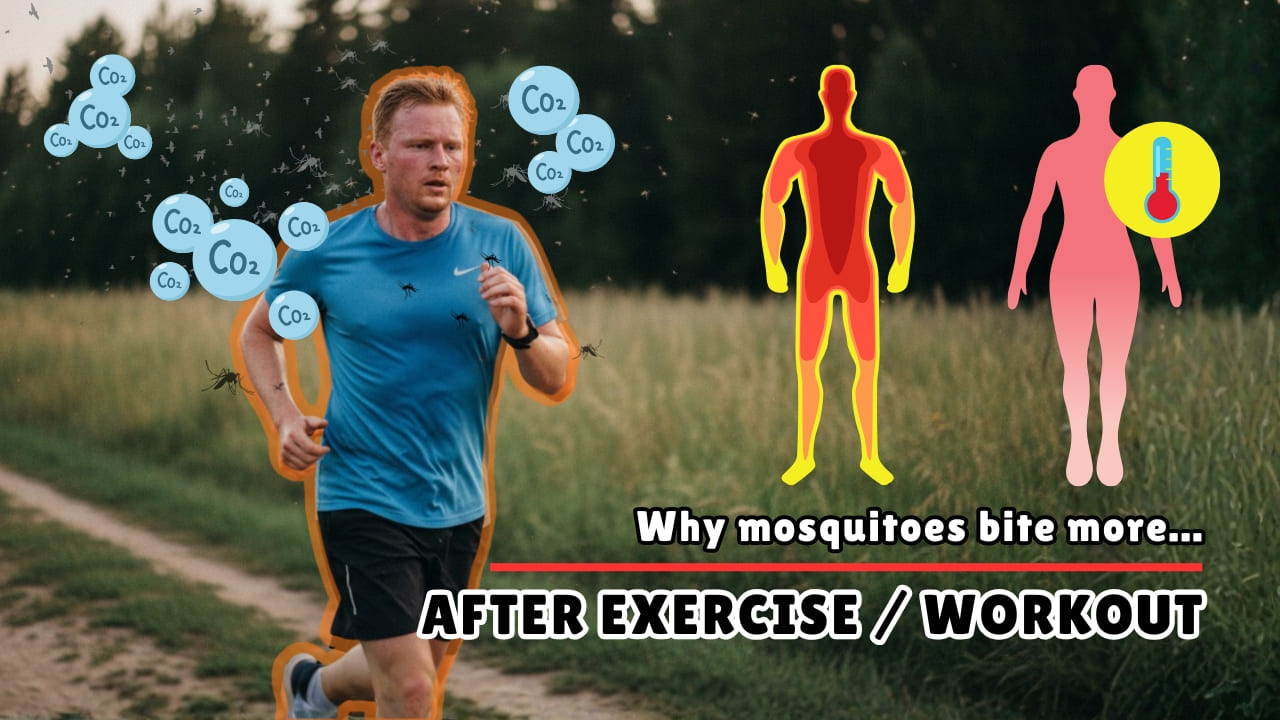
Why do mosquitoes bite more after exercise? The short answer: you become a louder, warmer, and chemically richer target. Your CO₂ output spikes, your body temperature climbs, and your skin starts releasing compounds that mosquitoes find irresistible. All of this happening at once — especially during outdoor evening workouts — makes you significantly more detectable than you are at rest.
Why Do Mosquitoes Bite More After Exercise?
The honest answer is that exercise temporarily turns you into a mosquito magnet — not permanently, but in ways that matter for the 20–40 minutes after you stop moving.
Three things are working against you at the same time:
- Elevated carbon dioxide (CO₂) from faster breathing
- Increased skin surface temperature, due to body heat
- Sweat loaded with lactic acid, ammonia, and bacteria-produced odors
Each of these independently makes you more detectable. Together, they create a strong signal that mosquitoes can pick up from surprisingly far away. Research published in the Journal of Chemical Ecology has confirmed that these combined cues drive significantly higher host-seeking behavior in common mosquito species like Aedes aegypti and Culex pipiens.
How Mosquitoes Find You — The Host-Seeking Behavior
Mosquitoes don’t just wander around randomly biting things. They use a layered, multi-sensory detection system that activates in stages depending on distance.
From as far as 50 meters away, mosquitoes detect CO₂ plumes using specialized chemoreceptors on their antennae. Once they lock onto a CO₂ trail, they fly upwind toward the source. This is the first and most powerful trigger — without elevated CO₂, most mosquitoes won’t even begin their approach.
Closer in — within a few meters — heat becomes the primary signal. Mosquitoes have infrared-sensitive pit organs that detect warm skin against a cooler background. A body temperature above baseline is easier to target.
At very close range, skin odor takes over. Volatile organic compounds released from sweat — particularly lactic acid, ammonia, and carboxylic acids — help mosquitoes distinguish between potential hosts and land on exposed skin.
According to entomologists at the London School of Hygiene & Tropical Medicine, this three-stage detection system is why some people get bitten far more than others — and why the same person gets bitten more after exercise than at rest.
What Exercise Does to Your Body (From a Mosquito’s Perspective)
| Body Change | What Happens During Exercise | Mosquito Response |
| CO₂ Output | Increases up to 20x | Detectable from 50+ meters away |
| Body Temperature | Rises 1–4°C above baseline | Used by mosquitoes for final targeting |
| Sweat (Lactic Acid) | Rises sharply during exertion | Powerful chemical attractant on skin |
| Ammonia (in sweat) | Released through pores | Triggers host-seeking behavior |
| Skin Bacteria Activity | Increases with moisture | Amplifies body odor signals |
Increased Carbon Dioxide (CO₂) After Exercise
At rest, you exhale roughly 200 milliliters of CO₂ per minute. During intense exercise, that number can climb to 4,000 milliliters or more — a 20-fold increase.
That matters because mosquitoes are exquisitely sensitive to CO₂. They can detect concentrations as low as a few parts per million above ambient air. When you’re breathing hard after a run, you’re creating a large, persistent CO₂ plume that extends well beyond your body.
What’s often overlooked is the lag. Even after you stop exercising, elevated CO₂ exhalation continues for 10–20 minutes while your respiratory system returns to baseline. You’re still broadcasting a strong signal even when you think you’ve calmed down.
Research shows that mosquitoes orient toward CO₂ sources with remarkable accuracy. In controlled studies, increasing CO₂ concentration by as little as 50 ppm above ambient significantly increased mosquito activation and directed flight behavior.
Body Heat and Mosquito Attraction After Workouts
Core body temperature during vigorous exercise typically rises 1 to 4 degrees Celsius above normal. Skin surface temperature — the part that actually matters for mosquito detection — also increases, particularly on exposed areas like arms, legs, and the neck.
Mosquitoes have heat-sensing organs that respond to thermal gradients. Warm skin essentially looks like a landing target in their sensory field. This targeting mechanism is most relevant at close range, once the mosquito has already been drawn in by CO₂.
What’s particularly inconvenient about post-exercise heat: it doesn’t dissipate instantly. Depending on the intensity of your workout and the ambient temperature, elevated skin temperature can persist for 15–30 minutes after you stop. If you’re sitting outside cooling down, you’re still a thermal target.
The Role of Sweat, Lactic Acid, Ammonia and Skin Odor in Mosquito Attraction
This is probably the most underappreciated part of the equation.
Sweat itself isn’t particularly attractive to mosquitoes — water and salt don’t do much. But the compounds that accumulate in sweat during exercise? Those are a different story.
Lactic acid builds up in muscle tissue during exercise and gets excreted through sweat glands. It’s a well-documented attractant. In one frequently cited study, synthetic lactic acid applied to a surface significantly increased mosquito landing rates compared to controls.
Ammonia is another byproduct released through sweat during physical exertion. It’s volatile, disperses quickly, and is known to activate mosquito olfactory receptors.
Then there’s the skin bacteria factor. Sweat creates a warm, moist surface environment where naturally occurring bacteria on your skin multiply and metabolize sweat compounds. This bacterial activity produces additional volatile fatty acids and carboxylic acids that further enhance your attractiveness as a host.
Scientific studies indicate that the combination of these compounds — not just any single one — creates the strongest mosquito attraction response. It’s an unfortunate cocktail that peaks during and immediately after exercise.
When You’re Most Vulnerable: High-Risk Situations
Not all outdoor exercise carries the same mosquito risk. Context matters quite a bit — specifically when, where, and how you’re working out.
| Scenario | Why It’s Risky | Risk Level |
| Evening runs (dusk) | Peak mosquito activity window | High |
| Humid outdoor environments | Moisture amplifies sweat odor | High |
| Wooded or shaded areas | Mosquito resting habitats nearby | High |
| Post-workout cool-down | Slow CO₂ drop + continued sweating | Medium–High |
| Daytime summer workouts | Some species active, heat spikes | Medium |
Evening workouts are particularly problematic. Most mosquito species — especially Culex and Aedes varieties common in North America and South Asia — are most active from dusk through the first few hours of nightfall. If you’re doing a post-work run at 7pm in summer, you’re overlapping peak mosquito activity with peak mosquito attraction from your body.
High humidity amplifies everything. Moisture keeps sweat compounds closer to the skin surface rather than evaporating, which concentrates the odor signal. Wooded, shaded areas near standing water are obvious risk zones — these are mosquito habitat.
How to Reduce Mosquito Bites After Exercise — Science-Based Tips
Here’s what actually helps, based on what we know about mosquito host-seeking behavior.
| Strategy | Why It Works | When to Apply |
| Cool down indoors | Reduces CO₂ and body heat faster | Immediately after exercise |
| Shower promptly | Removes lactic acid, ammonia, bacteria | Within 15–20 min post-workout |
| Wear light-colored, full-coverage clothes | Less skin exposure; light colors less attractive | During outdoor workouts |
| Apply EPA-registered repellent (DEET, Picaridin) | Disrupts mosquito chemical detection | Before and after outdoor sessions |
| Avoid peak hours (dusk/dawn) | Fewest active mosquitoes midday | Schedule workouts accordingly |
A few things worth noting about repellents: DEET and Picaridin are the two most well-studied active ingredients. According to the CDC, DEET at concentrations of 20–30% provides several hours of reliable protection. Picaridin is similarly effective with a less greasy feel, which may make it more practical during and after exercise.
IR3535 and oil of lemon eucalyptus (OLE) are additional EPA-registered options that show solid evidence of effectiveness. Plant-based repellents like citronella, on the other hand, offer much shorter protection windows and are generally not recommended as primary defense during workouts.
One thing people often overlook: the timing of your shower matters. Showering within 15–20 minutes of finishing your workout removes the lactic acid, ammonia, and bacteria that are driving most of the odor-based attraction. Waiting an hour to shower — while sitting outside — isn’t doing you any favors.
📰 Must Read,
✔️ Why Do Larger People Get Bitten by Mosquitoes More Often?
✔️ Why Do Mosquitoes Bite Me So Much? Factors that Makes You a Mosquito Magnet
The Bottom Line
Exercise makes you temporarily, measurably more detectable to mosquitoes. It’s not random — it’s a direct result of the CO₂ you exhale, the heat you generate, and the specific compounds released through sweat during physical exertion.
The good news is that this effect is temporary and partially manageable. Cooling down indoors, showering promptly, applying a CDC-recommended repellent before outdoor activity, and timing your workouts away from peak mosquito hours all meaningfully reduce your exposure.
You don’t have to stop exercising outside. You just need to understand what’s happening to your body — and make a few adjustments that actually hold up against the science.
Frequently Asked Questions (FAQs)
Q. Does everyone get bitten more after exercise, or just some people?
Honestly, it varies. Some people just produce more lactic acid or have a higher skin bacteria count, which makes them a stronger target. Blood type also plays a role — Type O has been linked to higher attraction in some studies. But broadly speaking, yes, exercise increases attraction for most people. It’s just more obvious for some than others.
Q. How long after a workout are you still attractive to mosquitoes?
Longer than you’d think. CO₂ levels stay elevated for 10–20 minutes after you stop. Body heat lingers even longer. And if you don’t shower, the lactic acid and ammonia on your skin keep broadcasting. Realistically, you’re still a heightened target for 30–45 minutes post-workout — maybe more in humid conditions.
Q. Does drinking alcohol before a workout make it worse?
It does, actually. Alcohol increases skin surface temperature and raises the ethanol content in sweat — both of which mosquitoes respond to. There’s a reason you get bitten more at outdoor evening events where drinks are involved. Combine that with exercise heat and sweat, and it compounds the problem.
Q. Are certain types of exercise worse than others?
High-intensity cardio is the worst offender. Running, cycling, HIIT — anything that spikes your breathing rate and makes you sweat heavily. Low-intensity stuff like walking or yoga still increases attraction slightly, but nowhere near the same level. The more you exert, the more CO₂ and lactic acid you produce. Simple as that.
Q. Does wearing dark clothing actually make a difference during outdoor workouts?
It does, though it’s one factor among many. Mosquitoes use visual cues alongside chemical ones — dark colors contrast more against the horizon and make you easier to spot. Black, navy, dark red workout gear isn’t doing you any favors. Light-colored, loose-fitting clothes are genuinely better, especially in the evening.
Q. Can diet affect how much mosquitoes target you after a workout?
There’s some evidence, though it’s not conclusive. High-potassium foods like bananas have been anecdotally linked to increased attraction — possibly because potassium affects sweat composition. Garlic is sometimes claimed to repel mosquitoes, but the science is weak. What’s clearer is that hydration matters — well-hydrated sweat is more diluted, potentially carrying fewer concentrated attractants.
Q. Is it better to work out in the morning to avoid mosquitoes?
For most species, yes. Culex mosquitoes — the most common in many urban areas — are most active at dusk and into the night. Morning workouts sidestep peak activity windows almost entirely. That said, Aedes aegypti bites during the day too, so in tropical or subtropical climates, morning isn’t a complete free pass.
Q. Does a cold shower after exercise actually reduce mosquito bites?
It helps, and probably more than people realize. A cold or cool shower drops your skin temperature faster than a warm one, removes sweat compounds, and reduces the odor signals mosquitoes are tracking. If you’re headed back outside after a workout, a quick cool shower before you go back out is one of the most practical things you can do. Warm showers clean just as well but don’t drop skin temperature as quickly.
Q. Does exercising outdoors make you more attractive to mosquitoes?
Yes — significantly. When you exercise, your CO₂ output can spike five to ten times above resting levels, your body temperature rises, and you start producing lactic acid in your sweat. That’s basically every signal mosquitoes use to find a host, all at once. The effect doesn’t disappear the moment you stop either — elevated CO₂ and residual sweat compounds linger for a while after the workout ends.
Editorial Team & Contributors

Raashid Ansari, Founder, Content Researcher & Author - MosquiTalk
Not an entomologist — just a genuinely curious writer who started researching mosquitoes and couldn't stop. What began as casual reading about repellents and bite prevention gradually turned into a deep ongoing dive into vector biology, disease epidemiology, animal health impacts, and the real science behind mosquito control. Everything published here is carefully edited, and written with one purpose: giving readers accurate, accessible information they can actually trust and use to protect themselves, their families, and their pets, birds and cattle.
Active across social platforms, regularly publishes, and genuinely invested in spreading mosquito awareness where it matters most. Because informed readers make better decisions — and better decisions save lives.