
Table of Contents
You bought the sprayer. You bought the concentrate. You marched out into your yard at 2 p.m. on a Saturday feeling productive, sprayed everything in sight, and by that evening you were still getting eaten alive at the grill.
So either the product’s junk, or something about the timing was wrong. In my experience — and I’ve walked a lot of yards doing exactly this kind of work — it’s almost always the timing.
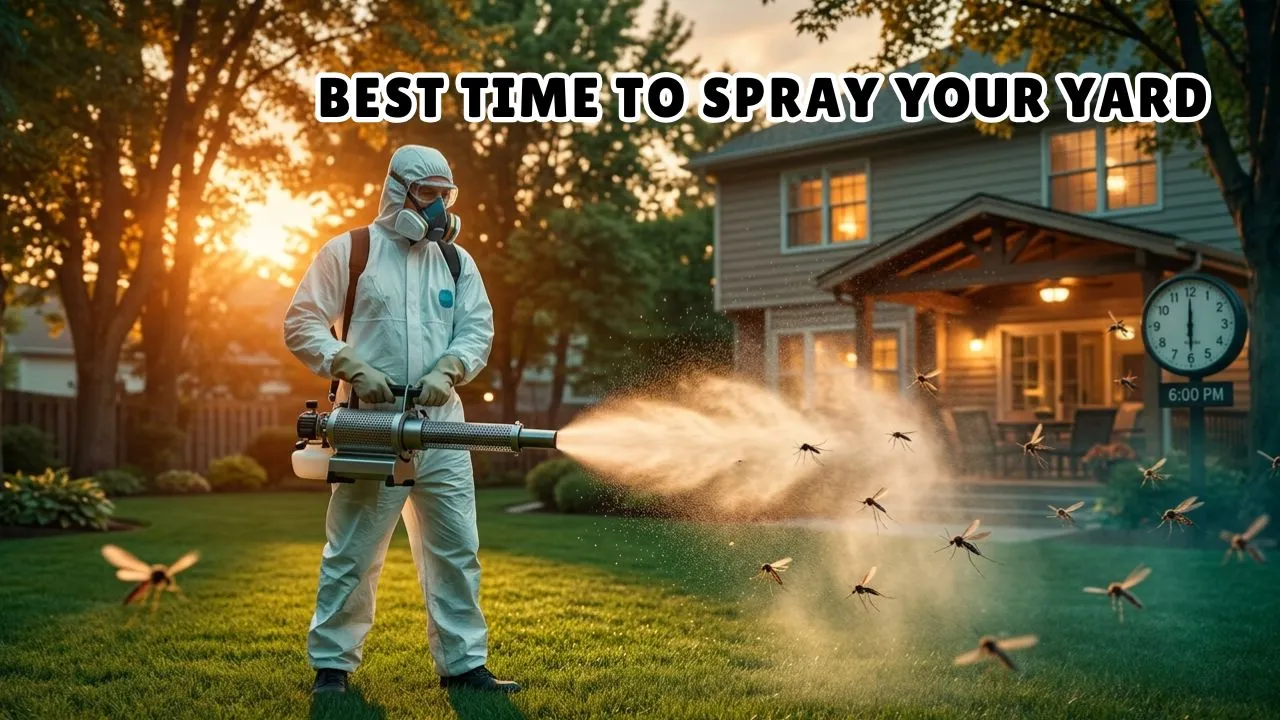
The best time to spray for mosquitoes in your yard is early morning or evening, during dawn and dusk hours, when mosquitoes are actively resting on foliage and temperatures are cooler. But that’s really just the headline answer. The full picture involves time of day, time of year, weather conditions, and a repeat schedule — because one spray, done once, was never going to fix this. Let me walk through the whole thing properly.
Best Time to Spray for Mosquitoes in Yard: Time of Day
Mosquitoes are, for the most part, crepuscular — meaning they’re most active during the low-light hours of dawn and dusk. Some species shift toward more nocturnal activity, and a few, notably the Asian tiger mosquito, will bite aggressively during the day too. But the bulk of your yard’s mosquito population is doing its feeding and flying in that early-morning and early-evening window.
That matters for two separate reasons, not just one.
- Mosquitoes are out and exposed during these hours, sitting on foliage or actively flying, rather than hidden away in shade
- Cooler temperatures during dawn and dusk slow the evaporation rate of the insecticide, so it actually stays wet and effective on the leaf surface longer
Spray at high noon in July heat, and you’re fighting a losing battle on both fronts. The mosquitoes are hunkered down in shaded, damp spots avoiding the heat, and whatever you do spray starts evaporating almost as fast as you apply it. Direct sun and high heat break down a lot of common active ingredients faster than manufacturers would probably like to admit.
Early Morning vs. Evening: Which Is Actually Better
Genuinely, both work. But there are small trade-offs worth knowing.
- Early morning (5:30–8:00 a.m.): cooler temps, low wind, dew still present which can help droplets adhere to foliage — but you’re racing daylight and household activity starting up
- Evening (6:00–8:30 p.m., depending on season): mosquitoes are ramping up toward peak dusk activity right as you spray, giving more direct contact kill — this is the window most professional services and DIY guides lean toward
- Avoid solar noon entirely: roughly 11 a.m. to 3 p.m. is the worst window, both for mosquito exposure and product longevity
If I had to pick one, I’d lean evening. You’re spraying right as the population becomes active, which means more direct knockdown, and the barrier has all night to bond to foliage before the next day’s heat and sun start breaking it down.
Best Time to Spray for Mosquitoes in Yard: Weather Conditions That Matter
Time of day is half the equation. Weather is the other half, and it gets skipped over constantly.
- Never spray in the rain, or right before rain is forecast — water washes the product straight off foliage before it has a chance to bond and dry.
- Avoid spraying right after rainfall too — wet grass and leaves won’t hold the treatment properly, and you’ll just be diluting it.
- Wind above roughly 10 mph causes drift, wasting product and pushing it off-target — calm dawn or dusk conditions are typically your best bet anyway.
- Give the treatment 30 to 60 minutes to dry before letting kids or pets back into the yard, regardless of what time you spray.
A lot of people treat weather as an afterthought. It’s not. I’ve watched a perfectly good barrier spray get wasted because someone sprayed at 6 p.m. and a thunderstorm rolled through by 6:45. Check the forecast first. It takes ten seconds and saves you a wasted application.
Best Season and Month to Start Spraying for Mosquitoes in Yard
Timing within the day is one layer. Timing within the year is the other, and arguably the more important one for actually staying ahead of a mosquito problem.
(i) Start Before the Season, Not During It
Mosquitoes can’t function below about 50°F — they’re cold-blooded, so cooler temperatures shut down their activity almost entirely. But here’s the thing: waiting until you’re already getting bitten to start spraying means you’re already behind. Mosquito breeding cycles move fast, and a single female can lay a batch of eggs in under a tablespoon of standing water.
The general rule of thumb — and this shifts by region — is to begin yard treatments a few weeks before your local mosquito season typically kicks off. For a lot of the country, that lands somewhere around March or early April. If you’re in the Gulf Coast, parts of Florida, or Texas, mosquito activity can realistically run close to year-round, so “season start” is a much softer concept down there.
(ii) Regional Timing Differences
- Northern and Midwest states: mosquito season generally runs roughly April/May through September/October — start treatments in early spring as temps climb past 50°F consistently
- Southern and Gulf Coast states: extended season, often March through November or later — some areas see mosquito activity nearly year-round
- Arid Western regions: mosquito pressure tends to track irrigation season and monsoon rains more than a fixed calendar window
- Coastal and humid regions: generally see mosquito season start earlier and run longer than dry inland areas at the same latitude
Know your local first frost and first thaw dates. Those are a far better guide than a generic national calendar, since mosquito activity really is temperature-driven, not date-driven.
How Often Should You Spray for Mosquitoes: Frequency and Schedule
This is probably the most misunderstood part of the whole process. People assume one good spray should handle the season. It won’t.
Most barrier treatments — the kind that bond to foliage and kill mosquitoes on contact — remain effective for about 21 days. After that, sun exposure, rain, mowing, and irrigation gradually break the product down, and its killing power drops off noticeably.
That 21-day window isn’t arbitrary, either. It roughly matches the mosquito life cycle — egg to larva to pupa to biting adult typically takes somewhere around one to two weeks in warm weather. Spraying every three weeks keeps knocking down new adults before the next generation has fully established itself in your yard.
(i) Standard Recurring Schedule
- Every 21 days during active mosquito season — this is the standard professional recommendation and it holds up well for most residential yards
- Every 14 days for high-pressure properties — homes near ponds, wooded lots, wetlands, or areas with heavy rainfall may need a tighter cycle
- Monthly at most, for low-pressure yards — smaller, sunnier, well-drained properties with minimal standing water can sometimes stretch treatments further apart
If you’re seeing mosquitoes again before your next scheduled treatment, that’s a signal to tighten the interval, not just grit your teeth until the calendar date arrives.
(ii) Signs It’s Time to Re-Spray Early
- You’re noticing bites again, especially in early evening
- It’s rained heavily since your last application
- You mowed or irrigated recently, which can strip product off lower foliage
- It’s been more than three weeks since the last treatment, full stop
Application Intensity: How Much and Where to Spray
More product is not automatically better here. Coverage and placement matter more than sheer volume.
(i) Focus On Resting Zones, Not Open Air
Mosquitoes spend most of the day resting in cool, shaded, humid spots — not flying around in open sunlight. Spraying into open air is mostly wasted product. Target where they actually sit:
- Undersides of leaves, especially on dense shrubs
- Tall grass, ground cover, and mulched garden beds
- Shaded areas near the foundation of the house
- Fence lines, wood piles, and any dense vegetation
- Areas around decks, patios, and other seating zones where people actually spend time
(ii) A Full Barrier, Not Just a Few Spots
Treat the entire perimeter of the yard, not just the patio area, so you’re creating a genuine barrier rather than a single clean pocket mosquitoes can still fly into from three feet away. A full property treatment, applied properly with a backpack or pump sprayer, typically takes somewhere between 10 and 30 minutes depending on lot size and vegetation density.
(iii) Two-Part Approach: Adulticide and Larvicide
Intensity isn’t just about how heavily you spray — it’s about treating both ends of the mosquito life cycle.
- Adulticide barrier sprays kill active, flying adult mosquitoes on contact and leave a residual effect on foliage for roughly three weeks
- Larvicide treatments target standing water you can’t fully eliminate — products containing Bti (Bacillus thuringiensis israelensis) can control larvae for up to 30 days, and methoprene-based products even longer
Skipping the larvicide step is one of the most common mistakes I see. You can spray the yard perfectly and still lose the fight if there’s a birdbath or a clogged gutter quietly producing a new batch of mosquitoes every week.
Before You Spray: Eliminate Standing Water First
No amount of correct timing fixes a yard that’s still actively breeding mosquitoes. This step comes before scheduling anything.
- Dump and scrub bird baths weekly
- Clear clogged gutters — a shockingly common, overlooked breeding site
- Empty flower pot saucers, buckets, and any container that collects rainwater
- Check low-lying areas of the yard that stay damp after rain
- Store outdoor toys, wheelbarrows, and pet bowls so they don’t collect water
A female mosquito needs less than a tablespoon of standing water to lay a full batch of eggs. Spray schedules matter, but this step arguably matters more.
Quick-Reference Yard Spraying Schedule
| Factor | Recommendation | Why |
|---|---|---|
| Time of day | Dawn or dusk (evening preferred) | Peak mosquito activity, cooler temps slow evaporation |
| Weather | Dry, calm, wind under 10 mph | Rain and wind wash away or scatter product |
| Season start | 2–3 weeks before local season begins | Gets ahead of the breeding cycle |
| Standard frequency | Every 21 days | Matches mosquito life cycle and product breakdown rate |
| High-pressure yards | Every 14 days | Wooded, wet, or waterfront properties need tighter coverage |
| Drying time | 30–60 minutes before re-entry | Allows product to bond to foliage safely |
Safety Considerations While Spraying
A few practical notes worth building into your routine, regardless of what product you’re using.
- Keep kids and pets indoors during application and for 30–60 minutes after, until the spray dries.
- Cover or bring in outdoor grills and furniture before spraying to avoid chemical residue on surfaces people touch.
- Spraying at dusk, when bees and other pollinators have mostly returned to their hives, reduces unintended harm to beneficial insects.
- Mow the lawn a day or two beforehand — shorter grass means less pollinator activity in the treated zone and less hiding cover for mosquitoes generally.
- EPA-registered products, applied as labeled, are generally considered low-risk for short-term human exposure, but minimizing direct contact during application is still good practice.
Frequently Asked Questions (FAQs)
Q. What is the single best time of day to spray for mosquitoes?
Evening, roughly an hour or two before dusk, is generally the strongest choice. It lines up with peak mosquito activity for direct contact kill, and cooler temperatures help the product bond to foliage before the next day’s heat breaks it down.
Q. How often should I spray my yard for mosquitoes?
Every 21 days is the standard recommendation for most residential yards, matching both product breakdown and the mosquito life cycle. Yards near water or heavy vegetation may need every 14 days instead.
Q. What month should I start spraying for mosquitoes?
Start a few weeks before your local mosquito season typically begins, generally once temperatures consistently climb above 50°F. For much of the U.S., that’s early spring, though Gulf Coast and southern regions may need treatment nearly year-round.
Q. Can I spray for mosquitoes in the middle of the day?
It’s not ideal. Midday heat accelerates evaporation and product breakdown, and mosquitoes are typically hidden in shaded, damp resting spots rather than active and exposed, so you’ll get weaker results for the same amount of product.
Q. Does rain ruin a mosquito spray treatment?
Yes, if it happens too soon after application. Give the product at least a few hours to dry and bond to foliage; check the forecast before spraying so a surprise storm doesn’t wash away your work.
Final Takeaways
Timing your mosquito spray really comes down to stacking a few small decisions correctly, rather than any single trick.
Spray at dawn or dusk, ideally evening. Avoid wind and rain. Start a few weeks ahead of your local season instead of reacting once you’re already covered in bites. Repeat roughly every 21 days, tightening to every two weeks if your yard backs up to woods or water. Clear standing water before any of this even starts, since that’s the step that actually breaks the breeding cycle rather than just knocking down the adults you can see.
None of this is complicated, honestly. It’s just a lot of small, correct habits stacked on top of each other. Get the timing right consistently, and that backyard barbecue stops being a mosquito buffet — which, at the end of the day, is really the entire point.
Editorial Team & Contributors

Raashid Ansari, Founder, Content Researcher & Author - MosquiTalk
Not an entomologist — just a genuinely curious writer who started researching mosquitoes and couldn't stop. What began as casual reading about repellents and bite prevention gradually turned into a deep ongoing dive into vector biology, disease epidemiology, animal health impacts, and the real science behind mosquito control. Everything published here is carefully edited, and written with one purpose: giving readers accurate, accessible information they can actually trust and use to protect themselves, their families, and their pets, birds and cattle.
Active across social platforms, regularly publishes, and genuinely invested in spreading mosquito awareness where it matters most. Because informed readers make better decisions — and better decisions save lives.