
Table of Contents
Introduction
The mosquito life cycle is one of the most studied biological processes in entomology — and for good reason. Mosquitoes are responsible for transmitting diseases like malaria, dengue fever, Zika, and West Nile virus to millions of people each year. Understanding how they develop isn’t just academic. It’s essential for effective control.
From egg to adult, mosquitoes undergo complete metamorphosis through four distinct stages. Each stage has its own biology, timeline, and vulnerabilities. Knowing those vulnerabilities is where prevention actually starts.
What Is the Mosquito Life Cycle? (Overview)
The mosquito life cycle refers to the sequential developmental stages a mosquito passes through from the moment it is laid as an egg to its emergence as a sexually mature adult. It follows a pattern called holometabolism — or complete metamorphosis — meaning each stage looks and functions entirely differently from the next.
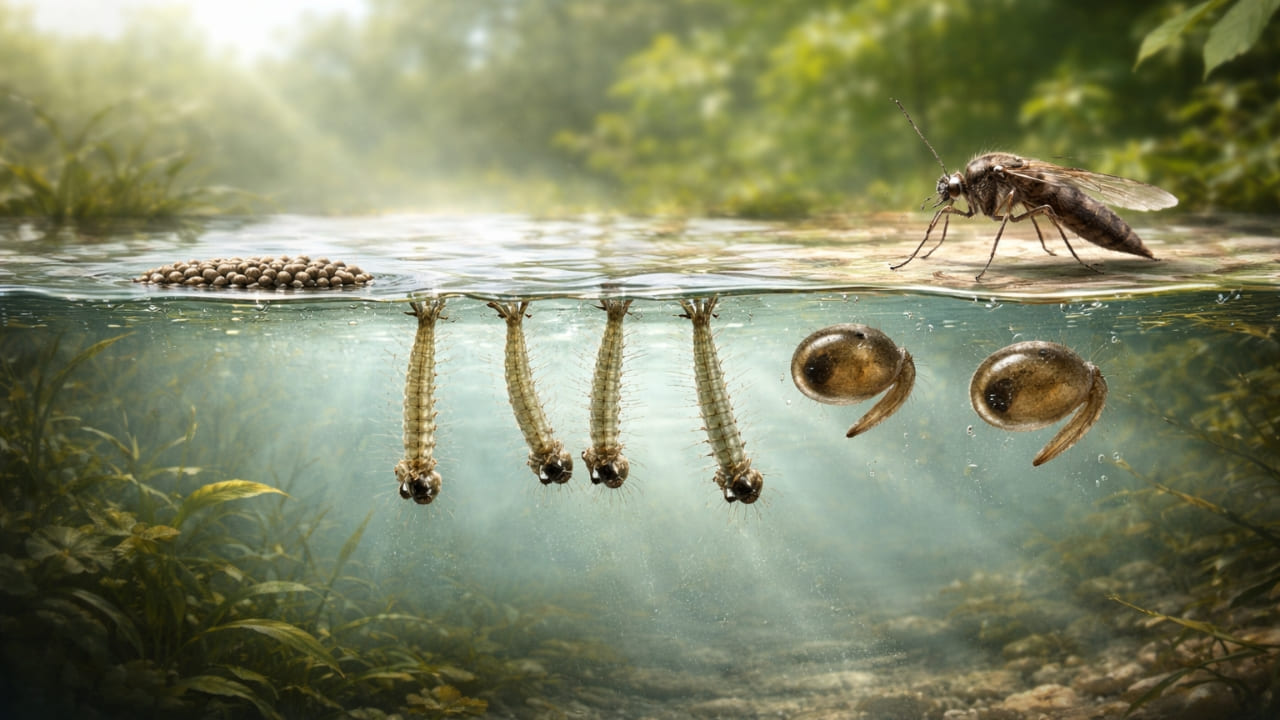
The four stages are: egg, larva, pupa, and adult. The first three are aquatic. Only the adult stage is terrestrial and airborne.
This matters because mosquito control strategies target different stages. Larvicides work only in water. Adulticidal sprays only affect the final adult stage. If you don’t understand where in the cycle a population is, you’re largely guessing.
The 4 Stages of the Mosquito Life Cycle Explained
Each stage has a specific biological function and environmental dependency. Here is a detailed breakdown including the hormonal and mechanical processes driving each transition.
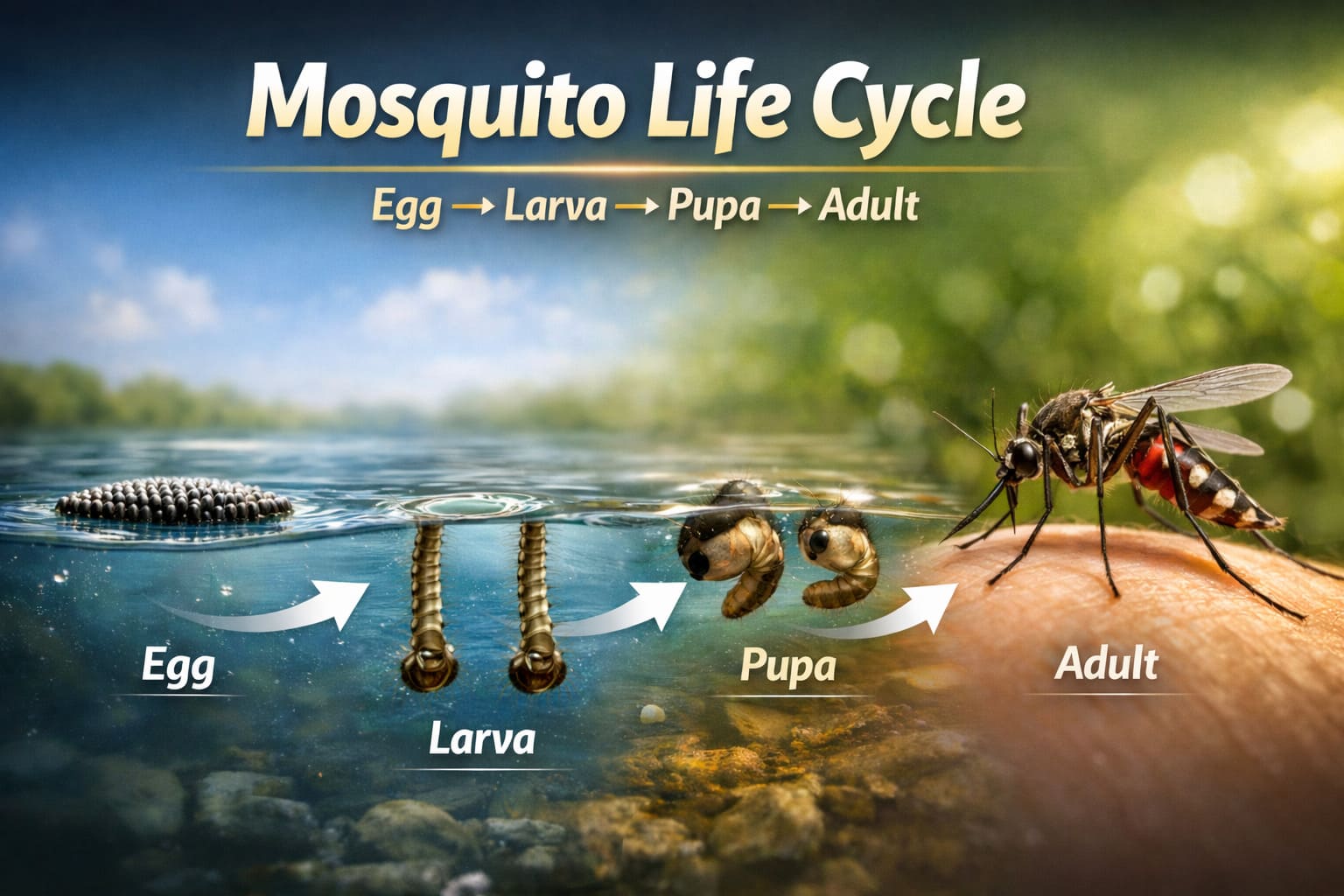
Stage #1: Mosquito Egg Stage (Where Life Begins)
Everything starts with water. Female mosquitoes lay their eggs on or near standing water — the type and location varies significantly by species, but stagnant or slow-moving water is almost always involved.
Eggs are small, typically 1 mm or less, and dark in color. Some species, like Aedes, lay eggs individually along damp soil or container walls just above the waterline. Others, like Culex, form floating egg rafts containing 100–300 eggs clustered together.
Hatching typically occurs within 24–72 hours in warm, humid conditions. Temperature plays a huge role — at around 25–30°C (77–86°F), hatching is rapid. In cooler climates, eggs of some species can remain dormant for months before conditions improve.
Egg Biology: Structure and Diapause
Mosquito eggs have a multi-layered protective shell. The outermost exochorion provides physical protection; the inner endochorion regulates gas exchange and moisture balance. In Aedes species, a specialized wax-like layer within the chorion gives eggs remarkable desiccation resistance — they can survive months without water and hatch once flooded.
A critical concept here is diapause — a hormonally regulated developmental pause. In temperate Culex and some Aedes species, eggs (or early larvae) enter diapause when exposed to shortening day length and cooling temperatures in autumn.
Diapause is triggered by suppression of juvenile hormone (JH), which normally drives development forward. Development simply stalls — waiting, essentially, for longer days and warmer temperatures to signal that spring has arrived.
This mechanism is why mosquito populations can seemingly disappear in winter and re-emerge explosively in spring — the eggs were never truly gone.
Stage #2: Mosquito Larva Stage (Aquatic Feeding Stage)
Once hatched, larvae enter the water. Commonly called “wrigglers” due to their jerky, undulating swimming motion, mosquito larvae are entirely aquatic and spend most of their time near the surface.
They are filter feeders. Using specialized mouth brushes, larvae consume algae, bacteria, organic matter, and microorganisms suspended in water. Feeding is nearly constant — they need energy to fuel rapid growth.
Larval Molting: Ecdysone and the Four Instars
Larvae molt through four successive growth stages called instars. Each molt is triggered by a surge in ecdysone (a steroid hormone, also called 20-hydroxyecdysone in its active form), which softens the cuticle and initiates shedding. Between ecdysone pulses, juvenile hormone (JH) keeps the larva in larval form rather than allowing premature metamorphosis.
The interplay between these two hormones — ecdysone driving change, JH suppressing adult development — is the core engine of mosquito metamorphosis. This hormonal axis is also the target of insect growth regulators (IGRs) like methoprene, which mimic JH and prevent larvae from completing development.
By the fourth instar, the larva has grown significantly. Aedes aegypti fourth-instar larvae can reach 7–9 mm in length. After the fourth-instar molt, the pupa emerges.
Larval Respiration Mechanisms
Most mosquito larvae breathe through a siphon — a hardened, tube-like structure on the eighth abdominal segment that pierces the water surface to access atmospheric air. The siphon connects to a tracheal system that distributes oxygen throughout the larva’s body.
Anopheles larvae are a notable exception. They lack a siphon entirely. Instead, they position themselves horizontally just beneath the water surface, using a pair of spiracles (small breathing pores) located dorsally to breathe. This difference in body posture — horizontal vs. head-down — is one of the easiest visual ways to distinguish Anopheles larvae from Culex or Aedes in field surveys.
Some larvae in highly polluted, low-oxygen water have adapted to breathe through their skin or use hemoglobin-like proteins to extract dissolved oxygen — though this is more common in Chironomid midges than true mosquitoes.
Stage #3: Mosquito Pupa Stage (Transformation Stage)
After the fourth larval molt, the mosquito enters the pupal stage. Pupae are comma-shaped, also aquatic, and commonly called “tumblers” because of their rolling motion when disturbed.
This is a non-feeding stage. The pupa doesn’t eat. Inside the pupal casing, massive internal reorganization is underway — larval organs are histolyzed (broken down by enzymes) and adult structures are built from clusters of undifferentiated cells called histoblasts.
Internal Transformation: What Happens Inside the Pupal Case
The pupal stage is where holometabolism becomes most dramatic. Once JH drops to near-zero levels, a final high-titer ecdysone pulse triggers the transformation. Larval muscles, gut epithelium, and much of the nervous system are partially or fully remodeled.
All adult structures — compound eyes, wings, legs, proboscis, and reproductive organs — are built fresh from imaginal discs, small clusters of cells quietly held in reserve since the larval stage. For Aedes aegypti, the entire rebuild completes in roughly 1–3 days at 28°C.
Pupae breathe through two trumpet-shaped respiratory horns (also called respiratory trumpets) at the top of the cephalothorax. Because they don’t feed and exist only briefly, they represent a relatively narrow window for control — larvicides have no effect, and pupae are mobile enough to evade some physical interventions.
Stage #4: Adult Mosquito Stage (Flying & Reproductive Stage)
The adult emerges from the pupal casing at the water surface, resting briefly as its wings expand and harden (a process called sclerotization). This cuticle hardening takes roughly 24 hours before the mosquito is flight-ready.
Male mosquitoes feed only on nectar and plant sugars. Females also feed on plant sugars but require a blood meal for egg protein synthesis — specifically, blood proteins like albumin and globulin trigger vitellogenin production in the fat body, which fuels yolk development in maturing oocytes.
The Gonotrophic Cycle and Reproductive Biology
After mating and a blood meal, the female enters the gonotrophic cycle: digestion (approximately 2–3 days), ovarian development, egg laying, and then seeking another blood meal. A single female can complete 3–5 gonotrophic cycles during her lifetime, laying 50–200 eggs per cycle depending on blood meal size and species.
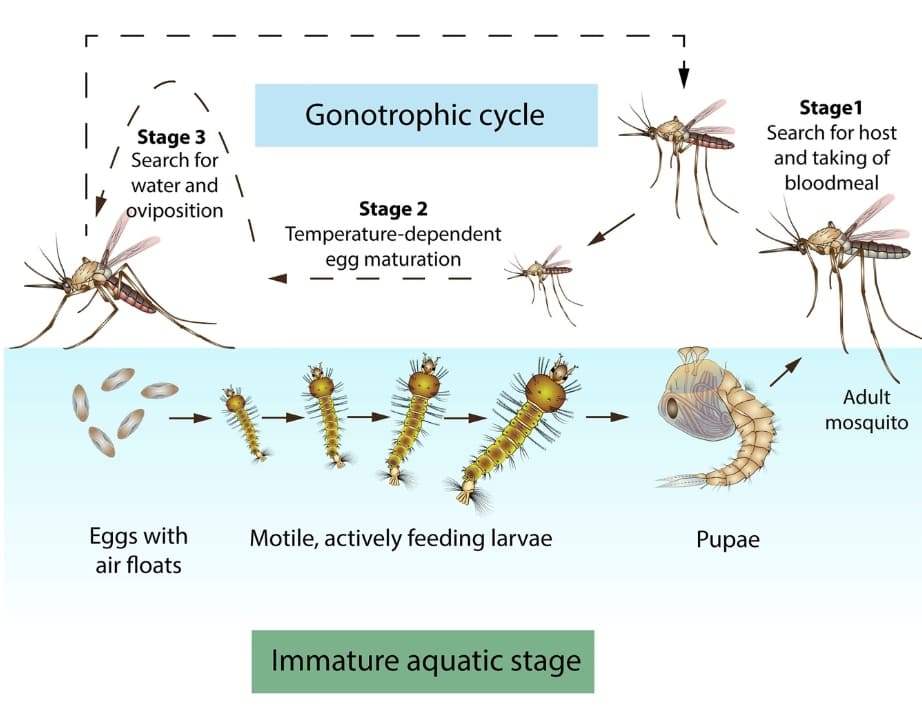
Mating typically occurs in swarms — males form large flight aggregations (often in the evening), and females fly through to select a mate. Males detect females by the frequency of their wingbeat; female Aedes aegypti beat their wings at roughly 400–600 Hz, and males tune their own flight frequency to match — a phenomenon called harmonic convergence.
Female lifespan in the wild typically ranges 2–4 weeks, constrained by desiccation, predation, and immune senescence. Males rarely live beyond 1–2 weeks.
How Long Does the Mosquito Life Cycle Take?
Under optimal conditions — warm temperatures around 28°C, clean standing water, sufficient food — the mosquito life cycle from egg to adult can be completed in as little as 7–10 days. In cooler or resource-limited environments, the same cycle may take 3–4 weeks.
Species matter significantly. Aedes aegypti completes development in 7–8 days in tropical conditions. Anopheles gambiae averages 9–12 days in sub-Saharan Africa. Culex pipiens in temperate zones often takes 14–20 days.
The practical implication: a container of standing water left undisturbed for just one week can produce a batch of adult mosquitoes. That is a very narrow window for intervention.
Environmental Factors That Affect Mosquito Development
Several environmental variables directly influence how fast — or whether — a mosquito completes its life cycle.
- Temperature: The most critical driver. Warmer water (25–30°C) speeds development dramatically. Below 10°C, development essentially halts. Above 34–36°C, development becomes inhibitory and larval mortality rises.
- Water availability: No water, no larvae. Even a few milliliters in a bottle cap can suffice for Aedes species.
- Humidity: High humidity prolongs adult mosquito lifespan. Dry conditions accelerate desiccation in newly emerged adults.
- Food availability: Larvae need microorganisms and organic particles. Nutrient-poor water delays or impairs development.
How Weather and Seasons Affect the Mosquito Life Cycle?
1. Winter: Dormancy, Diapause, and Overwintering Strategies
Cold weather does not kill mosquito populations — it pauses them. Different species have evolved distinct overwintering strategies, and understanding them explains why mosquitoes reappear every spring with such consistency.
Culex pipiens overwinters primarily as inseminated adult females. They enter a state of reproductive diapause — halting gonotrophic activity, accumulating fat reserves, and seeking sheltered microhabitats such as basements, storm drains, animal burrows, and hollow logs. Their metabolic rate drops significantly. When spring temperatures exceed roughly 10°C, fat reserves are mobilized, ovarian development resumes, and the female seeks a blood meal to begin egg laying.
Aedes species in temperate regions overwinter primarily as eggs. Aedes albopictus eggs, laid in late summer, enter diapause triggered by short-day photoperiod (typically fewer than 13 hours of daylight). The eggs remain dormant through winter, resistant to freezing and desiccation, and hatch in spring when day length and water temperature increase. This egg-stage overwintering is highly effective — it requires no energy expenditure and survives conditions that would kill adults.
Anopheles in colder climates typically overwinter as mated females in a similar fashion to Culex — sheltered and reproductively dormant. In warmer tropical regions where Anopheles is most prevalent, there is no true overwintering; transmission is year-round or limited only by rainfall seasonality.
2. Summer: Peak Development and Population Explosions
Summer is when the mosquito life cycle runs fastest and populations peak. High temperatures accelerate every stage — egg hatching, larval development, pupal transformation, and adult gonotrophic cycling all speed up in parallel.
At 30°C, Aedes aegypti can complete the full egg-to-adult cycle in approximately 7 days. At 20°C, the same cycle takes roughly 14–20 days. The difference is not trivial: faster cycling means more generations per season, more females seeking blood meals, and higher disease transmission potential.
Summer rainfall is equally important. Rain fills temporary containers, street puddles, and tree holes — creating new breeding sites rapidly. A single heavy rain event can trigger synchronized egg hatching in Aedes species, producing large adult emergence events within 7–10 days.
Heat stress does have an upper limit. Sustained temperatures above 35–36°C increase larval mortality and reduce adult longevity. In extremely hot, arid summers, some mosquito activity may temporarily decline during peak heat — only to rebound when temperatures moderate in late afternoon or after rain.
3. Humidity: The Hidden Driver of Adult Survival
Temperature gets most of the attention, but humidity is equally critical for adult mosquitoes. Mosquito cuticles are not fully waterproof — adults lose body water through transpiration continuously. At low relative humidity (below 40–50%), adult mosquitoes desiccate and die within hours to a few days. This is why mosquito activity drops sharply on hot, dry, windy days and spikes after rain.
High humidity (above 70–80%) dramatically extends adult lifespan. In humid tropical environments, female mosquitoes can survive long enough to complete multiple gonotrophic cycles — and since disease pathogens like Plasmodium or dengue virus require an extrinsic incubation period of 10–14 days inside the mosquito, only long-lived females in humid conditions become epidemiologically significant vectors.
This is one reason vector-borne disease burden is so heavily concentrated in tropical and subtropical regions: the humidity keeps females alive long enough to transmit.
4. Monsoon and Rainfall Patterns
In many parts of South Asia, Southeast Asia, and sub-Saharan Africa, mosquito population dynamics are tightly linked to monsoon seasons. The onset of heavy rains creates massive, simultaneous breeding site activation — flooded rice paddies, irrigation channels, and roadside pools all become Anopheles breeding grounds within days.
Malaria transmission in these regions peaks 4–6 weeks after monsoon onset — exactly the time needed for a generation of Anopheles to emerge, feed, and for Plasmodium to complete its extrinsic incubation inside the vector.
In contrast, very heavy flooding can actually wash away larval populations from temporary habitats, temporarily reducing mosquito densities. The relationship between rainfall and mosquito abundance is not always linear — it depends on rainfall intensity, habitat type, and species.
Where Mosquitoes Breed (Common Habitats)
Mosquitoes are not picky about where they breed — as long as there is water. Natural habitats include marshes, swamps, ponds, slow-moving streams, tree holes, and floodplains. Urban and human-made sites are often more dangerous from a public health standpoint because they are closer to people.
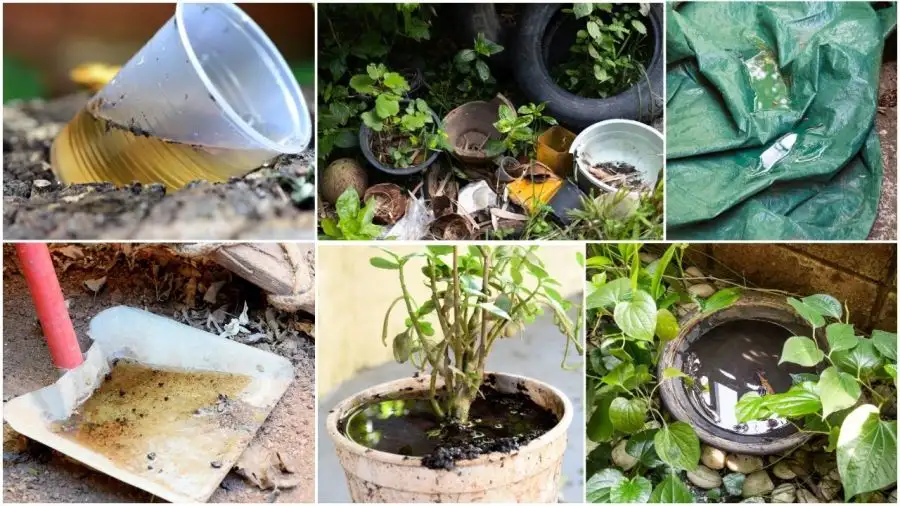
Common urban breeding locations include:
- Flower pots, buckets, and water storage containers
- Discarded tires (a classic Aedes breeding site)
- Clogged gutters and flat rooftops with pooled water
- Bird baths and ornamental fountains
- Construction site water accumulation
- Poorly maintained swimming pools
Why Understanding the Mosquito Life Cycle Matters
Mosquito-borne diseases kill hundreds of thousands of people each year. Malaria alone accounted for an estimated 608,000 deaths globally in 2022, according to the World Health Organization. Dengue infects up to 400 million people annually. West Nile virus, transmitted primarily by Culex mosquitoes, has spread across all 48 contiguous US states since its first detection in New York in 1999 — with no approved human vaccine still available to date.
Effective vector control is impossible without life cycle knowledge. Larviciding is far more efficient than adulticiding because larvae are concentrated in water, immobile, and easier to eliminate. Public health programs that successfully reduced mosquito-borne disease — like modern malaria interventions in sub-Saharan Africa — relied on systematic life cycle disruption.
How to Break the Mosquito Life Cycle? (Mosquito Prevention Tips)
Breaking the mosquito life cycle means eliminating water or introducing mortality at a vulnerable stage.
- Eliminate standing water: Empty containers, change bird bath water weekly, fix leaks. No water means no breeding.
- Use larvicides: Bacillus thuringiensis israelensis (BTI) is highly effective and safe. Insect growth regulators (IGRs) like methoprene mimic juvenile hormone and prevent larval maturation.
- Introduce larvivores fish: Gambusia and certain tilapia species consume larvae efficiently in larger water bodies.
- Cover water storage containers: Mesh or fitted lids prevent females from laying eggs.
- Clear clogged drains and gutters: Stagnant gutter water is a major urban breeding reservoir.
- Seasonal vigilance: Increase inspection and treatment efforts in late spring and early summer before populations peak. Post-monsoon periods in tropical regions require heightened attention.
Differences in Life Cycle Among Mosquito Species
Not all mosquitoes follow the same timeline or habits. Three genera dominate in terms of public health impact: Aedes, Anopheles, and Culex. But there is considerably more variation within and beyond these groups than most guides acknowledge.
i) Aedes Species: Container Breeders and Diurnal Biters
Aedes aegypti and Aedes albopictus are the most studied Aedes vectors. Both prefer small, clean, human-made containers. Aedes aegypti is highly anthropophilic — it prefers human blood and breeds almost exclusively around human habitation. Aedes albopictus is more opportunistic, feeding on birds, mammals, and humans.
Both are daytime biters, with peak activity in early morning and late afternoon. Both can complete development in 7–10 days in tropical conditions. Aedes albopictus has a wider temperature tolerance — it has expanded its range into temperate Europe, North America, and East Asia, partly due to its egg-stage diapause adaptation.
Aedes vexans, a floodwater mosquito common across North America and Europe, lays eggs on moist soil and hatches explosively after rainfall or irrigation — sometimes emerging in huge numbers within 5–7 days of flooding. It is a significant nuisance vector but less medically important than Aedes aegypti.
ii) Anopheles Species: Malaria Vectors with Distinct Larval Posture
The approximately 40 Anopheles species capable of transmitting malaria primarily breed in clean, sunlit, relatively permanent water bodies — rice paddies, slow streams, natural pools, and marshes. Unlike Aedes, they strongly avoid organic-rich or polluted water.
Anopheles larvae lie horizontally at the water surface — an instantly recognizable trait in field surveys. They lack a siphon and breathe through dorsal spiracles. Development typically takes 9–14 days depending on species and temperature.
Anopheles gambiae and Anopheles arabiensis are the dominant malaria vectors in sub-Saharan Africa. Anopheles stephensi, historically an urban vector in South Asia and the Middle East, has more recently been detected in East African cities — a range expansion with major public health implications. Anopheles dirus is the primary vector across much of Southeast Asia, breeding in forest pools and shaded habitats.
iii) Culex Species: Nocturnal Biters in Polluted Water
Culex mosquitoes are generalist breeders that thrive in nutrient-rich, organically polluted water — sewage drains, cesspools, polluted ponds, and stagnant canals. They form characteristic egg rafts and are primarily nocturnal.
Culex pipiens is the dominant vector of West Nile virus in North America and Europe. Culex quinquefasciatus is a major vector of lymphatic filariasis in tropical urban areas. Culex tarsalis transmits Western equine encephalitis and St. Louis encephalitis in the western United States.
Culex overwintering as inseminated females (as described earlier) means that infected females that fed on West Nile virus-positive birds in late summer can survive winter and initiate a new transmission cycle the following spring — a key reason West Nile virus persists year after year in endemic regions.
Other Notable Genera: Mansonia, Psorophora, and Toxorhynchites
Mansonia species in South and Southeast Asia are notable for their unusual larval respiration — instead of surfacing for air, larvae pierce the roots and submerged stems of aquatic plants (particularly Pistia and Eichhornia) to extract oxygen directly. This makes them resistant to surface-applied larvicides and oil-film treatments.
Psorophora species in the Americas are floodwater mosquitoes capable of flying long distances (up to 10–15 km from breeding sites). They are aggressive biters but of limited medical importance.
Toxorhynchites (“elephant mosquitoes”) are the largest mosquitoes and — uniquely — their larvae are predatory, consuming other mosquito larvae. Adults feed only on plant nectar. They have been explored as biological control agents, though with limited practical success at scale.
Key Takeaways on the Mosquito Life Cycle
- The mosquito life cycle consists of four stages: egg, larva, pupa, and adult — driven by ecdysone and juvenile hormone signaling.
- The first three stages are aquatic; only adults are terrestrial and airborne.
- Complete development can occur in as little as 7 days at optimal temperatures (~28–30°C).
- Only female mosquitoes bite; blood meals fuel egg protein synthesis through vitellogenin production.
- Winter triggers diapause — in eggs (Aedes), or dormant adult females (Culex) — allowing populations to persist year-round.
- Summer heat and humidity accelerate development and extend adult lifespan, driving transmission peaks.
- High humidity (>70%) is essential for adult longevity — and therefore disease transmission potential.
- Aedes, Anopheles, and Culex differ substantially in breeding habitat, overwintering strategy, and biting behavior — requiring species-tailored control.
- The larval stage remains the most efficient and practical intervention point in the life cycle.
Conclusion
The mosquito life cycle — egg, larva, pupa, adult — is a tightly orchestrated biological sequence shaped by hormonal cascades, environmental cues, and evolutionary pressures spanning millions of years. It can unfold in under two weeks in ideal conditions, or pause entirely through winter in frozen eggs or dormant adults.
Understanding this cycle — including the hormonal mechanisms, species-specific adaptations, and seasonal dynamics — is not just biological trivia. It directly determines when and where control efforts work. Larviciding in summer before peak emergence, managing overwintering habitats in autumn, and targeting container breeding sites before monsoon season are all strategies that fall out naturally from this knowledge.
The most important thing to remember: mosquitoes cannot complete their life cycle without water, and they cannot sustain adult populations without humidity and warmth. Those two facts, applied consistently across seasons, remain the foundation of every successful mosquito control program.
Editorial Team & Contributors

Raashid Ansari, Founder, Content Researcher & Author - MosquiTalk
Not an entomologist — just a genuinely curious writer who started researching mosquitoes and couldn't stop. What began as casual reading about repellents and bite prevention gradually turned into a deep ongoing dive into vector biology, disease epidemiology, animal health impacts, and the real science behind mosquito control. Everything published here is carefully edited, and written with one purpose: giving readers accurate, accessible information they can actually trust and use to protect themselves, their families, and their pets, birds and cattle.
Active across social platforms, regularly publishes, and genuinely invested in spreading mosquito awareness where it matters most. Because informed readers make better decisions — and better decisions save lives.