
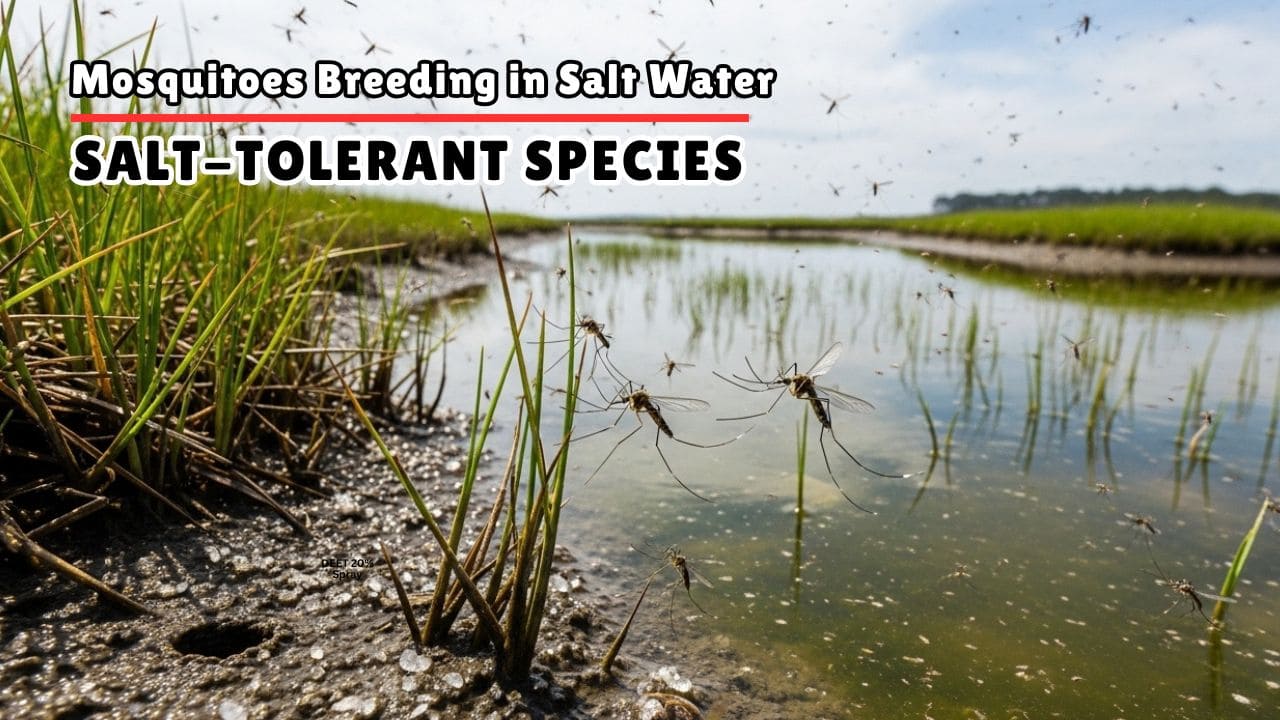
Can Mosquitoes Breed in Salt Water?
Yes — certain mosquito species absolutely can breed in salt water. That might surprise you if you’ve always assumed that only stagnant freshwater ponds or puddles around your yard are the problem. The reality is more complicated. Most common mosquito species do prefer fresh or brackish water, but a notable handful have evolved specifically to survive — and thrive — in saline environments.
If you live near a coastal marsh, tidal flat, or estuary along the Atlantic, Gulf Coast, or Pacific shoreline, you’re likely dealing with salt-tolerant mosquito species that most people have never even heard of. And if you’re wondering whether your backyard salt water pool is safe from mosquito larvae? Keep reading — because that answer is a bit more complex than a flat yes or no.
Which Mosquito Species Can Lay Eggs in Salt Water?
Not every mosquito can tolerate high-salinity environments. The majority of the 3,500+ known species worldwide — including the notorious Culex pipiens (the common house mosquito) and Aedes aegypti (yellow fever mosquito) — strongly prefer clean, standing freshwater. But evolution is a relentless engineer.
Several species have developed the biological adaptations to breed in saline or brackish water conditions. According to mosquito control research and state health agency reports, the main salt water-breeding species in the United States include:
- Aedes sollicitans (Eastern Saltmarsh Mosquito) — Found along the Atlantic coast from Canada down to Texas. Larvae develop in saline coastal marsh pools. Adults are aggressive biters and can fly up to 40 miles inland from their breeding sites. Also a known vector of Eastern Equine Encephalitis (EEE).
- Aedes taeniorhynchus (Black Salt Marsh Mosquito) — Distributed along the Atlantic coast and into California. Breeds in saline pools and tidal wetlands, bites fiercely during daylight hours.
- Aedes cantator — A northeastern coastal species that breeds specifically in saline depressions and marsh pools that flood with tides or heavy rain. Can produce multiple generations per year.
- Aedes dorsalis (Summer Salt Marsh Mosquito) — A brilliant gold-colored species found along California’s coast and the Sacramento-San Joaquin Delta. Larvae can survive in water with salt concentrations up to 3.3 times that of normal seawater, according to the Napa County Mosquito Abatement District.
- Culex salinarius — A permanent-water species found along the Gulf and Atlantic coasts that breeds in both salt and freshwater habitats, including cattail bogs, salt marshes, and roadside ditches.
These are real, well-documented species — not obscure scientific footnotes. If you live anywhere near a coastal area in the US, there’s a reasonable chance you’ve been bitten by one of them without ever knowing it.
How Do Mosquitoes Lay Eggs in Salt Water? The Breeding Cycle Explained
The salt-marsh mosquito breeding cycle is a little different from what most people picture. It’s not as simple as a female landing on a tidal pool and dropping eggs. There’s a specific environmental choreography involved.
Female saltmarsh mosquitoes deposit their eggs on moist soil or marsh surfaces — often in low-lying depressions — not directly on open water. The eggs then dry out for a period (sometimes days, sometimes much longer). When high tides, heavy rainfall, or seasonal flooding submerges those areas, the eggs hatch rapidly. Larvae develop quickly — sometimes in as little as a week — and adults emerge shortly after.
According to research cited by mosquito control programs in New Jersey and other coastal states, the frequency of high-run tides directly determines how many generations of saltmarsh mosquitoes emerge in a given season. In some years, two major flooding tides per month can mean two new mosquito generations — each one larger than the last.
Brackish vs. Full Salt Water: What’s the Difference for Mosquito Breeding?
Here’s something worth understanding: most salt-tolerant mosquitoes actually prefer brackish water — a mix of fresh and salt water — over pure ocean-level salinity. Brackish water is common in coastal estuaries, tidal creeks, and wetlands where freshwater runoff mixes with tidal inflow.
That said, Aedes dorsalis larvae have been documented surviving in water with salt concentrations significantly higher than seawater. So “salt water” isn’t a hard barrier. It’s more of a spectrum, and different species occupy different points on it.
Can Mosquitoes Breed in Salt Water Pools? What Pool Owners Need to Know
This is the question a lot of homeowners are searching for — and it deserves a direct, honest answer.
A properly maintained saltwater pool, one that is regularly chlorinated, filtered, and circulated — should not breed mosquitoes. The combination of chemical treatment and water movement makes it a hostile environment for mosquito larvae.
But. And this is important. A neglected saltwater pool absolutely can become a breeding ground.
According to guidance from the Warren County Mosquito Extermination Commission in New Jersey, unused pools will breed mosquitoes. Even a pool that’s actively used during summer can harbor larvae before and after the swim season if it isn’t properly sealed or treated. Water that collects on pool covers is another overlooked breeding site.
Saltwater Pool Mosquito Prevention: Key Tips
- Keep the pool filtration and chlorination running consistently, even when not in active use.
- Remove standing water from pool covers after rain — water pooling on covers is a prime larval habitat.
- At season’s end, either fully drain and cover the pool tightly, or maintain chemical treatment through fall.
- Inspect surrounding areas — decorative water features, plant pot trays, or low-lying spots that collect rain — separately from the pool itself.
- If larvae are spotted, consult your local mosquito control district or county health department for appropriate larvicide recommendations (such as Bti — Bacillus thuringiensis israelensis — a bacteria-based treatment safe for humans and pets).
Do Mosquitoes Lay Eggs in Ocean Water? What About the Shoreline?
No, the open ocean is not a mosquito breeding ground. The wave action, depth, and salinity make it entirely unsuitable. You will not find mosquito larvae floating in the sea.
But the coastal areas adjacent to the ocean — salt marshes, tidal flats, estuarine pools, brackish ditches — absolutely are. This distinction matters a great deal if you’re a coastal resident trying to figure out where your summer mosquito problem is actually originating.
The Eastern Saltmarsh Mosquito (Aedes sollicitans), for example, has been documented flying up to 40 miles from its coastal marsh breeding site. So if you’re 20 miles inland and getting eaten alive at dusk near the New Jersey shore, the source might be tidal wetlands you’ve never seen.
Disease Risks from Salt Marsh Mosquitoes: What Public Health Says
Salt-tolerant mosquito species aren’t just a nuisance. Several are confirmed vectors of serious diseases. This is an area where it’s important to be accurate — neither alarmist nor dismissive.
Documented disease risks associated with salt marsh mosquito species in the US include:
- Eastern Equine Encephalitis (EEE): Aedes sollicitans and Culex salinarius are both documented vectors. EEE is rare but has a high fatality rate. The CDC and state health departments in coastal states actively monitor for this virus.
- West Nile Virus (WNV): While WNV is primarily spread by Culex species (most of which prefer freshwater), Culex salinarius — a salt-tolerant species — has been linked to WNV transmission in coastal environments.
- Dog Heartworm: Aedes sollicitans is also a competent vector of dog heartworm (Dirofilaria immitis), which is relevant for pet owners in coastal areas.
If you live in a coastal region and want accurate, current disease risk data, your state health department’s vector control division is the most reliable source. The CDC’s ArboNET surveillance system tracks mosquito-borne disease cases nationally and is publicly accessible.
How to Control Salt Marsh Mosquito Breeding Near Your Property?
Individual homeowners have limited control over large tidal marshes — that’s managed at the regional and government level. But there are meaningful actions you can take on your own property.
1. Source Reduction: Eliminating Breeding Sites
- Drain or fill low-lying areas that collect water after tidal flooding or rain.
- Clear ditches and drainage channels so water flows rather than stagnates — standing water in roadside or property ditches can breed thousands of larvae.
- Remove or regularly empty any containers that hold water outdoors — flower pot saucers, buckets, tarps, bird baths. (Yes, even a bottle-cap worth of water is enough for egg laying.)
- Contact your local mosquito control district about Open Marsh Water Management (OMWM) programs — these link shallow mosquito breeding areas to larger permanent water bodies where natural fish predators can feed on larvae.
2. Biological Control Options
BTI (Bacillus thuringiensis israelensis) is a naturally occurring soil bacterium that is highly effective against mosquito larvae and completely safe for humans, pets, birds, and non-target insects like bees. It’s available in dunk or granule form at most hardware stores and online. The EPA has approved its use as a larvicide. This is generally the first-line biological control recommendation from public health agencies for standing water that can’t be drained.
Mosquitofish (Gambusia affinis) are a freshwater option for permanent ponds or water features — but note they are less suited to high-salinity environments.
3. Personal Protection Against Salt Marsh Mosquitoes
- Use EPA-registered insect repellents containing DEET, picaridin, IR3535, or oil of lemon eucalyptus — especially during dusk, dawn, and daytime hours when salt marsh species are most active.
- Wear long sleeves and pants when outdoors near coastal wetland areas.
- Install or repair window and door screens — salt marsh mosquitoes are aggressive and will readily enter homes.
- Be aware that saltmarsh species can fly significant distances — being miles from a visible marsh doesn’t mean you’re outside their range.
Final Takeaway: Yes, Mosquitoes Can Breed in Salt Water
So — can mosquitoes breed in salt water? Yes. Specific species absolutely can, and do, every summer along the US coastline. They’ve been doing it for a very long time. If you live near a tidal marsh, estuary, or coastal wetland, or if you own a saltwater pool that isn’t being maintained during the off-season, this is not a theoretical concern.
The good news is that salt marsh mosquito populations are actively monitored and managed by county and state mosquito control districts across the US. These agencies use aerial larviciding, open marsh water management, and biological control — they’re not ignoring the problem.
But there’s a real role for individual action too. Eliminating standing water on your property, maintaining your pool properly through every season, using EPA-approved repellents, and staying informed through your local health department are all genuinely meaningful steps.
Don’t wait until you’re dealing with a full-blown infestation. Take action now — check your property, contact your local mosquito control district, and share this article with coastal neighbors who might not know what species are flying out of those nearby marshes.
Have you dealt with salt marsh mosquitoes near your home or noticed breeding activity in unexpected places? Drop a comment below — your experience might help someone else figure out where their mosquito problem is really coming from.
Frequently Asked Questions (FAQs)
Q. Does salt water kill mosquito larvae?
High concentrations of salt can indeed kill mosquito larvae — but the threshold varies by species. Salt-adapted species like Aedes dorsalis can survive in water far saltier than the ocean. For freshwater species, even mildly brackish water can be lethal. Adding salt to a water feature as a DIY deterrent is not reliable or recommended — it would need to be at impractical concentrations and would harm plants and surrounding soil.
Q. Can mosquitoes breed in chlorinated salt water pools?
A well-maintained, regularly chlorinated saltwater pool should not support mosquito breeding — the disinfectant and circulation are hostile to larvae. The risk increases dramatically when pools are neglected, turned off for the season, or when water accumulates on pool covers.
Q. Do all mosquito species breed in salt water?
No. The majority of mosquito species — including the house mosquito (Culex pipiens) and the tiger mosquito (Aedes albopictus) — prefer freshwater. Only a specialized subset of species have the physiological adaptations to breed in saline or brackish environments.
Q. What is brackish water and why does it matter for mosquito control?
Brackish water is a mix of fresh and salt water — common in coastal estuaries, tidal flats, and wetlands. Many salt marsh mosquito species thrive in brackish conditions. This is important for mosquito control because brackish areas are often overlooked in favor of obviously stagnant freshwater ponds, allowing coastal breeding sites to go untreated.
Editorial Team & Contributors

Raashid Ansari, Founder, Content Researcher & Author - MosquiTalk
Not an entomologist — just a genuinely curious writer who started researching mosquitoes and couldn't stop. What began as casual reading about repellents and bite prevention gradually turned into a deep ongoing dive into vector biology, disease epidemiology, animal health impacts, and the real science behind mosquito control. Everything published here is carefully edited, and written with one purpose: giving readers accurate, accessible information they can actually trust and use to protect themselves, their families, and their pets, birds and cattle.
Active across social platforms, regularly publishes, and genuinely invested in spreading mosquito awareness where it matters most. Because informed readers make better decisions — and better decisions save lives.