
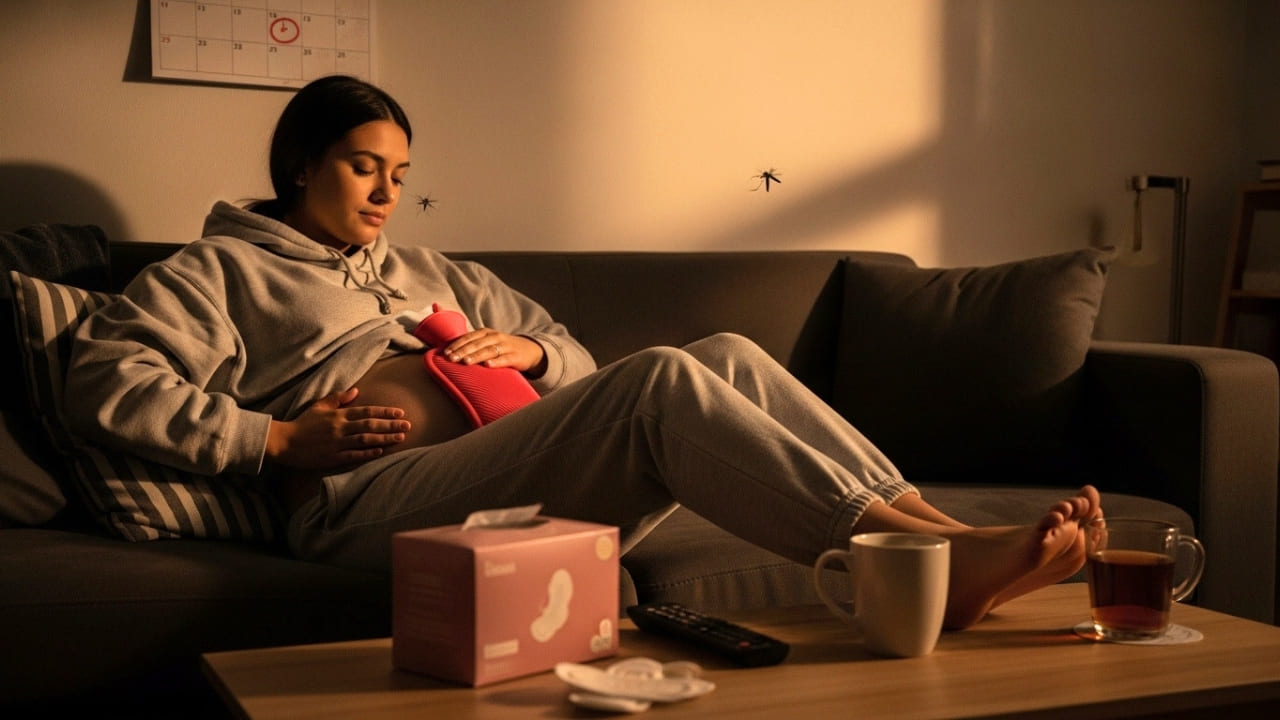
Every woman has had that moment. You’re sitting with a group of people — same weather, same outdoor setting — and somehow you’re the one walking away covered in bites while everyone else is completely fine.
It’s infuriating. And if it seems to happen more at certain times of the month, you’re not imagining it.
The question of whether mosquitoes are more attracted to menstruating women is one that floats around in online forums, gets whispered about at camping trips, and mostly gets dismissed as myth. But the truth is more interesting — and more nuanced — than a flat yes or no.
Because there IS science here. Not as much as we’d like. But enough to say something meaningful. Let’s get into it.
This article covers the research, the biology, the hormonal factors, and some genuinely practical tips — including what happens at the other end of the hormonal spectrum, during menopause.
Mosquitoes Attracted to Menstruating Women: What Does the Science Actually Say?
Let’s start with the honest version: the direct research specifically on menstruation and mosquito attraction is limited. This isn’t a topic that has received the research funding it probably deserves.
But here’s what we do know. A study conducted in the Gambia — one of the few that looked directly at this question — found that mosquitoes showed a measurable preference for women during menstruation compared to non-menstruating periods. The proposed mechanism wasn’t the blood itself. It was the hormonal changes that accompany menstruation.
That distinction matters a lot. And we’ll come back to it.
What’s better established is that mosquitoes respond to a complex cocktail of chemical signals: carbon dioxide, body heat, lactic acid, ammonia, and volatile skin compounds. Menstruation changes several of these factors — not dramatically, but measurably.
Mosquitoes are not tracking your calendar. They’re tracking your chemistry. And your chemistry shifts throughout your menstrual cycle in ways that can — under certain conditions — increase your attractiveness as a host.
Can Mosquitoes Smell Period Blood?
This is the question everyone is actually wondering about but feels weird Googling. So let’s just answer it directly.
Can mosquitoes smell period blood? The short answer is: probably not in the way you’re imagining — but there’s more to it.
Mosquitoes are extraordinarily sensitive chemical detectors. They can pick up on blood-related compounds. Research has shown that certain volatile compounds associated with blood — particularly those released when blood is exposed to air — can be detected by some insects. Tsetse flies, for instance, are strongly attracted to blood odor.
For mosquitoes specifically, the evidence is less clear-cut. Menstrual blood that remains inside a tampon or menstrual cup has minimal air exposure, which would limit volatile release. Blood that is present on external surfaces is a different scenario — more air exposure, more potential for volatile compounds to disperse.
But here’s the more important point: even if mosquitoes can pick up trace volatiles from menstrual blood, that’s almost certainly not the primary driver of any increased attraction. The hormonal changes of menstruation are far more significant — they change your whole-body chemistry in ways that are much more detectable to a mosquito than localized blood.
What Blood-Related Compounds Can Mosquitoes Detect?
Research from Sweden (published in the journal eLife) identified specific compounds in sweat and skin secretions that interact with blood-feeding insects. Some of these compounds — carboxylic acids, aldehydes — are present in menstrual blood and in the skin of menstruating women. The study found that these compounds influenced feeding behavior in both mosquitoes and tsetse flies.
So: not “smelling blood” in the dramatic sense. More like: detecting a suite of volatile compounds that are slightly elevated during menstruation. The difference is subtle but meaningful.
Do Mosquitoes Get Attracted to Period Blood? The Hormonal Explanation
Here’s where the real science sits.
The menstrual cycle is driven by hormonal shifts — primarily estrogen and progesterone. These hormones don’t just affect the reproductive system. They influence metabolism, body temperature, sweat production, immune function, and the composition of skin secretions. All of which are things mosquitoes can detect.
What Changes During Menstruation That Mosquitoes Pick Up On
1. Body Temperature
Core body temperature fluctuates across the menstrual cycle. It rises slightly after ovulation and drops at the onset of menstruation. This temperature shift — even fractions of a degree — affects how much heat your body radiates. Mosquitoes use infrared heat sensing at close range to pinpoint hosts. A warmer body surface is a slightly stronger signal.
2. Carbon Dioxide Output
Metabolic rate changes across the menstrual cycle. In the luteal phase (the week before your period), metabolic rate increases slightly — meaning you’re burning more energy and exhaling more CO₂. CO₂ is the single most important long-range mosquito attractant. Even a small increase in output matters.
3. Sweat Composition
Estrogen and progesterone both influence sweat gland activity. During menstruation, shifts in these hormones alter the compounds present in sweat — including lactic acid, ammonia, and various volatile organic compounds. Lactic acid in particular is a well-documented mosquito attractant. When its concentration in sweat changes, so does your attractiveness as a host.
4. Skin Microbiome
The hormonal environment of the skin affects which bacteria thrive there. Different bacterial communities metabolize skin compounds differently — producing different volatile byproducts. Some of these bacterial metabolites are mosquito attractants. The menstrual cycle’s hormonal shifts can subtly shift the skin microbiome, which in turn shifts the volatile profile mosquitoes are detecting.
5. Immune Function
Immune activity changes across the menstrual cycle. During menstruation, certain inflammatory markers are elevated. There’s evidence that immune status affects the chemical signals hosts produce. A host with altered immune activity may present a different chemical profile than the same host at a different point in their cycle.
Mosquitoes Attracted to Menstrual Blood: Breaking Down the Myth vs. Reality
So is it the blood or is it the hormones? Honestly — it’s mostly the hormones. But the distinction matters for practical reasons.
If it were purely about blood, then external protection (tampons, cups, period underwear) would largely neutralize the effect. If it’s hormonal — which the evidence more strongly suggests — then what you’re dealing with is a systemic shift in your body’s chemical output that can’t be blocked by a hygiene product alone.
That’s a less comfortable answer. But it’s probably the more accurate one.
The “mosquitoes attracted to menstrual blood” framing also misses something important: the changes aren’t limited to the days you’re actually bleeding. The hormonal buildup and the post-menstrual hormonal recalibration mean that the window of potentially elevated attractiveness may extend beyond the period itself — particularly in the late luteal phase.
How Long Can Mosquitoes Smell Period Blood?
People search this question a lot. And it’s worth addressing directly — even if the answer is a bit of a redirect.
“How long can mosquitoes smell period blood” implies a specific, time-limited detection scenario — like a shark tracking a blood trail. Mosquito biology doesn’t quite work that way.
Mosquitoes don’t pursue a blood scent trail over distance the way some predators do. They’re primarily attracted by CO₂ at range, then close in using heat and skin volatile cues. If menstrual blood is the source of volatile compounds, those compounds disperse quickly into the surrounding air. There’s no sustained trail being laid down.
What’s more relevant is: how long does the altered hormonal chemistry of menstruation persist? And the answer is roughly 3–7 days depending on cycle length and individual variation — the duration of menstruation itself, plus the hormonal fluctuations that precede and follow it.
So if there’s a window of elevated mosquito attraction, it’s roughly tied to the full menstrual phase — not to a specific moment of scent detection.
Does Your Phase in the Menstrual Cycle Matter?
Yes — and this is actually an underexplored angle.
The menstrual cycle has four phases: menstrual, follicular, ovulatory, and luteal. Hormone levels vary significantly across all four. Which means your potential mosquito attractiveness isn’t constant — it shifts.
- Menstrual phase (days 1–5): Estrogen and progesterone are low. Temperature drops. Some women report feeling less bitten during lighter flow days — though heavy flow days with elevated inflammatory markers may work differently.
- Follicular phase (days 1–13): Estrogen rises. Skin health often improves. CO₂ and temperature are relatively stable. Possibly the lower-attractiveness window for many women.
- Ovulatory phase (around day 14): Estrogen peaks. Body temperature rises. There’s some evidence that ovulation itself is associated with increased mosquito attraction — the hormonal peak produces the strongest systemic chemical changes.
- Luteal phase (days 15–28): Progesterone dominates. Metabolic rate increases. CO₂ output rises slightly. Body temperature is elevated. This is potentially the highest-attractiveness window — and it precedes menstruation, which may explain why many women feel bitten more in the days before their period.
Individual variation is significant here. These patterns won’t apply uniformly to every woman. But the framework is useful.
Menopause and Mosquito Bites: Does Hormonal Change Shift Your Risk?
This is a fascinating angle that almost nobody talks about.
Menopause involves a dramatic reduction in estrogen and progesterone levels. If these hormones are part of the reason menstruating women attract more mosquitoes, does their decline reduce mosquito attraction post-menopause?
The honest answer is: we don’t have strong direct research on this yet. But there are some clues.
Some postmenopausal women report being bitten less frequently — and attribute this subjectively to hormonal change. That’s anecdotal. But it’s consistent with what the hormonal biology would predict.
On the other hand, menopause brings its own chemical changes. Hot flashes, for instance, involve sudden increases in skin temperature and sweating — both of which are mosquito attractants. A woman in the middle of a hot flash is potentially a stronger target than she would be otherwise.
Hormone replacement therapy (HRT) adds another variable. Women on estrogen-based HRT may maintain a hormonal profile closer to their pre-menopausal state — which could affect mosquito attraction in ways that haven’t been specifically studied.
Menopause and mosquito bites is genuinely underresearched territory. If you’ve noticed a change in how often you’re bitten before and after menopause, you’re observing something real — science just hasn’t caught up to it fully yet.
Practical Tips: How to Reduce Mosquito Bites During Your Period
Understanding the biology is useful. Doing something about it is better.
Repellents That Actually Work
- DEET (10%–30%) — the most thoroughly tested and effective option. Works against virtually all mosquito species.
- Picaridin — comparable efficacy to DEET with a lighter feel and less skin irritation for many people.
- IR3535 — effective, widely available in US products, gentler option.
- Oil of lemon eucalyptus (OLE) — plant-based, good efficacy, but needs more frequent reapplication than DEET or picaridin.
Non-Chemical Strategies
- Shower before outdoor activities — reduces skin bacterial load and washes away accumulated volatile compounds.
- Avoid scented body products — fragrances can interact with natural skin volatiles in ways that amplify attractant signals.
- Wear light-colored, loose-fitting clothing to cover skin during peak mosquito hours (dawn and dusk).
- Stay in air-conditioned or well-screened spaces during the evenings — mosquitoes don’t fly well in cool, low-humidity environments.
- Eliminate standing water near your home — 7 days of stagnant water is enough to breed a new generation.
Timing Your Outdoor Activities
If you notice a pattern of increased bites at certain points in your cycle, work with it. Schedule outdoor evening activities during your follicular phase when possible. If you’re in the luteal phase or menstruating and need to be outside, double up on protection — repellent plus clothing coverage.
📰 Must Read,
✔️ What to Take Orally to Prevent Mosquito Bites: Pills, Vitamins, Diet, and Supplements
✔️ Backyard Mosquito Control: 10 Methods Compared (Cost, Effectiveness & Scientific Evidence)
The Bottom Line: Are Mosquitoes More Attracted to Menstruating Women?
The evidence says: possibly yes — but for reasons more complex than the common assumption.
Mosquitoes attracted to menstruating women isn’t really about blood detection. It’s about the cascade of hormonal changes that menstruation involves — shifts in CO₂ output, body temperature, sweat composition, and skin chemistry that make some women a stronger signal at certain points in their cycle.
Can mosquitoes smell period blood? Maybe trace volatiles, but that’s almost certainly not the main driver. The hormonal story is more convincing, better supported, and more practically relevant.
How long can mosquitoes smell period blood — or more accurately, how long does elevated attractiveness last? Roughly the duration of the menstrual phase plus the hormonal fluctuations around it. For many women, that means the luteal phase plus the period itself: potentially 10–14 days of a cycle where attraction may be elevated.
And for women navigating menopause and mosquito bites: the hormonal terrain changes significantly, but it doesn’t become simple. Hot flashes, HRT, and individual variation all play in.
The research on this topic is honestly thinner than it should be. Women’s health has historically been underfunded in insect-biology research, just as in so many other areas. What we have points in a clear direction — but more rigorous, gender-specific mosquito research would be welcome.
Have You Noticed a Pattern With Your Cycle and Mosquito Bites?
This is one of those topics where real-world observation genuinely adds to the conversation. Have you noticed that you get bitten more at certain times of the month? Has your pattern changed after menopause or starting hormonal birth control?
Drop your experience in the comments. Women sharing their observations on this could legitimately help others recognize patterns they’d dismissed as coincidence — and that’s worth something.
Frequently Asked Questions (FAQs)
Q: Do mosquitoes bite more when you have your period?
There’s evidence suggesting they might — but it’s not as simple as the period itself being the trigger. The hormonal changes that accompany menstruation alter CO₂ output, body temperature, and sweat chemistry in ways that can increase mosquito attraction. The effect varies by individual and isn’t universal. But if you notice a pattern, the biology supports that observation.
Q: Do mosquitoes know when you are on your period?
Not in any conscious or deliberate sense — mosquitoes aren’t making decisions. But their olfactory systems may detect the chemical differences that accompany menstruation, particularly changes in skin volatiles and sweat composition driven by hormonal shifts. It’s detection, not awareness.
Q: Can mosquitoes smell period blood from a distance?
Direct detection of menstrual blood at distance is unlikely in real-world conditions, especially with modern menstrual products that limit air exposure. What’s more plausible is that menstruation-related hormonal changes alter whole-body chemistry in ways mosquitoes detect at close to medium range — not a blood trail, but a subtly different scent profile.
Q: Are mosquitoes worse during PMS or the week before your period?
Possibly. The luteal phase — the week before menstruation — is when metabolic rate and progesterone are highest. CO₂ output increases slightly, and body temperature is elevated. This could create a window of slightly higher mosquito attraction before bleeding even begins. Many women report feeling more bitten during this phase, which aligns with the hormonal data.
Q: Does menopause affect how many mosquito bites you get?
Potentially. Reduced estrogen and progesterone post-menopause may lower some of the hormonal signals that attract mosquitoes. However, menopause symptoms like hot flashes increase skin temperature and sweating temporarily — both of which attract mosquitoes. The net effect likely varies by individual and by symptom severity.
Q: Which menstrual products are best for reducing mosquito attraction outdoors?
Menstrual cups and internal products that minimize blood air exposure are theoretically better from a volatile-compound standpoint. But since the primary driver of any increased attraction is systemic hormonal change rather than localized blood odor, product choice has a limited impact. Repellent and protective clothing are more effective strategies.
Q: Do female mosquitoes bite more than male mosquitoes?
Only female mosquitoes bite at all — they need blood protein to develop eggs. Male mosquitoes feed exclusively on nectar. So every mosquito bite you’ve ever had came from a female. This is relevant context when discussing female-specific attractants: the insect doing the biting and the human being targeted are both female.
Q: Is there a time of day mosquitoes are worst during menstruation?
Mosquito activity peaks at dawn and dusk regardless of your menstrual cycle phase. Any cycle-related increase in your attractiveness is layered on top of this baseline activity pattern — it doesn’t shift the timing, it potentially amplifies the impact. Avoid peak hours whenever possible, especially during the luteal and early menstrual phases.
Editorial Team & Contributors

Raashid Ansari, Founder, Content Researcher & Author - MosquiTalk
Not an entomologist — just a genuinely curious writer who started researching mosquitoes and couldn't stop. What began as casual reading about repellents and bite prevention gradually turned into a deep ongoing dive into vector biology, disease epidemiology, animal health impacts, and the real science behind mosquito control. Everything published here is carefully edited, and written with one purpose: giving readers accurate, accessible information they can actually trust and use to protect themselves, their families, and their pets, birds and cattle.
Active across social platforms, regularly publishes, and genuinely invested in spreading mosquito awareness where it matters most. Because informed readers make better decisions — and better decisions save lives.