
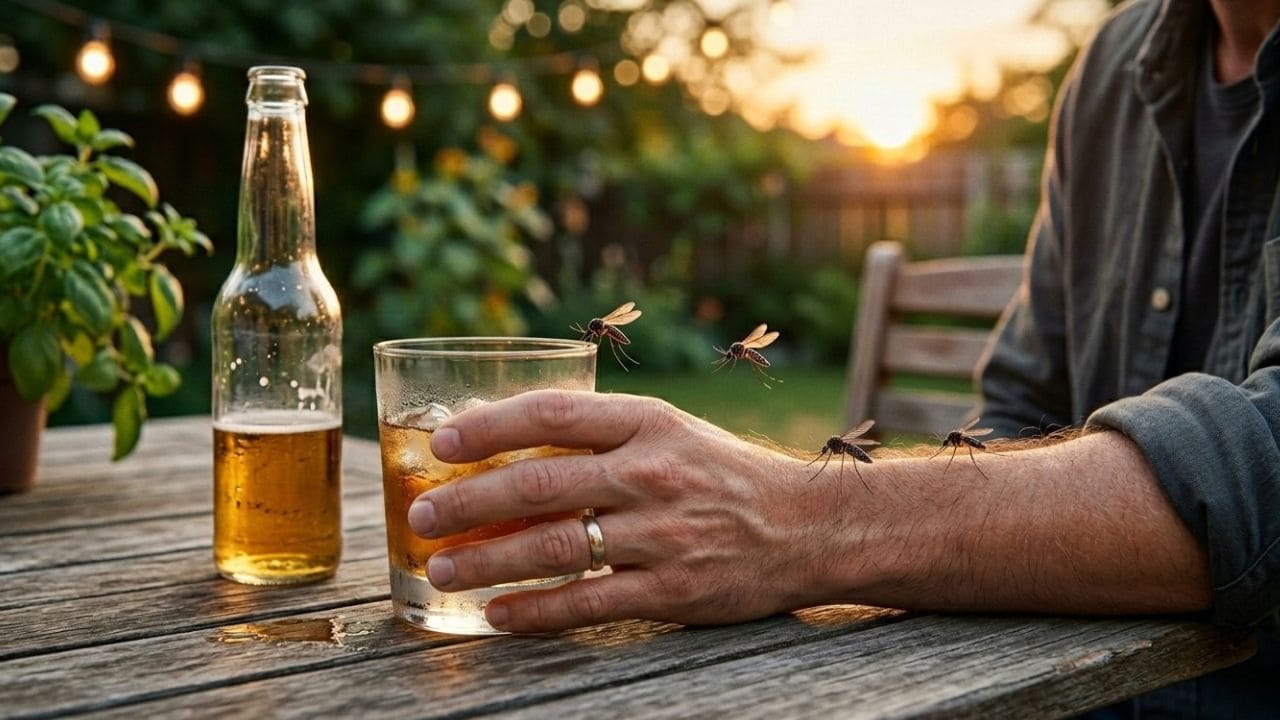
Does Really, Drinking Alcohol Attracts Mosquitoes?
Yes — drinking alcohol, especially beer, does attract mosquitoes. And if you’re the person at every summer BBQ who ends up with twice as many bites as everyone else, that cold beer in your hand may be a bigger reason than your blood type, your deodorant, or plain bad luck.
Do Mosquitoes Bite More When You Drink Alcohol?
The real answer, though, is more interesting than a simple yes. Because the exact mechanism is still debated by scientists. The carbon dioxide angle, the skin temperature theory, the sweat composition shift — researchers have proposed them all. Some hold up better than others. And knowing which is which can actually help you protect yourself. So let’s get into it.
Here’s what’s actually happening inside your body when you drink alcohol — and why mosquitoes notice before you do.
Do Mosquitoes Prefer Beer Drinkers? What the Research Says About Alcohol and Mosquito Attraction
Yes, beer drinkers are mosquito magnets. Two key studies dominate this conversation. Both are real. Both have limits. Worth knowing both.
1. The 2002 Japanese Study: One Beer Was Enough
Researchers at Toyama Medical and Pharmaceutical University in Japan ran a controlled study with 13 volunteers. Each participant had mosquito landing counts recorded before and after drinking a single 12-ounce beer. The result? Mosquito landings increased significantly after beer consumption. The authors concluded — in their own published words — that “drinking alcohol stimulates mosquito attraction.”
The kicker? Ethanol levels in sweat and actual body temperature did not significantly correlate with increased landings. So the researchers confirmed the effect but couldn’t fully explain the mechanism. That’s honest science. And it tells us something important: multiple body chemistry changes are probably at work, not just one.
2. The 2010 Burkina Faso Study: Beer and Malaria Mosquitoes
Published in PLOS ONE, this study tested 25 volunteers against the Anopheles gambiae mosquito — the primary malaria vector in sub-Saharan Africa. Using an olfactometer (a device that measures odor-driven behavior), researchers tested mosquito activation and directional flight before and after beer consumption.
Beer drinkers showed measurably higher mosquito attraction. Water drinkers? No change at all. The researchers went so far as to flag the public health implications, suggesting beer consumption may be a risk factor for malaria exposure.
3. The 2023 Music Festival Study: 44% More Attractive After Beer
The largest study of its kind was carried out at the Lowlands music festival in the Netherlands in 2023. Over 465 participants placed their forearms against a box of mosquitoes. The findings were striking. Beer drinkers were found to be 44% more attractive to mosquitoes than those who had abstained.
Meanwhile, festivalgoers who had showered and applied sunscreen were 48% less attractive. Cannabis users fell in the middle at 35% more attractive. Blood type, which many people swear by, showed no significant association in this study.
Why Does Drinking Alcohol Make You More Attractive to Mosquitoes?
This is where it gets genuinely fascinating. Mosquitoes don’t “want” your beer. They can’t taste it in any meaningful way. What they’re responding to are the physiological changes alcohol triggers in your body. Several are worth understanding separately.
1. Skin Vasodilation and Surface Warmth
Alcohol is a vasodilator. That means it causes your blood vessels to expand and warm blood to rush closer to the skin’s surface. Your core temperature doesn’t actually rise — that’s a common misconception — but the radiant heat from your skin increases detectably.
Mosquitoes use infrared heat sensors to locate hosts at close range. A flushed, vasodilated arm is basically a warmer, more readable target. That’s probably why the skin flush you see after a couple of drinks isn’t just aesthetic. It’s also a navigational beacon for insects you don’t want landing on you.
2. Increased Carbon Dioxide Output
Mosquitoes can track carbon dioxide plumes from over 100 feet away. CO₂ is their primary long-range navigation signal. Alcohol metabolism in the liver increases the metabolic rate slightly, which can elevate respiration and CO₂ output.
Beyond what’s in your lungs, there’s the drink itself. Open a beer and CO₂ bubbles directly into the air around you. Researchers have actually noted that carbonated beverages — beer especially — create a localized CO₂ plume that draws mosquitoes in. It’s why an open, flat beer left across the yard can function as a crude mosquito trap.
3. Altered Sweat Chemistry and Skin Microbiome Changes
When your body metabolizes ethanol, by-products — including acetaldehyde and various volatile organic compounds — are excreted through your sweat and breath. Mosquitoes have highly sensitive olfactory receptors tuned to detect specific human scent compounds.
Alcohol also shifts the composition of your skin microbiome. The bacteria living on your skin produce odors that mosquitoes can detect. Even slight shifts in microbial populations, triggered by drinking, can alter your scent signature in ways that register as more attractive to certain mosquito species. Research from the Lowlands festival found that Streptococcus bacteria on the skin were linked to higher mosquito attraction scores.
4. Increased Sweating
Alcohol increases overall sweat production. Sweat contains lactic acid, ammonia, uric acid, and other compounds that mosquitoes use as host-detection cues. The more you sweat, the stronger your scent signal. Combine elevated sweating with an outdoor environment at 85°F and you’re essentially broadcasting your location.
Mosquito Attraction Linked to Beer and Hygiene Habits
Here’s something most people don’t think about when they crack open a drink at a summer cookout — you’re not just dealing with what’s in the can. You’re dealing with what’s already on your skin.
And when beer meets a body that’s been sweating, skipped a shower, or been active all day? That’s a scent combination mosquitoes genuinely respond to more than either factor alone.
Your Skin Microbiome Is Working Against You
Fresh sweat, by itself, is largely odorless. The smell comes later — when the bacteria living on your skin break it down.
Skin bacteria break down components of sweat and sebum into odorous volatile compounds that mosquitoes can detect. Sweat itself is odorless when freshly secreted, but combined with the bacteria on your skin, it becomes significantly more attractive to mosquitoes than fresh sweat alone.
That’s worth sitting with. The mosquitoes aren’t chasing your sweat. They’re chasing what your skin bacteria do to your sweat. Two completely different things.
And specific bacteria matter more than others. Research found that in men who attracted more mosquitoes, the abundance of Staphylococcus spp. was 2.62 times higher and Pseudomonas spp. was 3.11 times higher compared to men the mosquitoes largely ignored. So not all skin bacteria are equal in this equation. Some species are just louder attractants than others.
Where Alcohol Enters the Equation
Now layer beer consumption on top of this.
Alcohol alters your skin microbiome. It changes the volatile compound profile being emitted from your skin surface. The 2023 Lowlands music festival study found that Streptococcus bacteria on the skin were linked to higher mosquito attraction scores — and that beer drinkers were among the highest scorers overall.
Showering removes the surface layer of sweat, lactic acid, and bacteria-produced odors that mosquitoes rely on for close-range targeting — but the protection window is narrow. Within an hour or two, the skin’s bacterial population begins reasserting itself.
So if you had a long day, skipped a shower, and then went outside with a beer — your skin has hours of accumulated bacterial activity already broadcasting your location. The alcohol then adds vasodilation, altered breath chemistry, and CO₂ from the drink itself. That’s three to four signals compounding simultaneously.
Mosquitoes are navigating by a layered system. You’ve just turned up the volume on most of the channels at once.
The Hygiene Habits That Actually Shift Your Attractiveness
This isn’t about being obsessively clean. It’s about understanding the timing.
Showering promptly after sweating removes lactic acid and ammonia before bacteria fully metabolize them. Using unscented or mildly scented products avoids adding fragrance compounds that can act as secondary attractants. Changing out of sweaty clothes matters too — sweat-soaked fabric keeps bacteria active and odor-producing longer than clean skin.
A few practical things worth building into your outdoor routine:
- Shower before, not after. If you’re heading to an evening patio gathering or cookout, showering an hour or two beforehand meaningfully lowers your scent load going in. The Lowlands festival study found showering was associated with nearly 48% lower mosquito attraction — one of the single strongest individual protective factors measured.
- Don’t combine post-workout beer with outdoor sitting. Exercise elevates lactic acid in your sweat. Lactic acid is a documented mosquito attractant. Crack a beer immediately after a run or gym session while sitting outside and you’re stacking exercise-induced chemistry on top of alcohol-induced chemistry. That’s a rough combination.
- Watch your soap and fragrance choices. No soap makes you repellent, but some soaps temporarily reduce the odor compounds mosquitoes track. Others add new ones — fragrance is often the variable that tips the balance. Floral and fruity fragrances can actually mimic plant volatiles that certain mosquito species use to locate hosts. Unscented or lightly scented products are generally the safer choice for outdoor evenings.
- Change your clothes if you’ve been sweating. A damp shirt from an afternoon of yard work, worn into the evening while you have a drink outside, is still actively producing bacterial odors. Fresh clothes lower your ambient scent signal even if the rest of your routine doesn’t change.
Nobody’s saying skip the beer and take two showers to survive a backyard gathering. That’s not the point.
The point is: these two things — alcohol consumption and accumulated sweat and bacteria on skin — are not independent variables when it comes to mosquito attraction. They interact. They compound.
Maintaining personal hygiene, particularly showering before outdoor activities, can help reduce the appeal of sweat to mosquitoes. Avoiding alcohol before extended outdoor time is also cited as a practical protective step.
If you’re someone who already seems to attract more bites than the people around you, your skin microbiome composition is probably part of the reason — and alcohol is almost certainly making that baseline higher, not lower. The combination of the two is worth taking seriously, especially if you’re spending evenings outdoors in areas where mosquito-borne disease risk is meaningful.
Small habit adjustments, layered together, add up. That’s really the whole message.
Does It Matter What You’re Drinking? Beer vs. Wine vs. Spirits
This is a fair question. And the simplest answer is: beer probably draws the most attention, but all alcohol contributes.
Beer has a compounding effect because it’s carbonated. The CO₂ released when you open a can or bottle, and while you’re drinking it, adds an extra attractant layer that wine and spirits don’t have. Still wine, whiskey, vodka — they don’t off-gas CO₂ the same way.
That said, any alcohol consumption triggers vasodilation, metabolic changes, and increased sweating. So if you’re drinking wine and wondering why you’re getting bitten — yes, the wine is a factor. Spirits too. The carbonation question is specific to beer, but the body chemistry changes apply across the board.
Bottom line: beer drinkers may be at the top of the mosquito preference list, but no alcohol is truly neutral.
Alcohol Is One Factor — Here Are the Others That Also Matter
Alcohol increases your risk, but mosquito attraction is multi-variable. Knowing the other factors helps you build a more complete defense.
- Blood type: Some research suggests Type O blood may attract more mosquito landings than Type A, though evidence is mixed and not consistent across all studies.
- Pregnancy: Pregnant individuals exhale more CO₂ and have a higher body temperature, making them more detectable targets. The CDC acknowledges elevated risk during pregnancy for mosquito-borne illness exposure.
- Exercise and lactic acid: Post-workout lactic acid in sweat is a documented mosquito attractant. If you’ve just exercised and then cracked a beer, you’re combining two significant attraction factors simultaneously.
- Dark clothing: Mosquitoes use visual cues at close range. Dark-colored clothing is more visible against the horizon, making you easier to locate once a mosquito is within visual range.
- Skin microbiome composition: Some individuals naturally host skin bacteria that produce more attractive odor profiles. This is why some people genuinely seem to attract more bites regardless of what they eat or drink.
- Floral or fruity fragrances: Perfumes, body sprays, and scented lotions can mimic plant-based attractants. Some fragrances draw mosquitoes; others — notably certain essential oils — repel them.
Does Drinking Alcohol Make Mosquito Bites Itch More?
This one comes up a lot. And the answer is: probably yes, though the mechanism is indirect.
When a mosquito bites you, it injects saliva containing anticoagulants and proteins that your immune system responds to. The itching is an inflammatory reaction — your body releasing histamine at the bite site.
Alcohol has a complex relationship with histamine. Alcoholic beverages — particularly wine, beer, and certain spirits — contain histamines naturally. Additionally, alcohol inhibits the enzyme (diamine oxidase) your body uses to break down histamine. So after drinking, histamine levels in your system tend to run higher.
Higher baseline histamine + a mosquito bite triggering more histamine release = potentially more intense itching and swelling. It’s not guaranteed for everyone, but if your bites seem worse after drinking, this is the likely biochemical explanation.
Alcohol also suppresses immune modulation temporarily, which could influence how quickly your body resolves the inflammatory response. More research is needed here, but the histamine connection is biologically plausible and well-supported.
Why This Actually Matters: Alcohol Consumption and Mosquito-Borne Disease Risk
More bites isn’t just an annoyance issue. In many parts of the world — and increasingly in the United States as climate patterns shift — mosquitoes transmit serious diseases.
The Burkina Faso PLOS ONE study specifically noted that beer consumption may function as a behavioral risk factor for malaria transmission. The authors called for this to be incorporated into public health messaging. That’s a significant conclusion from a peer-reviewed publication.
In the US, the CDC monitors mosquito-borne diseases including West Nile virus, dengue (increasingly in southern states), chikungunya, and Zika. For travelers heading to tropical regions where malaria is endemic, the alcohol-mosquito connection takes on genuine clinical relevance.
The point isn’t to alarm you. It’s to flag that increased bite frequency — even from a source as ordinary as having a drink on your patio — translates to increased exposure probability. That’s a real number, not a theoretical one.
How to Protect Yourself When You’re Drinking Outdoors?
The research doesn’t mean you have to stop enjoying drinks outside. It means you should be smarter about protection when you do. Here’s what actually works.
- Apply EPA-registered repellent before going outside. Products containing DEET (20–30%), picaridin, IR3535, or oil of lemon eucalyptus are all recommended by the CDC and EPA. DEET at 30% provides several hours of reliable protection even when sweating. Apply it before your first drink, not after.
- Keep beer cans or bottles covered when not drinking. An open, fizzing beer sitting on a table near you is emitting CO₂. That actively draws mosquitoes toward your seating area. Use a can cover or keep lids on when possible.
- Wear light-colored, long-sleeved clothing. Reduces exposed skin area and makes you visually less conspicuous to mosquitoes hunting by sight at close range.
- Use fans. Mosquitoes are weak fliers. Even a moderate breeze from a portable fan disrupts their flight path and disperses your CO₂ plume. This is one of the most underrated outdoor mosquito deterrents.
- Eliminate standing water near your outdoor space. Bottle caps, coolers, buckets, potted plant saucers — any standing water is a potential breeding site. Anopheles and Aedes mosquitoes can breed in as little as a tablespoon of standing water.
- Shower before outdoor evening events. The Lowlands festival study found that showering was one of the strongest individual protective factors — cutting mosquito attraction by nearly half. Reducing accumulated sweat and skin bacteria before going out makes a measurable difference.
- Consider timing. Mosquito activity peaks at dawn and dusk. If your outdoor drinking happens during those windows, protection matters more. Midday activity (especially in summer heat) tends to be lower for most mosquito species common in the US.
Common Myths About Alcohol and Mosquitoes — Cleared Up
Myth 1: Mosquitoes are attracted to the alcohol in your blood
False. Mosquitoes can’t detect blood alcohol content. What they respond to are surface-level signals — heat, CO₂, skin chemistry, and scent. The attraction happens before they even bite you.
Myth 2: Drinking alcohol raises your core body temperature
Not exactly. Alcohol causes peripheral vasodilation, which brings warm blood to the skin surface. You feel warmer and your skin radiates more heat — but your actual core temperature doesn’t measurably increase. The distinction matters because mosquitoes detect surface heat, not core temperature.
Myth 3: Only beer drinkers attract mosquitoes
The beer-specific research gained the most media coverage because those were the primary study beverages. But the underlying physiological effects — vasodilation, altered sweat, CO₂ changes — apply to all alcohol. Wine drinkers, cocktail drinkers, and spirits drinkers are all affected.
Myth 4: Drinking heavily repels mosquitoes
No. There’s no evidence that high blood alcohol acts as a repellent. If anything, heavier drinking amplifies the physiological signals that attract mosquitoes — more flushing, more sweating, more volatile compounds in your breath and skin emissions. The effect is dose-dependent in the direction of more attraction, not less.
Expert Perspective: What This Means for Everyday Life
Having spent years studying mosquito host-seeking behavior, what strikes me most about the alcohol-attraction research is how understudied it remains. We have strong directional evidence across multiple studies, conducted on different continents, with different mosquito species, and the signal is consistent.
But the mechanism is still not fully resolved. The easy answer — “ethanol in sweat” — didn’t hold up under scrutiny in the Japanese study. What we’re probably looking at is a combination of effects: skin temperature, microbiome alteration, volatile compound changes in breath, and altered sweat chemistry all working together to shift your attractiveness profile.
For most people in low-mosquito-density environments, the practical risk from an occasional drink outdoors is minimal beyond some extra bites. But for travelers to malaria-endemic regions, people in areas with active dengue or Zika transmission, or immunocompromised individuals — this is worth taking seriously.
The protective interventions are simple and highly effective. Use them.
Frequently Asked Questions (FAQs)
Q. Do mosquitoes bite more when you drink alcohol?
Yes. Multiple studies show that alcohol consumption increases mosquito landings and bites. The effect is most documented with beer but applies to other alcoholic beverages as well.
Q. Does drinking wine attract mosquitoes?
Yes. Wine causes the same vasodilation and metabolic changes as beer. It lacks the CO₂ off-gassing component of carbonated beer, but all other attraction factors still apply.
Q. Are beer drinkers really mosquito magnets?
The data suggests yes. The combination of CO₂ from carbonation, vasodilation effects, and altered skin chemistry makes beer drinkers more attractive than sober individuals in controlled study conditions.
Q. Can DEET protect you even when drinking?
Yes. EPA-registered repellents like DEET and picaridin work regardless of whether you’ve been drinking. They mask the chemical signals on your skin that mosquitoes use for host detection. Apply before you go outside.
Final Word: Does Drinking Alcohol Attracts Mosquitoes?
Yes. Alcohol consumption — particularly beer, but all types — measurably increases your attractiveness to mosquitoes. The science is consistent across multiple studies and several continents. The mechanism involves a combination of skin vasodilation, CO₂ changes, sweat chemistry shifts, and skin microbiome alterations.
Alcohol can also make bites itch more by elevating histamine levels in your system. That’s a double hit: more bites, more reaction per bite.
The practical response isn’t to stop enjoying outdoor drinks. It’s to layer your protection. Apply repellent before you go out. Keep your drink covered when not sipping. Wear appropriate clothing. Use a fan. Be especially diligent if you’re traveling somewhere with active disease transmission.
You don’t have to be a mosquito magnet just because you’re enjoying a drink outside. You just have to be a little more prepared than the person sitting next to you who isn’t.
💡 Have you noticed you get more bites when you’re drinking? Or do you have a protection routine that actually works outdoors? Drop your experience in the comments — real-world observations help others make smarter decisions.
Editorial Team & Contributors

Raashid Ansari, Founder, Content Researcher & Author - MosquiTalk
Not an entomologist — just a genuinely curious writer who started researching mosquitoes and couldn't stop. What began as casual reading about repellents and bite prevention gradually turned into a deep ongoing dive into vector biology, disease epidemiology, animal health impacts, and the real science behind mosquito control. Everything published here is carefully edited, and written with one purpose: giving readers accurate, accessible information they can actually trust and use to protect themselves, their families, and their pets, birds and cattle.
Active across social platforms, regularly publishes, and genuinely invested in spreading mosquito awareness where it matters most. Because informed readers make better decisions — and better decisions save lives.