
Last updated: October 2026 • Sources: CDC, Florida Dept. of Health, University of Florida IFAS, NOAA, Climate Central
Florida is one of only a handful of places in the United States where mosquito season never truly ends. While residents in Chicago or Boston get a frost-enforced reprieve every winter, Floridians have no such luck. Warm temperatures, high humidity, relentless summer rainfall, and a geography riddled with wetlands, lakes, and coastal waterways create ideal conditions for mosquitoes to breed, bite, and spread disease across virtually every month of the year.
Read More: Mosquito Season in US – State-wise data
For residents, homeowners, and travelers, understanding mosquito season in Florida — when it starts, when it peaks, and how it’s shifting — is no longer just a matter of comfort. It is a genuine public health priority. Mosquito-borne illnesses including dengue, West Nile virus, and Eastern equine encephalitis are documented in the state annually.
And according to data compiled through early 2026, the 2025 season was significantly more intense than average nationally, with the CDC and AMA reporting 41% more severe West Nile cases than the typical annual baseline.
When Does Mosquito Season Start in Florida?
The short answer: earlier than most people think, and later than most people hope.
Unlike northern states where mosquito activity is tightly bound to the warming and cooling of spring and fall, Florida’s season is driven primarily by two variables: temperature and rainfall. Mosquitoes become active once ambient temperatures consistently exceed 50°F (10°C). In Florida, that threshold is rarely threatened — even in winter.
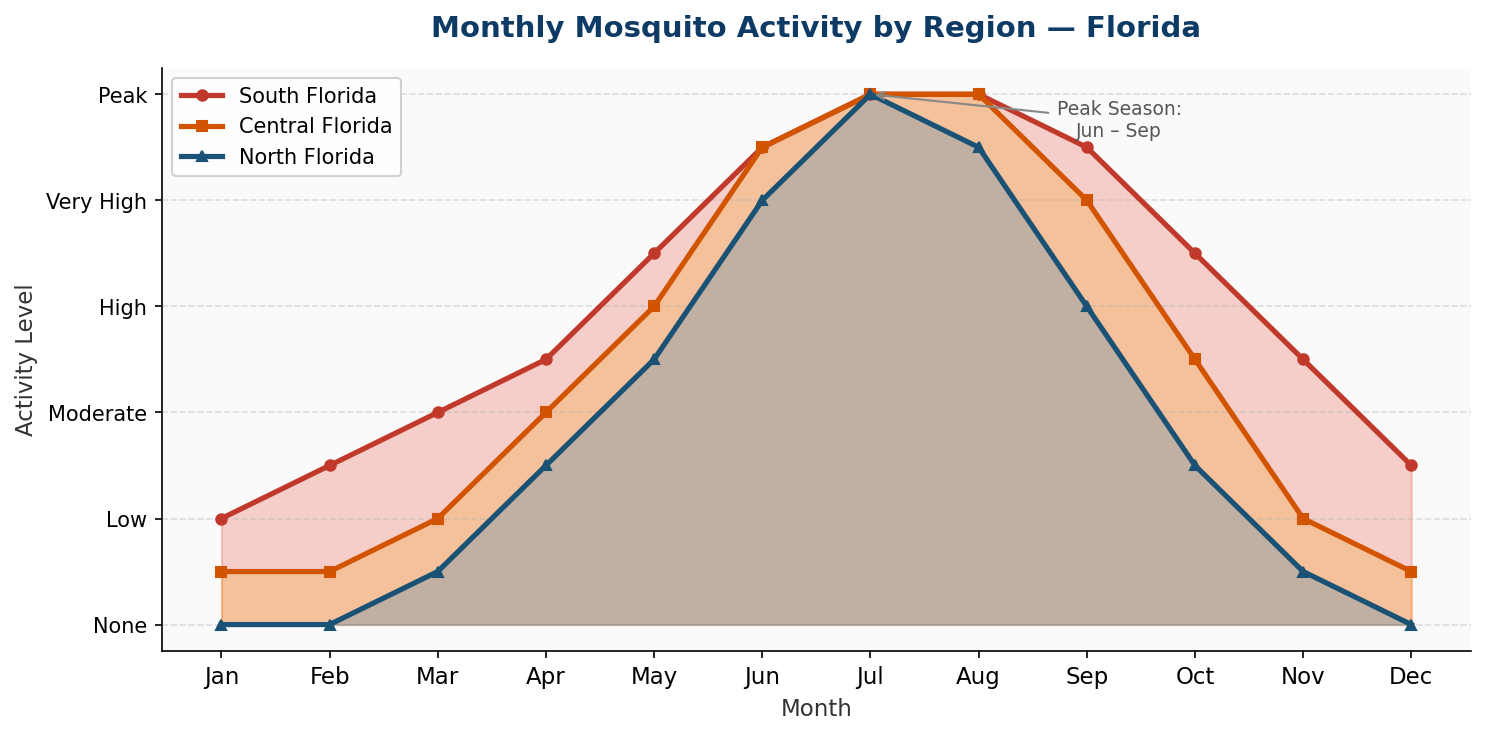
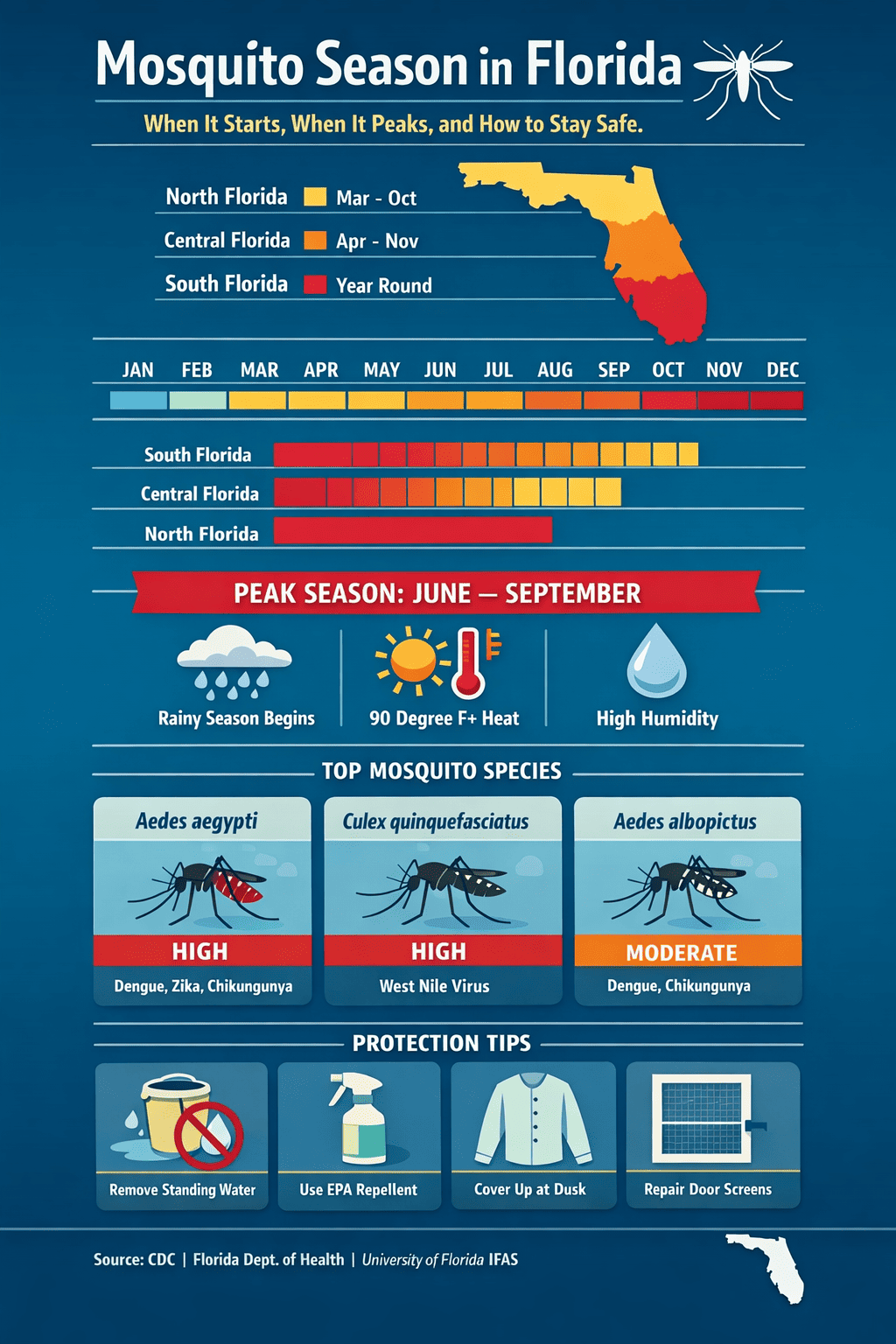
Here is a general month-by-month picture of how the season unfolds statewide:
- January–February: Activity is low in North and Central Florida, but South Florida’s subtropical warmth means mosquitoes never fully disappear. Coastal and urban areas in Miami-Dade and Broward see continued low-level activity.
- March–April: The season ramps up statewide. North Florida starts seeing meaningful mosquito populations. Warmer temperatures and pre-rainy-season moisture begin activating dormant eggs.
- May–June: Activity accelerates sharply. The onset of Florida’s rainy season — typically beginning in mid-June — creates a surge in standing water and explosive population growth.
- July–September: Peak season. Hot temperatures, near-daily afternoon thunderstorms, and maximum humidity combine to drive mosquito populations to their annual high point.
- October–November: Activity begins declining in North and Central Florida as night-time temperatures drop. South Florida remains active well into November.
- December: A functional off-season in the north; persistent low-level activity in the south, especially following warm fronts or late-season rain.
Table 1: Month-by-Month Mosquito Activity Snapshot — Florida
| Month | South FL | Central FL | North FL | Risk |
|---|---|---|---|---|
| Jan – Feb | Low-Moderate | Low | None-Low | Low |
| Mar – Apr | Moderate | Low-Moderate | Low-Moderate | Moderate |
| May – Jun | High | High | Moderate-High | High |
| Jul – Sep | PEAK | PEAK | PEAK | PEAK |
| Oct – Nov | Moderate-High | Low-Moderate | Low | Moderate |
| December | Low-Moderate | Low | None | Low |
Mosquito Season by Region in Florida
Florida’s climate is not uniform — it spans subtropical and tropical zones — and mosquito season by region in Florida reflects that diversity significantly.
South Florida (Miami-Dade, Broward, Palm Beach, Monroe Counties)
South Florida mosquito season is, effectively, a year-round event. In places like Broward, Miami-Dade, and Palm Beach counties, winter temperatures regularly stay above the 50°F threshold required to slow mosquito breeding. Even during a cold front, a return to warmth within days re-activates populations.
The Everglades and coastal salt marshes add another dimension, providing vast permanent breeding habitat for species like Aedes taeniorhynchus — the eastern salt marsh mosquito. In 2025, South Florida residents reported aggressive swarms of this species following the breakdown of early-season drought conditions, when stored eggs in dry soil hatched in large numbers once rains returned.
Expect meaningful biting activity from February through December in this region, with true peak intensity from June through October.
Central Florida (Orlando, Tampa Bay, I-4 Corridor)
Central Florida mosquito season typically runs from March through November, with the most intense activity from June through September. The Tampa Bay area’s subtropical climate delivers summer temperatures averaging 80–90°F and high humidity that mosquitoes thrive in.
Urban heat islands in the Orlando and Tampa metro areas create microclimates that extend active breeding periods. Standing water in storm drains, retention ponds, and unmaintained pools keeps populations elevated even between rainfall events.
North Florida (Tallahassee, Jacksonville, Pensacola)
North Florida mosquito season is the most similar to other southern US states. Meaningful activity typically begins in March, peaks between June and August, and declines significantly by October as overnight temperatures fall into the 50s. The first frost — however brief — marks a functional end to peak season.
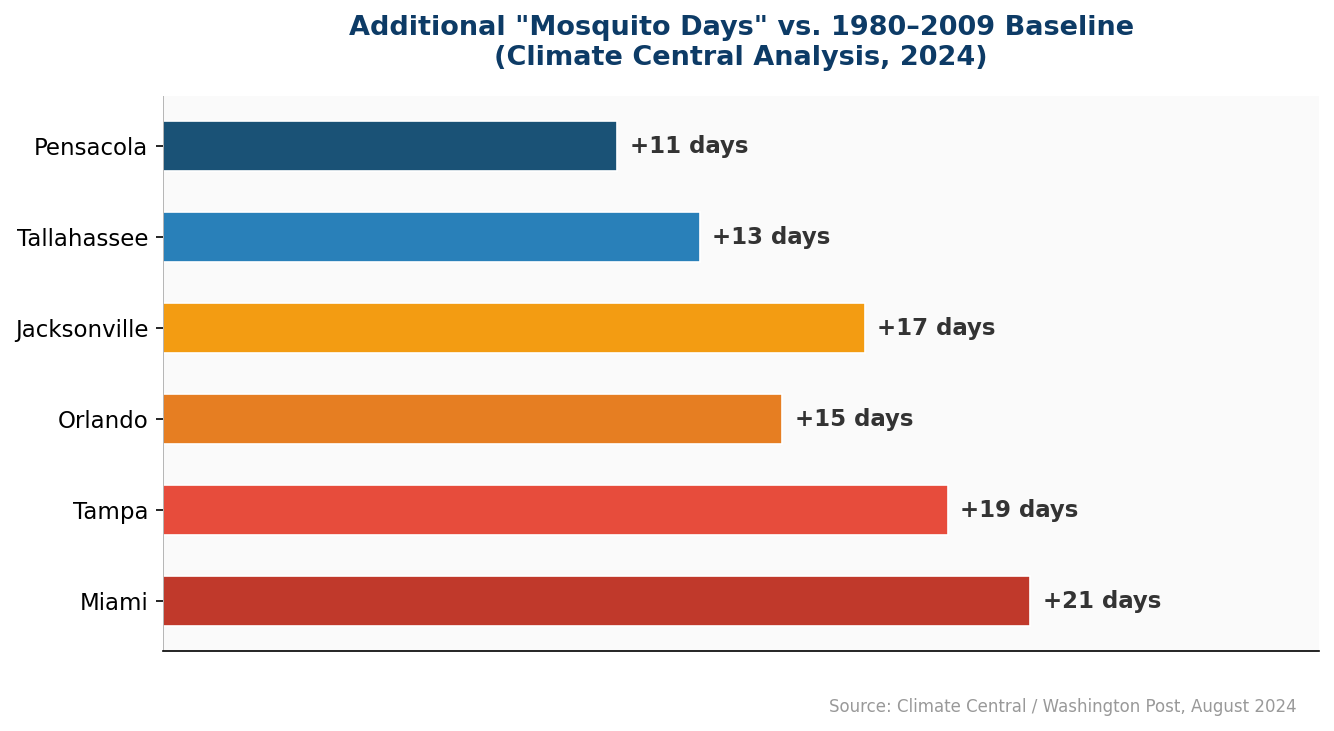
However, climate data is changing this picture. According to a Climate Central analysis reported by the Washington Post in August 2024, Jacksonville experienced a 17-day increase in “mosquito days” compared to the 1980–2009 baseline, driven primarily by warmer spring temperatures extending the early season.
Table 2: Florida Mosquito Season by Region
| Region | Season Start | Peak Months | Season End | Key Breeding Habitat |
|---|---|---|---|---|
| South Florida | Year-round | Jun – Oct | Never fully ends | Salt marshes, Everglades, urban containers |
| Central Florida | March | Jun – Sep | November | Retention ponds, storm drains, urban pools |
| North Florida | March | Jun – Aug | October | Freshwater wetlands, floodplains, containers |
Peak Mosquito Months in Florida: What Drives the Surge
Florida’s mosquito peak months — June through September — are determined by the convergence of three environmental forces: maximum heat, the rainy season, and peak humidity.
Florida’s rainy season runs from approximately June through October, delivering the bulk of the state’s annual rainfall in short, intense afternoon thunderstorms. Each storm event creates fresh standing water in yards, storm drains, pool covers, gutters, and natural depressions. Mosquito eggs can hatch in 24–48 hours and larvae develop into biting adults in as little as seven days under ideal summer conditions.
The combination of warmth and moisture also accelerates the mosquito life cycle itself. At 80°F+, the egg-to-adult cycle can compress dramatically compared to cooler temperatures, meaning populations rebuild faster after control efforts.
Coastal areas face the additional factor of salt marsh species, while inland and urban areas contend primarily with container-breeding species like Aedes aegypti — which requires nothing larger than a bottle cap of water to lay eggs.
Florida Mosquito Climate Trends: Is the Season Getting Worse?
The evidence increasingly points to yes — but with important nuance.
A Climate Central analysis published in August 2024 found that more than two-thirds of the continental United States has seen an increase in “mosquito days” — defined as days with temperatures between 50 and 95°F and humidity above 42% — compared to the 1980–2009 baseline period. Florida was no exception. Warming winters are the primary driver, eliminating what little cold-weather suppression the state’s northern counties once received.
The 2025 season illustrated how erratic climate patterns complicate mosquito management. According to reporting from University of Florida researchers and multiple NPR affiliates in October 2025, parts of North Florida experienced severe drought early in the year, causing mosquito eggs to accumulate in dry soil. When heavy rains finally arrived, those eggs hatched simultaneously — producing a dramatic population boom compressed into a short window.
As Dr. Eva Buckner, assistant professor at the University of Florida’s Institute of Food and Agricultural Sciences (UF/IFAS) Medical Entomology Laboratory, explained: “Florida’s multiple climate zones allow for a high diversity of mosquitoes.” That diversity means climate shifts don’t affect all regions or species equally — making statewide prediction difficult.
Adding another layer of complexity, drought conditions can actually increase disease transmission risk in some cases. When standing water is scarce, both mosquitoes and their bird hosts (which serve as virus reservoirs for West Nile) concentrate around the same limited water sources — increasing the odds of transmission that can then spill over to humans.
The long-term outlook, per University of Florida Emerging Pathogens Institute researchers, is that warming temperatures are expanding the geographic range of key mosquito species northward and lengthening their active seasons — a trend the IPCC has confirmed is tied to global temperature increases.
Common Mosquito Species in Florida
Florida is home to approximately 80 mosquito species. Most are nuisances; several are public health threats. Understanding which species are active helps assess your disease risk.
Table 3: Key Mosquito Species in Florida
| Species | Biting Time | Active Season | Risk | Key Diseases |
|---|---|---|---|---|
| Aedes aegypti (Yellow Fever Mosquito) | Daytime | Year-round South; Spring-Fall Central | HIGH | Dengue, Zika, Chikungunya, Yellow Fever |
| Aedes albopictus (Asian Tiger Mosquito) | Daytime | Spring through Fall | MODERATE | Dengue, Chikungunya |
| Culex quinquefasciatus (Southern House Mosquito) | Dawn and Dusk | Spring through Fall | HIGH | West Nile Virus, St. Louis Encephalitis |
| Anopheles quadrimaculatus (Common Malaria Mosquito) | Night | Summer | LOW-MOD | Malaria (rare; local cases 2023) |
| Culiseta melanura (Blacktailed Mosquito) | Night | Spring through Fall | MODERATE | Eastern Equine Encephalitis |
| Aedes taeniorhynchus (Salt Marsh Mosquito) | Dawn and Dusk | Year-round South Coast | LOW | Nuisance biting; minimal disease vector |
Aedes aegypti — The Yellow Fever Mosquito
The most consequential species for Florida residents. Aedes aegypti is a daytime biter, active in the hours around sunrise and sunset. It is the primary vector for dengue, Zika, chikungunya, and yellow fever. Unlike most mosquitoes, it thrives in urban environments, breeding in tiny water containers — planters, trash lids, bottle caps, pool covers. It is present year-round in South Florida and active throughout Central Florida from spring through fall.
Aedes albopictus — The Asian Tiger Mosquito
Recognizable by its bold black-and-white striped pattern, this aggressive daytime biter can transmit dengue and chikungunya. It is hardy enough to survive in cooler conditions than Aedes aegypti, making it active across a wider range of the state and for a longer portion of the year. It is notorious for biting persistently through clothing.
Culex quinquefasciatus — The Southern House Mosquito
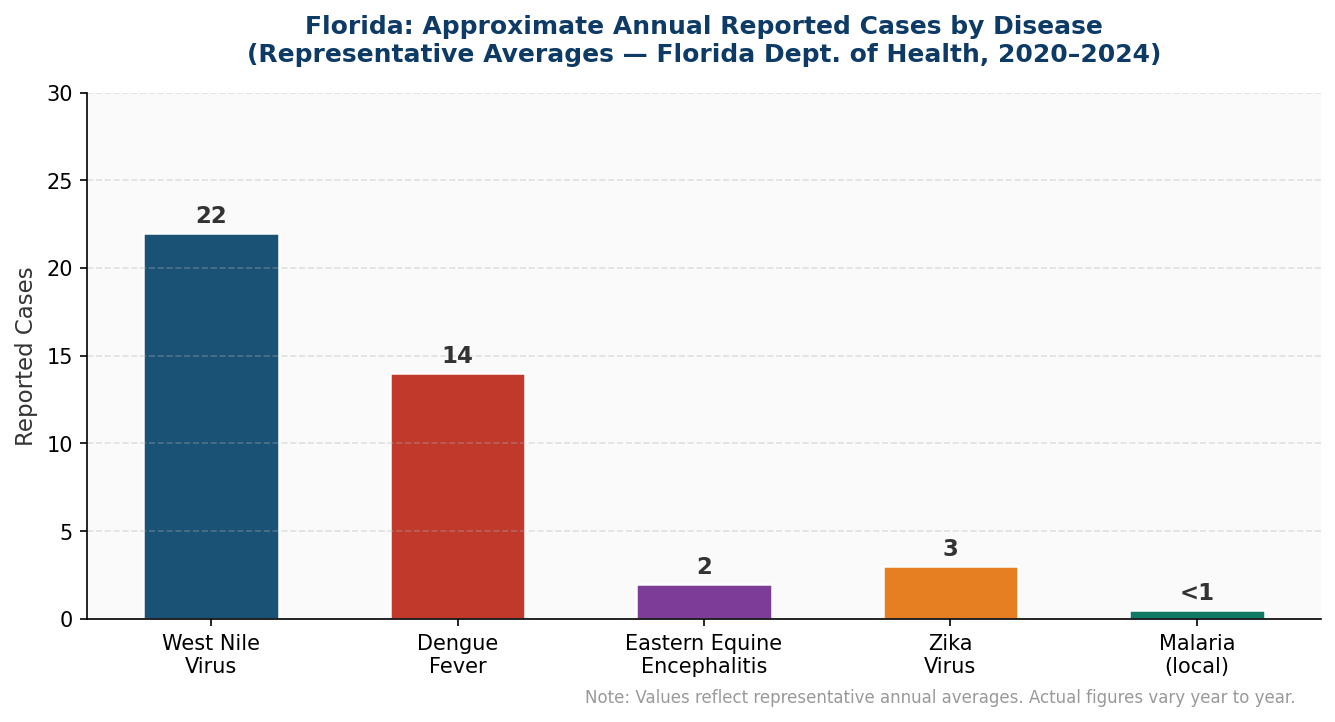
The primary vector for West Nile virus in Florida. This species bites primarily at dawn and dusk, breeds in organically enriched standing water (ditches, sewers, neglected pools), and is responsible for the majority of West Nile cases documented in the state annually. Florida typically records around 22 human West Nile cases per year, though 2025 data showed roughly half that number — a fluctuation experts attribute to drought conditions, increased larviciding, or natural disease cycles.
Anopheles quadrimaculatus — The Common Malaria Mosquito
While malaria is rare in Florida, this species is capable of transmitting it. The CDC and Florida Department of Health investigated a small cluster of locally acquired malaria cases in Florida in 2023 — the first domestic transmission in 20 years — raising concern that warming conditions may be increasing the potential for this species to spread the parasite.
Aedes taeniorhynchus — The Eastern Salt Marsh Mosquito
Primarily a coastal species, notorious for mass emergence events after tidal flooding or heavy rain in salt marsh areas. While it is not a significant disease vector for West Nile or EEE, its sheer numbers can make coastal life temporarily unbearable. South Florida saw aggressive swarms of this species in 2025 following late-season rainfall after an extended drought.
Mosquito-Borne Diseases in Florida: What You Need to Know
Florida’s status as a year-round warm-weather destination — with heavy international travel traffic — makes it one of the highest-risk states for mosquito-borne disease introductions and local transmission.
West Nile Virus
The most commonly reported mosquito-borne illness in Florida and the broader United States. Spread primarily by Culex mosquitoes, most infections are mild or asymptomatic. Roughly 1 in 5 infected people develop fever, headache, and body aches; fewer than 1% develop serious neurological illness. Florida’s 2025 season saw WNV cases running below the 10-year average, per Florida Department of Health data, though nationally the picture was more severe.
Dengue Fever
Dengue is a growing concern in Florida. Locally transmitted cases — not imported from travel — have been documented in South Florida. According to CDC provisional data through early 2026, nationally there were approximately 2,560 dengue cases reported by mid-October 2025. Local transmission in Florida, California, and Texas represented the primary domestic hotspots. Dengue causes high fever, severe joint pain, and rash; a second infection significantly raises the risk of life-threatening dengue hemorrhagic fever.
Zika Virus
Florida experienced the only sustained local Zika transmission in the continental US in 2016. While transmission has been minimal since then, the Aedes aegypti mosquito responsible remains abundant and active. The risk is particularly serious for pregnant women, as Zika can cause severe fetal brain defects. Travelers to Florida during peak mosquito season who are pregnant or planning pregnancy should take precautions seriously.
Eastern Equine Encephalitis (EEE)
Rare but devastating, with a fatality rate of up to 30% and serious neurological complications in survivors. EEE is transmitted by Culiseta melanura mosquitoes in freshwater swamp habitats, primarily to birds, but bridge vectors can transmit it to humans. As of mid-October 2025, the CDC reported three EEE cases nationally. Florida’s 2025 season showed EEE risk at a low level, per the University of Florida’s Jonathan Day, a professor emeritus of medical entomology.
Malaria
Historically rare in Florida. The 2023 cluster of locally transmitted cases — documented in Sarasota County and investigated by the CDC and Florida Department of Health — was the first domestic transmission in two decades. Experts caution this was likely a localized anomaly but emphasize that the Anopheles mosquitoes capable of transmission are present in the state.
How to Protect Yourself During Mosquito Season in Florida
Home & Yard Prevention
- Eliminate standing water: Empty birdbaths, flowerpot saucers, buckets, and any container holding water at least once a week. Mosquitoes need as little as a teaspoon of water to lay eggs.
- Manage pool covers: Pool covers are a prime breeding site. Use an automatic submersible pump to remove accumulated rainwater within 24 hours. Treat residual water with Bacillus thuringiensis israelensis (Bti) dunks, which are safe for humans and pets.
- Clean gutters: Clogged gutters hold standing water for weeks and are one of the most overlooked breeding sites near Florida homes.
- Treat standing water you can’t drain: Use Mosquito Dunks or granular Bti products in ornamental ponds, drainage ditches, and rain barrels.
- Maintain screens: Ensure window and door screens are intact and properly fitted, especially during peak season.
Personal Protection
- Use EPA-registered repellents: Products containing DEET (20–30%), picaridin, IR3535, or Oil of Lemon Eucalyptus are the CDC’s recommended options. Apply to all exposed skin.
- Wear protective clothing: Long-sleeved shirts and long pants — particularly during peak biting times at dawn and dusk — significantly reduce exposure. Consider permethrin-treated clothing for outdoor activities.
- Time outdoor activities wisely: Culex mosquitoes (the West Nile carriers) are most active at dawn and dusk. Aedes aegypti and the Asian tiger mosquito bite actively during daytime hours.
- Use fans: Mosquitoes are weak fliers. Outdoor ceiling fans or box fans on patios create wind that disrupts their ability to land.
Travel Tips for Visitors to Florida
- Check the Florida Department of Health’s Arbovirus Surveillance reports before travel, especially if visiting coastal or Everglades-adjacent areas during summer.
- Pregnant travelers should consult the CDC’s travel health guidance given Zika’s continued risk in South Florida.
- Pack EPA-registered repellent. Hotel rooms in South Florida are not a substitute for personal protection when spending time outdoors.
Future Outlook: What Experts Predict for Florida’s Mosquito Season
The trajectory is clear, even if the precise timeline is uncertain. Climate scientists and entomologists broadly agree on several trends shaping the future of mosquito season in Florida:
- Longer seasons: Warmer winters mean reduced cold-weather suppression, particularly in North and Central Florida. The mosquito season is expanding at both ends — starting earlier in spring and ending later in fall.
- Increased disease pressure: A Harvard Gazette analysis from October 2024 projected that climate change will expand the geographic range and transmission potential of dengue and other mosquito-borne diseases through 2050, with southern states bearing disproportionate risk.
- New species risks: University of Florida researchers have flagged Anopheles stephensi — an invasive malaria mosquito that has expanded from South Asia to parts of Africa — as a potential future threat if it reaches US ports. Unlike native Anopheles species, it breeds readily in urban containers.
- More erratic population dynamics: As 2025 demonstrated, drought-flood cycles driven by climate variability can produce compressed population booms that are harder to predict and manage. Communities that rely solely on reactive spraying rather than proactive larval control will be more vulnerable.
The response — per the American Mosquito Control Association (AMCA) and Florida’s county-level mosquito control programs — is moving toward Integrated Mosquito Management (IMM): a system combining surveillance, larval control, targeted adulticide application, and public education. But experts note that personal and household-level prevention remains irreplaceable.
Frequently Asked Questions (FAQs)
Q. When does mosquito season start in Florida?
South Florida sees activity as early as February. Central Florida ramps up in March. North Florida’s season typically begins in March as well, though meaningful population growth doesn’t occur until temperatures consistently stay above 60°F through spring.
Q. Does Florida have mosquitoes year-round?
In South Florida, yes. Miami-Dade, Broward, Monroe, and Palm Beach counties rarely experience temperatures low enough to halt mosquito breeding entirely. In Central and North Florida, there is a partial seasonal decline from December through February, though warm spells can reactivate populations at any point.
Q. What are Florida’s peak mosquito months?
June through September represent peak mosquito season statewide, coinciding with Florida’s rainy season. July and August typically see the highest activity, particularly in inland and urban areas where post-storm standing water accumulates quickly.
Q. Is mosquito season in Florida getting worse due to climate change?
Evidence suggests yes, particularly for North and Central Florida. Climate Central data shows Jacksonville experienced 17 additional mosquito-suitable days compared to the 1980–2009 baseline. Warmer winters are the primary driver. However, the relationship between climate and disease transmission is complex — drought conditions in 2025 actually suppressed some mosquito-borne disease cases in Florida even as populations fluctuated.
Q. What mosquito-borne diseases are a risk in Florida?
The primary risks are West Nile virus, dengue fever, Zika virus, Eastern equine encephalitis, and — in rare cases — malaria. Dengue and West Nile are the most consistently documented in Florida each year. The Florida Department of Health publishes weekly Arbovirus Surveillance reports during mosquito season.
Q. What is the most dangerous mosquito in Florida?
From a public health standpoint, Aedes aegypti carries the broadest range of dangerous pathogens — dengue, Zika, chikungunya, and yellow fever. Culex quinquefasciatus is responsible for the majority of West Nile cases. EEE, while rarer, is associated with high mortality and is transmitted by Culiseta melanura via bird hosts.
Q. What repellent works best against Florida mosquitoes?
The CDC recommends EPA-registered repellents. For Florida’s mix of daytime and dusk-active species, DEET (20–30%) provides reliable broad-spectrum protection. Picaridin is an effective odorless alternative. For extended outdoor activities, permethrin-treated clothing provides an additional protective layer.
The Bottom Line
Mosquito season in Florida is not a fixed window on a calendar. It is a dynamic, region-specific, and increasingly climate-influenced phenomenon that demands year-round awareness — particularly in South Florida, where the season is effectively permanent.
Understanding when activity peaks in your region, which species are most active, and which diseases they carry is the foundation of effective protection. Prevention starts at home: eliminating standing water, maintaining pool covers, and using EPA-registered repellents remain the most reliable and immediately actionable steps any Florida resident or visitor can take.
The data from 2025 and early 2026 reinforces a familiar message from public health experts: mosquito-borne disease transmission is complex, climate patterns are shifting the rules, and complacency is the greatest risk factor of all.
Have a question about mosquito season in your part of Florida? Drop it in the comments. Florida residents: what’s your most effective strategy for keeping mosquitoes off your property? Share your experience below — your insight may help someone in your region.
Editorial Team & Contributors

Raashid Ansari, Founder, Content Researcher & Author - MosquiTalk
Not an entomologist — just a genuinely curious writer who started researching mosquitoes and couldn't stop. What began as casual reading about repellents and bite prevention gradually turned into a deep ongoing dive into vector biology, disease epidemiology, animal health impacts, and the real science behind mosquito control. Everything published here is carefully edited, and written with one purpose: giving readers accurate, accessible information they can actually trust and use to protect themselves, their families, and their pets, birds and cattle.
Active across social platforms, regularly publishes, and genuinely invested in spreading mosquito awareness where it matters most. Because informed readers make better decisions — and better decisions save lives.