
Last updated: March 2026 • Sources: CDC, Nebraska DHHS, UNL Extension G2037, NOAA, Climate Central, Hein et al. 1999 (Journal of the American Mosquito Control Association)
Nebraska has a mosquito problem. Not a surprising one, and not one unique to the state, but if you spend any time outdoors between June and August, you already know what that means. The Platte River valley, the north-central Sandhills wetlands, the storm water ditches ringing Omaha — they are all genuinely productive mosquito breeding habitat, and the insects that emerge from them can make an evening on the porch feel like a public health event.
What a lot of people don’t realize is how much the season changes from year to year. A wet spring after a heavy snowpack can produce a surge of floodwater mosquitoes by late May. A dry summer following drought conditions can suppress populations that were expected to be bad. Nebraska’s climate is variable enough that a fixed mental model of ‘mosquito season in Nebraska’ doesn’t really hold up.
Climate patterns are shifting that picture in ways worth paying attention to. Warmer winters, earlier spring warmth, and more intense but erratic rainfall events are all affecting how mosquito seasons play out across the state.
This guide covers when mosquitoes are most active in Nebraska, what drives the peaks, which species are responsible for which risks, what the data says about long-term climate trends, and — most practically — what actually works to reduce exposure.
1. When Mosquito Season Starts in Nebraska
Nebraska winters are cold enough to suppress mosquito populations almost completely from November through early March. But eggs from some species overwinter in dry soil or leaf litter, waiting for warmth and standing water to trigger hatching. The season doesn’t start when you notice mosquitoes — it starts when the right conditions arrive.
Temperature Thresholds and First Emergence
Mosquito larval development requires sustained temperatures above approximately 50°F (10°C). Below this threshold, development slows dramatically and adults stop feeding and seeking hosts. Nebraska typically reaches and sustains that threshold in mid-to-late April across most of the state, though the eastern half tends to warm a week or two ahead of the Panhandle. Actual emergence timing also depends on species and local conditions.
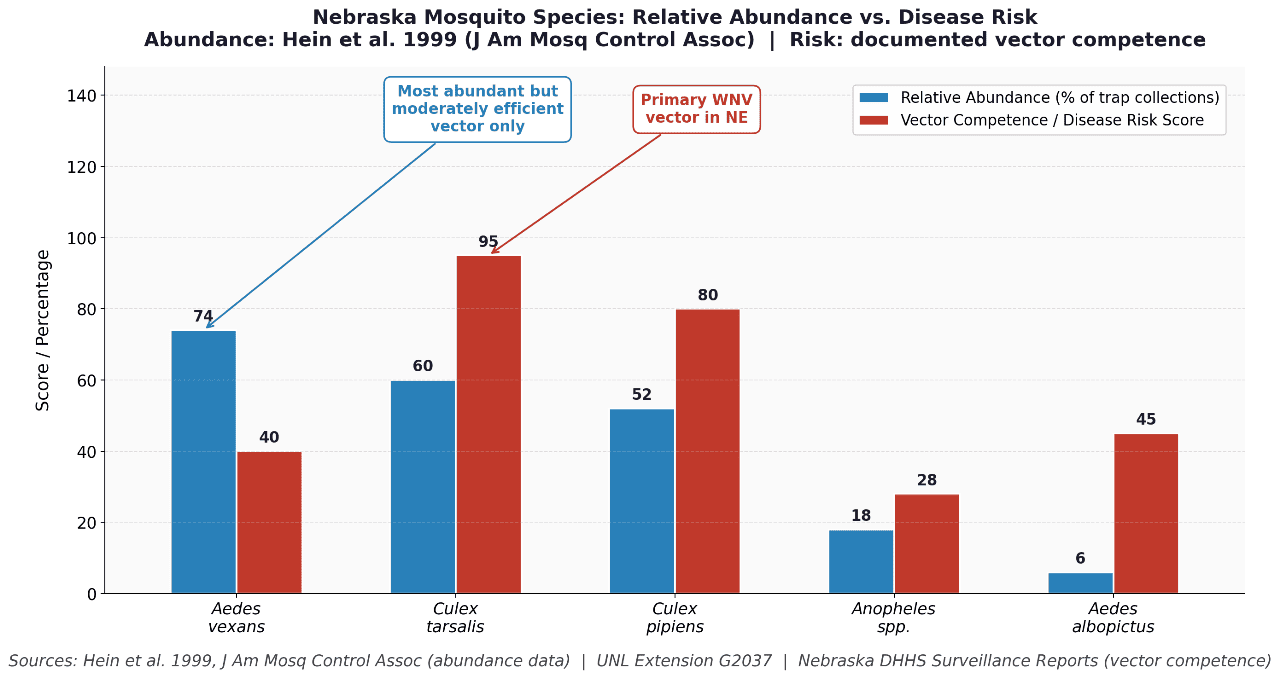
Spring snowmelt is often the first meaningful event of the mosquito season. A heavy snowpack that melts quickly can create extensive temporary pooling in low-lying areas, pastures, and floodplains. Aedes vexans — the most abundant mosquito in Nebraska, accounting for roughly 74% of all trap collections in statewide surveillance (Hein et al., 1999) — is specifically adapted to exploit exactly these conditions. Their eggs can sit dormant in soil for one to three years waiting for flooding.
First meaningful mosquito activity in Nebraska typically occurs in late April to early May in the east, and late May in the western Panhandle. Years with above-average spring precipitation push that earlier; drought years push it later.
Table 1: Nebraska Mosquito Season Timeline
| Month | Activity Level | Index | Key Environmental Conditions |
|---|---|---|---|
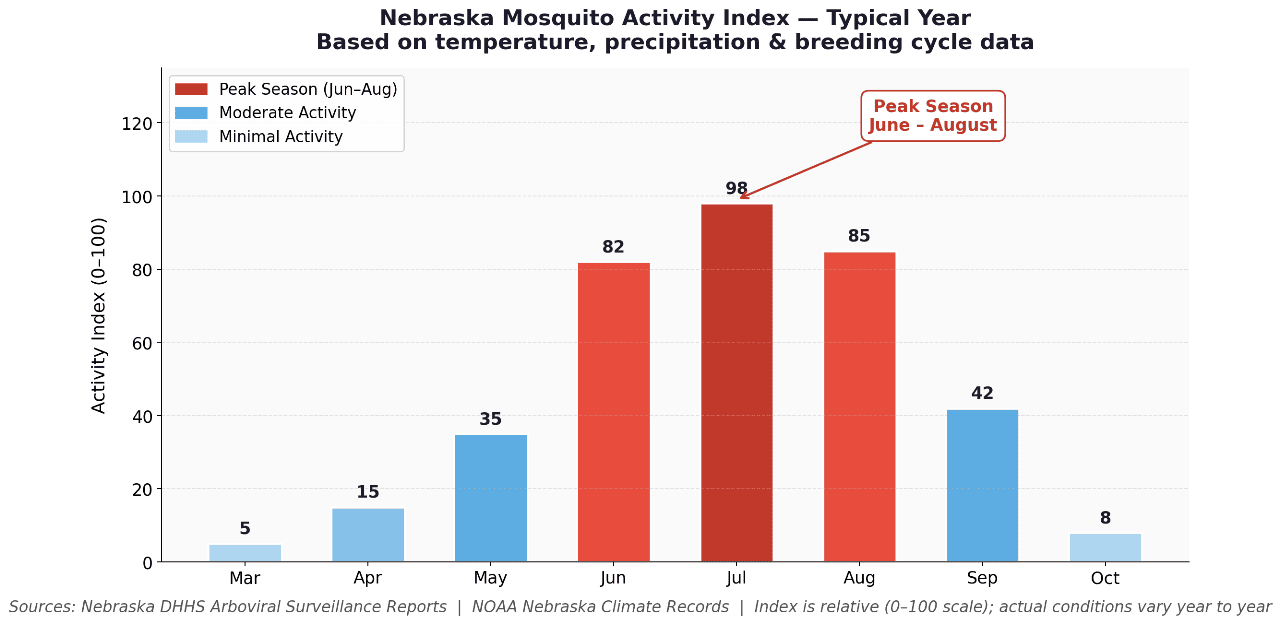
| March | Very Low | 5 | Snowmelt begins; soil still cold; no adult activity |
| April | Low | 15 | Standing water forms; overwintered eggs begin hatching |
| May | Rising | 35 | Temperatures warming; early Aedes species emerging |
| June | High | 82 | Rainy season; rapid population expansion; Aedes peak |
| July | PEAK | 98 | Maximum heat and humidity; Culex species dominant; WNV risk elevated |
| August | High | 85 | Late-season breeding; West Nile risk remains high |
| September | Declining | 42 | Cooling nights; population tapering |
| October | Minimal | 8 | Frost events begin; season effectively ends |
2. Peak Mosquito Season in Nebraska
If you want to pick three months to be vigilant in Nebraska, the answer is June, July, and August. July is statistically the worst month in most years. The combination of maximum air temperatures, peak soil moisture from June rains, and the overlap of multiple species’ breeding cycles produces conditions that entomologists describe as optimal for mosquito production.
What drives the July peak specifically is the Culex life cycle. These are the mosquitoes that matter most from a public health standpoint. Unlike the floodwater Aedes species that emerge early and in bursts after rain, Culex mosquitoes breed continuously in standing water — storm drains, ornamental ponds, neglected bird baths, standing water in old tires. July heat accelerates larval development time from roughly ten days to as few as seven. A single container of standing water can produce multiple generations within the month.
Warm nights are particularly important. Culex tarsalis — Nebraska’s primary West Nile virus vector — is most active during the hours from dusk through midnight, with feeding activity suppressed when nighttime temperatures fall. The sustained warmth of late July and August extends its biting window through the night, which matters because this species is primarily responsible for human West Nile Virus transmission in the state.
Nebraska’s peak biting window for disease-relevant Culex species is from one hour before sunset through midnight. Warm, humid evenings with little wind are when exposure risk is highest.
3. Climate Trends Affecting Mosquito Populations
Nebraska’s mosquito season is getting longer. That’s the short version. The mechanism is straightforward — warmer average temperatures are expanding the number of days each year when conditions are suitable for mosquito development and activity.
What the Data Shows
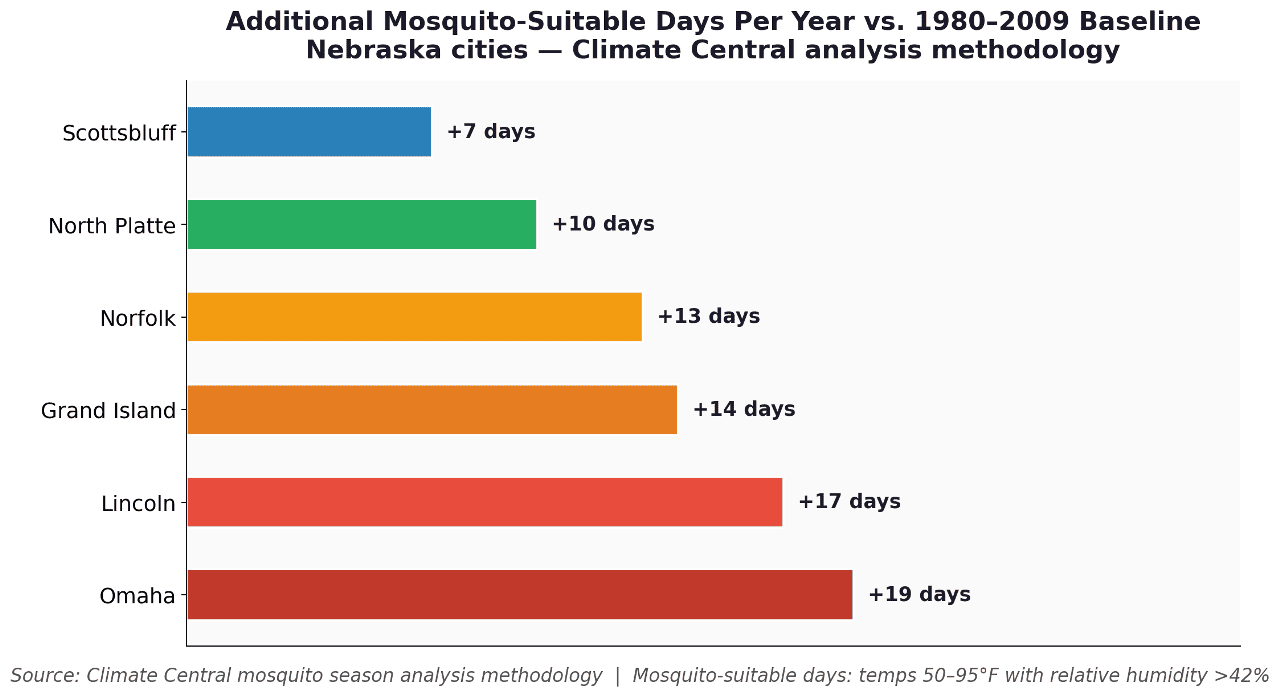
Climate Central analysis applied to Nebraska’s major population centers shows that Omaha has experienced approximately 19 additional mosquito-suitable days per year compared to the 1980–2009 baseline. Lincoln sits at roughly 17 additional days. The trend is consistent across the state, with eastern cities showing larger gains due to their already warmer and more humid baseline climate. The Panhandle (Scottsbluff: +7 days) shows smaller but still meaningful increases.
Rainfall and the Flooding Effect
Rainfall patterns matter as much as temperature — possibly more in some years. Nebraska sits in a zone where climate change projections consistently point toward more intense but less frequent precipitation events. The practical effect for mosquito populations is dramatic: heavy rain creates temporary breeding sites on a massive scale, then the standing water persists during subsequent dry periods.
The March 2019 Nebraska flooding was a vivid example. Widespread agricultural flooding across the eastern and central parts of the state created enormous temporary breeding habitat for floodwater species. Mosquito populations in affected counties were significantly elevated for weeks after the water receded. Years following moderate-to-severe flooding consistently show elevated early-season populations.
One pattern pest control professionals in Nebraska identify regularly is the drought-then-flood dynamic. A dry late spring followed by a heavy rain event allows eggs to accumulate in dry soil, then the flooding triggers simultaneous mass hatching — producing a disproportionately large population surge.
Table 2: Climate Factors and Their Effect on Nebraska Mosquito Populations
| Climate Factor | Effect on Mosquitoes | Nebraska Context |
|---|---|---|
| Warmer average temperatures | Longer season; faster larval development | Eastern Nebraska seeing +17–19 days vs. 1980–2009 baseline |
| Heavy rainfall events | Creates mass temporary breeding sites; population surge | Missouri River and Platte River floodplains most affected |
| Warmer winters | Earlier spring emergence; some reduced winter egg mortality | Panhandle still sees cold kills; eastern border shows larger effect |
| Drought conditions | Reduces temporary pools; suppresses floodwater Aedes species | Culex species persist in permanent stagnant water even during drought |
| Agricultural irrigation | Creates artificial breeding habitat during dry periods | Center pivot irrigation puddles common in Platte River valley |
| Urban heat islands | Extends nightly activity window; warmer overnight temps | Omaha and Lincoln showing steepest city-level increases |
Increased Rainfall Intensity
Climate change drives more intense but less frequent precipitation events across Nebraska. Heavy rains deposit large volumes of water rapidly across floodplains, fields, and low-lying areas.
Standing Water Pools Form
Water accumulates in floodplains, agricultural fields, roadside ditches, and urban drainage. Subsequent dry periods mean the water persists longer than it historically would.
More Breeding Sites, Wider Area
Aedes vexans eggs — dormant in soil for up to 3 years — hatch simultaneously when flooded. Each water source becomes a potential nursery across a geographically expanded zone.
Warmer Temperatures Accelerate Development
Rising summer heat compresses Culex larval development from 10 days down to ~7 days. Multiple generations emerge within a single month. Warm nights extend the nightly biting window.
Higher Populations & Extended Season
The compounding effect: more breeding habitat × faster development × warmer nights = larger adult populations and a longer active season. Omaha now sees +19 mosquito-suitable days/year vs. the 1980–2009 baseline.
Chain based on documented Nebraska ecology and peer-reviewed entomological literature
4. Common Mosquito Species in Nebraska
Nebraska is home to approximately 50 mosquito species — but only about half of them are capable of spreading disease to humans (Nebraska DHHS). Most residents will only meaningfully encounter a handful of species, but understanding the breakdown matters because different mosquitoes present very different health implications and require different control approaches.
Table 3: Common Mosquito Species in Nebraska
| Species | Habitat | Active Time | Disease Risk | Notes |
|---|---|---|---|---|
| Aedes vexans | Floodwater, temporary pools | Day and dusk | Low–Moderate | Most abundant (~74% of NE trap collections); nuisance biter after flooding; moderately efficient WNV vector; likely bridge vector between birds and mammals |
| Culex tarsalis | Transient pools, irrigation channels, roadside ditches | Evening and night | HIGH | Primary West Nile Virus vector in Nebraska; classified as transient water species by DHHS |
| Culex pipiens | Urban storm drains, stagnant ponds | Evening and night | HIGH | Secondary WNV vector; thrives in urban areas; also classified as transient water species |
| Aedes albopictus | Containers, tires, tree holes | Daytime | Moderate | Asian tiger mosquito; detected in 3 NE counties (Cuming, Douglas, Lancaster); establishment status under active DHHS surveillance |
| Anopheles quadrimaculatus | Marshes, slow-moving water | Night | Very Low | Locally, malaria transmission is not a current risk in Nebraska; any cases are travel-associated |
| Ochlerotatus trivittatus | Woodland pools | Day and evening | Very Low | Nuisance biter in wooded areas of eastern Nebraska |
Why Culex Species Demand Special Attention
The distinction between nuisance mosquitoes and disease vectors matters a lot in practice. Aedes vexans is responsible for most of the swarming, biting misery in Nebraska — especially after flooding — but UNL Extension entomology classifies it as a moderately efficient West Nile Virus vector (not a poor one), and notes it likely serves as a bridge vector between infected birds and humans during years of high abundance.
Culex tarsalis is the primary concern. It is highly competent at transmitting West Nile Virus and has a feeding preference that takes it from birds — the main virus reservoir — to mammals including people. The Nebraska DHHS tests Culex mosquito pools for West Nile Virus, St. Louis encephalitis, and western equine encephalitis each season, with Culex tarsalis as the primary surveillance target.
📰 Must Read,
✔️ Mosquito Season in Florida: Start, Peak & Climate Trends
✔️ Mosquito Season in Georgia: Start, Peak Months & Best Prevention Strategies
✔️ Mosquito Season in Louisiana: Peak Mosquito Activity & Health Risks
5. Health Risks Associated with Mosquitoes in Nebraska
i) West Nile Virus — The Primary Concern
West Nile Virus is the mosquito-borne disease that matters most in Nebraska. The state first detected human cases in 2002, and has reported cases in most subsequent years, with significant variation in annual counts depending on summer temperature and Culex abundance. Nebraska recorded 1,942 cases in 2003 — one of the worst years nationally — and the annual case count has ranged widely since.
The infection outcome breakdown, per CDC clinical guidance, is as follows:
- Approximately 80% of infected people have no symptoms at all.
- About 1 in 5 (roughly 20%) develop West Nile fever — headache, body aches, joint pain, vomiting, and fatigue lasting several days to a few weeks.
- Roughly 1 in 150 infected individuals (less than 1%) develop neuroinvasive disease such as encephalitis or meningitis. This is serious and can be fatal.
Nebraska DHHS maintains active arboviral surveillance from May through October each year, including sentinel chicken flocks, mosquito pool testing for three arboviruses (expanded to six in recent years including Cache Valley, Jamestown Canyon, and La Crosse viruses), and dead bird reporting. This data drives public health alerts and community mosquito control decisions.
ii) Other Mosquito-Borne Diseases
Eastern equine encephalitis (EEE) has been detected in Nebraska on rare occasions, though confirmed human cases are extremely uncommon. La Crosse encephalitis is present in the region, primarily affecting children, and transmitted by Aedes triseriatus mosquitoes in woodland areas of eastern Nebraska.
Malaria is not transmitted locally in Nebraska. Any cases reported in the state are travel-associated.
6. How Weather Changes Mosquito Numbers Year to Year
The same location in Nebraska can have dramatically different mosquito pressure from one year to the next. Understanding these weather-driven patterns helps residents calibrate how seriously to take prevention measures in any given summer.
Table 4: Environmental Factors and Their Effect on Nebraska Mosquito Populations
| Environmental Factor | Effect on Mosquito Population | Nebraska Context |
|---|---|---|
| Heavy spring rainfall | Mass breeding site creation; Aedes population surge | Post-2019 flooding produced multi-week population spike across eastern counties |
| Warm, dry summer | Faster Culex larval development; Aedes populations may decline | Urban standing water becomes dominant breeding habitat in dry years |
| Drought conditions | Reduces temporary pools; suppresses floodwater species | 2012 drought significantly reduced early-season Aedes populations |
| Agricultural irrigation | Creates persistent artificial breeding during dry periods | Center pivot irrigation puddles in Platte River valley; a year-round concern |
| Wetlands and marshes | Stable year-round habitat for Culex species | Rainwater Basin wetlands in south-central Nebraska are significant sources |
| Late-season warm spell | Extends season; enables additional Culex generation | Warm Septembers can keep WNV transmission risk elevated into early fall |
| Early frost | Abrupt season end; kills active adult mosquitoes | Early October frost typically ends the season in northern counties |
7. Practical Mosquito Prevention Tips
Most mosquito-related misery in Nebraska is preventable. Not all of it — if you live near the Platte River floodplain and June floods hit, you are going to have mosquitoes regardless of what you do around your property. But for typical suburban and rural conditions, the following measures make a meaningful difference.
Personal Protection
- Use EPA-registered repellents: DEET at 20–30% remains the most reliable option with decades of safety data. Picaridin at 20% is equally effective with a lighter skin feel. Both are recommended by CDC and Nebraska DHHS.
- Protective clothing: Long sleeves and long pants during evening hours significantly reduce exposure. Light-colored clothing does not repel mosquitoes but makes them easier to spot and brush off.
- Timing matters: Culex species — the disease-relevant vectors — are most active from one hour before sunset through midnight. If you can shift outdoor activities to midday, you reduce exposure to the species that pose the highest WNV risk.
- Permethrin on clothing: For outdoor workers, hikers, or anyone in high-exposure situations, permethrin-treated clothing provides contact repellency lasting through multiple washes.
Home and Yard Prevention
- Empty standing water containers at least once a week: The Culex mosquito life cycle from egg to adult can complete in as few as 7–10 days in warm weather — so weekly emptying interrupts the breeding cycle before adults emerge. Birdbaths, flowerpot saucers, buckets, clogged gutters, old tires, pool covers, and tarps are the most commonly overlooked.
- Clean gutters regularly: Clogged gutters can hold water for weeks and are one of the highest-productivity breeding sites near homes.
- Bti larvicide for water you can’t drain: Mosquito Dunks (Bacillus thuringiensis israelensis) are EPA-registered and safe for pets, wildlife, fish, and humans. Effective in ornamental ponds, rain barrels, and drainage areas.
- Maintain window and door screens: Intact screens keep Culex species — primarily indoor-entering night biters — out of living spaces.
- Outdoor fans: Mosquitoes are weak fliers. A fan on a patio or deck disrupts landing behavior and reduces bites in a localized area.
Community-Level Prevention
- Report dead birds: Dead crows, jays, and raptors can indicate West Nile Virus infection in your area. Report them to Nebraska DHHS during surveillance season (May–October).
- Support larvicide programs: Many Nebraska municipalities operate larval control programs using Bti and methoprene. These are highly targeted, environmentally selective programs.
- Monitor public health alerts: Nebraska DHHS issues arboviral alerts when WNV is detected in sentinel animals or mosquito pools. Check the DHHS website or sign up for alerts during peak season.
Table 5: Mosquito Prevention Checklist
| Action | Category | Timing / Frequency |
|---|---|---|
| Apply EPA-registered repellent (DEET or Picaridin) | Personal | Before every outdoor activity during season |
| Empty birdbaths, flowerpot saucers, buckets | Home / Yard | At least once a week |
| Clean gutters of debris and standing water | Home / Yard | Monthly during season; after heavy rain |
| Place Bti dunks in pond, rain barrel, or drainage area | Home / Yard | Every 30 days |
| Check pool cover for accumulated water | Home / Yard | Weekly; pump within 24 hours of rain |
| Repair torn window and door screens | Home / Yard | Before season starts in May |
| Wear long sleeves at dusk outdoors | Personal | June – September evenings |
| Report dead birds to Nebraska DHHS | Community | June – October if observed |
| Monitor DHHS arboviral surveillance updates | Community | Weekly during July–August |
8. Quick Visual Summary
Table 6: Nebraska Mosquitoes at a Glance
| Topic | Key Insight |
|---|---|
| Season Start | Late April in eastern Nebraska; late May in the Panhandle |
| Peak Activity | June through August; July is typically the worst month |
| Season End | October when first sustained frosts arrive |
| Most Common Species | Aedes vexans (~74% of trap collections); primary nuisance biter; moderate WNV vector |
| Primary WNV Vector | Culex tarsalis; highly efficient vector; classified as transient water species |
| Primary Health Risk | West Nile Virus; neuroinvasive disease risk elevated beginning at age 50; highest mortality age 70+ |
| WNV Outcome Breakdown | ~80% asymptomatic; ~20% West Nile fever; ~1 in 150 neuroinvasive disease (CDC) |
| Key Climate Trend | Omaha +19 days/year; Lincoln +17 days vs. 1980–2009 baseline (Climate Central) |
| Main Drivers | Spring rainfall, summer heat, agricultural irrigation, urban standing water |
| Best Prevention | Remove standing water weekly + EPA-registered repellent on skin |
| Best Surveillance | Nebraska DHHS ArboNet reports; NOAA spring flood forecasts; dead bird reporting |
📰 Must Read,
✔️ US Mosquito Statistics 2026: State-by-State Data, Mosquito Season, Disease Trends & Bite Rates
✔️ US Mosquito Season State-wise Data: Climate Trends, Peak Months & Risk Map
Conclusion
Nebraska’s mosquito season runs roughly from late April through early October, with the June–August period representing peak pressure across most of the state. July tends to be the most intense month — the alignment of maximum summer heat, accumulated standing water from spring rainfall, and the full breeding cycle of Culex species creates conditions that are hard to beat for mosquito production.
The bigger picture is that the season is expanding. Warmer springs, warmer falls, and more intense precipitation events are all contributing to a longer and less predictable mosquito season. Eastern cities like Omaha and Lincoln are seeing nearly three more weeks of mosquito-suitable conditions compared to the 1980–2009 baseline.
The good news is that effective prevention is straightforward. Source elimination is free and high-impact. Emptying standing water containers once a week interrupts the breeding cycle before adults emerge. Bti larvicide is safe, specific, and cheap. EPA-registered repellents work reliably. And the Nebraska DHHS runs an active arboviral surveillance program — their public health alerts during peak season are particularly worth following for anyone aged 50 and older.
If there is one thing to take away: the standing water situation in and around your property does more to determine your personal mosquito exposure than almost anything else. Fix that first, and the rest of the season becomes much more manageable.
Questions about mosquito activity in your area? Contact your county health department or visit the Nebraska DHHS arboviral surveillance page for current season reports and WNV alerts.
Sources and References:
- CDC — West Nile Virus Clinical Signs and Symptoms
- Nebraska DHHS — West Nile Virus Data and Arboviral Surveillance
- Nebraska DHHS — Mosquitoes in Nebraska (species list, invasive species status)
- Nebraska DHHS 2023 Mosquito Surveillance Report
- UNL Extension G2037 — Residential Mosquito Control
- Hein et al. 1999 — Survey of mosquitoes in Lancaster County, Nebraska. J Am Mosq Control Assoc 15(2):187–190 (Aedes vexans 74% abundance data)
- PMC — Using Climate to Explain and Predict West Nile Virus Risk in Nebraska
- PMC — Medical Risk Factors for Severe West Nile Virus Disease (age 50+ threshold)
- Climate Central — Mosquito Season Climate Analysis, 2024
- NOAA NCEI — Nebraska Climate Data
- American Mosquito Control Association — Integrated Mosquito Management
- Turell et al. 2002 — Vector Competence of North American Mosquitoes for West Nile Virus. J Med Entomol 39(4):533–560
