
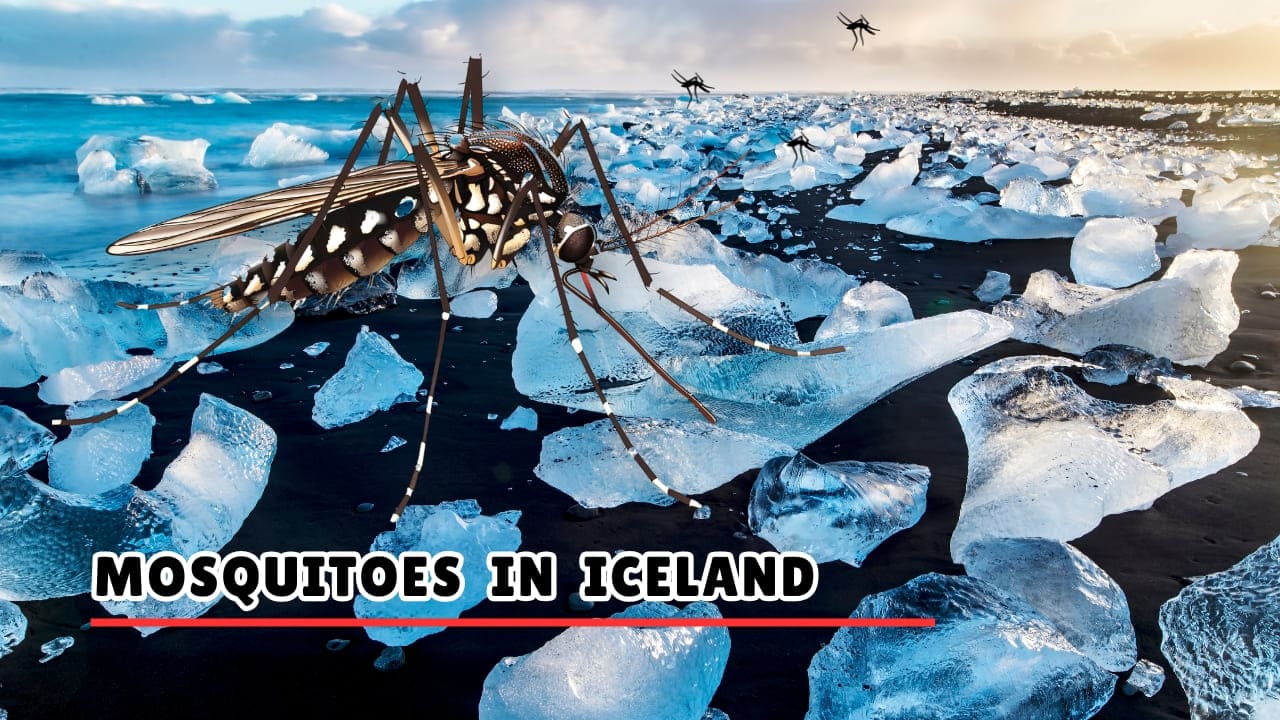
Are There Mosquitoes in Iceland, Yes or No?
Yes, there are mosquitoes in Iceland — first confirmed in October 2025.
For virtually all of recorded history, the answer was no. Iceland was one of the only two places on Earth, alongside Antarctica, with no wild mosquito population. Cold winters, short summers, and unstable freeze-thaw cycles made breeding impossible despite abundant wetland habitat.
That changed on October 16, 2025, when citizen scientist Björn Hjaltason caught three mosquitoes near Kjós, north of Reykjavík. The Natural Science Institute of Iceland confirmed them as Culiseta annulata — a cold-tolerant European species — on October 20, 2025.
Antarctica is now the only place on Earth considered entirely mosquito-free.
Introduction: Discovery of Mosquitoes in Iceland
Iceland was, for a very long time, one of the only places on Earth where you could step outside at dusk in summer and not be bitten. No swatting. No DEET. No coils on the porch. That was genuinely one of the country’s most unusual ecological distinctions — and honestly, something Icelanders seemed quietly proud of.
Then came October 2025.
For the first time in recorded history, mosquitoes were confirmed on Icelandic soil. Three specimens, caught by a citizen scientist north of Reykjavík, turned the country’s bug-free status into past tense. What changed? Why were there no mosquitoes in Iceland to begin with? What species showed up? And what does this mean going forward?
Let’s go through it properly — the biology, the climate science, the new findings, and what it all actually signals.
Why There Were No Mosquitoes in Iceland — The Science Behind It
This question has a surprisingly clear answer, and it comes down to three intersecting factors:
- temperature instability,
- a short warm season, and
- historically reliable freezing winters.
Mosquitoes are cold-blooded (ectothermic) insects. Their entire biology — egg hatching, larval development, adult activity, reproduction — is tied to ambient temperature. They need warmth. Not just a few warm days either. They need sustained warmth in standing water for larvae to develop through four instar stages to pupation, then emergence.
1. The Freeze-Thaw Problem
Iceland sits at 63–66°N latitude. For most of the year, temperatures oscillate around 0°C. What kills mosquito breeding is not necessarily deep cold alone — it’s the unpredictable swings. A pond warming enough for eggs to hatch, then refreezing two days later, wipes out a generation entirely.
Average temperatures in Iceland range from around -1°C in winter to approximately 11°C in the warmest months. That’s a narrow thermal window. Most mosquito species need sustained temperatures above 10°C for meaningful larval development, and above 15°C for efficient breeding cycles.
2. Plenty of Water, Wrong Temperature
Here’s the irony that entomologists have pointed out for years: Iceland has no shortage of the habitat mosquitoes need structurally. The country is full of marshes, ponds, bogs, and wetlands — a mosquito nursery terrain. Structurally ideal. Thermally hostile. The water is fed by cold glacial melt and groundwater, keeping pond temperatures too low even in summer for many species to complete larval development before the season turns.
Male mosquitoes also feed on flowers and plant nectar. Iceland’s short, cool flowering season limits that food source too — so even adult survival was historically constrained.
How Many Mosquitoes Are There in Iceland — What the 2025 Discovery Actually Found
To be precise about this: Three. Actually just three mosquitoes were found and confirmed. That’s the documented count as of the Natural Science Institute of Iceland’s announcement in October 2025.
On October 16, 2025, insect enthusiast Björn Hjaltason was running a wine roping trap near Kiðafell, Kjós — a valley about 20 miles north of Reykjavík. Wine roping (soaking braided cord in sweetened red wine) is a technique used to attract moths and other insects. He spotted something unfamiliar at dusk. He caught it. Then caught two more over the following days.
Two females and one male were sent to entomologist Matthías Alfreðsson at the Natural Science Institute of Iceland. Alfreðsson confirmed the identification: all three were Culiseta annulata, a large mosquito species common across northern Europe and the British Isles.
Three specimens does not mean three mosquitoes exist in Iceland. It means three were caught and verified. Whether a larger local population exists — or whether these were isolated arrivals — was not determined from the initial find. The institute stated they likely arrived via freight, though climate warming is considered to have made their survival increasingly plausible.
Could There Be More?
Realistically, yes. Culiseta annulata is a species known to overwinter as adults, sheltering in barns, basements, and outbuildings. If even a small number arrived via shipping and found suitable shelter before winter, they could survive and potentially reproduce come spring. The 2025 find is a confirmed first, not necessarily a full census.
Quick Facts: Culiseta annulata
| Attribute | Details |
|---|---|
| Species | Culiseta annulata |
| Family | Culicidae |
| Size | One of the largest European mosquito species |
| Distribution | Europe, British Isles, Northern Europe |
| Cold tolerance | High — overwinters as adult in sheltered structures |
| Disease vector? | Not known to carry diseases dangerous to humans in its range |
| Biting behavior | Bites humans and animals; considered a nuisance species |
Mosquitoes Found in Iceland in 2025 — What This Discovery Actually Means
The Natural Science Institute of Iceland confirmed the findings on October 20, 2025. This was not a rumor, not a misidentification, not a single media-inflated story. Three verified specimens, confirmed by a credentialed entomologist, representing the first documented wild mosquitoes in Iceland’s recorded natural history.
So what does it mean, practically speaking?
1. Iceland Is No Longer Mosquito-Free
This sounds obvious, but the ecological and reputational significance is real. Iceland, along with Antarctica, held a genuinely unique status in global entomology. Travelers specifically noted the absence of biting insects as a quality-of-life feature. That’s gone now — or at least, it’s no longer guaranteed.
2. The Species Is Cold-Adapted — That Matters
This isn’t a tropical mosquito that accidentally hitched a ride and died the next morning. Culiseta annulata is specifically adapted to cold-temperate climates. It does not enter true diapause (dormancy) in winter. Research from southern England has documented females remaining active and feeding intermittently through cold months when sheltered. They can survive Icelandic winters in outbuildings and basements.
The institute explicitly noted this species ‘survives the winter as an adult and then stays in shelter, such as outbuildings and basements.’ That’s a meaningful biological trait for Iceland. This isn’t a tourist. It could be a resident.
3. Arrival Via Freight — Not Just Climate
The institute stated the mosquitoes likely arrived via freight. This is consistent with what surveillance programs in the UK and Europe have documented for years: shipping containers, used tire imports, and cargo hubs are primary vectors for mosquito species movement across borders. Iceland’s port traffic and freight operations from mainland Europe are the most probable pathway.
Climate change may have made their survival more viable once they arrived. But the arrival itself was likely human-facilitated logistics, not the insects flying across the ocean on thermals.
4. Experts Are Cautious About the Climate Link — But Not Dismissive
Colin J. Carlson, an epidemiologist at Yale University, noted that Culiseta annulata has historically been found quite far north in Scandinavia, and that Iceland may have been hospitable to these insects even without contemporary climate change. He stated: “Climate change may have made this more likely, but I’m not convinced it’s a clear, direct impact.”
Meanwhile, the entomologist who confirmed the specimens, Matthías Alfreðsson, acknowledged that “warming temperatures are likely to enhance the potential for other mosquito species to establish in Iceland, if they arrive.”
Both positions are worth holding simultaneously. The specific 2025 find may or may not be a direct climate signal. The broader trend — that Iceland is warming, and that warmer conditions expand the range of insects — is supported by solid science.
Timeline of the 2025 Discovery of Mosquito in Iceland
| Date | Event |
|---|---|
| Oct 16, 2025 | Björn Hjaltason spots and catches the first mosquito at dusk in Kjós, using a wine roping trap |
| Oct 17–18, 2025 | Two more mosquitoes caught; all three specimens handed to authorities |
| Oct 20, 2025 | Reykjavík Grapevine reports the find; Matthías Alfreðsson confirms species identity |
| Oct 21–23, 2025 | Natural Science Institute of Iceland issues official confirmation; international media covers the story |
| Post-announcement | Institute notes mosquitoes may have arrived via freight; monitoring implications discussed |
Climate Change and Mosquitoes in Iceland — The Warming Context
Iceland is one of the fastest-warming regions on the planet. The Arctic and sub-Arctic are warming at approximately four times the global average rate, according to ongoing climate monitoring. That’s not a political statement — it’s a physical measurement.
In May 2025, parts of Iceland recorded temperatures more than 13°C above the seasonal norm. A World Weather Attribution analysis found that extreme heat event was made roughly 40 times more likely by human-driven climate change. Iceland had a record-breaking hot summer in 2025, which also accelerated glacial melting.
From a mosquito biology standpoint, these temperature shifts matter in specific ways:
- Warmer air and water accelerate larval development, shortening the time from egg to adult
- Longer warm seasons extend the feeding and breeding window
- Milder winters reduce adult mosquito mortality in sheltered microhabitats
- New rainfall patterns and glacial melt can create additional standing water breeding sites
- Warmer conditions allow mosquito-borne pathogens to develop faster inside the insect host
The World Health Organization has identified mosquito range expansion as one of the most significant public health threats associated with climate change. Europe is already seeing this play out. Aedes aegypti eggs were found near Heathrow in September 2023. The Asian tiger mosquito (Aedes albopictus), capable of transmitting dengue, chikungunya, and Zika, has established itself in parts of southern England. These are not Iceland-specific concerns yet — but they illustrate the direction of travel.
What Mosquitoes in Iceland Mean for Residents, Travelers, and Public Health
Right now? Not much in immediate practical terms. Three mosquitoes found in a valley don’t constitute an infestation, and Culiseta annulata is not a disease vector of significant concern in northern Europe. But the signal matters.
i) For Icelanders
The country joins essentially the entire rest of the world in having mosquitoes. Practically speaking, Icelanders may start encountering biting insects at dusk in certain areas, particularly near standing water in autumn — which is when Culiseta annulata is most active. They’re large mosquitoes. Their bites are noticeable.
ii) For Travelers
Iceland’s marketing appeal partly rested on its unusual status as a mosquito-free destination. That selling point is now, technically, incorrect. Whether this becomes an on-the-ground nuisance depends entirely on whether the species establishes a reproducing population over the coming years. As of now, the probability of being bitten in Iceland remains extremely low — but it is no longer zero.
iii) For Public Health and Surveillance
This is where the 2025 find matters most institutionally. The Natural Science Institute noted that this mosquito represents one of a growing number of new insect species discovered in Iceland in recent years, driven by warming climate and increased international transportation.
Surveillance programs tracking mosquito species introductions in similar northern-edge environments — Scandinavia, northern UK, sub-Arctic Canada — consistently identify freight and port entry as the primary introduction pathway. Iceland’s biosecurity systems would benefit from incorporating entomological monitoring at ports and freight hubs, as many European countries have done.
Could More Dangerous Species Follow?
This is the right question to ask, and the honest answer is: possibly, over time. As Iceland’s climate continues warming, the thermal threshold for other mosquito species becomes more achievable. Culiseta annulata is cold-adapted and largely benign from a disease standpoint. Other species that could potentially arrive — particularly if freight monitoring is not robust — may carry different risk profiles.
This is not a reason for alarm. It is a reason for monitoring infrastructure investment.
Iceland vs. Other Northern Countries: Mosquito Risk Context
| Country | Endemic mosquitoes? | Disease vector risk | Notes |
|---|---|---|---|
| Iceland (pre-2025) | None confirmed | None | Only mosquito-free country outside Antarctica |
| Iceland (Oct 2025+) | 3 specimens confirmed | Very low | Culiseta annulata; not disease-carrying in Europe |
| Norway / Finland | Yes — multiple species | Low to moderate | Aedes species present; limited pathogen transmission risk |
| UK | Yes — 30+ species | Low-moderate; rising | Aedes albopictus and Ae. aegypti found in recent years |
What Happens Next — Surveillance, Monitoring, and What to Watch For
The 2025 find ended a chapter. What matters now is what Iceland does with the information.
From a scientific and public health standpoint, these are the priority steps:
- Establish systematic entomological surveillance at Icelandic ports, airports, and major freight hubs — the most likely introduction pathways for additional species.
- Monitor the Kjós site and surrounding areas through the 2026 warm season to determine whether Culiseta annulata establishes a breeding population or whether the 2025 specimens were isolated arrivals.
- Expand citizen science reporting infrastructure. Björn Hjaltason’s find came through informal Facebook groups — dedicated reporting channels would improve data quality and speed.
- Document any additional species introductions promptly, particularly Aedes species (Aedes albopictus, Aedes. aegypti) which carry significantly higher disease risk.
- Communicate clearly with the public about what the find does and does not mean for health risk. Culiseta annulata is a nuisance; it is not currently a public health emergency.
The Natural Science Institute of Iceland handled this well. The confirmation was timely, the public communication was measured, and the framing — this species likely arrived via freight; climate change may enhance future potential — was scientifically accurate and appropriately cautious. That’s the model.
Conclusion: Mosquitoes in Iceland — The End of an Exception
For decades, Iceland stood as one of the world’s only mosquito-free countries, a quirk of cold temperatures, freeze-thaw instability, and short warm seasons that made breeding impossible even with abundant standing water habitat. The question of why there were no mosquitoes in Iceland had a clear scientific answer: the climate simply didn’t permit them.
October 2025 changed that. Three Culiseta annulata mosquitoes, confirmed by the Natural Science Institute of Iceland, represent the country’s first documented wild mosquitoes. They were found by a citizen scientist in Kjós, north of Reykjavík, using a wine roping trap aimed at moths. The species is cold-tolerant, is known to overwinter as an adult in sheltered structures, and is common across northern Europe.
They likely arrived via freight. Whether they establish a reproducing population in Iceland is still unknown. The immediate public health risk from this specific species is low — Culiseta annulata bites, but is not currently linked to disease transmission in humans in its European range.
What the mosquitoes in Iceland found in 2025 actually mean is this: Iceland is warming, international freight creates biological connectivity between previously isolated ecosystems, and the ecological distinctiveness that defined the country for a long time is eroding. Antarctica is now the only place on Earth with no mosquitoes.
That’s worth paying attention to — not with panic, but with rigorous monitoring, honest communication, and the kind of biosurveillance infrastructure that northern Europe has been building for years. Iceland’s entomological baseline has shifted. The response should match the moment.
Editorial Team & Contributors

Raashid Ansari, Founder, Content Researcher & Author - MosquiTalk
Not an entomologist — just a genuinely curious writer who started researching mosquitoes and couldn't stop. What began as casual reading about repellents and bite prevention gradually turned into a deep ongoing dive into vector biology, disease epidemiology, animal health impacts, and the real science behind mosquito control. Everything published here is carefully edited, and written with one purpose: giving readers accurate, accessible information they can actually trust and use to protect themselves, their families, and their pets, birds and cattle.
Active across social platforms, regularly publishes, and genuinely invested in spreading mosquito awareness where it matters most. Because informed readers make better decisions — and better decisions save lives.