
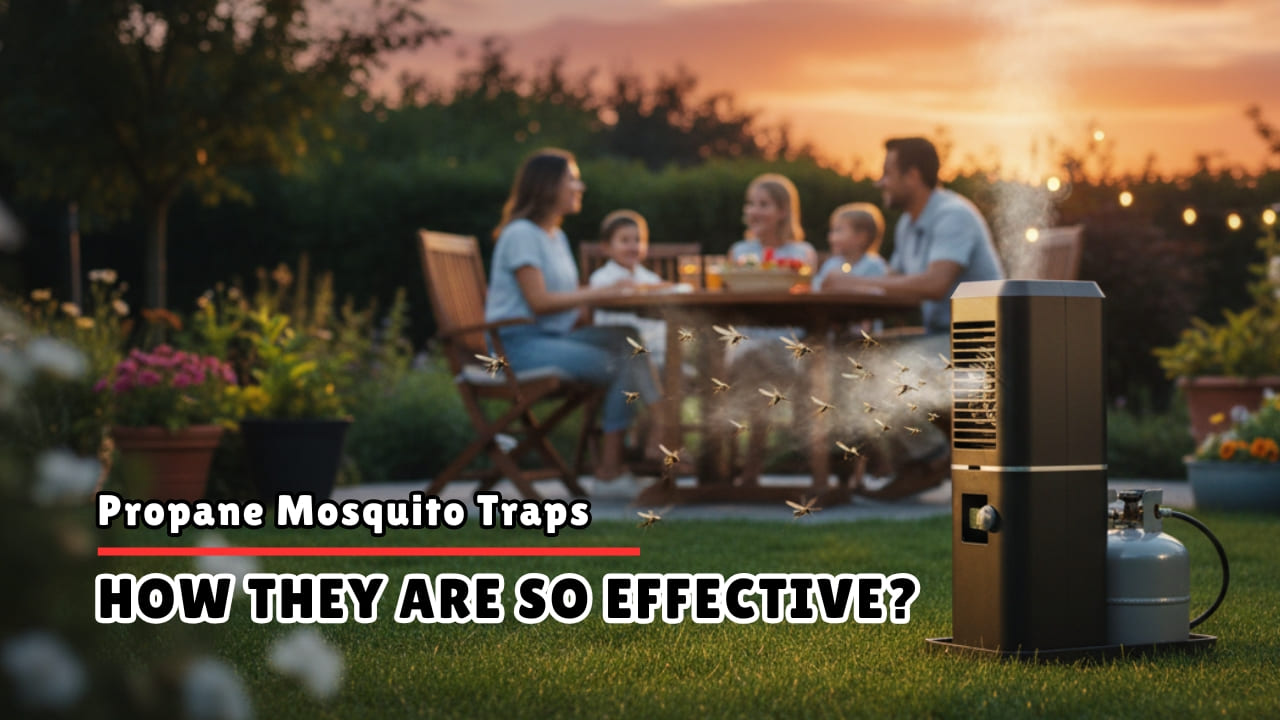
It happens every summer. You drag the patio furniture out, fire up the grill, pour yourself something cold — and within ten minutes you’re slapping your arms and retreating inside. The mosquitoes found you. Again. They always do.
You’ve probably tried a lot of things. Citronella candles that flicker out in the breeze. Bug zappers that electrocute moths and beetles but leave the mosquitoes completely unbothered. Maybe even those clip-on repellent fans that make you smell vaguely chemical for hours. Nothing really works. Not consistently, anyway.
So why — when so many products fail — do propane mosquito traps actually reduce mosquito populations around a yard? Why do they work when other traps can’t even seem to attract the right insects?
The answer is rooted in entomology. It comes down to how mosquitoes find you in the first place. And once you understand that, it becomes very clear why a propane trap — done right — is not just a trap. It’s a scientifically calibrated imitation of a living, breathing human being. One that never goes inside.
Understanding Mosquito Host-Seeking Behavior
Before we talk anything about propane mosquito control, we need to talk about the mosquito. Specifically, how it hunts.
Female mosquitoes — the ones that bite — are not randomly wandering around your yard. They are actively searching for a blood meal using a layered, multi-signal detection system that has been refined over roughly 100 million years of evolution. The entomological term for this is “host-seeking behavior,” and it’s been the subject of sustained scientific study for decades.
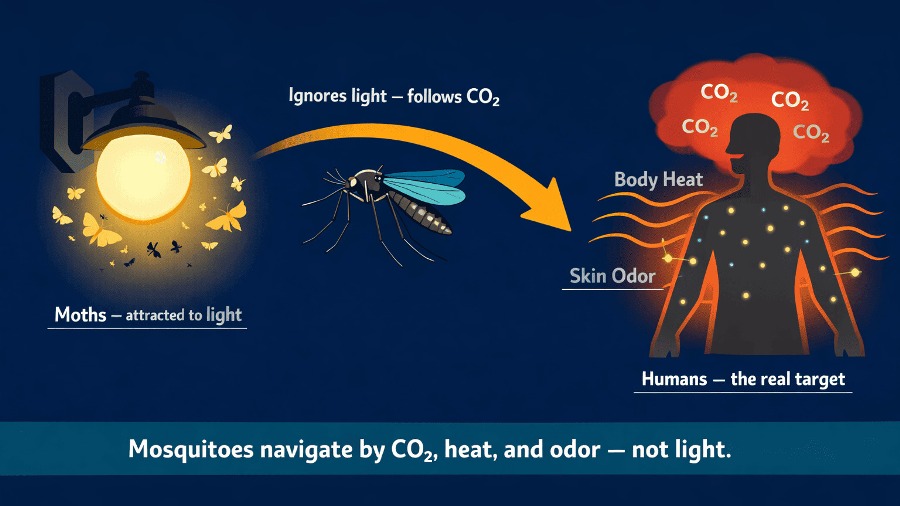
Research from the London School of Hygiene & Tropical Medicine and the University of California Davis has mapped out the sequence in detail. At long range — distances of 30 to 50 meters or more — mosquitoes are primarily following plumes of carbon dioxide (CO₂). At medium range, thermal heat signatures and moisture vapor become more important. Up close, within a meter or two, specific skin-derived chemical compounds take over.
In other words: mosquitoes navigate toward hosts using at least three distinct sensory channels simultaneously. A trap that only addresses one of them will underperform.
The Carbon Dioxide Plume: Long-Range Navigation
Carbon dioxide is the keystone. Every time a warm-blooded animal exhales, it releases a small plume of CO₂ into the surrounding air. Mosquitoes have specialized receptor neurons — located in sensory organs on their antennae and maxillary palps — that are exquisitely sensitive to CO₂ concentration changes as small as a few parts per million above ambient levels.
When a mosquito detects an elevated CO₂ concentration, it doesn’t just fly toward it in a straight line. It enters a behavioral mode known as upwind flight — it orients itself against the prevailing wind current and zigzags back and forth within the CO₂ plume, maintaining contact with it while flying upwind toward the source. This is called “casting” behavior in the entomological literature, and it’s the same kind of plume-following strategy used by many insects and even some crustaceans.
Research published in the journal Chemical Senses has demonstrated that this CO₂-triggered upwind flight is the initiating step in host location for Aedes aegypti, Culex quinquefasciatus, and Anopheles gambiae — three of the world’s most consequential disease-vector mosquitoes.
Propane combustion produces CO₂ continuously. A typical propane trap running at standard output can produce CO₂ at a rate roughly comparable to human exhalation — which is not an accident. It’s the design goal.
Heat, Moisture, and the Thermal Signature
CO₂ alone is not enough to bring a mosquito in for a landing. Once a mosquito is within about five to ten meters of the source, it begins integrating additional cues. The most important of these are infrared heat and moisture.
Human skin sits at around 33 to 35 degrees Celsius. To a mosquito, that warmth creates a detectable thermal gradient — a warm bubble of air radiating outward from the body. Combined with the moisture vapor exhaled in breath and transpired through skin (humans lose about 500ml to a liter of water per day through the skin alone), the effect is a kind of warm, humid microclimate around a resting person.
Propane combustion produces both. The combustion reaction generates heat and water vapor (H2O) as direct byproducts, creating an artificial thermal and humidity signature that mimics, with reasonable fidelity, the microenvironment surrounding a human body.
Laboratory studies at Rothamsted Research (UK) confirmed that Aedes mosquitoes showed significantly elevated attraction responses to combinations of heat and CO₂ versus CO₂ alone — underscoring why traps that combine these outputs outperform CO₂-only designs.
The Role of Chemical Lures: Octenol, Lactic Acid, and Skin Odor Compounds
Now we’re getting into the really interesting stuff.
Human skin is not just warm. It’s chemically distinctive. Skin bacteria metabolize secretions from sweat glands and sebaceous glands, producing a constellation of volatile organic compounds (VOCs) that are, from a mosquito’s perspective, an unmistakable signature of edible mammal.
The most studied of these compounds in the context of mosquito attraction are:
- 1-Octen-3-ol (Octenol): A fungal alcohol found in human and bovine breath and exhalations. Octenol dramatically increases mosquito trap catches when added to CO₂ streams, particularly for Aedes and Culex species. Research from the University of Florida’s Institute of Food and Agricultural Sciences (IFAS) demonstrated catch increases of up to 10-fold in field studies using octenol in combination with CO₂.
- Lactic Acid: A product of carbohydrate metabolism, lactic acid is present in human sweat in relatively high concentrations. Aedes aegypti, the yellow fever and dengue mosquito, is particularly responsive to lactic acid. Studies from the Vanderbilt University Department of Biological Sciences identified lactic acid as a primary activating compound for Aedes host-seeking.
- Ammonia and Carboxylic Acids: These compounds, derived from skin bacteria and amino acid metabolism, form part of what researchers call the “human odor blend.” The exact composition varies between individuals — which is partly why some people get bitten more than others — but the general profile is identifiable to mosquitoes from a distance.
Better-quality propane traps allow users to add lure cartridges containing octenol, lactic acid, or species-specific blends. This is not a gimmick. It reflects the actual science of olfactory host detection and can meaningfully shift what species are captured, and how many.
The table below compares common mosquito control options against the known host-detection cues that propane mosquito traps are designed to replicate:
Table 1: Mosquito Control Methods vs. Host-Detection Cue Replication
| Trap Type | CO₂ Output | Heat Signature | Skin Odor Mimics | Effectiveness Rating |
|---|---|---|---|---|
| Propane Trap (e.g., Mosquito Magnet) | High (continuous) | Yes | Yes (Octenol, lactic acid) | ★★★★★ |
| UV/Bug Zapper | None | Minimal | No | ★★ |
| CO₂-Only Electric Trap | Moderate | Some | Rarely | ★★★ |
| Sticky Trap / Glue Board | None | No | No | ★ |
| Citronella Candle | Trace CO₂ | Minimal | Weak repellent only | ★ |
| DEET Repellent (personal) | N/A – personal use | N/A | Masks signals | ★★★★ (personal) |
How the Propane Combustion Process Creates a Multi-Cue Lure?
Let’s walk through what actually happens inside a propane mosquito trap during operation.
Propane (C3H8) undergoes combustion in the presence of oxygen, producing carbon dioxide, water vapor, and heat. The trap’s catalytic converter or combustion chamber manages this reaction at a controlled rate. The output — CO₂ at a set concentration, warm moist air — exits through a funnel or nozzle designed to produce a downward-drifting plume that behaves somewhat like the exhaled breath and body heat of a sitting person.
The mosquito, following its CO₂ plume upwind, is drawn toward the trap. As it closes range, the heat and moisture cues reinforce the signal. If a chemical lure is present, the olfactory confirmation seals the deal. The insect commits to landing — and instead encounters a vacuum impeller that draws it into a capture net or holding container, where it dies from dehydration.
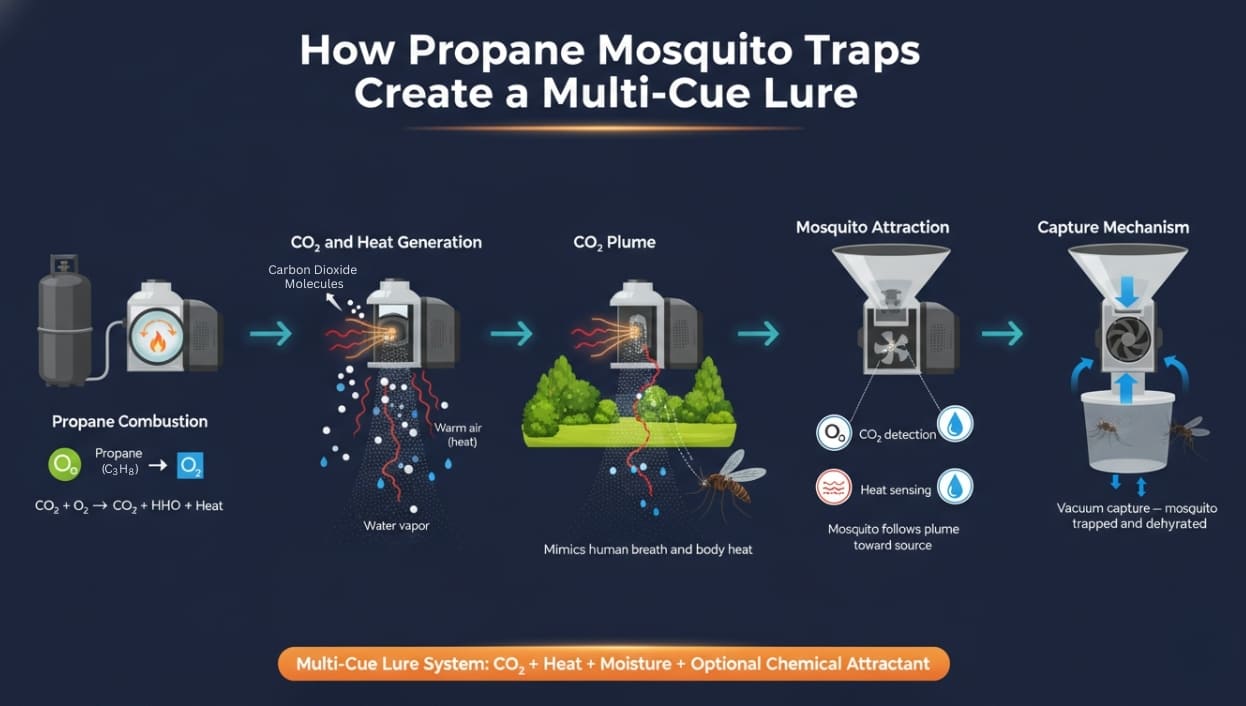
There’s no electricity discharge, no UV light, no toxic spray. The mosquito is deceived by its own evolved detection system and removed from the population permanently.
The table below summarizes the primary detection cues that mosquitoes use and how each is replicated:
Table 2: Mosquito Host-Detection Cues and Propane Trap Replication
| Detection Cue | Biological Source | Mimicked by Propane Trap? |
|---|---|---|
| Carbon Dioxide (CO₂) | Exhaled breath, metabolic respiration | Yes — primary output of combustion |
| Thermal Heat Plume | Skin surface temperature (~34°C) | Yes — combustion heat signature |
| 1-Octen-3-ol (Octenol) | Human and bovine skin/breath | Yes — common lure additive |
| Lactic Acid | Sweat from skin surface | Yes — available as lure |
| Moisture (H2O vapor) | Exhaled breath, skin transpiration | Yes — byproduct of combustion |
| Visual Contrast | Dark clothing, body silhouette | Partial — dark trap housing |
Why UV Bug Zappers Fail at Mosquito Control?
This is worth addressing directly because a lot of people still use them.
Bug zappers work by emitting UV light, which attracts a wide range of flying insects. Mosquitoes are, broadly speaking, not UV-attracted insects. They are CO₂ and heat-attracted insects. The overlap is minimal.
A 1996 study by researchers at the University of Notre Dame, led by Dr. Douglas Tallamy and subsequently widely cited by extension services including the North Carolina State University Department of Entomology, found that in residential settings, bug zappers killed thousands of beneficial and neutral insects per day — but mosquitoes represented less than 0.1% of total catch.
The UV zapper is not targeting the right sensory channel. It’s like putting up a billboard in a language the mosquito doesn’t read.
Population Suppression: Why Trapping Works Over Time
One thing that often confuses people is the timeline. Propane mosquito traps don’t provide instant relief. You might run one for a week and still notice mosquitoes. And you might assume the trap isn’t working.
But the mechanism here is population suppression, not immediate eradication. Female mosquitoes require blood meals to reproduce — and they reproduce rapidly. Aedes aegypti can complete a generation in as little as 8 to 10 days under optimal conditions. By continuously removing gravid (egg-bearing) females from the population, the trap interrupts reproductive cycles that would otherwise compound exponentially.
The American Mosquito Control Association (AMCA) and various county mosquito control districts have noted that sustained mechanical trapping over a 4 to 8 week period can produce measurable and significant reductions in local mosquito populations, particularly in areas with limited larval habitat. The key word is sustained. The trap has to run continuously during active mosquito season.
Research cited by the Rutgers University Center for Vector Biology indicates that a single well-placed CO₂/octenol trap can suppress mosquito populations in an area of up to half an acre when operated continuously. Larger properties benefit from multiple units positioned downwind of breeding areas.
Placement Science: Where You Put the Trap Matters Enormously
Placement is something that a lot of manufacturers undersell and most homeowners get wrong.
The core principle: place the trap between the breeding source and the living area. Mosquitoes follow CO₂ plumes upwind. They are typically moving from shaded, humid resting areas toward human activity areas at dawn and dusk. If your trap sits in the middle of your patio, you’re competing with yourself — the trap is attracting the same mosquitoes that would otherwise be attracted to you, but it has no head start.
The University of Florida IFAS Mosquito Research Program recommends positioning traps 30 to 40 feet from human activity, in shaded, relatively still-air areas, upwind of primary breeding sources (standing water, dense vegetation, woodland edges). This gives the trap’s plume time to intercept mosquitoes before they reach the patio.
Avoid placing traps near dense air currents — wind disperses the CO₂ plume and makes it harder for the trap to function properly. Similarly, direct sunlight can overheat the unit and interfere with lure effectiveness.
Species-Specific Effectiveness: Which Mosquitoes Propane Traps Catch
Not all mosquitoes respond equally to propane traps. This is worth understanding if you’re dealing with a particular pest species.
Aedes species — including the Asian Tiger Mosquito (Aedes albopictus), the most aggressively invasive mosquito species in the United States — are strongly CO₂-responsive and well captured by propane traps with octenol lures. Aedes albopictus, which the CDC has flagged as a vector for dengue, chikungunya, and Zika, is a daytime biter and responds particularly well to species-specific chemical lures.
Culex pipiens, the primary vector for West Nile Virus, also responds well to CO₂, though the optimal lure blend for Culex may differ from that for Aedes. Some manufacturers offer Culex-specific lure formulations, and extension services like those run by Texas A&M AgriLife Extension have published guidance on matching lure chemistry to the dominant local mosquito species.
Table 3: Mosquito Species and Propane Trap Effectiveness
| Mosquito Species | Disease Vector | Response to CO₂ + Octenol Lure |
|---|---|---|
| Aedes aegypti | Dengue, Zika, Yellow Fever | Strong |
| Aedes albopictus (Asian Tiger) | Dengue, Chikungunya | Strong |
| Culex pipiens | West Nile Virus | Moderate–Strong |
| Anopheles quadrimaculatus | Malaria (in endemic regions) | Moderate |
| Ochlerotatus triseriatus | La Crosse Encephalitis | Moderate |
Do Propane Mosquito Traps Have Any Limitations?
Propane traps are not a silver bullet. I think it’s important to say that clearly.
They work best as part of an integrated mosquito management approach. This means combining trapping with source reduction — eliminating standing water in gutters, bird baths, pot saucers, and low-lying areas where mosquitoes breed. No trap, regardless of how well-designed, can compensate for an abundant breeding environment nearby.
They are also not effective during periods of very high wind, which disperses the CO₂ plume before mosquitoes can follow it. And they require consistent maintenance — propane tanks need refilling, lure cartridges need replacing, and catch containers need regular clearing to prevent the dead mosquitoes from becoming a secondary odor attractant for other insects.
Cost is a real factor too. Quality propane traps from established manufacturers run from $200 to over $500, with ongoing propane and lure costs. Cheaper, unbranded “propane traps” sometimes lack the precision combustion calibration that makes the real ones work — so it’s genuinely worth investing in a unit with documented performance data.
Scientific Evidence Behind Propane Mosquito Trap’s Effectiveness
The performance claims around propane traps for mosquitoes vary widely, and some of the marketing is admittedly overheated. So let’s ground this in what the research actually demonstrates.
A field study conducted in New Jersey — a state with some of the highest mosquito pressure in the US — and cited by the Rutgers University Mosquito Research and Control Unit found that propane traps with CO₂ and octenol lures reduced Aedes albopictus populations by approximately 60 to 70% in treated yards versus control yards over a 6-week period.
Research from the Florida Medical Entomology Laboratory, part of the University of Florida’s IFAS system, documented that continuous operation of propane-based traps during peak season significantly reduced gravid female catches in residential settings — directly impacting reproduction.
The Connecticut Agricultural Experiment Station, which runs one of the most active arbovirus surveillance programs in the northeast US, uses propane CO₂ traps as a primary surveillance tool — specifically because of their reliable, consistent capture rates across target species. The fact that mosquito control professionals use these traps for scientific population monitoring is, in itself, a meaningful endorsement of their sensitivity and effectiveness.
Why Some Mosquito Repellent Methods Are Less Effective?
There’s a reason the mosquito control landscape is littered with products that don’t really work.
Mosquitoes are not attracted to the things we often assume they are. They are not strongly attracted to light (with some species-specific exceptions at very specific wavelengths). They are not attracted to vibration. They are not repelled by ultrasonic sound — the research on this has been reviewed repeatedly, including by the American Mosquito Control Association, and consistently finds no measurable effect.
They are attracted to metabolic outputs: CO₂, heat, moisture, and specific volatile compounds from human skin. Any product that fails to address those cues will underperform relative to the marketing copy.
Propane traps work because the people who designed the effective ones actually studied what mosquitoes respond to, not just what seemed intuitive or was cheap to engineer. The science was done first. The trap followed.
📰 Must Read,
✔️ Rain, Hot or Cold – What Weather Do Mosquitoes Enjoy?
✔️ US Mosquito Season State-wise Data: Climate Trends, Peak Months & Risk Map
Propane Mosquito Control: Why Propane Mosquito Traps Work?
If you’ve been frustrated with mosquito control, it’s probably not that you haven’t tried hard enough. It’s that most products aren’t targeting the right signals.
Mosquitoes are sophisticated navigators. They use a layered system of chemical, thermal, and moisture cues to locate warm-blooded hosts from a distance. A mosquito trap that replicates only one of those cues — or none of them — is going to catch a fraction of what’s available.
Propane mosquito traps succeed because they replicate the exact signals that mosquitoes evolved to follow. The CO₂ plume mimics exhalation. The combustion heat mimics body temperature. The moisture byproduct mimics breath humidity. The chemical lures mimic skin volatiles. Together, they create an artificial host signal that is, from the mosquito’s perspective, indistinguishable from a sitting human being.
Used consistently, positioned correctly, and paired with source reduction, they are genuinely one of the most effective tools available for residential mosquito management. The entomology supports it. The field data supports it. And if you’ve spent a summer running one properly, your experience probably does too.
Frequently Asked Questions (FAQs)
How long does it take for a propane mosquito trap to work and reduce mosquito populations?
This is the question most homeowners ask first, and the honest answer is: longer than you want it to. Don’t expect dramatic overnight results. A propane trap works by interrupting mosquito breeding cycles, not by killing every adult mosquito in your yard on day one. Most users start noticing a meaningful reduction in mosquito activity after three to four weeks of continuous operation.
The science explains why: female mosquitoes need blood meals to produce eggs, and the trap removes gravid (egg-bearing) females before they can deposit those eggs in standing water. Since Aedes mosquitoes can complete a full generation in as few as 8 to 10 days under warm conditions, each generation removed by the trap results in a compounding population reduction over time.
Run the propane trap continuously — don’t turn it off at night or between weekends. Every break in operation is an opportunity for the local population to recover.
Does a propane mosquito trap use a lot of propane, and is it cost-effective compared to other mosquito control methods?
Propane consumption varies by model and run settings, but most residential propane mosquito traps consume roughly 1 lb of propane per day at standard operation, meaning a standard 20 lb grill tank lasts about three weeks of continuous use. A 100 lb tank will run most of a mosquito season. On a per-day cost basis, propane traps typically run $1 to $2 per day including propane and lure replacement. Compare that to professional spray treatments, which often cost $75 to $150 per visit and need to be repeated every few weeks.
Over a full season, a well-maintained propane trap is frequently more economical — and unlike pesticide applications, it doesn’t introduce insecticides into your yard’s soil and plant ecosystem. The upfront hardware cost ($200–$500 depending on model) is the main investment, but it amortizes quickly across multiple seasons.
Where is the best placement for a propane mosquito trap to maximize CO₂ plume interception?
The fundamental rule: position the propane trap between the breeding source and the activity area, not next to where people sit. Mosquitoes travel upwind following CO₂ plumes from resting areas (dense vegetation, woodland edges, shaded humid zones) toward human activity. If the trap is placed 30 to 40 feet from your patio, in partial shade, upwind of where mosquitoes originate, it intercepts them in transit before they reach you.
Avoid placing traps in direct sunlight or in high-wind corridors, which disperse the CO₂ plume and reduce attractant range. Trap placement is as important as trap selection — even a premium trap placed incorrectly will underperform a mid-range trap placed correctly. One additional tip: if you have identifiable standing water sources nearby (a pond, drainage swale, or neighbor’s yard), bias the trap position toward that direction.
What is octenol and do I actually need a mosquito trap lure to attract mosquitoes effectively?
Octenol (1-octen-3-ol) is a volatile organic compound naturally present in human breath and skin secretions. It functions as a close-range chemical cue that signals “warm-blooded host nearby” to a mosquito that has already been drawn in by the CO₂ plume. Think of CO₂ as the billboard on the highway and octenol as the sign on the exit ramp. You can run a propane trap without a lure — and it will still catch mosquitoes through CO₂ and heat alone.
But field research from the University of Florida IFAS program found catch rates increased up to tenfold when octenol was added to CO₂ streams in traps targeting Aedes and Culex species. Whether you need the lure depends on your local mosquito species. Aedes albopictus (Asian Tiger Mosquito) and Aedes aegypti respond very strongly to octenol. Culex pipiens (West Nile vector) shows a somewhat different olfactory profile and may respond better to lures containing a blend of ammonia and carboxylic acids.
If you’re unsure which species are dominant in your area, contact your local mosquito control district — most maintain surveillance data and can tell you exactly what you’re dealing with.
Are propane mosquito traps safe to use around children, pets, and garden pollinators like bees?
Yes — propane traps use no pesticides or toxins at all. The capture mechanism is purely physical: a vacuum fan pulls mosquitoes into a net where they dehydrate. CO₂ output is comparable to a person breathing and disperses harmlessly. Bees don’t respond to CO₂ or octenol the way mosquitoes do, so bycatch of beneficial insects is minimal compared to sprays or UV zappers.
Will a propane trap draw more mosquitoes into my yard from outside?
It’s a fair concern, but the research doesn’t support it as a practical problem. The effective lure range of a residential propane trap is roughly 30 to 75 feet — about the same as a person sitting outdoors. Mosquitoes attracted by the trap would have been attracted to your yard’s human occupants anyway. The trap simply wins the competition. Starting early in the season, before populations peak, keeps you ahead of the curve.
Do propane traps work on Asian Tiger Mosquitoes — the daytime biters?
Yes, and this is actually one area where propane traps outperform many alternatives. The Asian Tiger Mosquito (Aedes albopictus) is a particularly aggressive daytime biter unlike Culex mosquitoes, which primarily bite at dusk and dawn, Aedes albopictus bites throughout the day — making it far more disruptive to outdoor living and harder to avoid with behavioral strategies alone.
Critically, Aedes albopictus is highly responsive to CO₂ and octenol-based lures. Field studies have consistently shown strong catch rates for this species in propane traps, particularly when octenol lures are used.
If Asian Tiger Mosquitoes are your primary problem, a propane trap with an octenol lure, positioned near dense low vegetation (their preferred resting habitat), is one of the most targeted tools available to residential users short of professional treatment programs.
How does a propane trap compare to professional mosquito spraying and fogging treatments?
They work differently and, used together, they complement each other. Professional spraying (typically pyrethrin or permethrin-based) provides fast knockdown of adult mosquito populations. You’ll notice results within 24 hours. But the effect is temporary: spray treatments don’t prevent new adults from emerging from nearby larval habitat, so populations typically rebound within 2 to 4 weeks.
Propane traps are slower to produce results but target the ongoing reproductive cycle rather than just the existing adult population. They remove females before eggs are laid, reducing future generations. The mosquito control model used by many professional programs in high-pressure areas — including those guided by mosquito control districts in Florida, Texas, and New Jersey — combines adult control (spraying) with source reduction and mechanical trapping as a sustained suppression strategy.
For homeowners, a practical hybrid approach might be: professional spray treatment at the start of the season for immediate relief, followed by continuous propane trap operation through the season to maintain suppression without repeated chemical applications. The combination addresses both the short-term discomfort problem and the long-term population management goal.
Editorial Team & Contributors

Raashid Ansari, Founder, Content Researcher & Author - MosquiTalk
Not an entomologist — just a genuinely curious writer who started researching mosquitoes and couldn't stop. What began as casual reading about repellents and bite prevention gradually turned into a deep ongoing dive into vector biology, disease epidemiology, animal health impacts, and the real science behind mosquito control. Everything published here is carefully edited, and written with one purpose: giving readers accurate, accessible information they can actually trust and use to protect themselves, their families, and their pets, birds and cattle.
Active across social platforms, regularly publishes, and genuinely invested in spreading mosquito awareness where it matters most. Because informed readers make better decisions — and better decisions save lives.