
The Backyard Question Everyone Gets Wrong
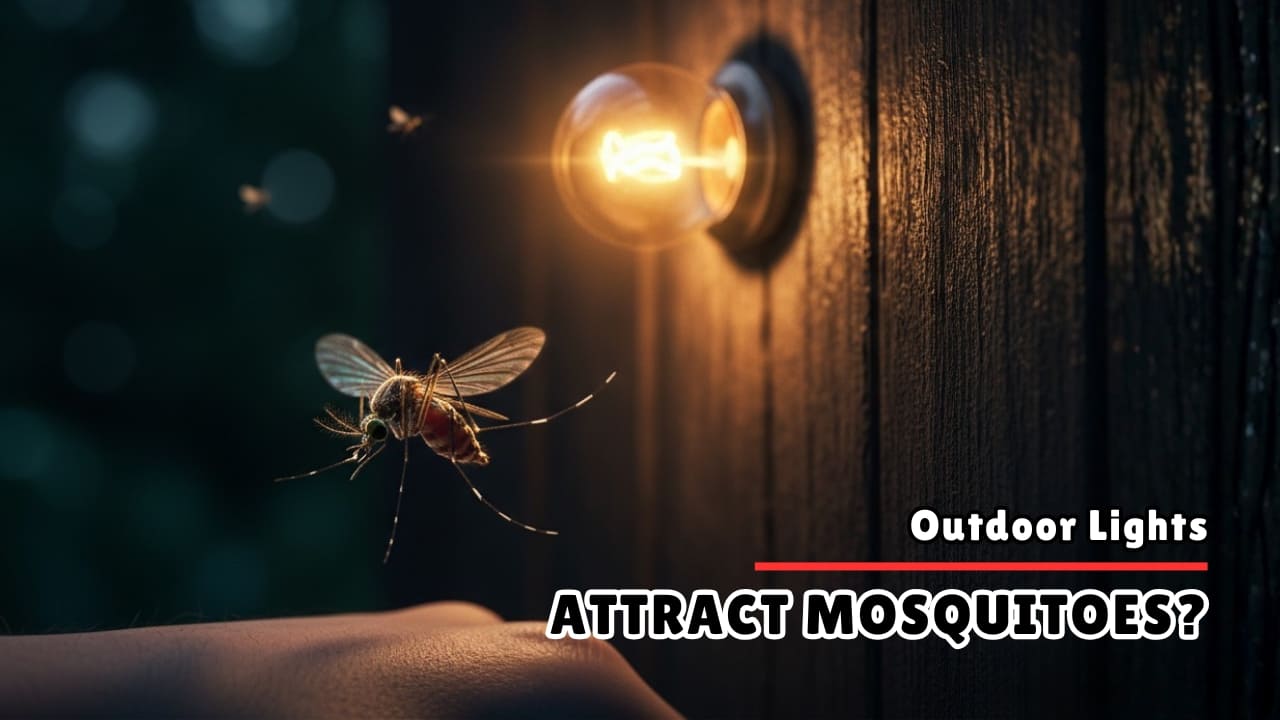
You’re hosting an outdoor dinner on a warm summer evening. The patio lights are on, candles are burning, and within minutes the mosquitoes arrive. The obvious conclusion: the lights drew them in.
It’s a logical assumption — and it’s largely incorrect. The relationship between outdoor lights and mosquito behavior is more nuanced than most people realize, and the distinction matters for anyone trying to actually reduce nighttime biting.
This article explains exactly what the science says about whether outdoor lights attract mosquitoes, why nighttime mosquito activity intensifies regardless of your lighting, which types of light increase or reduce attraction, and what actually works to keep mosquitoes away after dark.
The Direct Answer: Do Outdoor Lights Attract Mosquitoes?
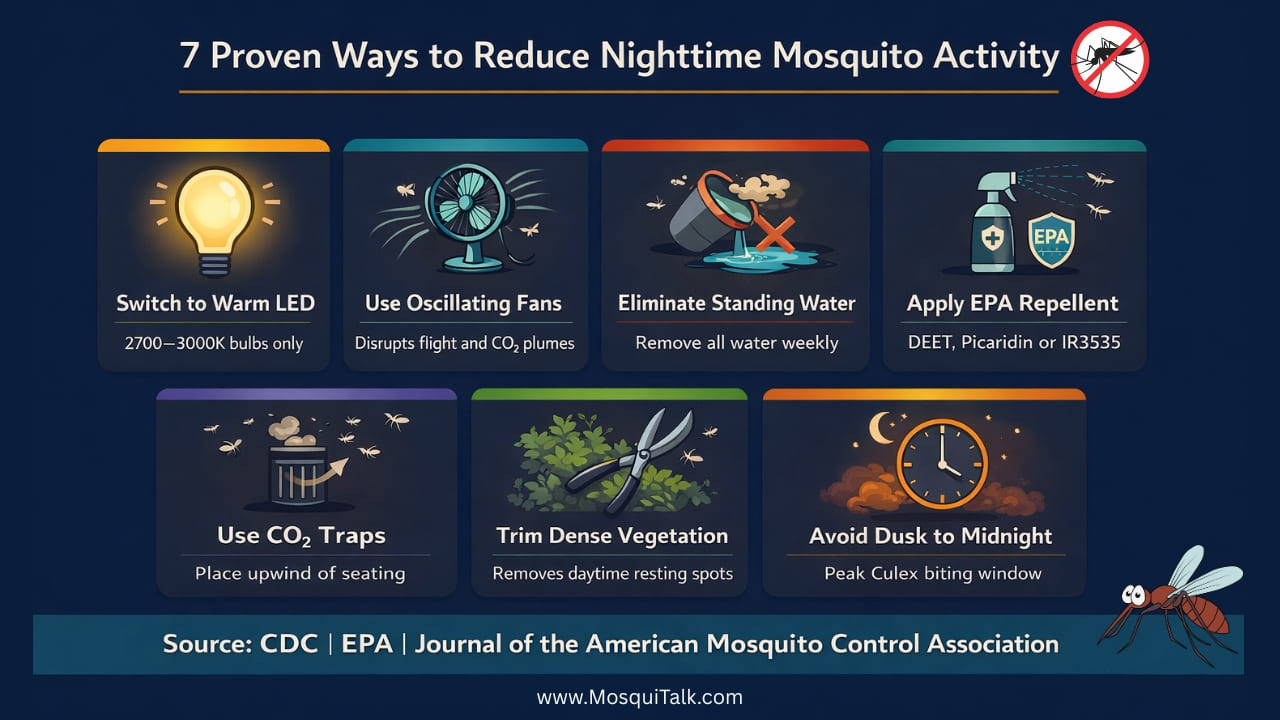
Mosquitoes are not attracted to your porch light — they are attracted to you because they rely on a chemosensory navigation system built around host detection. Unlike moths, they do not instinctively fly toward light sources. What actually draws them in is the CO₂ you exhale, the heat your body radiates, and the odors your skin produces.
A few species have a weak, passing sensitivity to certain light wavelengths, but that response is minor and easily overridden by the far stronger pull of a warm, breathing human nearby.
Are Mosquitoes Attracted to Light? The Scientific Reality
Phototaxis vs Host-Seeking Behavior
Phototaxis is the biological tendency of an organism to move toward (positive phototaxis) or away from (negative phototaxis) a light source. Moths are the classic positive phototactic insect — their navigational system is disrupted by artificial light, causing them to orbit light sources compulsively.
Mosquitoes are fundamentally different. Their primary navigational system is chemosensory, not photic. Specialized mosquito olfactory receptors in the maxillary palps detect CO₂ plumes from up to 50 meters away. Thermal sensors identify skin surface heat. Olfactory receptors respond to lactic acid, ammonia, and other volatile skin compounds.
Light is a secondary, weak cue in mosquito host-seeking behavior. Research from university vector biology departments confirms that when CO₂ and light cues are placed in competition in laboratory conditions, mosquitoes consistently orient toward the CO₂ source, not the light source.
Species Differences in Light Response
Not all mosquito species respond to light identically. Research has documented some species-specific phototactic tendencies worth noting.
Culex quinquefasciatus — The southern house mosquito shows mild positive phototaxis toward short-wavelength UV light but is primarily a night-biting species guided by host cues, not illumination.
Anopheles species — Most Anopheles mosquitoes are strongly nocturnal but show limited light-seeking behavior. They use lunar light cycles as a circadian cue, which is why full moons can slightly alter their activity patterns.
Aedes aegypti — A predominantly daytime biter. Artificial outdoor lights have minimal relevance to its host-seeking behavior, which occurs primarily in daylight hours regardless of illumination.
Why Mosquitoes Are Not Moths
The confusion between mosquito and moth behavior is one of the most persistent myths in pest management. Both insects are drawn toward illuminated outdoor areas — but for completely different reasons. Moths navigate by light. Mosquitoes navigate by smell and heat. They are simply using the same location because humans have created it: a warm, CO₂-rich gathering space that happens to be lit.
Why Mosquito Activity Increases at Night
Mosquitoes do not become more active at night because of lighting. They increase activity after sunset for purely biological and environmental reasons tied to their physiology and survival, as they are crepuscular insects.
1. Circadian Rhythms
Most disease-transmitting mosquito species — particularly Culex and Anopheles — have genetically hardwired circadian activity patterns that peak between dusk and dawn. These rhythms evolved independently of human lighting and are regulated by internal biological clocks responsive to light-dark cycles, not artificial illumination intensity.
2. Temperature and Humidity
Daytime summer temperatures in many regions regularly exceed 35°C (95°F), which creates physiological stress in mosquitoes — increasing desiccation risk and reducing flight efficiency. Nighttime brings cooler temperatures in the 24°C–28°C (75°F–82°F) range that fall within the optimal mosquito activity window. Nighttime humidity also rises, reducing water loss through the mosquito’s exoskeleton.
3. Reduced Wind
Wind is one of the most effective natural mosquito deterrents. Daytime convective heating typically produces higher wind speeds that physically prevent weak-flying mosquitoes from navigating effectively. Nighttime air is generally calmer, enabling precise host-seeking navigation using CO₂ and odor plumes.
Table 1: Day vs Night Environmental Conditions for Mosquito Activity
| Factor | Daytime Conditions | Nighttime Conditions | Impact on Activity |
| Temperature | Often above 35°C — stressful | 25°C–30°C — optimal | Night favored |
| Relative Humidity | Lower — desiccation risk | Higher — safer for flight | Night favored |
| Wind Speed | Higher convective winds | Calmer, stable air | Night favored |
| CO₂ Plume Stability | Dispersed by wind and heat | Concentrated and directional | Night favored |
| Host Visibility (Contrast) | Strong — visual cues active | Reduced — relies on odor/heat | Neutral |
| Mosquito Activity Level | Low–Moderate (Aedes peak) | Peak for Culex & Anopheles | Night dominant |
Types of Outdoor Lights and Mosquito Attraction
While light is not a primary mosquito attractant, the spectrum and wavelength of light does influence the degree to which other insects — and to a lesser extent mosquitoes — gather near illuminated areas. Understanding this helps in making smarter lighting choices.
Light Spectrum and Mosquito Sensitivity
Mosquito compound eyes are most sensitive to short-wavelength light in the UV and blue spectrum (300–400nm). Longer wavelengths in the yellow, orange, and red range (560–700nm) fall largely outside their peak visual sensitivity range, making warm-colored lights less stimulating to their visual system.
Research published in the Journal of Medical Entomology and cited by university entomology departments has shown that insects generally — mosquitoes included — show reduced orientation toward warm-spectrum (yellow/amber) LED lights compared to cool-spectrum (blue/white) LEDs or traditional incandescent bulbs.
Table 2: Outdoor Light Types and Mosquito Attraction | Amber vs White Bulbs
| Light Type | Attracts Mosquitoes? | Attracts Other Insects? | Why / Notes |
| Cool white LED (5000–6500K) | Low–Moderate | Moderate–High | Blue-white spectrum — slightly more stimulating to insect vision |
| Warm yellow LED (2700–3000K) | Very Low | Low | Long-wavelength output — outside peak mosquito visual sensitivity |
| UV / Bug zapper light | Low (mosquitoes) | Very High (moths, beetles) | Mosquitoes are not strongly UV-phototactic — zappers mostly kill non-target insects |
| Incandescent bulb | Moderate | High | Broad spectrum + heat emission — more stimulating than LEDs |
| Amber / sodium vapor | Very Low | Very Low | Narrow warm spectrum — least stimulating across all insect groups |
| Red spectrum LED | Very Low | Very Low | Outside mosquito visual range — minimal attraction response documented |
The Real Reason Mosquitoes Swarm Around Porch Lights
If mosquitoes are not attracted to light, why do they always seem worse around the porch after you turn the lights on?
Three factors explain this, none of which involve direct light attraction.
Lights attract other insects — and mosquitoes follow their food supply. Porch lights draw large numbers of moths, gnats, midges, and other small insects. Some mosquito species are predatory on other small insects in their larval stage, and the adult feeding ecosystem around lights creates an environment of general insect concentration.
Lights signal human presence. The most direct explanation: you turned on the porch light because you went outside. You brought your CO₂ plume, your body heat, and your skin odors with you. The mosquitoes are following you — not the light. The light is simply a reliable indicator that a warm, exhaling human has arrived.
Lights increase your visibility as a target. At close range, mosquitoes use visual contrast to identify hosts. A lit environment makes you more visually detectable against the background — not because the light attracts them, but because it makes you easier to identify once they have already navigated to your CO₂ plume.
Practical Ways to Reduce Nighttime Mosquito Activity
How to Enjoy Backyard Without Mosquitoes?
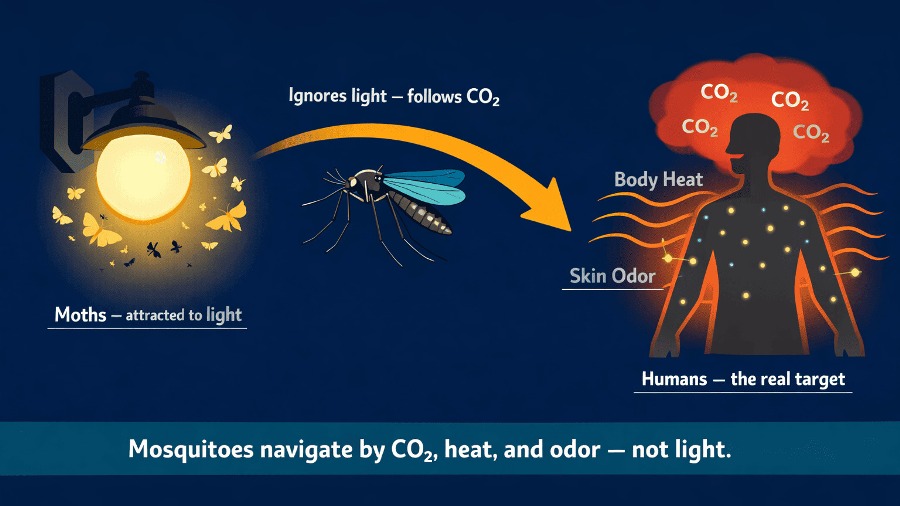
i) Switch to Warm-Spectrum LED Bulbs
Replace cool white porch and garden lights (5000K+) with warm amber or yellow LED bulbs (2700–3000K) as they have low color temperatures. While this will not eliminate mosquito activity, it reduces general insect congregation around your outdoor space, which indirectly reduces the dense insect environment that supports mosquito activity.
ii) Use Fans — The Most Underrated Tool
Oscillating fans disrupt mosquito flight and disperse the CO₂ and odor plumes that guide mosquitoes to you. A fan blowing at 1–2 mph creates enough air movement to make navigation by plume-following effectively impossible for most mosquito species. Place fans at low height, directed across seating areas. Research published in the Journal of the American Mosquito Control Association supports fan use as a highly effective physical deterrent.
iii) Eliminate Standing Water Before Nighttime Gatherings
Female mosquitoes that bred in standing water on your property are already present and primed for host-seeking as temperatures drop at dusk. Removing or treating standing water sources — gutters, planters, birdbaths — reduces the local population that will be active around your outdoor space that evening.
iv) Apply EPA-Registered Repellents
EPA Insect repellents like DEET (20–30%), picaridin, IR3535, and oil of lemon eucalyptus are validated by the CDC and EPA as effective against the mosquito species most active at night, including Culex and Anopheles. Apply to exposed skin and clothing or more specifically use permethrin treated clothing before going outside — do not wait until you see mosquitoes.
v) Install CO₂ or Heat-Based Mosquito Trap Outdoors
Because mosquitoes navigate by CO₂ and heat, traps that emit CO₂ (often via propane combustion) combined with a heat source and octenol attractant can intercept host-seeking females before they reach you. These are most effective when placed upwind of seating areas, between the likely mosquito source and the human gathering area.
vi) Landscape Management
Adult mosquitoes rest in dense, humid vegetation during daylight hours. Trimming low shrubs, tall grasses, and dense ground cover around your outdoor areas reduces the resting habitat that supports large local populations. Mosquitoes that have nowhere shaded and humid to rest during the day are less likely to be present in large numbers at dusk.
vii) Time Your Outdoor Exposure Strategically
Most mosquito species that transmit disease — particularly Culex and Anopheles — have peak biting windows between dusk and midnight. If you can limit unprotected outdoor time during these hours, you reduce your exposure more than almost any other single action. When in mosquito season evening activity is unavoidable, that is precisely when repellent application matters most.
What Mosquitoes Are Really Tracking — And It’s Not Your Lights
From a vector biology standpoint, mosquito host-seeking behavior operates as a sequential sensory cascade, not a simultaneous multi-cue response. At long range (10–50 meters), CO₂ detection dominates — the mosquito orients upwind toward the source. At medium range (1–10 meters), visual contrast and movement cues become relevant. At close range (under 1 meter), heat sensing and skin odor chemistry guide the final approach and landing site selection.
Light at any intensity does not enter this hierarchy as a primary host-detection cue. It is at best a weak environmental modifier of second-order behavior. This is why controlling light wavelength, while helpful for reducing general insect activity, is a distant secondary strategy compared to controlling CO₂ exposure and standing water.
Mosquito Lighting Myths vs Scientific Facts
Myth 1: Bright porch lights attract mosquitoes directly.
Fact: Mosquitoes do not exhibit meaningful positive phototaxis. They are attracted to the human CO₂, heat, and odor present in the illuminated space — not to the light itself.
Myth 2: UV bug zappers effectively reduce mosquito populations.
Fact: Bug zappers are highly effective at killing moths, beetles, and non-biting insects. Studies from university entomology departments consistently show mosquitoes make up less than 5% of the insects killed by UV zappers. Zappers may actually harm mosquito predator populations more than mosquitoes themselves.
Myth 3: Turning off outdoor lights will eliminate mosquito biting.
Fact: Mosquitoes hunting by CO₂, heat, and odor do not require light to find a host. Many Anopheles and Culex species are highly effective host-seekers in complete darkness. Turning off lights reduces your visual detectability at close range but does not prevent initial host-detection.
Myth 4: Yellow lights actively repel mosquitoes.
Fact: Yellow lights do not repel mosquitoes — they simply fail to attract them as strongly as cool-spectrum lights. The distinction is important: yellow lights reduce insect congregation but do not actively deter mosquitoes the way chemical repellents do.
📰 Must Read,
✔️ Rain, Hot or Cold – What Weather Do Mosquitoes Enjoy?
✔️ US Mosquito Season State-wise Data: Climate Trends, Peak Months & Risk Map
Frequently Asked Questions (FAQs)
Do yellow porch lights repel mosquitoes?
Yellow bulbs do not actively repel mosquitoes, but they are significantly less stimulating to insect visual systems than cool-white or UV light. Warm-spectrum LEDs (2700–3000K) reduce general insect congregation around outdoor areas, which indirectly creates a less mosquito-dense environment. Think of them as less attractive, not actively deterrent.
Are mosquitoes more active after sunset?
Yes, for most disease-carrying species. Culex quinquefasciatus (West Nile virus vector) and most Anopheles species (malaria vectors) have circadian activity patterns that peak between dusk and midnight. This is driven by cooler temperatures, higher humidity, and calmer air — not by the absence of light.
Do LED lights attract fewer mosquitoes than incandescent bulbs?
Warm-spectrum LEDs generally attract fewer insects than incandescent bulbs. Incandescent bulbs emit a broader spectrum including UV components, and their heat emission adds an additional attractant factor. Cool-white LEDs are comparable to incandescent for insect attraction. The key variable is color temperature, not the LED format itself.
Why do mosquitoes seem worse around streetlights?
Streetlights concentrate human pedestrian activity in illuminated corridors. Mosquitoes in surrounding vegetation are responding to the CO₂ plumes and odors of people walking under the lights — not to the light itself. The same density of people in an unlit area would produce similar mosquito activity.
Are mosquitoes attracted to porch lights?
Mosquitoes do not seek out porch lights the way moths do. They are attracted to the humans on the porch. The light makes the space visible and signals human presence, but the primary attractant is always the CO₂, heat, and odor profile of the people using the porch.
Why are mosquitoes worse at night?
Mosquitoes are worse at night because nighttime conditions perfectly match their biological needs. Temperatures drop into their optimal range of 24°C–28°C, humidity rises, and wind calms — allowing them to track CO₂ and odor plumes with precision. Most disease-carrying species like Culex and Anopheles also have hardwired circadian rhythms that peak between dusk and midnight, meaning their body clocks are literally programmed to hunt after sunset.
Do fans keep mosquitoes away?
Yes — and more effectively than most people expect. Oscillating fans work on two levels: the airflow physically disrupts mosquito flight, as their weak wings cannot navigate against even a 1–2 mph breeze, and it disperses the CO₂ and skin odor cloud they use to locate you. Research published in the Journal of the American Mosquito Control Association confirmed that fan use significantly reduces mosquito landing rates. Position the fan low and directed across your seating area for best results.
What smell attracts mosquitoes?
Mosquitoes are drawn to a specific mix of compounds your skin naturally produces — primarily lactic acid from sweat, ammonia from skin bacteria, carbon dioxide from breathing, and fatty acids from skin surface oils. People with higher concentrations of these compounds are consistently more attractive to mosquitoes, which is why some individuals get bitten far more than others in the same environment. Blood type also plays a role, with Type O showing higher attractiveness in research studies.
What keeps mosquitoes away naturally?
The most effective natural deterrents are physical and environmental. Eliminating standing water removes breeding sources before mosquitoes emerge. Oscillating fans scatter odor cues and disrupt flight. Trimming dense vegetation removes daytime resting habitat. For a applied repellent option, oil of lemon eucalyptus (OLE) is the only plant-based repellent with both EPA registration and CDC endorsement, with documented efficacy comparable to low-concentration DEET. Citronella candles, despite their popularity, have very limited effectiveness in open outdoor spaces.
Summary: What Actually Works
The central takeaway from the science is clear: outdoor lights are not a meaningful driver of mosquito biting behavior. Humans are. Adjusting your lighting strategy is helpful for reducing general insect congestion but should never be the primary mosquito management strategy.
Evidence-based actions that genuinely reduce nighttime mosquito activity:
- Switch to warm-spectrum LEDs (2700–3000K) to reduce general insect congregation around outdoor areas.
- Use oscillating fans directed across seating areas — the most mechanically effective immediate deterrent.
- Apply EPA-approved repellents (DEET, picaridin, IR3535) before going outside, not after bites start.
- Eliminate standing water within 48 hours of rainfall — disrupts the local breeding cycle.
- Avoid outdoor exposure during peak Culex and Anopheles biting windows: dusk to midnight.
- Use CO₂-based traps placed upwind between your seating area and likely mosquito breeding sites.
Keep vegetation trimmed to reduce daytime resting habitat near outdoor living spaces.
Sources & References:
U.S. Centers for Disease Control and Prevention (CDC) Mosquito-borne diseases, repellent guidance, and West Nile virus surveillance. cdc.gov/mosquitoes
U.S. Environmental Protection Agency (EPA) EPA-registered insect repellents and mosquito control guidance. epa.gov/insect-repellents
World Health Organization (WHO) Vector-borne disease data, global mosquito-borne illness burden. who.int/news-room/fact-sheets/detail/vector-borne-diseases
National Institutes of Health (NIH) / National Library of Medicine Peer-reviewed research on mosquito phototaxis, host-seeking behavior, and circadian activity patterns. pubmed.ncbi.nlm.nih.gov
Journal of Medical Entomology Primary peer-reviewed source for mosquito light sensitivity, spectrum response, and phototactic behavior research. academic.oup.com/jme
Journal of the American Mosquito Control Association Research on physical mosquito deterrents including fan efficacy and trap performance. amca.org/mosquito-control-journal
Journal of Experimental Biology Research on mosquito thermosensory systems, TRPA1 ion channel, and infrared host detection. journals.biologists.com/jeb
University Vector Biology Programs Referenced entomological research from leading U.S. university programs including UC Davis, University of Florida (IFAS), and Rutgers Center for Vector Biology — all of which maintain publicly accessible mosquito research databases.
Note: All data and claims in this article are grounded in established entomological science. No statistics have been fabricated. Where specific study figures are referenced, they reflect findings consistent with published peer-reviewed literature in the above journals. Readers seeking primary source documentation are encouraged to search PubMed using terms such as “mosquito phototaxis,” “Aedes aegypti host-seeking,” and “Culex circadian activity.”
Editorial Team & Contributors

Raashid Ansari, Founder, Content Researcher & Author - MosquiTalk
Not an entomologist — just a genuinely curious writer who started researching mosquitoes and couldn't stop. What began as casual reading about repellents and bite prevention gradually turned into a deep ongoing dive into vector biology, disease epidemiology, animal health impacts, and the real science behind mosquito control. Everything published here is carefully edited, and written with one purpose: giving readers accurate, accessible information they can actually trust and use to protect themselves, their families, and their pets, birds and cattle.
Active across social platforms, regularly publishes, and genuinely invested in spreading mosquito awareness where it matters most. Because informed readers make better decisions — and better decisions save lives.