
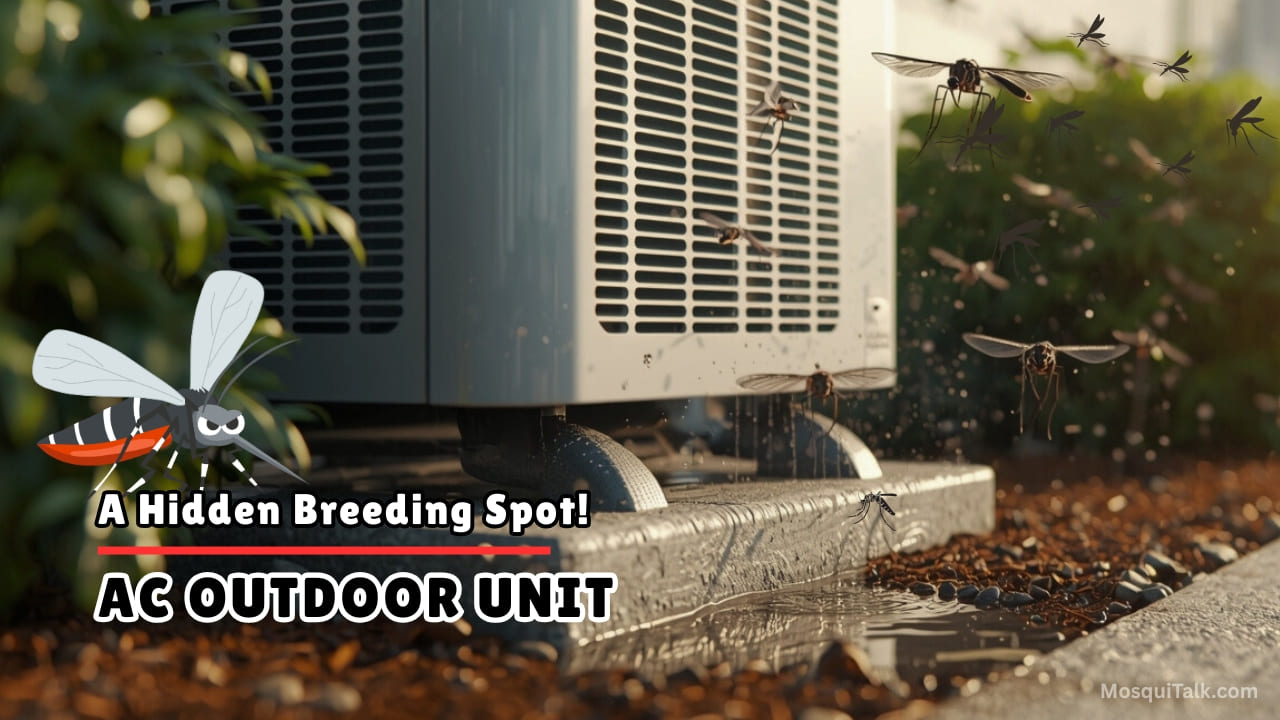
You step outside to check on your AC condenser and — Booom! Three mosquito bites before you even reach the unit. It’s frustrating, it’s itchy, and honestly, it feels a little unfair. Your air conditioner is supposed to make summer bearable, not invite insects to feast on you.
Here’s the thing: mosquitoes around outdoor AC units is one of the most common warm-weather complaints homeowners report — and most people have no idea why it’s happening or how to stop it.
The good news? This is absolutely a fixable problem. In this guide, we’ll walk you through exactly why your AC unit is attracting mosquitoes, what risks you’re dealing with, and step-by-step solutions that work — without damaging your HVAC system or spending a fortune.
Why Are Mosquitoes Drawn to Your Outdoor AC Unit?
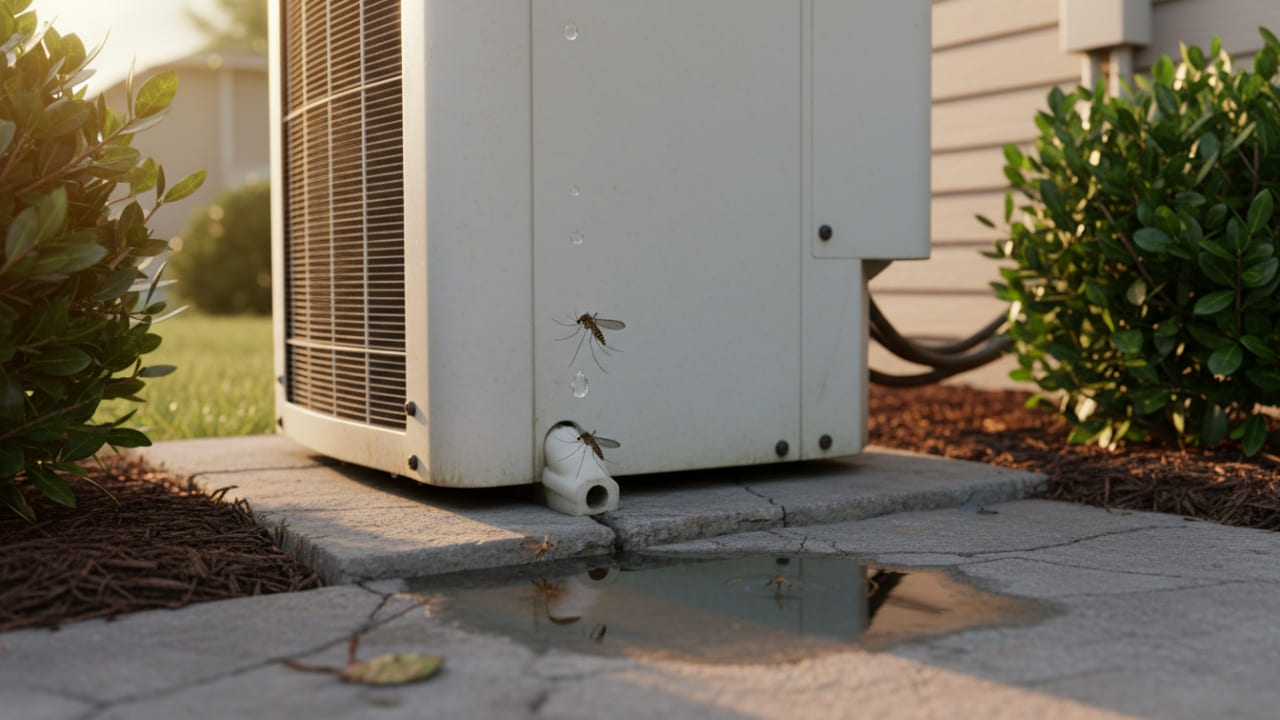
Your outdoor AC condenser isn’t just pushing out cool air — it’s also expelling moisture. A lot of it. As warm air passes over the evaporator coil inside, condensation forms and drains outside. The result is a consistent, slow drip of water near or around your unit, often pooling in low spots on the ground.
Mosquitoes need as little as a bottle cap’s worth of standing water to lay eggs. That slow drip from your AC? It’s basically a five-star resort for them.
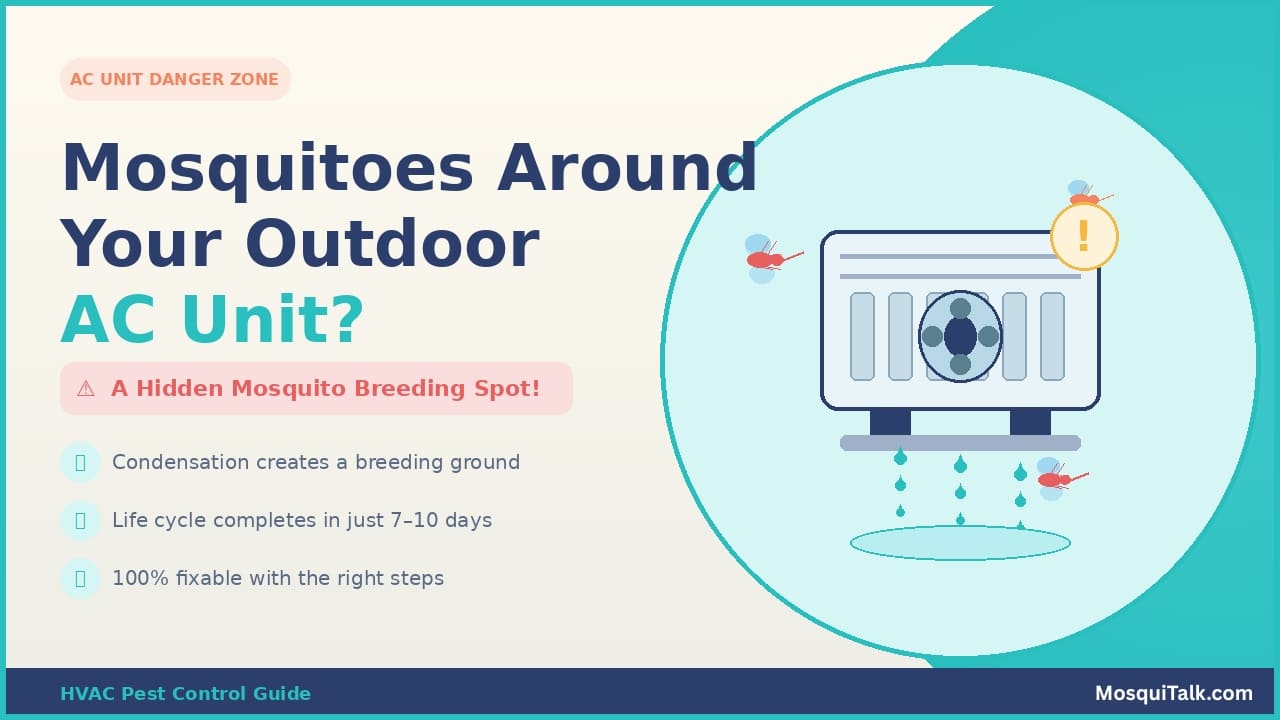
Here are the most common reasons your outdoor AC unit is attracting mosquitoes:
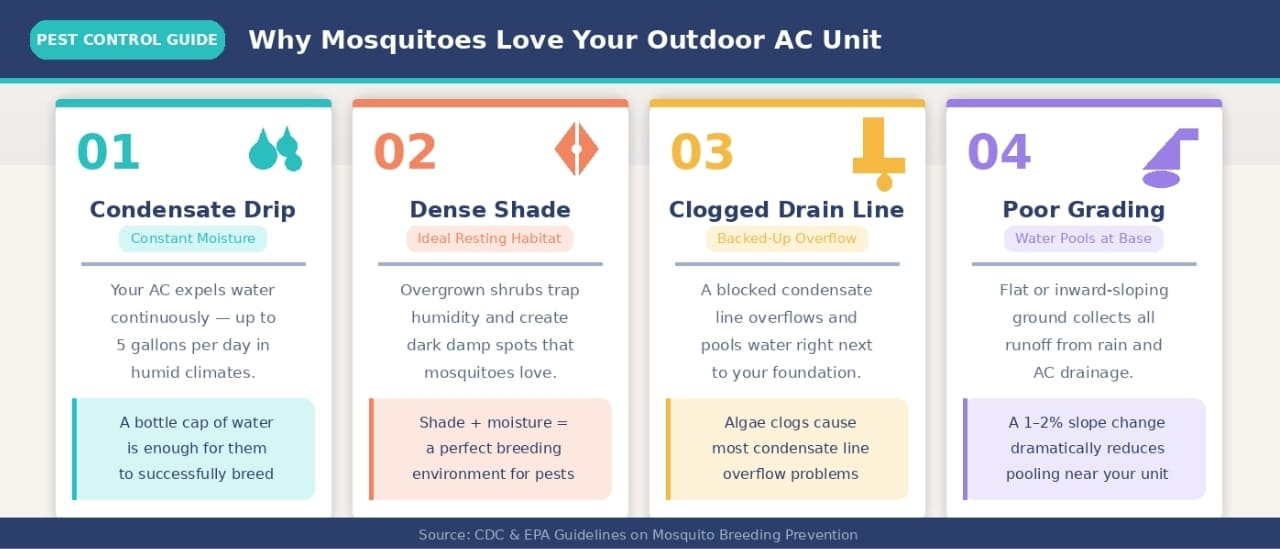
- Condensation drainage: AC units produce significant condensate, especially in humid climates. If the drain isn’t flowing away from the unit, water accumulates nearby.
- Clogged or slow condensate lines: A partially blocked HVAC drainage line can cause water to back up and overflow at the base of your unit.
- Poor grading around the foundation: If your yard slopes toward the house, water from rain, irrigation, and AC runoff collects near the unit instead of draining away.
- Dense surrounding landscaping: Shrubs, mulch, and ground cover around the condenser trap moisture and create the damp, shaded conditions mosquitoes prefer.
- Debris buildup in the drip pan: Leaves, dirt, and organic matter collecting in and around the unit create standing water that’s even more attractive for breeding.
The Hidden Risk: Why This Is More Than Just Annoying
A few bites might seem like a minor nuisance, but a mosquito breeding ground next to your home is a legitimate public health concern.
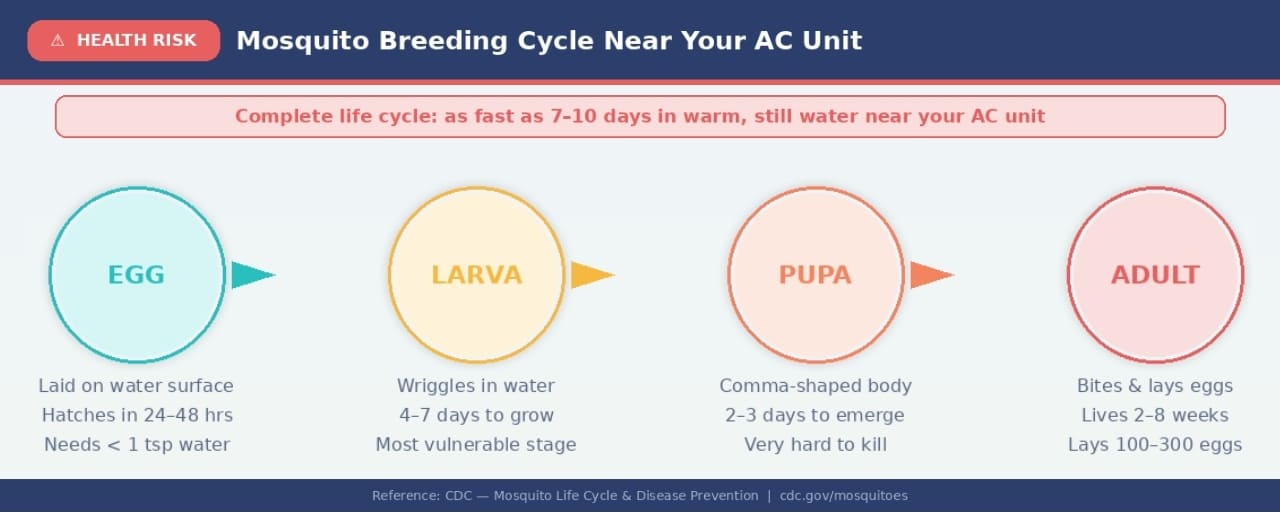
Mosquitoes complete their life cycle — egg to biting adult — in as little as 7 to 10 days when conditions are ideal. Warm, shallow, stagnant water near your AC unit can support multiple generations per season, rapidly building up the population around your home.
According to the CDC, mosquitoes are vectors for West Nile Virus, dengue fever, and Zika virus in various parts of the United States and beyond. While not every mosquito carries disease, dense populations near your living areas increase your household’s exposure risk significantly.
The EPA also notes that eliminating standing water is the single most effective way to reduce mosquito populations at the local level. That makes your AC drainage area a priority — not an afterthought.
Step-by-Step: How to Get Rid of Mosquitoes Near Your AC Unit
The fastest way to eliminate mosquitoes around your outdoor AC unit is to attack the root cause: standing water and moisture. Here’s how to do it safely and effectively.
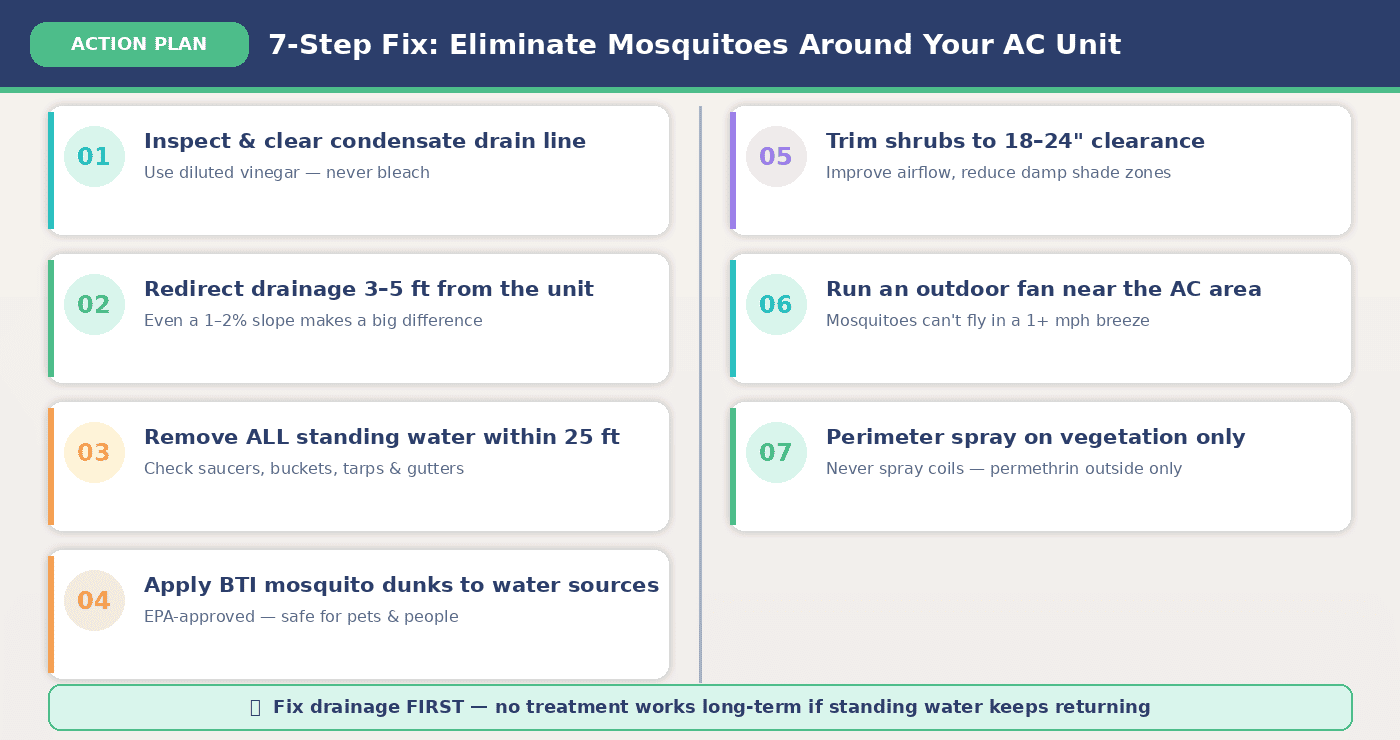
Step #1: Inspect and Clear Your Condensate Drain Line
Locate your AC’s condensate drain line — typically a PVC pipe running from your indoor air handler to outside. Check if it’s dripping consistently and freely. If water is backing up or overflowing, the line may be clogged with algae or debris. A wet/dry vacuum or a flush with diluted vinegar (not bleach) can clear minor blockages. If the clog is significant, call your HVAC technician.
Step #2: Redirect Drainage Away from the Unit
Water should drain at least 3–5 feet away from your foundation and condenser base. Use gravel channels, drainage pipe extensions, or regrade the soil slightly so that water flows away naturally. Even a 1–2% slope makes a significant difference.
Step #3: Eliminate All Standing Water Within 25 Feet
Walk a 25-foot radius around your AC unit and remove any water-collecting sources: flower pot saucers, old tires, low spots in mulch, buckets, or clogged gutters overhead. Mosquitoes don’t care about property lines — they’ll breed anywhere within flying distance.
Step #4: Use Mosquito Dunks (BTI) in Unavoidable Water
If you have drainage areas, decorative ponds, or water features near your AC that you can’t eliminate, use mosquito dunks containing Bacillus thuringiensis israelensis (BTI). BTI is a naturally occurring bacteria that kills mosquito larvae but is completely safe for people, pets, birds, and beneficial insects. The EPA classifies it as safe for use in drinking water containers. Drop one in any standing water every 30 days.
Step #5: Trim and Open Up the Area
Cut back any dense shrubs or ground cover within 2–3 feet of the condenser. Increase air circulation and sunlight exposure to dry out the area faster after rain or irrigation. Mosquitoes prefer shaded, moist environments — make yours hostile to them.
Step #6: Run an Outdoor Fan
Mosquitoes are weak flyers. A simple outdoor fan near your patio or AC work area can reduce bites significantly while you’re outside. This doesn’t eliminate the source, but it provides immediate relief while your long-term fixes take hold.
Step #7: Consider a Perimeter Treatment (Carefully)
If adult mosquito populations are already high, a targeted perimeter spray using products containing permethrin or bifenthrin can knock down adults quickly. Spray vegetation and shaded areas — not the AC unit itself. Always follow label instructions and ventilate the area before operating the unit again.
What NOT to Do Near Your AC Unit
Some DIY solutions can backfire badly, damaging your HVAC system or creating new hazards. Avoid these mistakes:
- Don’t spray harsh insecticides directly on the condenser coils. Chemical residue can degrade coil fins and reduce efficiency. Keep sprays on surrounding vegetation only.
- Don’t pour bleach into the drain pan or condensate line. While bleach kills algae, it can corrode metal drain pans, damage PVC connections over time, and harm surrounding soil and plants.
- Don’t block airflow around the unit. Planting dense shrubs too close actually reduces AC efficiency by 10–25% and creates the damp conditions mosquitoes love.
- Don’t ignore condensate line backups. What looks like a minor drip problem can signal a larger HVAC drainage issue that will get worse and more expensive if left unaddressed.
Long-Term Prevention Plan: Keep Mosquitoes Away for Good
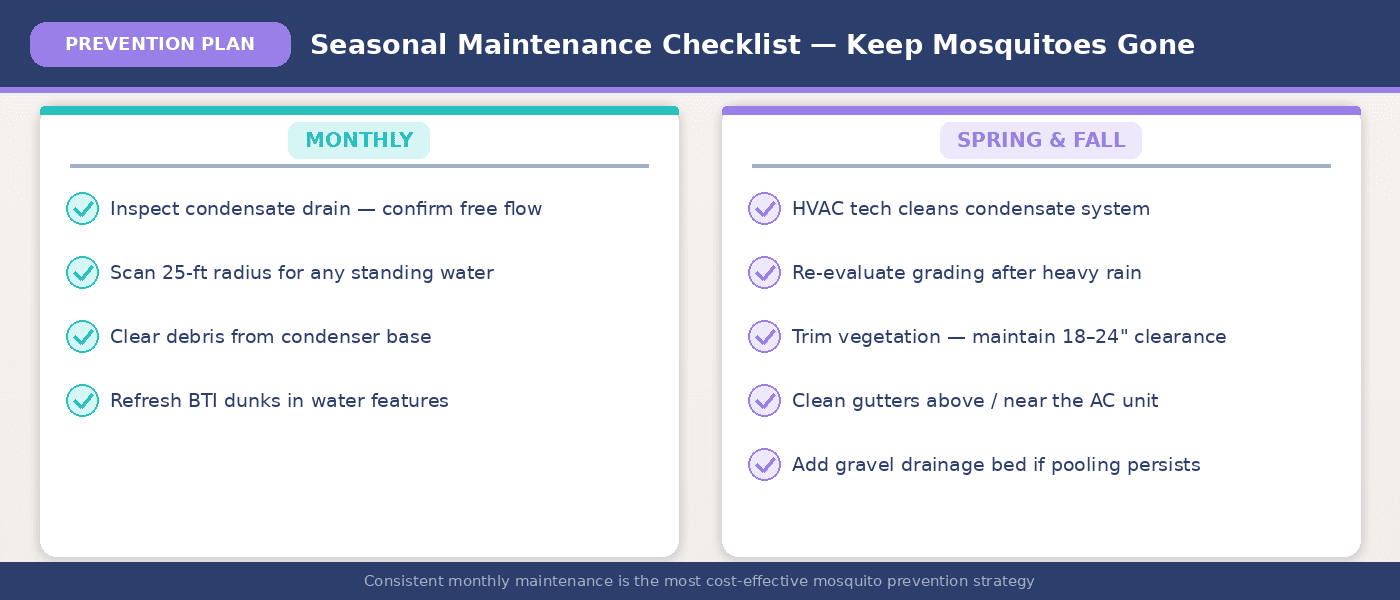
Quick fixes help, but a consistent maintenance routine is what keeps mosquitoes from returning every season. Use this simple checklist:
Monthly Checks
✅ Inspect condensate drain line — confirm it’s draining freely and flowing away from the unit
✅ Check for standing water within 25 feet of the unit
✅ Remove debris (leaves, mulch buildup) from base of condenser
✅ Replace or refresh BTI mosquito dunks in any unavoidable water sources
Seasonal Maintenance (Spring & Fall)
✅ Have HVAC technician clean and inspect condensate system
✅ Re-evaluate grading around foundation — regrade if water pools near AC base after rain
✅ Trim vegetation to maintain 18–24 inch clearance around condenser
✅ Inspect and clean gutters directly above or near the AC unit
✅ Consider a drip shield or gravel drainage bed if condensate pooling is a recurring issue
When It’s Time to Call a Professional
DIY solutions handle most mosquito problems around AC units. But there are situations where a professional is the smarter call:
- Persistent standing water despite drainage efforts — may indicate a structural drainage or grading problem requiring a landscaping contractor or French drain installation.
- AC condensate line that repeatedly clogs — a recurring blockage usually means algae buildup or a drainage slope issue that needs HVAC service.
- Large-scale infestation across your property — if mosquito populations are extreme, a licensed pest control company can perform targeted larviciding and fogging treatments safely.
- Unusual amounts of water pooling at the condenser base — could indicate refrigerant issues or a malfunctioning component, not just a drainage problem.
📰 Must Read,
✔️ 12 Hacks to Make Your Mosquito Spray Last Longer Outdoors
✔️ Child-Safe Mosquito Repellents for Kids: Every Parents should Use
Frequently Asked Questions (FAQs)
Q. Can mosquitoes actually breed in AC condensation?
Yes, they can. Mosquito eggs require very little water to hatch — a small puddle or even a consistently damp patch of soil near your AC unit is enough. If condensate water is pooling rather than draining away, it can absolutely become a breeding site within days.
Q. Does AC condensation attract other bugs too?
Yes. Standing water and damp soil near your condenser can attract gnats, drain flies, and certain ant species as well. Addressing the moisture issue benefits your overall pest situation, not just mosquitoes.
Q. Should I spray bug spray near my AC unit?
Avoid spraying aerosol insecticides directly onto the condenser coils, fins, or drain lines. Instead, spray surrounding vegetation, mulch, and shaded areas where mosquitoes rest. Always allow the product to dry and ventilate the area before running the unit or spending time nearby.
Q. Are mosquito dunks (BTI) safe to use around HVAC systems?
Yes. BTI is a biological larvicide, not a chemical. It poses no risk to HVAC equipment, pets, or people. The EPA has approved its use even in potable water containers. It’s one of the safest and most effective tools for managing mosquito larvae near your home.
Q. Why are there suddenly more mosquitoes near my house this year?
Several factors can cause sudden spikes: above-average rainfall creating new breeding sites, warmer spring temperatures accelerating the life cycle, or changes in your yard providing new water sources. Check for standing water across your entire property, including areas you might overlook like tarps, children’s toys, and birdbaths.
Q. Is it safe to run my AC if mosquitoes are nesting near it?
Mosquitoes near your condenser won’t directly affect AC performance. However, the underlying cause — standing water, drainage issues, vegetation overgrowth — can contribute to debris buildup and airflow restriction over time. Addressing the mosquito problem usually means fixing conditions that are better for your HVAC system overall.
Q. Why mosquitoes don’t bite when AC is on?
Mosquitoes are cold-blooded insects, meaning their body temperature matches their environment. When your AC lowers the room temperature below 60°F (15°C), they become sluggish, disoriented, and lose the ability to fly and navigate effectively. They also rely on body heat and carbon dioxide to locate a target — cool air disperses these cues, making it much harder for them to find you. On top of that, the airflow from AC units physically disrupts their flight path. Essentially, a well-cooled room is one of the simplest natural mosquito deterrents available.
Q. How to stop mosquitoes from coming through AC?
Start by inspecting your AC unit’s seal where it meets the window or wall — even a small gap is an open invitation. Use foam weatherstripping or caulk to close any gaps around the unit’s edges. Make sure the AC filter is intact with no tears, as damaged filters can allow insects to pass through. Check the condensate drain line exit point outside and cover it with a fine mesh screen.
Installing window screens on any adjacent openings adds another layer of defense. A regular monthly check of seals and screens during warm months keeps the entry points consistently closed.
Q. Can mosquitoes come through AC?
Yes, they can — but only if there are gaps or structural flaws in the installation. Window AC units that aren’t tightly sealed leave spaces on the sides where mosquitoes easily slip through. Central AC systems are generally safer since air travels through sealed ductwork, but a cracked duct or an uncovered outdoor vent can still allow entry.
The condensate drain line is another overlooked entry point — mosquitoes can follow it inward if it’s not screened. Properly installed and well-maintained AC units with intact seals pose very little risk of mosquito entry.
The Bottom Line
Mosquitoes around your outdoor AC unit aren’t a random act of nature — they’re responding to a very real and specific problem: moisture. Your condensate drainage is creating the exact conditions these insects need to breed and thrive.
The fix is straightforward: clear your drain lines, redirect water away from the unit, eliminate standing water nearby, and use BTI dunks in any water you can’t remove. Pair that with consistent seasonal maintenance and you can eliminate this problem for good.
Have you noticed mosquitoes swarming near your AC unit this season? What did you try — and what actually worked? Drop your experience in the comments below.
Editorial Team & Contributors

Raashid Ansari, Founder, Content Researcher & Author - MosquiTalk
Not an entomologist — just a genuinely curious writer who started researching mosquitoes and couldn't stop. What began as casual reading about repellents and bite prevention gradually turned into a deep ongoing dive into vector biology, disease epidemiology, animal health impacts, and the real science behind mosquito control. Everything published here is carefully edited, and written with one purpose: giving readers accurate, accessible information they can actually trust and use to protect themselves, their families, and their pets, birds and cattle.
Active across social platforms, regularly publishes, and genuinely invested in spreading mosquito awareness where it matters most. Because informed readers make better decisions — and better decisions save lives.