

Table of Contents
Introduction: Does Smoke Keep Mosquitoes Away?
If you have ever sat around a campfire on a summer evening and noticed fewer mosquitoes landing on you, you are not imagining things. The link between smoke and reduced mosquito activity is old — older than recorded history — and it is real.
Does smoke keep mosquitoes away? The short answer is: it reduces them, temporarily, in the immediate vicinity of the smoke source. That is not the same as repelling them in any pharmacological sense. Understanding that distinction — why it matters, and what it means practically for outdoor mosquito control — is what this article is about.
To answer the question properly, you need to understand what smoke is made of, how mosquitoes detect hosts in the first place, and exactly how smoke interferes with that process.
Why Smoke and Mosquitoes Have Always Been Linked
The use of smoke as a mosquito deterrent goes back to the earliest human communities. They have developed smudge fire practices — burning smoldering plant material near sleeping areas, livestock enclosures, and outdoor gathering spaces — as a way to reduce insect pressure.
Beekeepers have relied on smoke for thousands of years to manage hive behavior, exploiting a consistent principle: insects in a smoke-dense environment become disoriented and less responsive to normal behavioral triggers.
Early livestock herders noticed their animals clustering near smoky fires during peak mosquito hours. Indigenous communities across multiple continents identified specific plant materials — neem, Lantana, rosemary, citronella grass, eucalyptus — that produced smoke with heightened deterrent effects.
What Does Smoke Actually Consist Of?
Smoke is not a single substance. It is a complex mixture of gases, liquid aerosols, and solid particulate matter produced when organic material burns incompletely. The specific composition varies considerably depending on what is burning, combustion temperature, and oxygen availability — but the broad categories are consistent across fuel types.
- Particulate Matter (PM2.5 and PM10) — Fine particulate matter — particles with an aerodynamic diameter of 2.5 micrometers or less (PM2.5) — is among the most physically significant components of smoke for insect deterrence. These particles remain suspended in air for extended periods and reach high concentrations near the smoke source.
- Volatile Organic Compounds (VOCs) — Incomplete combustion releases a wide range of volatile organic compounds. The composition varies substantially by fuel: wood combustion primarily releases guaiacol, syringol, and related phenolic compounds, several of which have demonstrated aversive or irritant effects on insects in experimental settings.
Plant-based fuels such as neem and citronella grass release additional terpenoid and aldehyde compounds with more specific mosquito-deterrent properties. This difference in VOC profile is a primary reason why certain plant-based smokes appear to have stronger deterrent effects than plain wood combustion.
- Carbon Monoxide and CO₂ — Combustion also produces carbon monoxide and CO₂. This matters because mosquitoes use CO₂ as a primary long-range host-detection cue — but importantly, they respond to the temporal pattern and concentration gradient of exhaled CO₂, not simply to raw CO₂ presence in the environment.
Fire-produced CO₂ generates a large, diffuse, and continuously present plume that differs qualitatively from the pulsed exhalation pattern mosquitoes are neurologically tuned to follow. This disrupts their ability to isolate and track a human-origin CO₂ signal within the noisy chemical environment near a fire, contributing to orientation confusion rather than simple attraction.
- Water Vapor and Ash — Smoke also carries water vapor and suspended ash particles. These contribute to the physical density of the smoke cloud and add to the broader sensory interference that insects experience in heavily smoke-laden environments.
How Smoke Specifically Disrupts the Mosquito’s Sensory System
To understand why smoke affects mosquitoes, you first need to understand how mosquitoes find a host. Female mosquitoes — the ones that bite — do not hunt randomly. They use a layered, sequential sensory system that allows them to detect hosts at distance and close in with precision. Smoke interferes with this system at multiple points simultaneously, though no single mechanism produces complete protection.
i) The Antenna and Maxillary Palps: Primary Chemical Detectors
The mosquito antenna is densely covered in olfactory sensilla — microscopic hair-like structures that function as chemical receptors. Different sensilla types are tuned to different compounds: some detect CO₂, others detect specific host-emitted chemicals including lactic acid, 1-octen-3-ol (octenol), ammonia, and various carboxylic acids.
Fine particulate matter from smoke is believed to interfere with the function of these sensilla — reducing the sensitivity of olfactory receptors and impairing the mosquito’s ability to track the precise chemical gradients it depends on for host location.
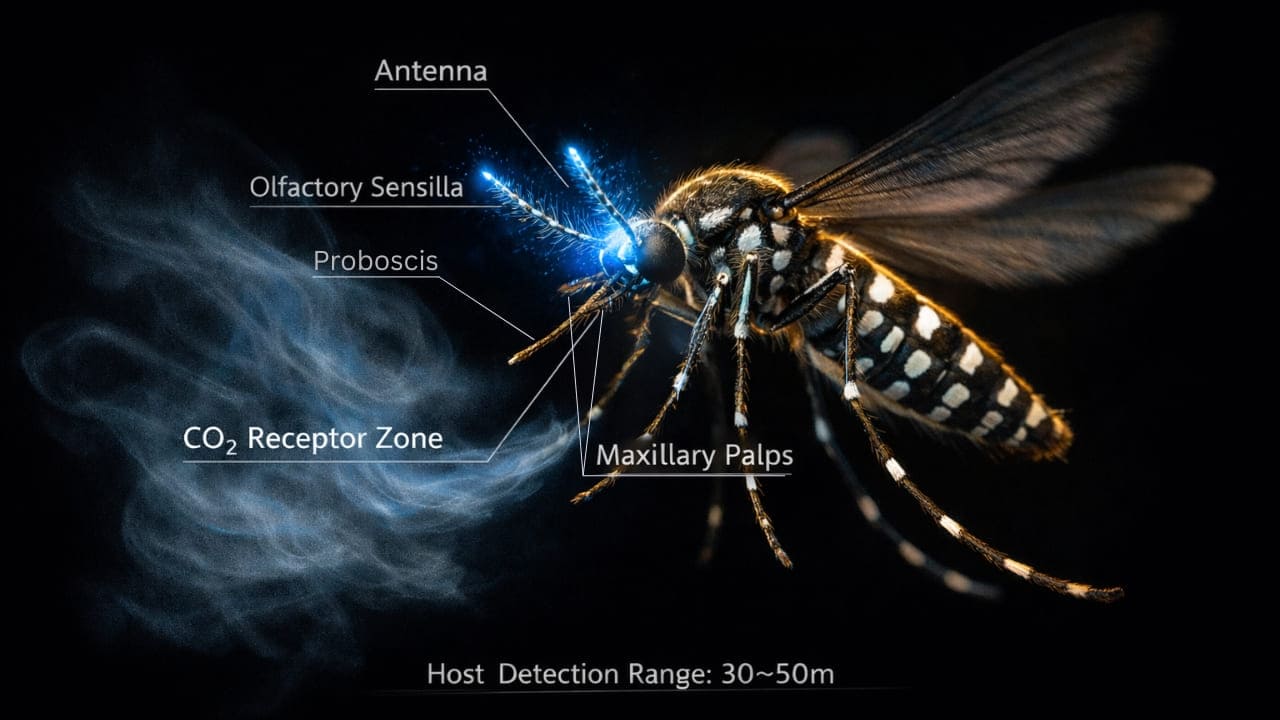
Image Credit: Illustration by Author
ii) CO₂ Plume Disruption at Long Range
Under optimal still-air conditions, mosquitoes have been observed orienting toward CO₂ plumes at distances of up to 30–50 meters, though real-world detection range is typically shorter due to plume disruption by wind and environmental turbulence.
In a smoke-heavy environment, the large diffuse CO₂ output from combustion creates a noisy chemical background that can interfere with a mosquito’s ability to isolate and follow the specific pulsed CO₂ pattern characteristic of human exhalation.
The disruption is one of the reasons people near a dense, smoldering fire tend to experience reduced biting pressure even at some distance from the flame.
iii) Short-Range Odor Competition
At close range, mosquitoes shift from CO₂ navigation to skin-emitted volatiles — a rich and species-specific blend of compounds that guides final host selection. VOCs released by burning wood and especially by herbal plant materials can partially compete with these skin-odor signals, degrading the quality of the close-range chemical information available to an approaching mosquito. This short-range interference adds another layer to the overall impairment effect.
iv) Thermal Detection: Less Affected by Smoke
At very close range, mosquitoes also detect the radiant heat and thermal gradient from warm skin via thermoreceptor neurons located on their antennae. This mechanism is less disrupted by smoke than chemical sensing, which is one reason smoke never provides complete protection: a mosquito that navigates through a smoke plume and reaches close proximity to a host may still orient correctly by thermal cues even with its chemosensory function partially compromised.
v) Flight Behavior in Dense Smoke
Dense smoke also affects mosquito flight behavior. In smoke-laden air, many mosquito species reduce flight activity and land rather than continue navigating — a behavioral response likely triggered by sensory overload and irritant compounds. This flight inhibition contributes to the reduced biting rates observed near fires and has been documented in studies of insect behavior in smoky environments.
- Sensory interference at olfactory sensilla
- CO₂ signal disruption at long range
- VOC competition with host odors at close range
- Smoke-triggered flight inhibition
Does Smoke Repel Mosquitoes or Just Reduce Their Activity?
Smoke does not create a deterrent zone at all. Mosquitoes in a smoke-dense environment are not choosing to avoid the area because they sense something aversive from a distance. Their host-detection capability is simply compromised while they are within the smoke plume. The moment smoke concentration drops — because the fire dies down, wind disperses the plume, or they move to the edge of the smoke zone — sensory function recovers and they reorient toward hosts normally.
Smoke protection is entirely dependent on maintaining smoke concentration. It does not create a lasting deterrent effect and it does not influence mosquito behavior in areas where smoke is not present.
Plain smoke from wood or plant combustion does not kill mosquitoes under normal outdoor conditions. Lethal concentrations of smoke constituents would require a fully enclosed space with sustained high-density smoke — conditions that would simultaneously be dangerous to humans. In typical outdoor settings, plain smoke impairs and deters. It does not kill.
Mosquito coils formulated with synthetic pyrethroids — transfluthrin, metofluthrin, or d-allethrin — are a categorically different matter. These compounds volatilize into the surrounding air as the coil burns and, at sufficient concentrations in semi-enclosed spaces, can achieve knockdown and kill of exposed insects, not just behavioral deterrence.
The smoke from an insecticidal coil is a delivery mechanism for neurotoxic compounds; this is fundamentally different from the sensory-disruption mechanism of plain combustion smoke.
Wood Smoke and Mosquitoes: Why Campfires Sometimes Work
With the sensory mechanism understood, campfire smoke reduction in biting activity makes intuitive sense. A large, smoldering fire producing dense smoke output in calm evening air can maintain a particulate and VOC concentration that meaningfully impairs mosquito olfaction and flight behavior within a defined zone around the fire.
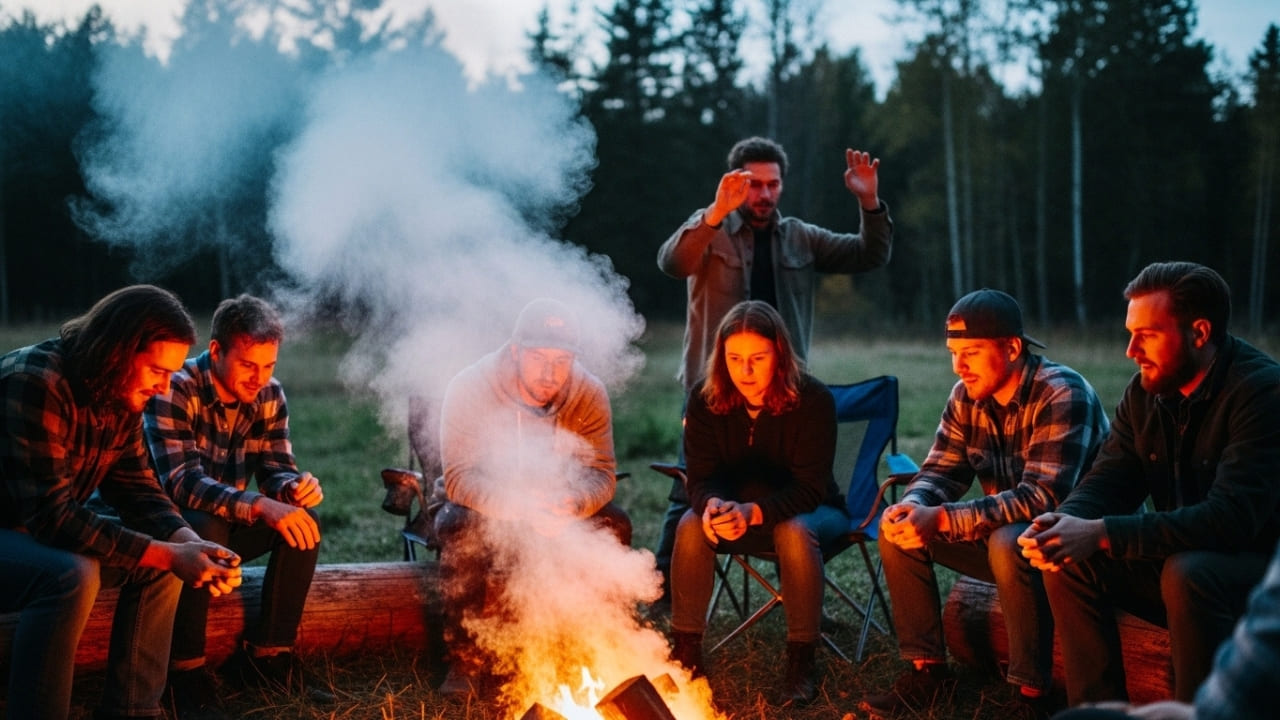
Image Credit: Illustration by Author
People sitting in or near that zone — particularly downwind — can experience a real reduction in biting pressure.
Several practical factors determine how much benefit you actually receive.
- Smoke volume matters more than wood species — a dense, smoldering fire undergoing partial combustion produces substantially more protective smoke than a clean, hot-burning flame.
- Wind is the dominant variable: even a light breeze disperses the smoke plume rapidly, collapsing the protective zone and effectively eliminating any benefit within minutes.
- Distance follows a steep drop-off; the effect at ten feet is considerably less than at two feet, and in most open settings, meaningful protection extends only a few feet from the smoke source.
The practice of deliberately adding damp wood or green leaves to increase smoke density has genuine empirical basis. Dense, sustained smoke is more effective at impairment than light wisps from an efficient fire. The trade-off is comfort — dense campfire smoke is irritating to eyes and airways, and prolonged exposure carries its own health considerations.
📰 Must Read,
✔️ How Does Fire Pits Keep Mosquitoes Away?
✔️ Can We Use Coffee Grounds as Mosquito Repellent?
Does Smoke Type Matter? Wood vs. Herbal vs. Synthetic
Yes — and the differences are more significant than most casual discussions acknowledge. The VOC profile, particulate characteristics, and presence or absence of insecticidal active ingredients all vary substantially across smoke types.
Herbal Smoke Repellent: Do Plant-Based Smokes Work?
Citronella grass, neem, eucalyptus, lemon grass, rosemary, clove, etc. have all been studied in various forms, and the volatile fractions released by several of these materials include compounds that mosquitoes demonstrably avoid under controlled conditions.
The VOC profile is the primary differentiator between plain wood smoke and herbal smoke.
- Conifers such as cedar and pine release terpenoid compounds with mild insect-deterrent activity.
- Herbal materials like citronella grass release citronellal and geraniol — volatile aldehydes and alcohols with well-documented mosquito-aversive properties.
- Standard eucalyptus species (Eucalyptus globulus) are primarily characterized by eucalyptol (1,8-cineole).
- Lemon eucalyptus (E. citriodora) is the species that contains citronellal and citronellol, and forms the botanical basis for OLE-based repellents.
- When neem is burned, the deterrent fraction comes from its essential oil volatiles — terpenoids including limonene and β-caryophyllene — rather than from azadirachtin, which is a non-volatile compound and does not release effectively during combustion.
- Rosemary releases camphor, borneol, and 1,8-cineole when burned. Camphor specifically has documented mosquito-repellent activity and is one of the reasons rosemary smoke is one of the more effective kitchen-herb options people reach for outdoors.
- Clove releases eugenol, one of the most well-studied mosquito-aversive volatile compounds. Strong evidence. Should definitely be in the list.
- Lavender — releases linalool and linalyl acetate when burned. Documented insect-deterrent activity, particularly against Aedes species.
- Sage / White sage — camphor and thujone release. Widely used in traditional smudging practices across North America. Limited but real evidence.
- Peppermint / Mint leaves — menthol and menthone release. Short-acting but with documented mosquito-aversive effects in lab conditions.
- Lemongrass — often confused with citronella grass but is a distinct species (Cymbopogon citratus vs C. nardus/winterianus). Releases citral rather than citronellal as the primary volatile. Worth separating from citronella grass in the list.
- Coffee grounds — release volatile nitrogen compounds and phenolic derivatives during combustion. Mosquito aversion to coffee smoke remains understudied, with limited peer-reviewed evidence available compared to the herbal options above.
Synthetic pyrethroid coils sit in a separate category entirely. The transfluthrin or metofluthrin they release are insecticidal compounds — neurotoxic to insects at low concentrations — not plant-derived deterrents. The smoke is purely the delivery vehicle. This is why the efficacy profile of pyrethroid coils is qualitatively different from every other entry in the table above.
Smoke Type Effectiveness Against Mosquitoes
Ranked by effectiveness score (0–10) based on available peer-reviewed evidence under favorable conditions
Smoke Types & Mosquito Deterrence — Comparison Table
| Smoke Type | Active Compounds | Primary Mechanism | Kill Effect? | Effectiveness | Duration |
| Wood smoke (general) | Guaiacol, syringol, phenolics | Particulate + CO2 background masking | No | Modest at close range, calm air only | While fire burns |
| Cedar / Pine (conifer smoke) | Terpenoids (pinene, limonene) | VOC deterrent + particulate | No | Mild; better than plain hardwood | While fire burns |
| Citronella grass smoke | Citronellal, geraniol | VOC deterrent + particulate | No | Moderate; well-documented in lab | While smoldering |
| Lemongrass smoke | Citral (neral + geranial) | VOC deterrent + particulate | No | Mild–moderate; distinct from citronella | While smoldering |
| Neem smoke | Limonene, β-caryophyllene (essential oil volatiles) | VOC deterrent + particulate | No | Moderate; stronger in enclosed spaces | While smoldering |
| Clove smoke | Eugenol | VOC deterrent (strong aversive) | No | Moderate–high; one of best herbal options | While smoldering |
| Rosemary smoke | Camphor, borneol, 1,8-cineole | VOC deterrent + particulate | No | Mild–moderate; camphor drives effect | While smoldering |
| Lavender smoke | Linalool, linalyl acetate | VOC deterrent | No | Mild; particularly vs. Aedes species | While smoldering |
| Sage / White sage smoke | Camphor, thujone | VOC deterrent + particulate | No | Mild; traditional use, limited studies | While smoldering |
| Peppermint / Mint smoke | Menthol, menthone | VOC deterrent (short-acting) | No | Mild; lab evidence, fades quickly | While smoldering |
| Standard eucalyptus smoke (E. globulus) | Eucalyptol (1,8-cineole) | VOC deterrent + particulate | No | Mild–moderate | While smoldering |
| Lemon eucalyptus smoke (E. citriodora) | Citronellal, citronellol | VOC deterrent (OLE basis) | No | Moderate; stronger than standard eucalyptus | While smoldering |
| Coffee grounds smoke | Volatile N-compounds, caffeic acid derivatives | VOC deterrent | No | Mild; limited peer-reviewed evidence | While smoldering |
| Citronella candle (formulated) | Citronellal, geraniol (controlled release) | VOC deterrent | No | ~42% landing reduction at close range | While burning |
| Smudge fire (mixed plant material, enclosed) | Mixed VOCs by plant blend | VOC + particulate (concentrated) | No | Moderate–good; best in enclosed structures | While burning |
| Mosquito coil (pyrethroid) | Transfluthrin / metofluthrin / d-allethrin | Insecticidal compound volatilization | Yes — knockdown | High in semi-enclosed spaces | 4–8 hrs per coil |
Sensory Disruption by Mechanism & Smoke Type
How much each mechanism contributes to total mosquito impairment — broken out by smoke type (scale: 0–10 contribution per mechanism)
Mosquito Coil Smoke: A Different Category of Protection
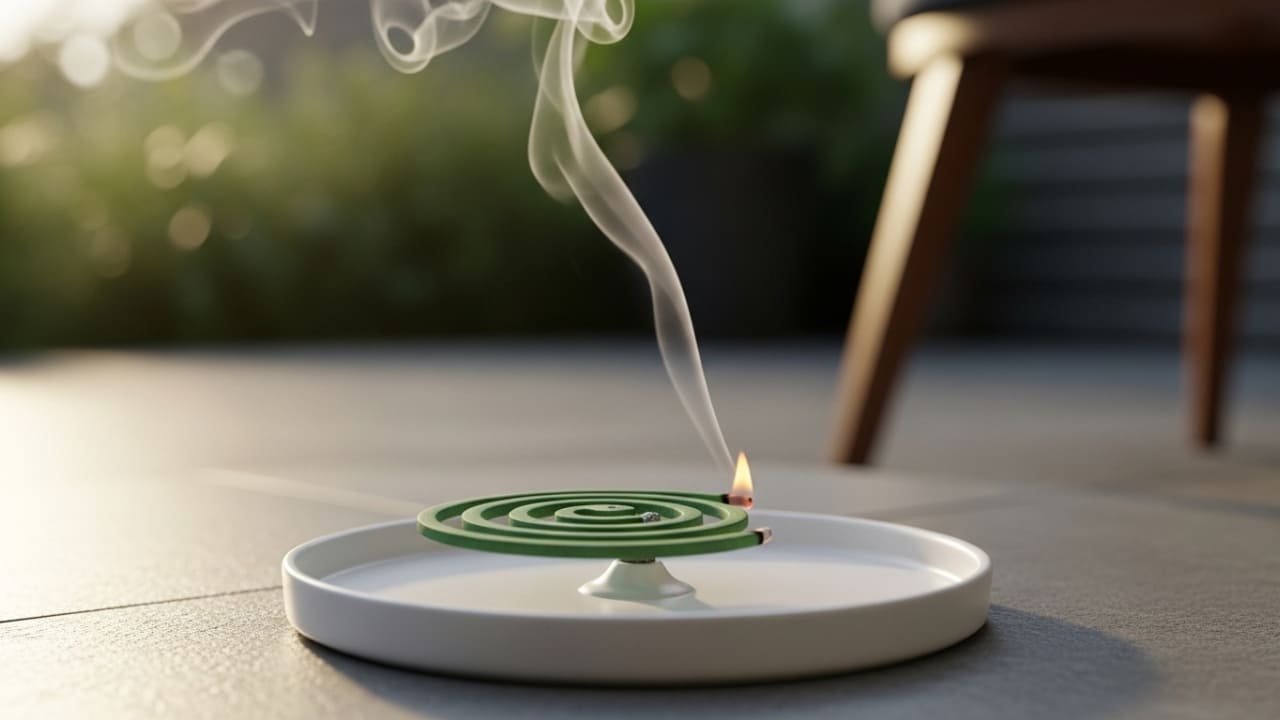
Image Credit: Illustration by Author
Mosquito coils deserve separate treatment because they operate on a fundamentally different principle than every other smoke source in this article. A standard mosquito coil is a slow-burning spiral impregnated with an insecticidal active ingredient.
Historically, coils used pyrethrum — a natural botanical extract from Chrysanthemum cinerariifolium. Modern commercial formulations predominantly use synthetic pyrethroids: transfluthrin, metofluthrin, or d-allethrin, depending on formulation and regional market.
The coil burns at a controlled rate, continuously volatilizing the active compound into surrounding air over several hours. The protection from a mosquito coil derives from the insecticidal compound, not from the smoke itself. The smoke is purely a thermal delivery mechanism.
Coils perform best in semi-enclosed outdoor spaces — covered porches, canopy seating areas, screened patios — where the active ingredient can build to effective concentrations rather than immediately dispersing. In fully open, breezy outdoor conditions, the active compound disperses more rapidly, reducing effective coverage while some close-range benefit remains.
How Long Does Smoke Protection Last?
Smoke-based protection lasts exactly as long as smoke concentration remains sufficient to impair mosquito sensory function. Unlike topical repellents, which bind to the skin and provide time-limited passive protection without ongoing maintenance, smoke-based deterrence requires continuous active management of the smoke source. The moment output drops, protection drops with it.
For campfires, the most protective phase is typically the smoldering, dense-smoke phase rather than the clean-burning flame phase. Once a fire transitions to low-smoke combustion, the protective effect diminishes substantially even if the fire remains lit. When the fire burns out, protection ends essentially immediately.
Insecticidal coils are considerably more consistent in their output. A standard coil burns for four to eight hours depending on size and formulation, providing steady active-compound volatilization throughout that period. This predictability and passive operation without fuel management is one of the primary practical advantages of coils over campfire or smudge fire approaches.
There is no residual deterrent effect from any smoke source after it extinguishes. Mosquitoes whose host-seeking behavior was disrupted by smoke reorient normally once the smoke disperses. Smoke does not establish a treated zone that persists after the source is removed.
At What Smoke Concentration Does Protection Actually Work?
This is a practical question the research addresses inconsistently, because most studies use specific experimental conditions — defined smoke sources, controlled environments, measured particulate densities — that do not translate directly to casual campfire settings. The general finding, however, is consistent: meaningful sensory disruption in mosquitoes requires smoke concentrations substantially above what most casual outdoor campfire situations produce.
Studies examining mosquito behavior in controlled smoke-dense environments generally document meaningful impairment of host-seeking behavior at concentrations that are physically uncomfortable for unprotected humans — dense, visibly opaque smoke with measurable eye and airway irritation. Light, drifting smoke wisps provide little to no measurable protection.
The practical threshold for reliable sensory interference appears to be well above the concentration most people would voluntarily maintain around a campsite or backyard fire.
This is one of the fundamental constraints of outdoor smoke-based mosquito control: the concentration required for reliable effect is difficult to achieve and sustain in open-air settings, demands active management of the smoke source, and is itself unpleasant and potentially harmful with prolonged exposure.
Traditional smudge fire practices in enclosed sleeping spaces worked precisely because enclosed environments allowed smoke concentration to build and sustain — a condition that is structurally unavailable around an open outdoor fire.
Smoke Effectiveness Against Mosquitoes: What Research Shows
Studies of smoldering fires and structured smudge combustion — using specific plant materials in semi-controlled conditions — have documented biting rate reductions of approximately 50–70% in close proximity to the smoke source under favorable low-wind conditions. These figures should not be generalized to casual open campfire settings, where smoke density is typically lower and wind conditions less controlled. The drop-off with distance and wind is steep: protection largely disappears beyond a few feet from the smoke source in any real breeze.
Species responses are not uniform. Available evidence suggests Aedes species — including Aedes aegypti and Ae. albopictus, the primary vectors for dengue, Zika, and chikungunya — may be more tolerant of environmental disruption, including smoke, than crepuscular Culex species. This is a meaningful consideration when evaluating smoke as a protective strategy in regions where Aedes-transmitted diseases are present.
The overall scientific picture: smoke provides real but modest, proximity-dependent, temporary reduction in mosquito activity. Environmental conditions — particularly wind — dominate outcomes. Smoke is not a reliable standalone mosquito control method for open outdoor use.
Smoke vs. Chemical Mosquito Repellents: A Direct Comparison
Side by side, the comparison between smoke-based approaches and modern EPA-registered repellents reveals a substantial gap in reliability and predictability. Topical repellents applied correctly to exposed skin provide protection that is not dependent on wind, fire management, or proximity to a smoke source.
| Method | Mechanism | Duration | Wind Sensitivity | Kills Mosquitoes? | Skin Protection? |
| DEET 30% | Olfactory receptor interference | 6–8 hrs | None | No | Yes, direct |
| Picaridin 20% | Olfactory receptor interference | 8–12 hrs | None | No | Yes, direct |
| Pyrethroid coil | Insecticidal volatilization | 4–8 hrs | Moderate–High | Yes (knockdown) | Indirect, nearby |
| Campfire / wood smoke | Sensory impairment (temporary) | While producing dense smoke | Very High | No | Only in plume |
| Herbal smudge (open air) | VOC + particulate impairment | While smoldering | Very High | No | Mild, in plume |
| Citronella candle | VOC deterrent | While burning | High | No | Minimal |
Pyrethroid coils occupy a useful middle position — more reliable than raw smoke, more localized than topical repellents, and effective as a space treatment around a defined outdoor area. They do not, however, match the individual protection consistency of properly applied skin repellent. For personal protection in any environment where mosquito-borne disease is a concern, topical repellents should be the primary line of defense.
Smoke vs. Repellents — Full Profile Comparison
Five-axis radar comparing campfire smoke, herbal smoke, pyrethroid coil, and DEET across key protection dimensions
When Does Smoke Works Best for Outdoor Mosquito Control?
Camping in calm evening air is the scenario most favorable to campfire smoke benefit. A large, smoldering fire with people sitting close in the smoke zone can meaningfully reduce biting pressure during peak mosquito activity hours. In low-disease-burden environments where nuisance reduction is the goal, this is a practical and chemically simple option with real basis. It is not comprehensive protection.
Semi-enclosed outdoor spaces — covered porches, gazebo seating, pergola dining areas — benefit more than open spaces because smoke concentration can be maintained more consistently. This is also where insecticidal coils perform best. A pyrethroid coil positioned under a covered dining table provides substantially more effective protection than the same coil placed in open lawn conditions.
The enclosed environment is what enables smoke concentration to reach and sustain protective levels.
Limitations of Using Smoke as a Mosquito Repellent
- Wind disperses protection instantly. Even a light breeze collapses the smoke plume within minutes. Mosquito activity peaks at dawn and dusk — precisely the periods most likely to have light air movement working against you.
- Protection requires constant active management. Unlike a topical repellent applied once, smoke demands continuous attention to fuel, placement, and output. There is no grace period — the moment smoke density drops, protection disappears without warning.
- Aggressive species are largely unfazed. Aedes aegypti and Ae. albopictus — vectors for dengue, Zika, and chikungunya — are persistent, day-biting, and relatively tolerant of environmental disturbance. Relying on campfire smoke against these species in an endemic region is not a sound protective strategy.
- The effective concentration is uncomfortable to sustain. The smoke density needed for reliable sensory disruption is visibly opaque and irritating to eyes and airways. In practice, the level most people will tolerate outdoors sits below the threshold for consistent protection — a tension smoke-based control cannot resolve in open settings.
- No residual effect after the source extinguishes. Once smoke disperses, mosquitoes reorient normally. There is no treated zone, no lingering deterrence, and no population-level impact on mosquitoes in the surrounding area.
- Protection is strictly localized. Even under ideal conditions, the impairment zone extends only a few feet from the smoke source. Anyone not sitting directly in the plume receives little to no benefit.
Natural Ways to Complement Smoke-Based Mosquito Control
- Use physical barriers as your foundation. Window screens, door screens, and sleeping nets provide continuous passive protection regardless of wind, weather, or fire management. In high-burden settings, permethrin-treated LLINs add an insecticidal layer on top.
- Eliminate standing water first. Even small volumes — a clogged gutter, a plant saucer, a forgotten container — sustain significant larval development. Reducing breeding habitat reduces the population smoke and repellents have to contend with.
- Apply EPA-registered topical repellents for personal protection. DEET, picaridin, IR3535, and OLE (oil of lemon eucalyptus) are your most reliable individual defense where disease-vector mosquitoes are present. Smoke supplements these — it does not replace them.
📰 Must Read,
✔️ How to Keep Mosquitoes Out of Your Tent While Camping?
✔️ What to Take Orally to Prevent Mosquito Bites: Pills, Vitamins, Diet, and Supplements?
Conclusion: Does Smoke Really Repel Mosquitoes?
Smoke reduces mosquito activity — temporarily, locally, and only while concentration holds. It works by disrupting the sensory system mosquitoes use to find hosts: particulates interfere with olfactory receptors, combustion CO₂ masks human breath plumes, herbal VOCs compete with skin odors, and dense smoke suppresses flight. These are real effects, but none of them are permanent.
What smoke does not do is repel. It creates no avoidance zone, leaves no residual protection, and fails entirely in any meaningful wind. The concentrations needed for consistent effect are above what most outdoor users will comfortably maintain.
Pyrethroid coils are a different tool entirely — insecticidal, not sensory — and should be treated as such. Herbal smokes offer mild supplementary benefit, strongest in enclosed spaces. Plain campfire smoke is the least reliable of all three.
Use smoke where conditions favor it. Never rely on it where mosquito-borne disease is a concern. Anchor your protection in what the evidence consistently supports — and treat smoke as a supplement, not a solution.
Frequently Asked Questions (FAQs)
Q. Does campfire smoke keep mosquitoes away?
Campfire smoke does reduce mosquito activity near the fire — but only when the smoke is dense, the air is calm, and you are sitting close enough to be in the plume. The mosquitoes are not repelled; they are disoriented. Smoke masks the CO₂ and skin-odor signals they use to find you, and the moment it disperses, they reorient and come straight back.
Q. Does sitting near a campfire actually reduce mosquito bites?
Yes, it does — but only if you are sitting close and the smoke is genuinely dense. A clean, pretty campfire with minimal smoke output does almost nothing. You need the smoldering, eyes-watering kind of smoke for any real effect, and even then the moment someone shifts the wood and the smoke changes direction, you are exposed again.
Q. Is mosquito coil smoke the same as campfire smoke?
Not even close. A mosquito coil is essentially a slow-burning insecticide delivery system — the smoke carries pyrethroid compounds that knock mosquitoes down on contact. Campfire smoke is just combustion byproduct. People often assume they work the same way because they both produce smoke, but the mechanisms are completely different. Coils are far more reliable.
Q. Why do mosquitoes seem to come back the second the fire dies down?
Because they never really left — they were just disoriented. Smoke impairs the sensory systems mosquitoes use to locate hosts, but it does not drive them away or kill them. They are still nearby, still looking. Once the smoke thins out, their navigation recovers quickly and they are right back to doing what they do. There is no residual effect, no memory of the smoke, nothing.
Q. Is burning neem leaves or rosemary actually effective?
There is real science behind both, particularly neem. Burning neem releases terpenoid compounds from its essential oil that mosquitoes avoid, and East African field studies in enclosed sleeping spaces have shown meaningful reductions in mosquito entry. Rosemary smoke releases camphor, which has documented repellent activity. That said — both work considerably better in a closed or semi-closed space than out in the open air where the smoke disperses immediately.
Q. Can you get enough protection from smoke alone for a camping trip?
In low-disease-burden areas where nuisance biting is the main concern — maybe, under the right conditions. Still air, dense smoke, people sitting close to the fire. But the honest answer is no, not reliably. Wind, distance, fire management, species — too many variables work against you. A DEET or picaridin application takes thirty seconds and gives you hours of guaranteed coverage regardless of what the fire is doing.
Q. Does the type of wood you burn make a difference for mosquito deterrence?
Somewhat. Conifers like pine and cedar release terpenoid compounds that have mild insect-deterrent activity beyond plain hardwood smoke. But the honest answer is that smoke volume and density matter far more than wood species. A smoldering, poorly-combusted hardwood fire will outperform a small, efficient cedar fire every time. If you want better deterrence, focus on producing more smoke — not on sourcing a particular wood type.
Editorial Team & Contributors

Raashid Ansari, Founder, Content Researcher & Author - MosquiTalk
Not an entomologist — just a genuinely curious writer who started researching mosquitoes and couldn't stop. What began as casual reading about repellents and bite prevention gradually turned into a deep ongoing dive into vector biology, disease epidemiology, animal health impacts, and the real science behind mosquito control. Everything published here is carefully edited, and written with one purpose: giving readers accurate, accessible information they can actually trust and use to protect themselves, their families, and their pets, birds and cattle.
Active across social platforms, regularly publishes, and genuinely invested in spreading mosquito awareness where it matters most. Because informed readers make better decisions — and better decisions save lives.