
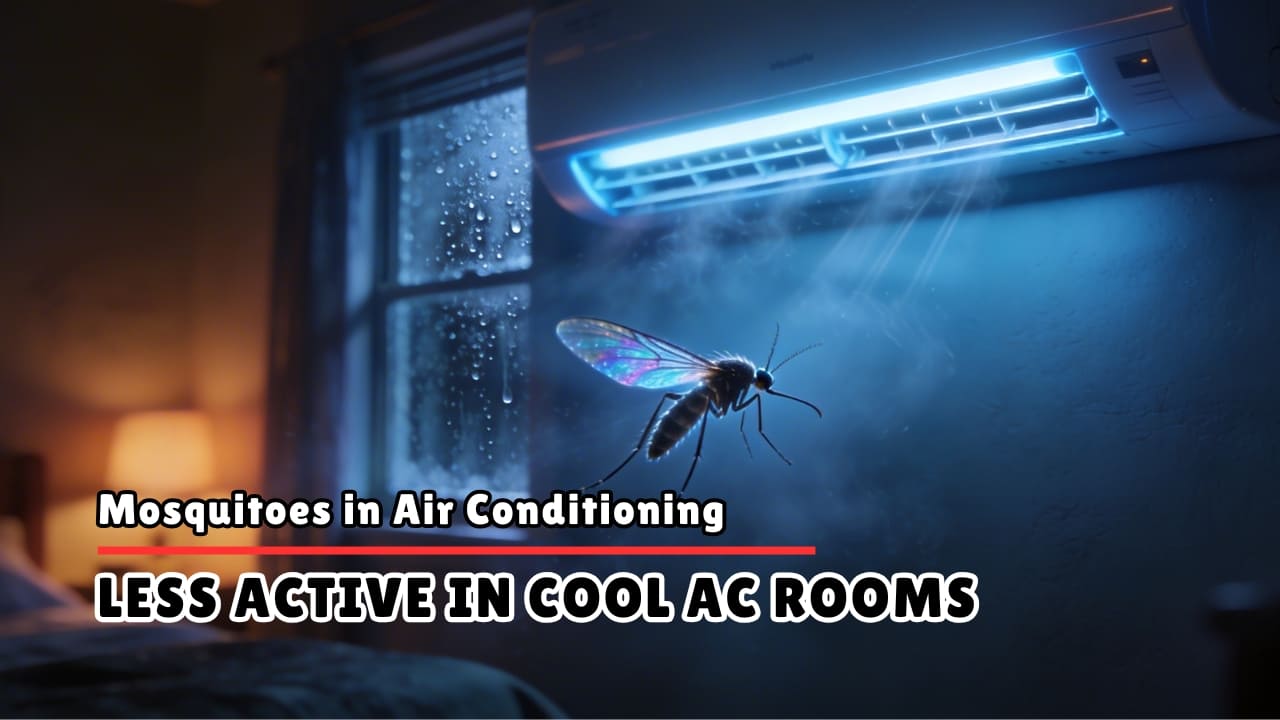
Mosquitoes in Air Conditioning: Has It Ever Happened to You?
It happens more than you’d think. Windows shut, doors closed, air conditioner running — and yet there’s a mosquito in room. Then another. You slap at it in the dark and spend the next ten minutes wondering how it got in. The air conditioner is right there. Could that actually be the problem?
It’s a reasonable question, and the answer is more interesting than a simple yes or no. Mosquitoes don’t usually travel through the AC system itself — the mechanics of how those units work make that unlikely for most setups.
But the installation, the gaps, the drainage lines, the frame — that’s a different story. And once they’re inside, the cold air does something to them that most people have noticed but never quite had a name for: it slows them down, makes them quieter, reduces the biting. The biology behind that is actually worth understanding.
So let’s go through it properly. Whether mosquitoes can come through AC, what the cold air actually does to them, and what you can do about both.
Can Mosquitoes Come Through AC Units?
The short answer is: not usually through the unit itself, but very possibly through everything around it.
A window AC unit or a split AC installation creates a physical opening in your wall or window frame. The unit fills most of that opening — but most of it is not all of it. The foam strips, rubber seals, and filler panels that close the gaps around a window unit degrade over time. They crack, compress, pull away from the frame. A gap of a few millimeters is all a mosquito needs. They’re smaller than most people realize when folded and resting.
For split AC systems, the entry point is the conduit hole — the opening cut through the wall for the refrigerant pipes, power cable, and drainage line. If that hole isn’t sealed completely after installation, and it very often isn’t, it creates a direct passage from outside. Mosquitoes don’t need much. They follow warmth, carbon dioxide, and humidity gradients, and an unsealed conduit hole that connects a cool indoor space to outdoor air is exactly the kind of route they’ll find.
Common Entry Points Around AC Systems
- Gaps between the window AC unit and the window frame — especially at the side panels
- Deteriorated or missing foam sealing strips on older window unit installations
- The conduit hole in the wall for split AC refrigerant and drainage lines
- Drainage pipe outlets that run outside — if the pipe is loose or unsealed at the wall
- Gaps behind poorly fitted AC covers or grilles on the interior wall
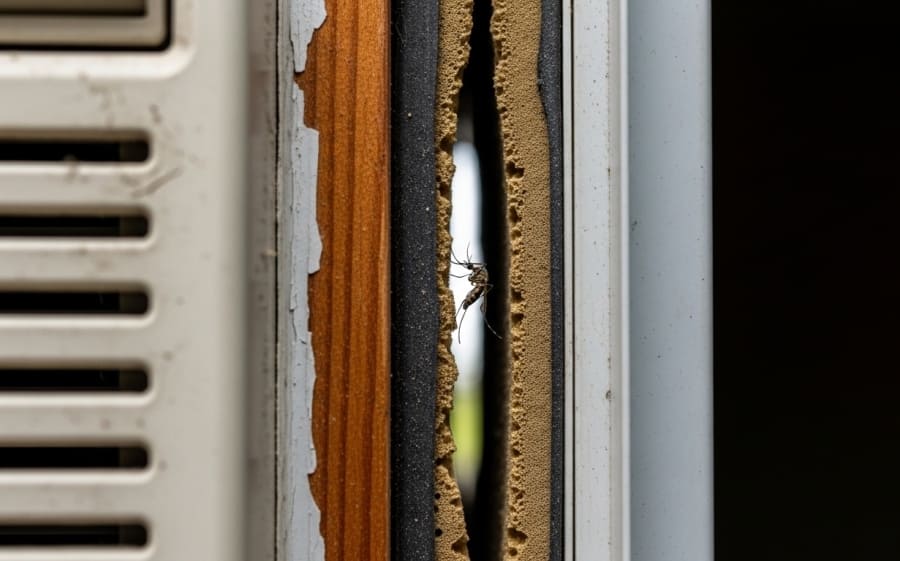
Image Courtesy: Illustration by Author
The AC unit’s internal components — compressor, coils, fans — are not a realistic pathway for mosquitoes in a functioning installation. The airflow direction, filter mesh, and the mechanical barrier of the unit itself prevent that. What allows mosquitoes in is structural, not mechanical.
Why Air Conditioning Reduces Mosquito Bites
This is where the biology gets genuinely interesting. People notice they get bitten less in air-conditioned rooms, and they’re right. But the reason isn’t simply that the cold repels mosquitoes in some vague way. There are specific physiological mechanisms at work.
Mosquitoes are ectotherms — cold-blooded. Their body temperature is determined by their environment. When the ambient temperature drops, their metabolism slows. Enzyme activity decreases. Muscle function becomes less efficient. Flight requires significant energy expenditure, and at lower temperatures, a mosquito’s ability to generate and sustain that energy drops measurably.
Most mosquito species are optimally active between roughly 26°C and 32°C. Below 21°C, flight activity and feeding behavior begin to decline noticeably. Below 15°C, most species become essentially lethargic — still alive, still capable of biting if they’re in contact with a host, but no longer actively hunting.
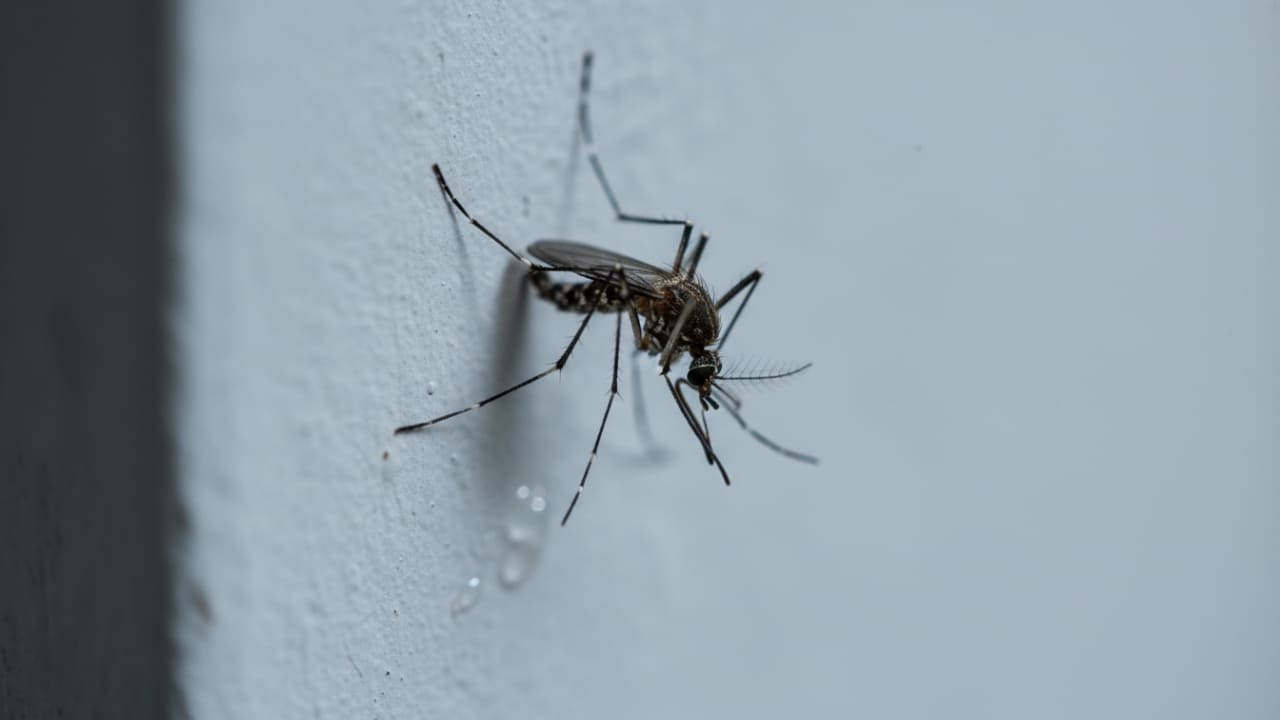
Image Courtesy: Illustration by Author
A typical air-conditioned room in summer, set somewhere around 22°C to 24°C, sits in that transitional range where mosquitoes are present but suppressed.
What Cold Air Does to Mosquito Sensory Systems
Beyond basic metabolism, lower temperatures specifically interfere with the sensory detection systems mosquitoes depend on to find hosts.
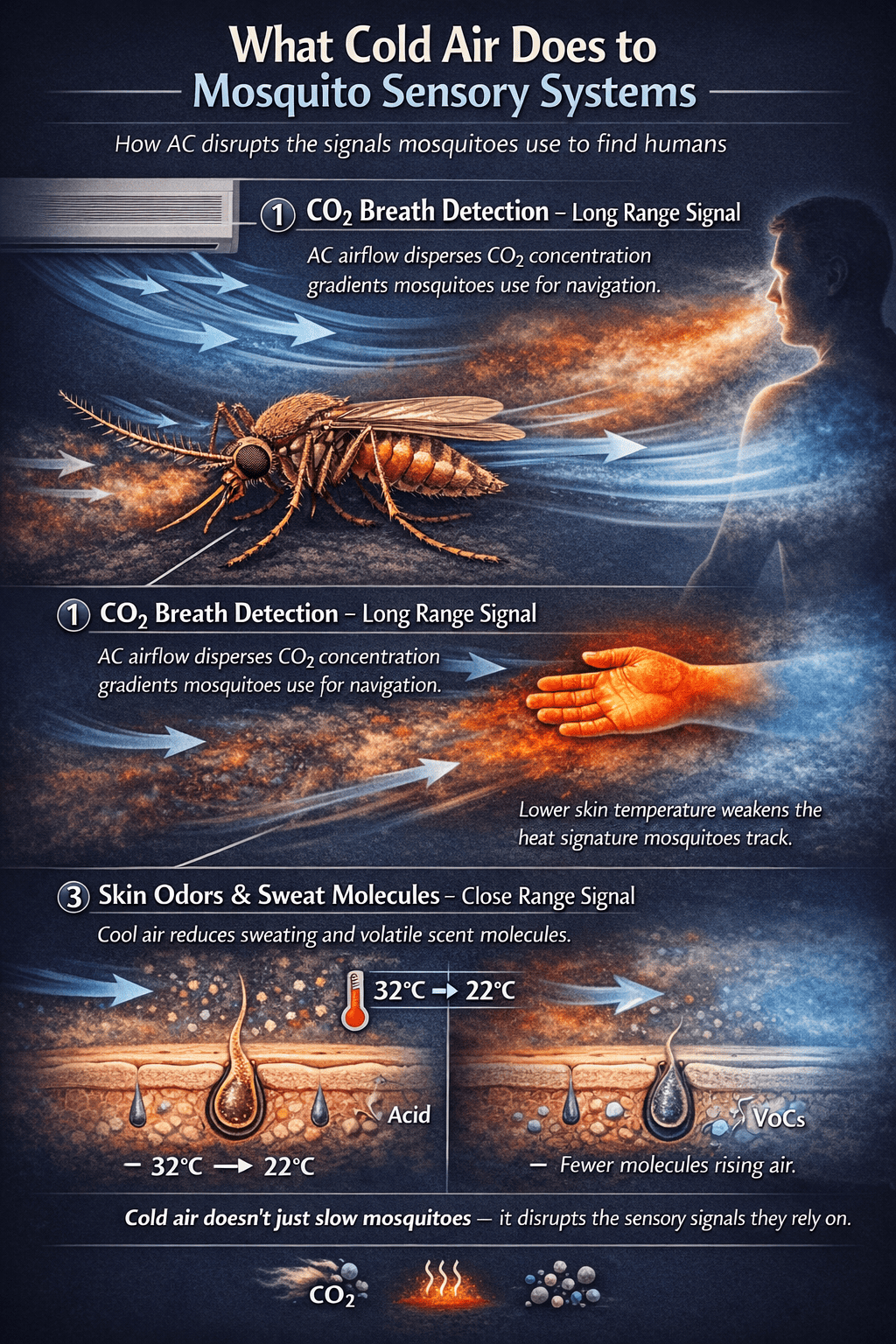
A mosquito locates a human through a layered detection process. Carbon dioxide — the CO2 in exhaled breath — is the primary long-range attractant, detectable from tens of meters. Closer in, body heat becomes a navigational signal. At very close range, skin odors, lactic acid, and moisture guide the final approach. Air conditioning disrupts all three of these signals simultaneously.
Lower skin temperature means less heat radiating from the body surface. Reduced sweating means fewer volatile organic compounds being released. The moving air from the AC unit dilutes and disperses CO2 plumes before they can form the kind of concentration gradient a mosquito uses to navigate. The sensory environment of an air-conditioned room is genuinely harder for a mosquito to work in. This isn’t just cold tolerance — it’s signal disruption.
Do Mosquitoes Bite When AC Is On?
Yes. They can. This one matters to be honest about.
A mosquito that was already in the room before the AC turned on, or one that entered through a gap, will not simply die or stop functioning because the temperature drops a few degrees. It will slow down. It will become less active. It may rest on a wall or ceiling for extended periods. But if you approach it — or rather, if your warmth and CO2 bring you close enough — it can and will bite.
The feeding suppression is real but not absolute. At typical air-conditioned room temperatures, a gravid female mosquito that needs a blood meal will still take one when the opportunity is obvious. What the cold does is raise the energetic cost of active host-seeking. Passive contact biting — when the host comes to the mosquito rather than the mosquito finding the host — can still happen. That’s the bite you get in the middle of the night when you’re sleeping, still, warm under a sheet.
Lower temperatures also slow the digestion of previous blood meals and the development of eggs, which can paradoxically extend the period during which a female continues to seek blood. The biology doesn’t always work in your favor.
Does AC Kill Mosquitoes?
No, not directly. This is worth clearing up because it’s a common assumption.
Air conditioners do not produce anything toxic to mosquitoes. The cold air doesn’t kill them at the temperatures typical indoor AC units reach — you’d need sustained temperatures well below 10°C for prolonged periods to cause direct cold mortality in most species. That’s not what a home AC is doing.
What cold temperatures do is shorten the effective lifespan of mosquitoes indirectly. A cold, dry environment reduces their activity. They feed less, which means they reproduce less. Dehydration becomes a factor in very low-humidity AC environments because mosquitoes lose water through their cuticle and need to replace it. But none of this amounts to the AC unit killing them in any meaningful timeframe. A mosquito can survive for days to weeks in an air-conditioned room, especially if it manages to take a blood meal.
The World Health Organization (WHO) and CDC consistently recommend physical barriers and source reduction as primary mosquito control strategies precisely because environmental modification alone — including temperature reduction — is insufficient to eliminate mosquito populations.
Why Mosquitoes Sometimes Appear in AC Rooms
If you’re finding mosquitoes in a room that’s supposedly sealed and air-conditioned, there’s almost always a straightforward explanation. It helps to think through the possibilities methodically rather than assuming the worst.
The most common cause is simply that mosquitoes were already inside when the room was closed. They hide in dark corners, under furniture, behind curtains. They don’t need to be actively flying to be present. A room that had the door or window open for even a few minutes during peak mosquito activity hours — dusk and the early evening — may have acquired one or two passengers that are now very hard to find.
The second most common cause is the AC installation gap issue described earlier. A single 3mm gap in foam sealing around a window unit is enough, particularly if the unit runs continuously and creates a slight negative pressure in the room that draws air — and anything small enough to travel in air — from outside.
Other causes include nearby outdoor breeding sites — a container of standing water on a balcony directly outside the unit, or a clogged drainage tray on the outdoor component of a split system. Mosquitoes active near the outdoor AC unit are in close proximity to any structural gap.
How to Stop Mosquitoes From Coming Through AC
Sealing the Installation
- Inspect the foam sealing strips on window AC units annually. Replace them if compressed, cracked, or pulling away from the frame.
- Use closed-cell foam tape or weatherstripping to close gaps at the sides and top of window unit installations.
- For split AC conduit holes, seal around the pipe bundle with expanding foam sealant or silicone caulk. Check the exterior side of the hole specifically.
- Inspect the drainage pipe where it exits the wall. The pipe itself should fit snugly; any gap around it should be sealed.
Mesh and Physical Barriers
- Fit fine insect mesh (aperture 1.2mm or smaller) over the drainage outlet of window AC units if it exits to the outside through a tube without a built-in flap.
- Some split AC indoor units have a gap at the top or sides where the unit meets the wall bracket — check this and seal if accessible.
- Consider adding mosquito mesh to any ventilation grilles that connect to outside air.
Removing Breeding Sites Near the Outdoor Unit
- Check the drainage tray of the outdoor compressor unit for standing water. Clean it regularly during mosquito season.
- Remove any containers, pot saucers, or debris collecting water within a few meters of the outdoor unit.
- Ensure the outdoor AC unit’s drainage flows away from the building rather than pooling nearby.
None of these are complicated. The gap sealing in particular takes an hour at most and solves the majority of AC-related mosquito entry problems in one go.
The Science Behind Mosquito Behavior in Cool Rooms
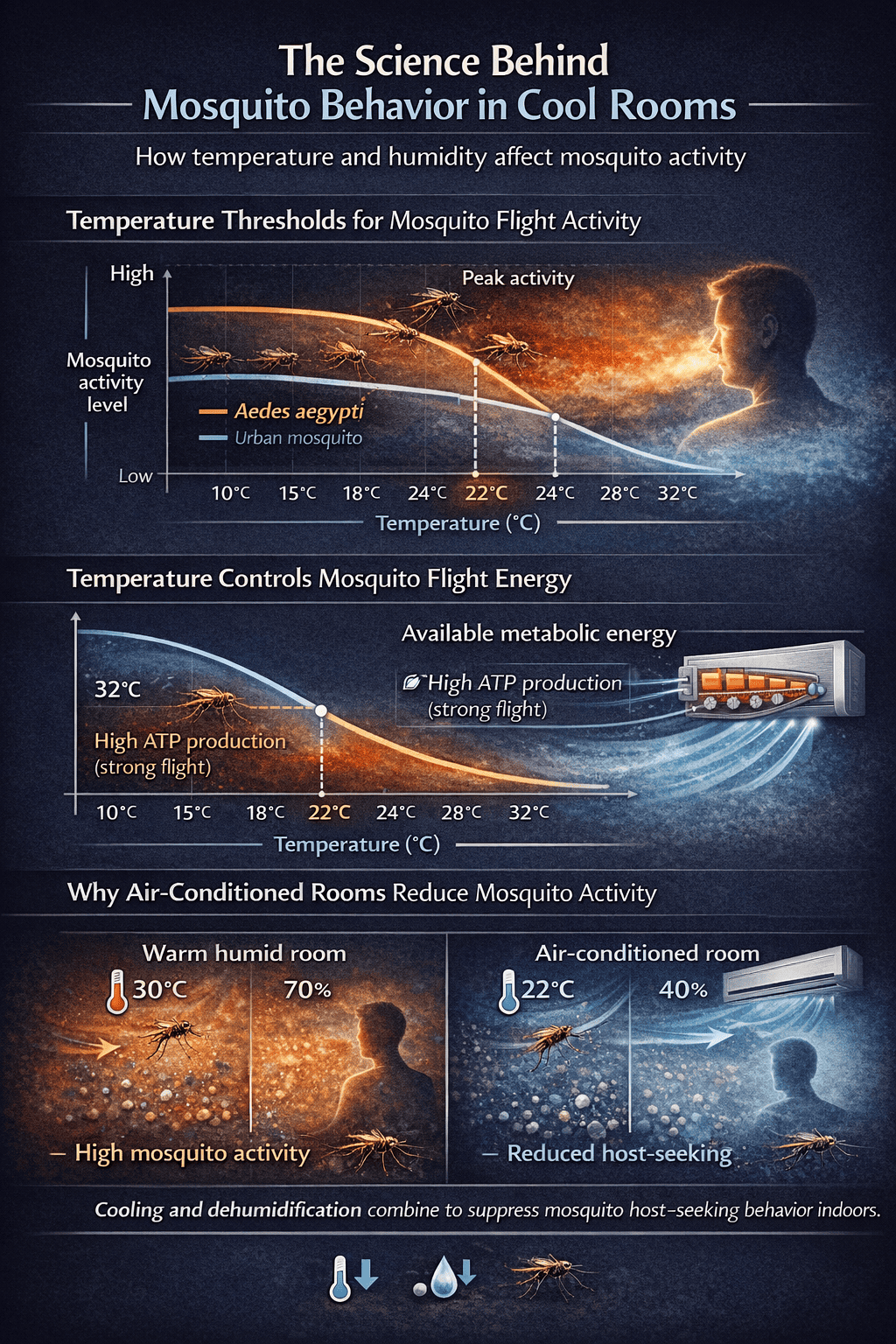
To put a number on it: research in mosquito thermal biology indicates that Aedes aegypti — one of the most common urban biting species — shows significantly reduced flight activity below 24°C and near-complete cessation of host-seeking behavior below 18°C. Culex species, which are the primary nighttime biters in many regions, have similar thresholds though with slightly more cold tolerance.
The metabolic basis for this is well established. Mosquito flight muscle requires rapid ATP production, which depends on enzymatic reactions that are temperature-sensitive. As temperature falls, reaction rates drop in rough proportion to the Arrhenius equation — for every 10°C drop in temperature, metabolic rate roughly halves. At 22°C versus 32°C, a mosquito’s available flight energy is substantially reduced.
Humidity also matters. Mosquitoes are drawn to humid environments partly because they need moisture to survive and partly because human perspiration — a key host-detection cue — is more concentrated in humid air. Air conditioners actively dehumidify indoor air. The combination of lower temperature and lower humidity creates a compounding suppressive effect on mosquito activity that is greater than either factor alone.
This is why the air-conditioned room phenomenon is real and consistent. It’s not placebo. The biology supports the observation that mosquito biting decreases meaningfully in properly cooled indoor environments. What it doesn’t do is make mosquito entry through structural gaps irrelevant — those gaps still need to be addressed physically.
📰 Must Read,
✔️ Mosquitoes Around Your Outdoor AC Unit? A Hidden Breeding Spot!
✔️ Do Outdoor Lights Attract Mosquitoes? How to Reduce Nighttime Activity?
Conclusion: Seal the Gaps, Understand the Biology
Mosquitoes entering through air conditioners is almost always a structural problem, not a mechanical one. The AC unit itself is not the passage — the unsealed gaps around the installation are. A tube of silicone sealant and fresh weatherstripping solve that problem more reliably than anything else.
As for why you get bitten less in cold rooms — the science is real and fairly elegant. Temperature-dependent metabolism, signal disruption, humidity reduction, and airflow interference combine to make an air-conditioned room a genuinely hostile hunting environment for a mosquito. They can still bite. They don’t stop existing. But the conditions work against them in measurable ways.
The practical takeaway is straightforward: fix the gaps around your AC installation to prevent entry, eliminate any standing water near the outdoor unit to eliminate local breeding, and let the cold air do what it does naturally — not kill mosquitoes, but significantly slow them down. That combination works. The biology says so.
