
Table of Contents
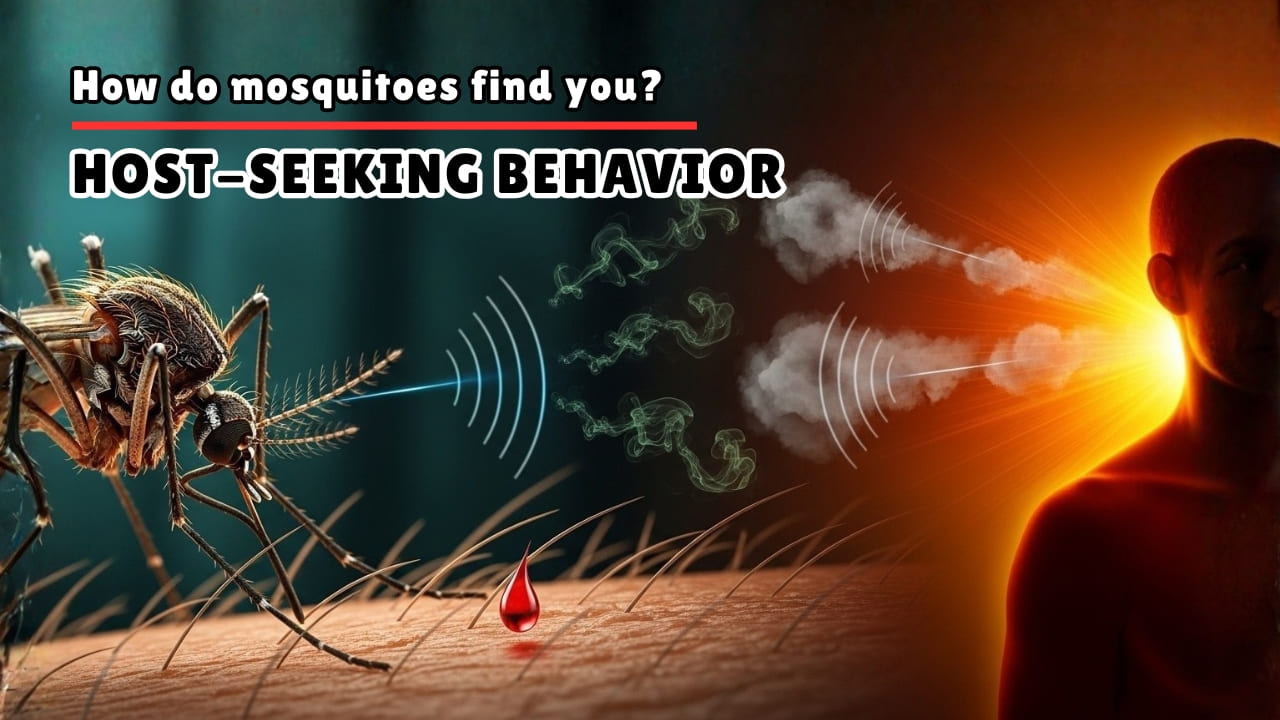
Have you Ever Thought, How Do Mosquitoes Find Humans to Bite?
Imagine a completely dark room. No light, no sound, no visible movement. A mosquito enters. Within minutes, it has located you, landed on your arm, and begun sucking your blood. How does it do that? You can’t see it. It can barely see you.
Image Courtesy: Illustration by Author
And yet the navigation is precise enough to find exposed skin on a specific part of your body, avoid thicker areas, and position its proboscis on a viable blood vessel location.
This isn’t luck or randomness. Mosquito host-seeking behavior is one of the more sophisticated sensory achievements in the insect world — a layered, sequential system that combines chemical detection, thermal sensing, visual processing, and humidity tracking into a coordinated guidance mechanism.
Each signal triggers the next stage. Each cue narrows the search radius. By the time a mosquito is close enough to land, it has processed more environmental information than most people realize.
Understanding how this system works matters beyond pure scientific interest. The more precisely you understand what signals mosquitoes are following, the more precisely you can disrupt them.
The Host-Seeking Mission: Why Female Mosquitoes Need Blood
Male mosquitoes don’t bite. That’s worth stating clearly because it reframes the entire behavior. Host-seeking is exclusively a female activity, and it is driven by a specific biological requirement: blood proteins are needed for egg development.
Female mosquitoes feed on plant nectar for their own metabolic energy — the same as males. But when a female has mated and is ready to produce eggs, she requires a blood meal. The proteins and lipids in vertebrate blood provide the raw materials for vitellogenesis — yolk protein synthesis — which is the process by which eggs develop to maturity. Without a blood meal, a gravid female cannot complete egg production.
This means mosquito host-seeking behavior is fundamentally a reproductive behavior, not simply a feeding behavior. The evolutionary pressure driving it is the pressure to reproduce. A female that fails to locate a blood host cannot complete her reproductive cycle.
Over millions of years, this has produced sensory systems of remarkable precision and redundancy — multiple overlapping detection mechanisms that work together to ensure the mission succeeds even when individual cues are weak or intermittent.
The Centers for Disease Control and Prevention (CDC) and the World Health Organization (WHO) both note that female mosquitoes of medically significant species — Aedes aegypti, Culex quinquefasciatus, Anopheles gambiae — are among the most efficient host-finders in the insect world. That efficiency is not accidental. It is the product of very specific anatomy.
| Mosquito Species | Primary Host | Peak Biting Hours | Disease Vector |
| Aedes aegypti | Humans (preferential) | Dawn & dusk (daytime) | Dengue, Zika, Yellow Fever, Chikungunya |
| Aedes albopictus | Humans & animals | Dawn & dusk (daytime) | Dengue, Chikungunya |
| Culex quinquefasciatus | Humans & birds | Night (after dusk) | West Nile Virus, Filariasis |
| Anopheles gambiae | Humans (strongly preferential) | Late night to early morning | Malaria |
| Anopheles stephensi | Humans & animals | Night | Malaria (urban) |
The Mosquito Sensory System: Anatomy of Detection
The primary sensory organs involved in host detection are the antennae and the maxillary palps — two pairs of structures on the mosquito’s head that serve very different but complementary functions.
The antennae are long, segmented structures covered in sensory hairs called sensilla. Different types of sensilla detect different chemical compounds.
- Olfactory sensilla respond to volatile organic chemicals — the compounds that make up body odor.
- Mechanosensory sensilla detect air movement and sound vibrations.
- CO₂-sensitive sensilla, technically called cpA neurons, are tuned specifically to carbon dioxide and are extraordinarily sensitive to concentration changes.
The maxillary palps are shorter, club-shaped structures positioned near the proboscis. In female Anopheles mosquitoes they are roughly as long as the proboscis itself; in Aedes and Culex species they are shorter.
The maxillary palps carry their own set of sensilla and are particularly important for close-range detection — they appear to play a major role in heat sensing and near-contact chemical assessment immediately before landing.
The Olfactory Receptor Neurons
Inside each sensillum on the antennae and palps are olfactory receptor neurons — the actual cells that translate chemical contact into neural signals. These neurons express specific olfactory receptor proteins that bind to particular molecules. When a target molecule lands on a receptor, it triggers an electrical signal that travels to the mosquito’s antennal lobe — the olfactory processing center in the brain.
| Sensory Organ | Structure | Primary Function | Detection Range |
| Antennae | Long segmented, covered in sensilla | CO₂ detection, volatile odor tracking, sound/vibration | 10–50+ metres (CO₂ plume) |
| Maxillary Palps | Short club-shaped, near proboscis | Heat sensing, close-range chemical assessment | < 1 metre |
| Compound Eyes | Multi-faceted visual organs | Contrast detection, movement tracking, visual targeting | 5–15 metres |
| Hygroreceptors | Neurons on antennae | Humidity gradient detection | 1–3 metres |
| Thermoreceptors | Neurons on palps & antennae | Infrared heat signature detection | < 1 metre |
What makes mosquito olfaction remarkable is its specificity. Research published in journals including Nature and Cell has identified the specific receptor neurons that respond to human-associated compounds. The cpA neuron responding to CO2, for instance, is distinct from neurons responding to lactic acid or ammonia.
This means the mosquito is not simply detecting “smell” in a general sense — it is simultaneously processing multiple distinct chemical channels in parallel, each one providing different information about host location, distance, and quality.
What Attracts Mosquitoes to Humans: The Attractant Cues
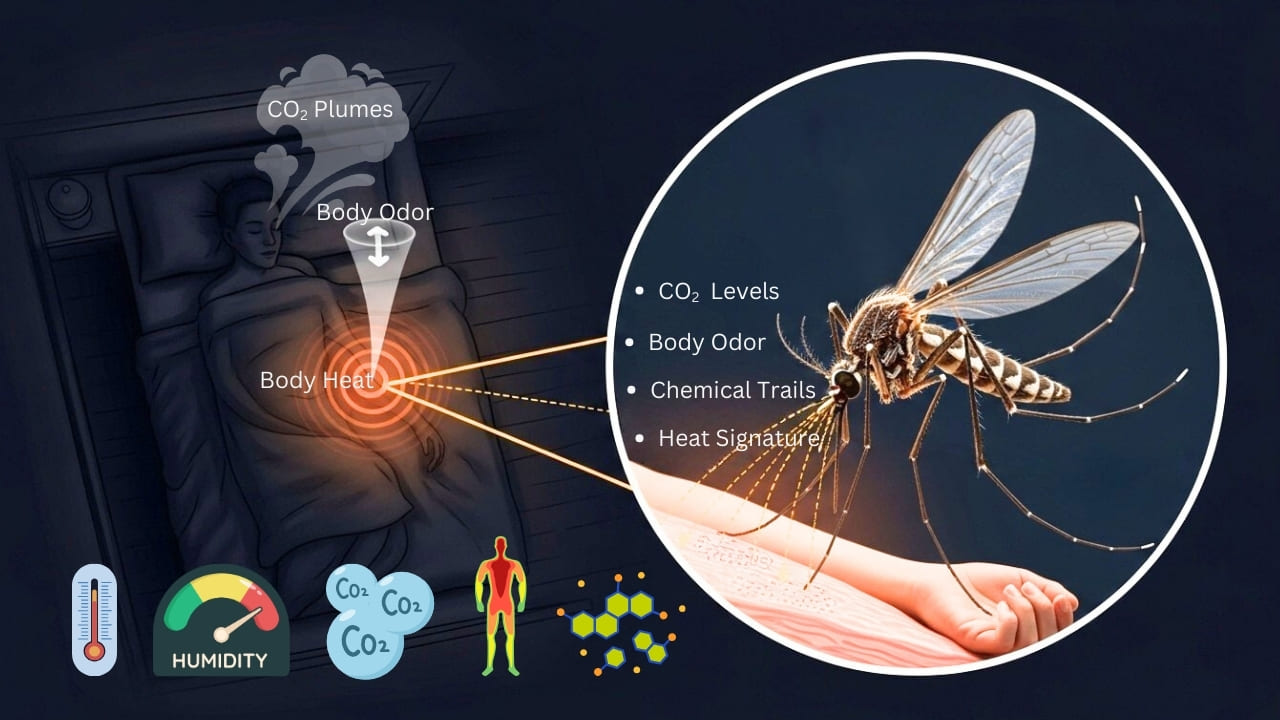
Image Courtesy: Illustration by Author
i) Carbon Dioxide Detection: The Long-Range Signal That Starts Everything
Of all the cues mosquitoes use to locate hosts, carbon dioxide is the one that starts the process. It works at the greatest distance — sometimes 10 or even 15 meters under the right wind conditions — and its detection triggers the behavioral state of active host-seeking. Humans exhale roughly 200ml of CO2 per minute (translates to roughly 15–25 ml of CO2 per breath). At rest, this produces a continuous plume that drifts downwind, gradually diluting with distance.
A mosquito resting upwind, even a significant distance away, can detect the elevated CO2 concentration in that plume. The threshold is very low. When the cpA neurons in the antennae register CO2 concentrations above background atmospheric levels, the mosquito transitions from a resting or random-search state into oriented flight toward the source.
This is called klinokinesis and klinotaxis in entomological terms — the mosquito begins zigzagging upwind within the CO2 plume, tracking the concentration gradient toward its peak. When it loses the plume — flies out of it or the plume disperses — it begins casting: flying in wider arcs transversely to try to re-contact the gradient. This is why mosquito flight near a human appears erratic. It isn’t. It’s a search algorithm.
Why CO₂ Alone Is Not Enough
Elevated CO2 alone doesn’t tell a mosquito much beyond ‘a breathing organism is upwind.’ Plants, decomposing organic matter, and soil microbes also produce CO2 locally. What CO2 does is activate the host-seeking system and orient the mosquito toward an area worth investigating.
The identity and quality of the host are determined by subsequent cues at closer range. Fans and moving air disrupt the plume gradient, which is why airflow is one of the more effective passive deterrents.
| CO₂ Source | Concentration Level | Mosquito Response |
| Human at rest (exhaled breath) | 400–450 ppm above ambient | Strong activation, oriented upwind flight |
| Human exercising | 600–800 ppm above ambient | Intense activation, accelerated host-seeking |
| Decomposing organic matter | Variable, low-level, diffuse | Weak or no directional response |
| Soil microbial activity | Very low, ground-level | Minimal — lacks thermal/odor confirmation |
| Atmospheric background | ~420 ppm | Baseline — no activation |
ii) Human Skin Odors and Chemical Signals: The Identity Layer
Once a mosquito is moving in the direction of elevated CO2, skin odor compounds begin to provide more specific information. These are volatile organic compounds — molecules with low boiling points that evaporate from skin surface at room temperature and drift into the surrounding air.
The human skin produces a complex chemical signature. Some of it comes directly from metabolism — lactic acid, uric acid, ammonia, and various fatty acids diffuse through sweat and the skin surface. A significant portion comes from the skin microbiome — the community of bacteria living on the skin surface that metabolize sebum and sweat into secondary compounds including carboxylic acids, aldehydes, and ketones.
The specific blend varies enormously between individuals based on genetics, diet, hygiene, and microbiome composition.
Key Attractant Compounds
Research has identified specific compounds that mosquitoes respond to strongly. Among the most studied:
- Lactic acid — produced through normal cellular metabolism and secreted in sweat, highly attractive to Aedes aegypti specifically
- Ammonia — a metabolic byproduct present in sweat, acts synergistically with other compounds rather than as a standalone attractant
- Carboxylic acids (particularly butyric acid and propionic acid) — produced by skin bacteria metabolizing sebum, contribute to the characteristic human body odor that mosquitoes track
- 1-octen-3-ol — a volatile compound associated with human breath and body odor, known to attract multiple species
- Nonanal and decanal — aldehydes present in human skin secretions, detected by specific olfactory receptor neurons
- Sulcatone (6-methyl-5-hepten-2-one) — present in human sweat and shown to activate specific Anopheles gambiae receptor neurons
| Compound | Source on Human Body | Mosquito Species Attracted | Role in Detection |
| Lactic acid | Sweat glands (muscle metabolism) | Aedes aegypti (primary) | Close-range attractant, synergistic with ammonia |
| Ammonia | Sweat, skin microbiome | Multiple species | Synergistic — enhances lactic acid response |
| Butyric acid | Skin bacteria (sebum metabolism) | Culex, Aedes | Medium-range odor signature component |
| Propionic acid | Skin bacteria | Anopheles, Aedes | Odor blend component, host identification |
| 1-octen-3-ol | Breath, skin secretions | Multiple species (broad) | Long-range co-attractant with CO₂ |
| Nonanal | Skin lipid oxidation | Culex quinquefasciatus | Close-range host confirmation |
| Sulcatone | Sweat | Anopheles gambiae (specific) | Species-specific receptor activation |
| Acetone | Exhaled breath, sweat | Multiple species | Long-range co-attractant |
iii) Other Physical and Biological Factors: Reason Why Some People Attract More Mosquitoes Than Others
This is one of the most asked questions in mosquito biology and the answer is genuinely complex. The short version: individual variation in skin chemistry, microbiome composition, and metabolic output creates real and significant differences in attractiveness to mosquitoes.
People who produce higher concentrations of lactic acid — through exercise, certain metabolic conditions, or genetic factors — tend to be more attractive to Aedes mosquitoes. People with higher body temperatures, larger body mass producing more CO2, or skin microbiome communities that generate more of the carboxylic acids mosquitoes respond to are consistently bitten more.
Blood type O has been associated with higher attractiveness in some studies, though the mechanism is not fully established. Pregnancy increases CO2 output and body temperature, both of which increase attractiveness.
| Factor | Effect on Attractiveness | Primary Signal Amplified |
| Blood type O | Moderately higher | Skin surface chemical profile (secretor status) |
| Pregnancy | Significantly higher | CO₂ output (+21%), body temperature |
| Physical exercise | Significantly higher | Lactic acid, CO₂, body heat — all three simultaneously |
| Alcohol consumption | Moderately higher | Skin surface ethanol, body temperature |
| High skin bacteria diversity | Variable — can increase or decrease | Carboxylic acid blend composition |
| Larger body mass | Moderately higher | CO₂ output (proportional to metabolic rate) |
| Natural masking compounds | Lower | Suppresses olfactory receptor binding |
Why Some People Get Bitten More Than Others
Revisiting this question in the context of the full sensory system makes the answer clearer. Being bitten more is about emitting stronger or more specific versions of the signals mosquitoes are tracking — higher CO2 output, higher skin temperature, specific skin bacteria, and lactic acid production.
- Higher CO₂ output — larger lung capacity, higher metabolic rate, pregnancy, physical exertion all increase exhaled CO₂
- Higher skin temperature — higher baseline body temperature or recent exercise increases the thermal gradient
- Specific skin bacteria — microbiome communities that produce higher concentrations of mosquito-attractant carboxylic acids
- Lactic acid production — higher concentrations in sweat, particularly after exercise
- Genetic factors — skin chemistry differences with a heritable component, including compounds that actively mask attractant signals in some individuals
- Blood type O — some research suggests type O individuals are bitten more, potentially related to secretor status
- Alcohol consumption — modestly increases skin ethanol and surface temperature, both attractants
iv) Body Heat and Thermal Detection: The Final Approach
As a mosquito closes within roughly one metre of a potential host, thermal cues become increasingly important. Warm-blooded hosts — humans and animals — radiate infrared heat continuously. The temperature differential between the host surface and ambient air creates a detectable thermal gradient that the mosquito uses for fine navigation.
The maxillary palps appear to be the primary organ for thermal sensing at close range, though the antennae also contribute. The sensory cells involved are thermosensitive neurons that respond to temperature gradients rather than absolute temperature — meaning they detect the warmth of the host relative to the surrounding environment.
| Ambient Temperature | Skin-to-Air Gradient | Thermal Detection Range | Mosquito Biting Activity |
| 32°C (hot outdoor) | ~5°C differential | Minimal — gradient too small | High — compensates via chemical cues |
| 28°C (warm indoor) | ~8–9°C differential | ~50–80 cm effective range | High — optimal conditions |
| 24°C (mild AC room) | ~12–13°C differential | ~30–50 cm effective range | Moderate — suppressed but active |
| 20°C (cool AC room) | ~16–17°C differential | ~20–30 cm effective range | Low — metabolic suppression begins |
| 15°C (cold room) | ~21°C differential | Close contact only | Very low — near-lethargic |
This is relevant for understanding why cold air conditioning reduces biting. Lower ambient air temperature reduces the thermal gradient between host skin and environment, making the heat signature less detectable at distance. The signal is still there — the human is still warmer than the air — but the contrast is diminished and detection range decreases.
v) Visual Cues and Movement Detection: Close-Range Navigation
Mosquitoes are not primarily visual hunters — their compound eyes have relatively low resolution compared to predatory insects. But visual cues play a real and documented role in host-seeking at short to medium range.
The most well-established visual attractant is contrast. Mosquitoes are more attracted to dark colors against lighter backgrounds — dark clothing, dark skin areas, and shadowed body parts are detected more readily at close range. Movement is a significant visual trigger. A stationary person is harder for a mosquito to visually acquire than a moving one, even at identical chemical emission levels.
| Visual Cue | Mosquito Response | Practical Implication |
| Dark clothing (black, navy, dark red) | Strong attraction at 5–15 metre range | Wear light-coloured clothing outdoors |
| Light clothing (white, pale yellow, beige) | Reduced visual acquisition | Preferred outdoor clothing colour choice |
| Moving objects | Strong visual activation — triggers approach flight | Avoid unnecessary movement at dusk/dawn |
| Stationary objects | Lower visual salience | Remaining still reduces detection probability |
| High contrast (dark vs light background) | Target acquisition enhanced | Avoid dark clothing against light walls/sky |
| UV light sources | Attracts some species (variable) | Replace UV outdoor bulbs with warm LED |
vi) Humidity and Moisture Signals
Humidity is a somewhat underappreciated component of the host-detection system. Humans emit moisture through both exhaled breath and transepidermal water loss — water vapour diffusing continuously through the skin surface even without active sweating.
Mosquitoes have hygroreceptors — humidity-sensitive sensory neurons — on their antennae. These neurons detect relative humidity gradients and contribute to host orientation at close range. A warm, humid microenvironment near a human host creates a detectable moisture signature that provides an additional navigational signal layered on top of chemical and thermal cues.
How Mosquitoes Find You: The Step-by-Step Host-Seeking Sequence
Putting the individual signals together into a behavioral sequence gives the clearest picture of how mosquito host-seeking behavior actually unfolds in practice.
| Stage | Distance from Host | Primary Cue | Sensory Organ | Behavioural Response |
| 1 — Activation | >15 metres | CO₂ plume detection | Antennae (cpA neurons) | Shift from rest to active host-seeking; upwind oriented flight |
| 2 — Odor Navigation | 5–15 metres | Skin volatile compounds | Antennae (olfactory sensilla) | Zigzag tracking within combined CO₂ + odour plume |
| 3 — Visual Acquisition | 5–15 metres | Dark contrast, movement | Compound eyes | Flight path redirected toward visual target |
| 4 — Thermal Approach | < 1 metre | Infrared heat gradient | Maxillary palps, antennae | Fine navigation toward warmest exposed skin surface |
| 5 — Landing & Probing | Contact | Local skin chemistry, heat | Palps, proboscis tip | Site assessment, fascicle insertion, blood vessel probing |
Stage 1 — CO₂ Detection and Activation
A resting or foraging female detects elevated CO2 in the surrounding air. The cpA neurons in the antennae trigger a shift into active host-seeking mode. The mosquito orients upwind and begins flying toward the CO2 source, tracking the plume by zigzagging within the concentration gradient.
Stage 2 — Odour Plume Navigation
As the mosquito moves upwind within the CO2 plume, skin odour compounds become detectable at increasing concentration. These compounds confirm a warm-blooded host rather than a generic CO2 source and refine the directional flight.
Stage 3 — Visual Acquisition
Within roughly 5 to 15 metres, visual input begins to contribute. Dark, moving objects in the visual field are flagged as potential hosts. The mosquito’s flight path begins to orient toward the visual target while chemical detection continues in parallel.
Stage 4 — Thermal Detection
Within approximately one metre, the infrared heat signature of the host becomes detectable. The thermal gradient guides the mosquito through the final approach, distinguishing the warm host surface from cooler surrounding surfaces.
Stage 5 — Landing and Probing
The mosquito lands, typically on exposed skin. It briefly probes with the tip of the proboscis, assessing the immediate chemical and thermal properties of the landing site. If suitable, it inserts the fascicle through the skin and begins searching for a blood vessel.
How Environmental Conditions Affect Mosquito Host-Seeking
The sensory system doesn’t operate in isolation — environmental conditions modulate how effectively each signal travels and how actively mosquitoes are seeking.
| Environmental Factor | Optimal for Mosquitoes | Effect on Host-Seeking | Practical Note |
| Temperature | 26°C – 32°C | Below 21°C: activity declines. Below 15°C: near-lethargic | AC rooms at 22–24°C suppress but do not eliminate biting |
| Humidity | 70–90% RH | High humidity enhances odour plume integrity and volatilisation | Dry AC air partially disrupts chemical signal transmission |
| Wind speed | 0–2 km/h (very light) | Strong wind disperses CO₂ plume; still air allows plume accumulation | Fans are highly effective passive deterrents |
| Light level | Low light / darkness | Crepuscular peak at dusk and dawn; some species active at night | Peak risk: 30 min before and after sunrise/sunset |
| Barometric pressure | Falling pressure | Activity may increase before rain | Increased vigilance during approaching storm conditions |
Practical Ways to Reduce Mosquito Attractant Cues
Understanding the sensory system provides a rational basis for personal protection strategies. Each of the following methods works by targeting a specific signal in the host-seeking sequence.
Disrupting Chemical Signals
- Shower before outdoor activity — reduces skin surface accumulation of lactic acid, ammonia, and bacterial metabolites.
- Avoid strongly fragranced products — certain floral and fruity fragrances contain compounds overlapping with mosquito attractant chemicals.
- Use DEET or picaridin-based repellents — these interfere with mosquito olfactory receptors, making the wearer chemically difficult to detect.
- Limit Alcohol Consumption — reducing alcohol consumption before outdoor exposure has measurable effects on skin surface chemistry.
- Manage diet — making changes in our diet so that it influences our body heat, body odor and chemical emissions, to those which are not favorable for mosquitoes.
Disrupting Thermal and CO₂ Signals
- Use fans outdoors — airflow disperses CO₂ plumes and odor gradients before they can form detectable concentration gradients
- Avoid peak exertion outdoors during mosquito activity hours — exercise simultaneously increases CO₂ output, lactic acid, and body temperature
- Stay in air-conditioned spaces during peak hours — reduces body temperature differential and skin vapor emission
Disrupting Visual Signals
- Wear light-coloured clothing — reduces visual contrast mosquitoes use to acquire targets at medium range
- Cover skin with loose-fitting clothing — removes exposed skin serving as both chemical emitter and visual/thermal target
- Avoid unnecessary movement during high-activity periods — reduces visual salience to approaching mosquitoes
Environmental Modifications
- Eliminate standing water near living areas — removes breeding sites, reducing local gravid female population
- Use yellow or warm outdoor lighting — reduces UV visual attractant versus standard bulbs
- Install fine insect mesh (1.2mm or smaller) — most reliable physical barrier
- Manage or trim vegetation near outdoor seating — dense plants provide resting habitat and reduce dispersing airflow
| Protection Method | Signal Disrupted | Effectiveness Level | Notes |
| DEET repellent (30–50%) | Olfactory (chemical) | Very High | Blocks multiple receptor types simultaneously |
| Picaridin repellent | Olfactory (chemical) | Very High | Similar efficacy to DEET, less skin feel |
| Electric fan (outdoor) | CO₂ plume + odour gradient | High | Disrupts plume formation and flight stability |
| Light-coloured clothing | Visual contrast | Moderate | Combined with coverage = significantly more effective |
| Full skin coverage (clothing) | Chemical + visual + thermal | High | Removes surface emission and target area |
| Insect mesh screens | All cues (physical barrier) | Very High | Prevention rather than disruption |
| Eliminating standing water | Population reduction (source) | Very High | Reduces number of seeking females in area |
| Air conditioning (22–24°C) | Thermal + humidity + CO₂ diffusion | Moderate | Suppresses but does not eliminate indoor biting |
| Shower before exposure | Chemical (skin microbiome) | Moderate | Temporary — effect diminishes within 1–2 hours |
📰 Must Read,
✔️ What Kind of Smell Repels Mosquitoes?
✔️ Rain, Hot or Cold – What Weather Do Mosquitoes Enjoy?
Conclusion: A Sophisticated System Worth Understanding
Mosquito host-seeking behavior is a precisely sequenced, multi-sensory guidance system that operates across multiple spatial scales — from tens of meters via CO2 gradient tracking, through medium range via skin odor navigation and visual acquisition, to centimeter-level thermal and chemical assessment at the point of landing.
The practical implication of understanding this system is that disruption works best when it targets multiple signals simultaneously. A single intervention — repellent alone, fan alone, light-coloured clothing alone — will reduce biting but not eliminate it. Combining chemical masking with airflow disruption, physical barriers, and environmental source reduction addresses the system more comprehensively.
The American Mosquito Control Association and the CDC both emphasize integrated personal protection — combining repellents, clothing, barriers, and source reduction — for exactly this reason. The biology supports that recommendation.
Mosquitoes use redundant, overlapping detection systems precisely so that the failure of one cue doesn’t end the hunt. Effective protection mirrors that redundancy by operating on multiple levels at once.
Understanding how mosquitoes find their targets doesn’t just satisfy scientific curiosity. It gives you a rational framework for reducing your attractiveness as a host — and that framework is considerably more useful than the usual advice to simply apply repellent and hope for the best.
Frequently Asked Questions (FAQs)
Q. How do mosquitoes find their prey?
Mosquitoes run a layered detection sequence rather than relying on a single sense. Carbon dioxide from exhaled breath is the first trigger — the cpA neurons in their antennae detect even slight elevations above background levels and activate upwind oriented flight. As they close in, skin volatile compounds like lactic acid and carboxylic acids confirm a warm-blooded host.
Within a metre, infrared heat from the body surface takes over as the final navigation signal, guiding the mosquito to exposed skin. The entire system operates as a sequence — each cue unlocking the next stage.
Q. How do mosquitoes find veins or blood vessels before biting?
They don’t locate veins before landing — that part happens after. The proboscis doesn’t operate like a precision scanner from the outside. What actually happens is a probing process: once the mosquito lands on skin, it inserts the fascicle — the needle-like inner mouthpart — through the epidermis and begins moving it beneath the surface, hunting for a capillary. The tip of the proboscis contains mechanoreceptors sensitive to pressure changes that occur when a blood vessel is contacted.
The fascicle is flexible and can bend and redirect as it probes. When the tip contacts a blood vessel, the pressure difference and the chemical composition of blood trigger the mosquito to begin feeding. The process can take anywhere from a few seconds to several minutes depending on how quickly a vessel is contacted. You often don’t feel it because mosquito saliva contains anaesthetic compounds that suppress local pain sensation while feeding is underway.
Q. How do mosquitoes find water to breed in?
Gravid females locate water through olfactory and visual cues working together. Microbial communities in standing water produce volatile organic compounds — fatty acids, ammonia derivatives — that mosquitoes detect from a distance as strong oviposition signals. Dark-colored containers, heat absorption, and local humidity gradients serve as additional beacons. Water with established microbial activity signals a nutrient-rich larval environment — which is precisely the mechanism the Bucket of Doom exploits by replicating those signals in a treated container.
Q. How do you find where mosquitoes are coming from?
Start by checking structural gaps — window AC installations, conduit holes in walls, door frame gaps, and damaged mesh screens are the most common indoor entry points. Then look at breeding sources: even a small container of standing water indoors — a plant saucer, a pet bowl, a vase — can produce mosquitoes that never came from outside at all.
If the problem is consistent after dark, check that door gaps at floor level are sealed, as mosquitoes follow CO₂ gradients indoors and can enter through surprisingly small openings. Tracing the time of appearance helps too — mosquitoes entering from outside peak at dusk, while indoor-breeding populations appear more unpredictably throughout the day.
Q. Do mosquitoes use their eyes to find hosts?
Yes, but vision is a secondary cue that refines rather than initiates host-seeking. At 5 to 15 metres, mosquitoes detect dark objects against lighter backgrounds and respond strongly to movement — a moving target is far easier to acquire than a stationary one. Dark clothing is consistently more attractive than light clothing in controlled studies. In complete darkness, mosquitoes locate hosts through chemical and heat cues alone, but visual input accelerates the approach and improves landing accuracy at close range.
Q. Does carbon dioxide alone attract mosquitoes?
CO₂ activates and orients mosquitoes but doesn’t identify the host. Plants, soil microbes, and decomposing matter all produce CO₂ — if it were sufficient alone, a compost pile would be as attractive as a human. What CO₂ does is switch the mosquito into active host-seeking mode and direct it upwind toward the source area. The confirmation comes from skin volatile compounds overlaying the CO₂ plume at closer range. Disrupt the CO₂ signal with airflow and you reduce activation; disrupt the skin odor blend and the mosquito cannot confirm what it’s tracking.
Q. Why are mosquitoes more active at dusk and dawn?
Temperature, humidity, and light levels converge at those times in ways that maximise host-seeking efficiency. Lower light reduces predator risk while humidity is typically higher, improving odour plume integrity and reducing mosquito desiccation. Temperatures at dusk sit in the optimal 26–32°C activity window after the suppressive heat of midday. Above 35°C, flight activity drops for the same metabolic reasons it does in cold conditions. The crepuscular peak is the daily window where every environmental variable aligns in the mosquito’s favour.
Editorial Team & Contributors

Raashid Ansari, Founder, Content Researcher & Author - MosquiTalk
Not an entomologist — just a genuinely curious writer who started researching mosquitoes and couldn't stop. What began as casual reading about repellents and bite prevention gradually turned into a deep ongoing dive into vector biology, disease epidemiology, animal health impacts, and the real science behind mosquito control. Everything published here is carefully edited, and written with one purpose: giving readers accurate, accessible information they can actually trust and use to protect themselves, their families, and their pets, birds and cattle.
Active across social platforms, regularly publishes, and genuinely invested in spreading mosquito awareness where it matters most. Because informed readers make better decisions — and better decisions save lives.