
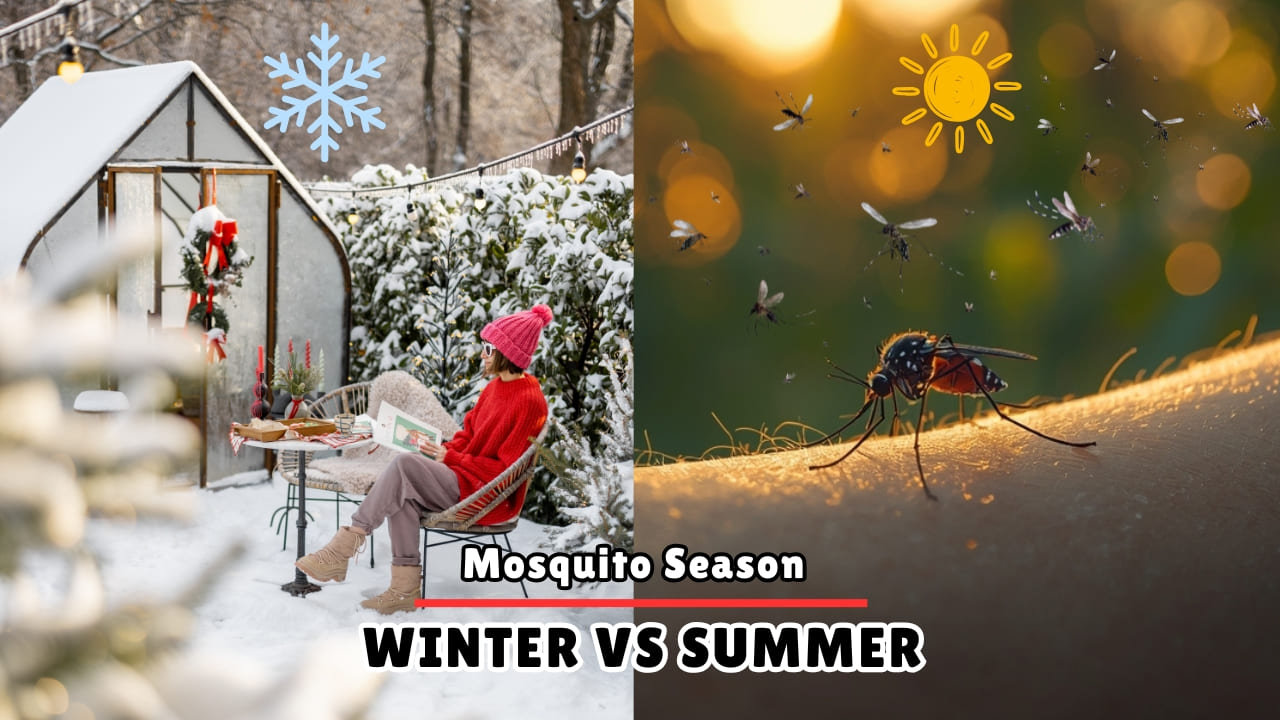
Why Mosquitoes Vanish in Cold Weather — and Come Back Every Summer!
One evening in late September, you notice something: the mosquitoes are gone. No buzzing, no bites. By December, it feels like they never existed. Then June arrives, the temperature climbs, and they are back — relentless and right on schedule.
This pattern is not random. Mosquito seasonal behavior is driven by precise biological and environmental mechanisms tied directly to temperature. Understanding what happens to mosquitoes in winter, and why they only come out when it’s hot, answers one of the most common questions in pest biology — and helps you prepare more effectively.
The Mosquito Life Cycle
Mosquitoes undergo complete metamorphosis — four distinct life stages, each with different environmental requirements.
- Egg: Laid on or near standing water. Highly resilient. Some species’ eggs can survive freezing temperatures for months.
- Larva: Aquatic stage. Requires water temperatures above 10°C (50°F) to develop. Development accelerates with heat.
- Pupa: Transitional, non-feeding stage. Still aquatic. Completes in 1–4 days under warm conditions.
- Adult: Emerges from water. Lifespan 1–8 weeks. Requires warmth to fly, feed, and reproduce.
Every stage of this cycle is temperature-dependent. Drop below a critical threshold and the cycle stalls entirely — which is precisely what winter does.
2. What Happens to Mosquitoes in Winter?
Mosquitoes do not simply die when temperatures drop. Different species use different survival strategies, all biologically designed to wait out the cold.
Diapause: The Mosquito’s Winter Mode
Diapause is a state of suspended biological development — similar in concept to hibernation but more precisely described as a hormonally regulated dormancy. When day length shortens and temperatures fall, certain mosquito species enter diapause.
During diapause, a female mosquito’s reproductive system shuts down, her metabolism drops dramatically, and she seeks out a sheltered location — hollow logs, animal burrows, basements, or dense leaf litter — where she enters a state of near-complete inactivity. She does not feed, does not reproduce, and burns fat reserves accumulated during autumn.
Culex pipiens, the common house mosquito and a primary vector of West Nile virus in the United States, is a well-documented diapausing species. Research from university entomology departments confirms that these females can survive for several months in diapause before re-emerging in spring.
Egg Survival Through Winter
Some species, particularly Aedes mosquitoes including Aedes albopictus (the Asian tiger mosquito), do not overwinter as adults. Instead, the female lays diapausing eggs in late autumn that are specifically adapted to survive freezing temperatures. These eggs remain dormant in soil or leaf litter through winter and hatch when temperatures rise and rainfall provides moisture in spring.
This egg-based survival strategy is remarkably effective. Aedes albopictus eggs have been documented surviving temperatures as low as -10°C (14°F) in protected environments, which is one reason this species continues to expand its geographic range into historically cooler regions.
Species Differences in Winter Survival
| Species | Winter Strategy | Survival Stage | Re-activation Temp |
| Culex pipiens | Adult diapause | Adult female | Above 10°C (50°F) |
| Aedes albopictus | Egg diapause | Diapausing egg | Above 10°C (50°F) |
| Aedes aegypti | No true diapause | Tropical — does not survive hard frost | Above 15°C (59°F) |
| Anopheles spp. | Adult diapause (some species) | Adult female | Above 10°C (50°F) |
| Culiseta melanura | Adult diapause | Adult female | Above 10°C (50°F) |
Do Mosquitoes Come in Winter or Summer?
Mosquitoes are primarily warm-season insects. Most species become inactive or dormant below 10°C (50°F) and cease development entirely below 7°C (45°F). Peak activity occurs between 25°C–30°C (77°F–86°F). In tropical and subtropical climates, mosquitoes can remain active year-round.
In temperate regions like the United States, Canada, and most of Europe, mosquitoes are a spring-through-autumn phenomenon. The first adults typically emerge when sustained daytime temperatures consistently exceed 10°C (50°F) — usually March to May depending on latitude.
In tropical regions — sub-Saharan Africa, Southeast Asia, Central America — temperatures rarely drop below the mosquito’s activity threshold. This is why malaria, dengue, and other mosquito-borne diseases are endemic year-round in these areas, as noted by both the WHO and CDC in their vector control guidelines.
Indoor environments complicate this picture. Heated buildings, particularly in urban areas, can support small overwinter mosquito populations even in cold climates — which is why occasional winter bites indoors are not unheard of.
| Season | Avg Temp Range | Mosquito Activity | Breeding Status |
| Winter | Below 10°C (50°F) | Dormant / Absent | None |
| Early Spring | 10°C–15°C (50°F–59°F) | Low — first adults emerging | Minimal |
| Late Spring | 15°C–20°C (59°F–68°F) | Moderate — populations building | Active |
| Summer | 25°C–35°C (77°F–95°F) | Peak activity | Rapid and continuous |
| Autumn | 15°C–10°C (59°F–50°F) | Declining — diapause begins | Slowing |
Why Do Mosquitoes Only Come Out in the Summer?
Mosquitoes are ectotherms — cold-blooded organisms whose internal body temperature matches their surrounding environment. Unlike mammals, they cannot generate their own heat. This means every biological process they perform — digestion, flight, reproduction, egg development — is directly governed by ambient temperature.
Metabolism and Cold-Blooded Biology
Below 10°C (50°F), a mosquito’s metabolic rate drops so severely that it cannot sustain the muscle contractions needed for flight. At temperatures approaching freezing, enzymatic processes — the chemical reactions that power all cellular activity — slow to a near halt.
Summer heat does the opposite. Warmer temperatures accelerate enzymatic activity, increase muscle efficiency, and enable the full range of mosquito behaviors: host-seeking, feeding, mating, and egg-laying. This is not behavioral preference — it is basic biochemistry.
The Temperature Threshold That Activates Mosquitoes
| Temperature | Mosquito Status | Development Rate | Flight Capability |
| Below 7°C (45°F) | Fully dormant / dead | Zero | None |
| 7°C–10°C (45°F–50°F) | Dormant — diapause or inactive | Negligible | None |
| 10°C–15°C (50°F–59°F) | Transitional — sluggish | Very slow | Limited |
| 15°C–20°C (59°F–68°F) | Active — low intensity | Slow | Moderate |
| 20°C–25°C (68°F–77°F) | Active — building | Moderate | Good |
| 25°C–30°C (77°F–86°F) | Peak activity | Rapid | Optimal |
| Above 35°C (95°F) | Reduced — heat stress | Slows | Reduced |
Why Do Mosquitoes Only Come Out When It’s Hot?
Temperature does not just activate mosquitoes — it determines how fast their populations grow. This is where the relationship between heat and mosquito problems becomes most relevant for public health.
Development Speed vs Temperature
The time it takes a mosquito egg to develop into a biting adult is directly inversely proportional to temperature. At 25°C (77°F), this process takes roughly 10–14 days. At 30°C (86°F), it compresses to 7–10 days. At cooler temperatures of 15°C (59°F), the same process can take 4–6 weeks.
This acceleration effect explains why a hot summer week following rainfall can produce a sudden surge in mosquito numbers — the entire developmental pipeline speeds up simultaneously across thousands of breeding sites.
Breeding Acceleration in Heat
Warmer water temperatures also directly accelerate larval development. Mosquito larvae require water to complete their aquatic stages, and heated standing water — puddles, gutters, containers, ponds — becomes an accelerated breeding environment. The EPA’s guidance on mosquito management specifically identifies warm, stagnant water as the primary high-risk breeding condition.
Additionally, female mosquitoes digest blood meals faster at higher temperatures, meaning they return to host-seeking behavior sooner, bite more frequently, and complete more gonotrophic (reproductive) cycles per season in hot weather than in cooler conditions.
Regional Differences: Cold vs Tropical Climates
The mosquito season length varies enormously by geography, and this has direct implications for disease transmission risk.
- Northern United States and Canada: Mosquito season typically spans May to September — roughly 4–5 months. Hard frosts reliably terminate adult populations.
- Southern United States (Florida, Texas, Gulf Coast): Season extends 8–10 months. Mild winters allow some year-round activity in warmer years.
- Tropical regions (sub-Saharan Africa, Southeast Asia, Amazon basin): Year-round activity. No meaningful cold season to interrupt breeding cycles. This is why these regions carry the heaviest burden of mosquito-borne disease globally.
- Mediterranean and Southern Europe: Expanding season due to warming temperatures. Aedes albopictus is now established across much of southern and central Europe.
- High-altitude regions: Even in tropical latitudes, elevations above 2,000 meters typically limit mosquito activity due to lower temperatures and reduced humidity.
How Climate Change Is Affecting Mosquito Seasons
Climate change is measurably altering mosquito seasonal patterns in several documented ways.
Earlier spring emergence: Rising average temperatures are pushing the 10°C threshold earlier in the year across temperate regions, extending the effective mosquito season by weeks at both ends.
Geographic range expansion: Aedes albopictus has expanded from its original subtropical range into Central Europe, the northeastern United States, and parts of South America — areas previously too cold for sustained populations. The European Centre for Disease Prevention and Control (ECDC) has been tracking this expansion and its implications for dengue and chikungunya transmission risk in Europe.
Higher winter survival rates: Milder winters mean fewer killing frosts, allowing more overwintering adults and diapausing eggs to survive successfully, resulting in larger baseline populations at the start of each season.
Increased disease transmission windows: The WHO has identified climate-driven changes in vector distribution as one of the key factors in the expanding global footprint of dengue fever, now present in regions where it was previously absent.
Practical Prevention Tips Based on Season
Spring (Season Start — Population Building)
- Conduct a full property inspection for standing water as soon as temperatures consistently exceed 10°C.
- Flush and refill bird baths, pet water bowls, and water features weekly.
- Clear winter debris — leaves, tarps, containers — that collected water over winter.
- Apply Bti (Bacillus thuringiensis israelensis) biological larvicide to ornamental ponds or drainage areas that cannot be emptied.
Summer (Peak Season — Maximum Protection)
- Apply EPA-registered repellents containing DEET (20–30%), picaridin, or IR3535 during outdoor activity.
- Wear long-sleeved, light-colored clothing during dawn and dusk — peak biting hours for most species.
- Ensure window and door screens are intact and properly fitted.
- Eliminate any standing water after each rainfall — even small containers like bottle caps can serve as breeding sites.
- Consider permethrin-treated clothing for extended outdoor exposure.
Autumn (Season Wind-Down)
- Continue water source management through September — Aedes species remain active until first frost.
- Seal gaps around windows, pipes, and foundations to prevent diapausing females from entering structures to overwinter indoors.
Authoritative Summary
Mosquito seasonal behavior is governed by a single overriding factor: temperature. As ectotherms, mosquitoes cannot maintain biological function below 10°C (50°F). In cold climates, they survive winter through species-specific strategies — adult diapause, diapausing eggs, or tropical species retreating to heated environments. Peak activity occurs between 25°C–30°C (77°F–86°F), when development accelerates, breeding intensifies, and biting frequency increases.
This biology is well-established across entomological literature and reflected in the public health guidance of the CDC, WHO, and EPA. Climate change is extending and expanding mosquito seasons globally, increasing the urgency of year-round vector awareness even in historically temperate regions.
📰 Must Read,
✔️ Rain, Hot or Cold – What Weather Do Mosquitoes Enjoy?
✔️ US Mosquito Season State-wise Data: Climate Trends, Peak Months & Risk Map
Frequently Asked Questions (FAQs)
What happens to mosquitoes in winter?
Most mosquito species survive winter through diapause — a state of suspended development. Adult females of species like Culex pipiens enter dormancy in sheltered locations, while species like Aedes albopictus overwinter as frost-resistant diapausing eggs. Neither strategy involves dying off entirely; both are biological mechanisms designed to resume activity when temperatures warm.
Do mosquitoes come in winter or summer?
In temperate climates, mosquitoes are primarily a summer phenomenon, with activity concentrated between late spring and early autumn. They are functionally absent during cold winters. In tropical climates, where temperatures remain above the 10°C threshold year-round, mosquitoes are present and active in all seasons.
Why do mosquitoes only come out in the summer?
Mosquitoes are cold-blooded. Their metabolism, flight capability, and reproductive cycle are all directly dependent on ambient temperature. Summer provides the heat necessary to sustain all biological functions. Below 10°C (50°F), these functions shut down. Summer is not a preference — it is a biological requirement.
Why do mosquitoes only come out when it’s hot?
Heat accelerates every stage of mosquito biology — larval development, adult metabolism, blood digestion, and egg production. Warmer temperatures compress the generation time from egg to biting adult, allowing populations to build rapidly. The optimal temperature range for mosquito activity is 25°C–30°C (77°F–86°F), which aligns with peak summer conditions in most regions.
At what temperature do mosquitoes stop being active?
Mosquito activity drops sharply below 15°C (59°F) and ceases almost entirely below 10°C (50°F). Development of eggs and larvae stops below 10°C. Adult mosquitoes cannot sustain flight below approximately 7°C–10°C (45°F–50°F). These thresholds are consistent across most common species studied in entomological research.
Can mosquitoes survive indoors during winter?
Yes, in some cases. Diapausing females that enter heated buildings in autumn can survive winter in low-activity states in warm interior spaces. This is more common with Culex species. These individuals may bite occasionally on warm indoor days but are generally less active than their summer counterparts.
Why do I still get bitten on warm autumn days?
Autumn mosquito activity persists as long as daytime temperatures remain above 10°C–15°C. Female mosquitoes are actively preparing for winter diapause and may be especially motivated to obtain a final blood meal to build fat reserves. Biting activity can continue well into October in mild climates.
Do all mosquito species behave the same way in winter?
No. Behavior varies significantly by species. Culex mosquitoes overwinter as adult females in diapause. Aedes mosquitoes typically overwinter as diapausing eggs. Tropical species like Aedes aegypti have no diapause mechanism and cannot survive frost, which limits their range to warmer climates.
Does a mild winter mean more mosquitoes the following summer?
Generally yes. Milder winters increase the survival rate of overwintering adults and diapausing eggs, resulting in a larger starting population at the beginning of the next season. Combined with early spring warmth, a mild winter can produce noticeably elevated mosquito populations by late spring.
Why are mosquitoes worse after heavy rainfall in summer?
Rainfall creates new standing water breeding sites and reactivates dormant eggs that were waiting for moisture. Combined with summer heat, the developmental cycle from egg to adult can complete in as little as 7–10 days — meaning a single rainstorm can produce a new wave of adult mosquitoes within one to two weeks.
Are mosquitoes active at night in summer?
Most mosquito species are crepuscular — most active during dawn and dusk. However, Aedes species including Aedes aegypti and Aedes albopictus are daytime biters. At night in summer, when temperatures remain warm, some species continue feeding. Nighttime activity is most pronounced on warm, humid evenings.
Can mosquitoes develop resistance to cold over time?
Mosquitoes do not develop resistance to cold in an individual’s lifetime. However, evolutionary pressure from climate variability can gradually shift population-level cold tolerance over generations. The range expansion of Aedes albopictus into cooler regions is partly attributed to selection for greater cold hardiness in egg-stage diapause.
How long does a mosquito live in summer?
Female mosquitoes typically live 2–8 weeks in summer depending on species, temperature, and whether they successfully obtain blood meals. Males live considerably shorter — 1–2 weeks. Cooler temperatures within the active season extend lifespan; extreme heat above 35°C (95°F) can shorten it.
Does mosquito repellent work differently in different seasons?
The chemistry of repellents does not change seasonally, but application strategy should. In peak summer, reapplication frequency matters more due to heat and sweating reducing effectiveness over time. The CDC recommends EPA-registered repellents with DEET, picaridin, or IR3535 regardless of season whenever mosquito exposure is anticipated.
Conclusion
Mosquitoes do not disappear in winter by accident. They survive through precisely regulated biological strategies — diapause, cold-resistant eggs, and metabolic dormancy — that have been refined over millions of years of evolution.
They return every summer for an equally precise reason: heat is the engine that drives every stage of their life cycle. Remove the heat, and the cycle stalls. Restore it, and populations rebuild with remarkable speed.
Understanding this biology does not just satisfy curiosity — it directly informs when and how to act. Targeting breeding sites in early spring, before populations build, is far more effective than reactive measures in peak summer. And with climate change pushing mosquito seasons earlier and further, that window for proactive action is narrowing every year.
