
Table of Contents
Introduction
You are standing in the natural health aisle trying to find a plant-based mosquito repellent. You see three different products within arm’s reach. One says Oil of Lemon Eucalyptus. Another says Lemon Eucalyptus Oil. The third just says Eucalyptus Oil. The names are close enough that most people assume they are essentially the same thing, maybe just different brands or concentrations of the same ingredient.
They are not. Not even close.
This is one of those naming situations where the similarity is genuinely misleading, and the consequences are real. Someone buying regular eucalyptus oil thinking it will protect them against mosquitoes the way Oil of Lemon Eucalyptus does is going to end up with bites. Possibly a lot of them.
This article breaks down exactly what each oil is, where it comes from, how it is made, and which one actually has the science behind it as a mosquito repellent. If you are trying to find a natural alternative to DEET, this is probably the most important distinction you need to understand.
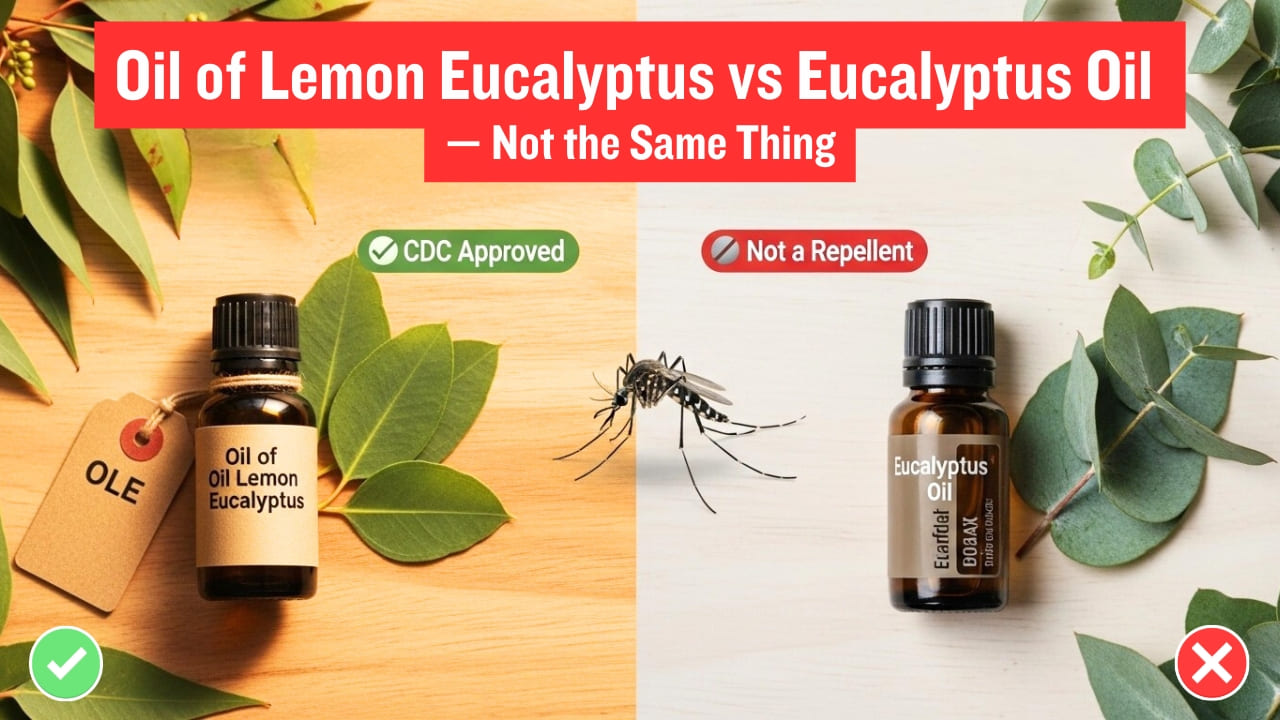
Oil of Lemon Eucalyptus vs Eucalyptus Oil: Why People Confuse These Oils
The naming problem starts with the plant itself. Lemon eucalyptus — scientific name Corymbia citriodora — is a real eucalyptus species with a distinctly lemony scent. That much is straightforward. But what gets extracted from it and how it gets processed is where the two products completely diverge.

Image Credit: Wikimedia Commons, Forest and Kim Starr
Regular eucalyptus oil uses a different species entirely and goes through a simple distillation process. Oil of Lemon Eucalyptus goes through an additional refinement step that fundamentally changes its chemical makeup. Same general plant family. Very different end product.
Add to that the fact that some manufacturers label their products loosely, and you have a consumer landscape where the same-sounding names refer to chemically distinct substances with different effectiveness profiles. It is a genuine labeling problem that causes real confusion.
What Is Oil of Lemon Eucalyptus (OLE)?
Oil of Lemon Eucalyptus is not an essential oil. That distinction matters more than it might sound. It starts with the leaves of Corymbia citriodora, which are steam distilled in the same way as other essential oils. But that is where the similarity ends.
After distillation, the raw extract goes through a refinement and enrichment process specifically designed to concentrate a compound called PMD — para-menthane-3,8-diol. PMD is the active ingredient. It does not exist in meaningful concentrations in the raw plant material. It develops during this additional processing step, partly through the natural conversion of a related compound called citronellal.
PMD is what makes OLE work as a mosquito repellent. It interacts with the olfactory receptors mosquitoes use to detect hosts. Essentially it disrupts their ability to locate you. The mechanism is similar in principle to how DEET works, though the chemistry is different.
This is also why OLE is recognized by the CDC as an effective mosquito repellent. The active compound PMD has been evaluated in peer-reviewed efficacy studies and holds up well against Aedes and Anopheles species. It is the only plant-based repellent option that sits alongside DEET and picaridin in CDC recommendations for preventing mosquito-borne disease.
OLE is also sometimes referred to as citriodiol in European and some scientific contexts — same compound, different naming convention.
What Is Regular Eucalyptus Oil?
Regular eucalyptus oil is an essential oil. Most commonly derived from Eucalyptus globulus, though other species are used too. The leaves are steam distilled and the resulting oil is used largely as-is.
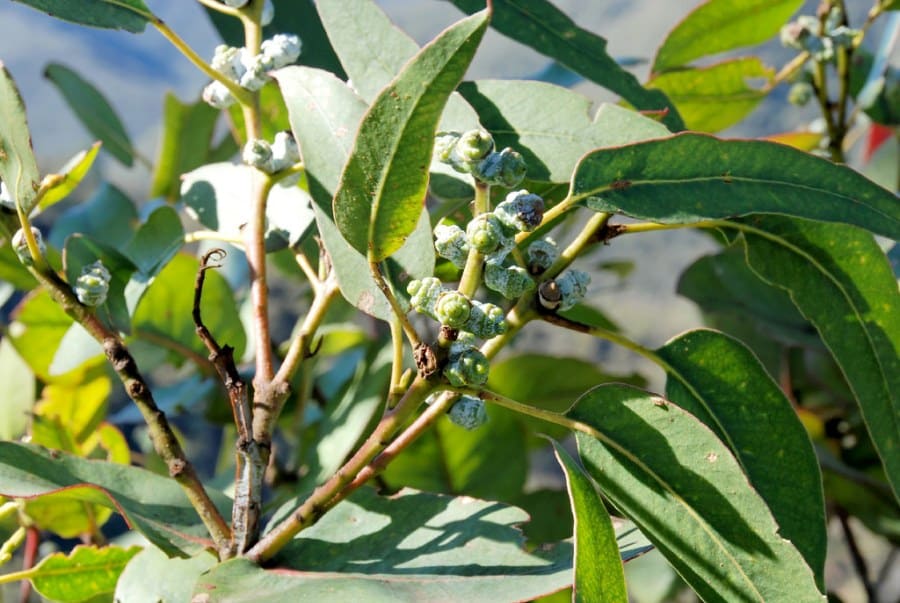
Image Credit: Flickr, Tony Rodd
The dominant compound in regular eucalyptus oil is eucalyptol, also called 1,8-cineole. It gives the oil its familiar sharp, medicinal smell. Eucalyptol has well-documented uses — it is anti-inflammatory, appears in topical muscle rubs, is used in some mouthwashes, and is a common fragrance ingredient. These are legitimate uses.
What it is not is a reliable mosquito repellent. Eucalyptol does not interact with mosquito sensory receptors the way PMD does. Some small studies have shown very brief repellent activity from eucalyptus essential oil at high concentrations, but the effects are inconsistent and the duration is short. Essential oils in general evaporate quickly from skin surface, which means even modest initial effects disappear fast.
This is why DIY mosquito repellent recipes built around eucalyptus essential oil tend to disappoint people. The oil smells strong, which makes it feel like it should work. The mosquitoes frequently disagree.
Oil of Lemon Eucalyptus vs Eucalyptus Oil: Key Chemical Differences
The core difference comes down to PMD versus eucalyptol.
PMD is a terpenoid compound that is highly specific in how it affects insect chemoreception. When mosquitoes approach a host, they are following chemical trails — CO₂, lactic acid, skin volatiles. PMD interferes with their ability to process these signals at close range. It essentially creates chemical noise that masks the host’s presence.
Eucalyptol does not do this in any meaningful or consistent way. It has a strong odor that may have minor deterrent effects at very high concentrations in lab conditions, but that does not translate to reliable field protection on human skin. The biology is just different.
To put it simply — OLE is processed specifically to produce a compound that mosquitoes cannot navigate through. Regular eucalyptus oil is not processed that way and does not contain that compound at effective levels. The names overlap. The chemistry does not.
Does Oil of Lemon Eucalyptus Repel Mosquitoes?
Yes, with real evidence behind it. OLE-based repellents have been tested in multiple peer-reviewed studies against various mosquito species including Aedes aegypti, the primary vector for dengue, Zika, and yellow fever, as well as Anopheles species responsible for malaria transmission.
At concentrations typically found in commercial repellent products, OLE provides protection duration that is genuinely comparable to lower-concentration DEET formulations. Not identical, but in the same general range — which is meaningful for a plant-based option.
This is why it has earned CDC recognition as a recommended active ingredient for preventing mosquito-borne illness. That is a high bar. Most natural repellent ingredients never reach it.
If you are a traveler heading to a region with mosquito-borne disease risk and you want to avoid DEET, OLE is the strongest plant-based alternative currently available with legitimate evidence behind it.
Does Eucalyptus Oil Repel Mosquitoes?
The honest answer is: not reliably, and not for long.
There are occasional studies showing some repellent activity from eucalyptus essential oil, particularly at high concentrations in controlled lab settings. But the results are inconsistent across species and conditions. And the evaporation problem is real — essential oils disappear from skin surface relatively quickly, which limits any protection window even in best-case scenarios.
Regular eucalyptus oil is not on the CDC recommended repellent list. It is not on the EPA registered repellent list under the same standing as OLE. Using it as your primary mosquito protection strategy, especially in areas with disease-carrying mosquitoes, carries genuine risk.
It is not that eucalyptus oil is useless as a product. It has plenty of other applications. It just does not belong in the same conversation as OLE when the subject is mosquito repellent effectiveness.
Table 1: Oil of Lemon Eucalyptus vs Eucalyptus Oil: Side-by-Side Comparison
| Feature | Oil of Lemon Eucalyptus (OLE) | Regular Eucalyptus Oil |
| Plant source | Corymbia citriodora (lemon eucalyptus) | Various eucalyptus species (E. globulus most common) |
| Production method | Steam distilled then refined and enriched to concentrate PMD | Simple steam distillation of leaves — no refinement |
| Active compound | PMD (para-menthane-3,8-diol) — the repellent agent | Eucalyptol (1,8-cineole) — primary compound, not a proven repellent |
| Mosquito repellent effectiveness | Proven. CDC recognized. Comparable to low-concentration DEET. | Limited and inconsistent. Short duration. Not CDC recommended. |
| Typical uses | Commercial mosquito repellent sprays and lotions | Aromatherapy, topical muscle rubs, fragrance, cleaning products |
| Scientific evidence | Strong. Multiple peer-reviewed efficacy studies. | Weak. Limited studies, inconsistent results, rapid evaporation. |
| Age safety | Not recommended for children under 3 years | Use with caution around young children and pets |
| Verdict | Recommended for mosquito bite prevention | Not recommended as a standalone mosquito repellent |
Oil of Lemon Eucalyptus Insect Repellent: What It Actually Protects Against
When people talk about oil of lemon eucalyptus insect repellent, they mostly mean mosquitoes. That is fair — mosquitoes are the primary concern and the most studied target. But OLE-based formulations have shown repellent activity against a broader range of insects than most people realize.
Beyond mosquitoes, oil of lemon eucalyptus insect repellent products have demonstrated effectiveness against:
- Biting midges
- Stable flies
- Deer flies (in some studies)
The PMD compound appears to interfere with host-detection broadly across biting insects that rely on chemical cues — not just the mosquito species most people think of. This makes OLE a more versatile option than its mosquito-specific reputation suggests.
That said, effectiveness does vary by insect species and concentration. For tick prevention specifically, DEET and permethrin remain better-studied options. Here is a quick breakdown of where OLE stands:
- Mosquitoes — strongest evidence base, CDC recognized
- Biting midges and stable flies — demonstrated activity, solid secondary use
- Ticks — limited evidence, not recommended as primary tick protection
If you are spending time outdoors in areas where multiple biting insects are a problem, an oil of lemon eucalyptus insect repellent covers more ground than a product focused on a single species. Just do not rely on it alone in high tick-risk environments.
Oil of Lemon Eucalyptus Mosquito Repellent: How to Use It Correctly
Buying the right product is step one. Using it correctly is step two — and this is where a lot of people shortchange themselves even with a good oil of lemon eucalyptus mosquito repellent.
Application coverage matters more than most people think. An oil of lemon eucalyptus mosquito repellent needs to be applied to all exposed skin, not just the obvious areas. Mosquitoes will find the patch of wrist between your sleeve and your glove, the strip of ankle above your sock. Apply evenly and thoroughly.
Reapplication is the other thing. OLE has solid protection duration — generally in the range of four to six hours depending on concentration, activity level, and heat. Sweating heavily reduces that window. If you are hiking or working outdoors in summer heat, plan to reapply more frequently than the label’s maximum suggests.
Do not apply oil of lemon eucalyptus mosquito repellent under clothing — it works on skin surface exposure, not through fabric. Apply it after sunscreen, not before, and give the sunscreen a minute to absorb first. A few small practical details like these make a real difference in how well any repellent performs.
Table 2: Common OLE Myths vs Facts
| Myth | Fact |
|---|---|
| OLE and eucalyptus oil are the same | Completely different chemistry and effectiveness |
| Natural means safer for all ages | OLE is not recommended for children under 3 |
| More OLE = longer protection | Concentration has limits — excess increases skin sensitivity risk |
| OLE works as well as DEET for ticks | DEET and permethrin remain stronger for tick prevention |
| Home distilled lemon eucalyptus = OLE | Home distillation cannot produce PMD at effective concentrations |
| Lemon eucalyptus essential oil repels mosquitoes | Without PMD refinement, repellent effect is weak and short-lived |
How to Make Oil of Lemon Eucalyptus at Home: What You Need to Know First
This comes up constantly in DIY natural repellent communities, and the honest answer requires a bit of nuance. Learning how to make oil of lemon eucalyptus — true OLE with active PMD — at home is not really possible with standard home equipment. The reason goes back to what OLE actually is.
The PMD that makes OLE effective is not present in meaningful concentrations in raw lemon eucalyptus leaves. It is produced during the refinement and enrichment step that follows distillation — a process that requires controlled chemical conditions to convert citronellal into PMD at effective concentrations. Home distillation of lemon eucalyptus leaves gives you an essential oil. A nice-smelling one. Not OLE.
So if you are researching how to make oil of lemon eucalyptus at home hoping to produce something equivalent to commercial OLE repellents, the straightforward answer is that you cannot replicate the PMD concentration through home methods.
What you can do is distill lemon eucalyptus leaves to produce a raw essential oil with mild citronellal content. Some small-scale studies suggest citronellal has minor repellent properties on its own. But it is significantly weaker than PMD and will not give you the same protection duration or effectiveness as a commercial OLE product.
If you want to make a natural mosquito repellent spray at home, a more practical approach is to purchase a commercially produced OLE extract and follow these steps:
- Look for citriodiol or PMD listed as the active compound on the label
- Dilute it into a carrier base of water with a small amount of isopropyl alcohol to help it disperse evenly
- Transfer into a fine mist spray bottle for even skin application
- Store in a cool dark place — PMD degrades faster with heat and light exposure
That way you are working with the actual active ingredient rather than starting from scratch with raw plant material.
The DIY appeal makes complete sense. But when it comes to how to make oil of lemon eucalyptus with real repellent effectiveness, the honest answer is: start with the right ingredient, not the leaf.
Safety Considerations for Lemon Eucalyptus Products
OLE is generally well tolerated on adult skin when used as directed. That said, a few things are worth knowing before you reach for it.
Age restriction is the most important one. OLE-based repellents are not recommended for children under three years old. This is not a blanket natural-equals-safe situation — PMD is a chemically active compound and the guidance exists for good reason. For children in that age range, other CDC-recommended options are more appropriate.
Skin sensitivity is possible, as with any topically applied product. If you have particularly sensitive skin, testing on a small area first is sensible. Avoid applying near eyes or on broken skin.
One more thing worth flagging: some products labeled as lemon eucalyptus essential oil are not the same as OLE. The labeling confusion extends to the products themselves. If you are buying specifically for mosquito repellent purposes, look for PMD or citriodiol listed as the active ingredient, not just lemon eucalyptus oil as a fragrance component.
📰 Must Read,
✔️ What Essential Oils Repel Mosquitoes Naturally and Effectively?
✔️ How to Apply Mosquito Spray for Maximum Protection?
Conclusion: Oil of Lemon Eucalyptus vs Eucalyptus Oil
These are not the same product. They do not have the same chemistry. They do not have the same effectiveness. And using one when you need the other is a mistake that leaves you genuinely unprotected.
Oil of Lemon Eucalyptus, processed to contain active PMD, is a legitimate mosquito repellent with scientific backing and public health recognition. Regular eucalyptus essential oil is a useful product for other purposes that does not meet the same standard for mosquito protection.
The practical tip is simple: when buying a mosquito repellent, look at the active ingredients list, not the product name. If you see PMD or citriodiol listed as the active ingredient, you have the right product. If you see eucalyptus oil listed under fragrance or as a general ingredient without PMD specified, you are looking at something different. Names are confusing. Ingredients are not. Read the label.
Frequently Asked Questions (FAQs)
Q. Is Oil of Lemon Eucalyptus the same as lemon eucalyptus essential oil?
No, and this is probably the most important distinction to understand. Lemon eucalyptus essential oil is a raw distilled product. Oil of Lemon Eucalyptus is refined and enriched to concentrate PMD — the actual repellent compound. Same plant, completely different end product.
Q. Is Oil of Lemon Eucalyptus safe for children?
OLE-based repellents are not recommended for children under three years old. This is not a general caution — it is a specific age restriction that exists because PMD is a chemically active compound, not a gentle natural ingredient. For younger children, other CDC-approved repellent options are more appropriate.
Q. How long does Oil of Lemon Eucalyptus mosquito repellent last?
Generally four to six hours depending on concentration, heat, and activity level. Heavy sweating shortens that window noticeably. If you are hiking or doing outdoor work in summer conditions, plan to reapply more frequently than you might in a relaxed evening setting.
Q. Does eucalyptus oil repel mosquitoes on its own?
Not reliably. Some lab studies show very brief repellent activity at high concentrations, but results are inconsistent and the protection window is short because essential oils evaporate quickly from skin. It is not on the CDC recommended repellent list for a reason. Using it as your main mosquito protection is a gamble you will probably lose.
Q. What is PMD and why does it matter?
PMD stands for para-menthane-3,8-diol and it is the active compound that gives OLE its mosquito repellent properties. It interferes with the chemical signals mosquitoes use to locate hosts. Without PMD at effective concentrations, a lemon eucalyptus product is essentially just a fragrance — it smells right but does not do the job.
Q. Can I use Oil of Lemon Eucalyptus on my face?
Avoid applying it directly around the eyes, mouth, or on broken skin. For face application generally, the safer approach is to spray it onto your hands first and then apply carefully, avoiding the eye area. The same basic rules that apply to DEET and picaridin apply here too.
Q. How is Oil of Lemon Eucalyptus different from citronella?
They are completely separate plants with different active compounds. Citronella comes from Cymbopogon grass species and its repellent effect, while real, is considerably shorter-lived than OLE. Citronella candles and torches dilute the effect further. OLE with active PMD consistently outperforms citronella-based products in head-to-head repellent studies.
Q. Does Oil of Lemon Eucalyptus repel ticks?
OLE has shown some repellent activity against ticks in limited studies, but it is not the strongest option available for tick prevention specifically. The evidence base for OLE is significantly stronger against mosquitoes than ticks. For tick protection, DEET at higher concentrations and permethrin applied to clothing remain the better-studied and more reliable choices.
If you are spending time in heavily tick-infested areas — tall grass, woodland edges, hiking trails — relying on OLE alone as your tick defense is not advisable. Use it for mosquitoes where it genuinely performs. For ticks, pair it with permethrin-treated clothing or switch to a higher-concentration DEET product.
Q. Where can I buy a genuine Oil of Lemon Eucalyptus repellent product?
Look for products with PMD or citriodiol listed specifically as the active ingredient — not just lemon eucalyptus oil listed under fragrance or botanical ingredients. Reputable brands formulate OLE repellents at concentrations that match efficacy study parameters. The label is everything here. If PMD is not in the active ingredients column, keep looking.
