

Table of Contents
Introduction
New parents searching for natural mosquito repellents for their babies almost always land on eucalyptus oil at some point. It sounds gentle. It is plant-based. It smells clean and fresh. And after reading about how Oil of Lemon Eucalyptus and regular eucalyptus oil work as mosquito repellents — which we covered in detail in our earlier articles — the next obvious question is whether these oils are actually safe to use around the most vulnerable people in your household.
That question deserves a straight answer. Not a vague “consult your doctor” deflection, not a wellness blog reassurance that natural equals safe. An actual breakdown of what the evidence and medical guidance says.
Because eucalyptus oil safety for babies and pregnant women is genuinely more complicated than most people realize — and the stakes of getting it wrong are higher than a mild skin rash.
First: These Are Not the Same Oil — And That Matters for Safety
Before getting into safety, one thing needs to be clear — eucalyptus oil and Oil of Lemon Eucalyptus (OLE) are two completely different products. This is not a minor labeling distinction. The chemistry is different, the production process is different, and critically for this article, the safety profiles are different too. We have a dedicated article covering the full scientific difference between the two, but here is the version that matters specifically for this safety discussion:
- Regular Eucalyptus Oil — steam distilled from various eucalyptus species (most commonly Eucalyptus globulus). The dominant compound is eucalyptol (1,8-cineole). It is an essential oil used widely in aromatherapy, topical products, and as a mild insect deterrent. This is the oil most people have at home.
- Oil of Lemon Eucalyptus (OLE) — derived from Corymbia citriodora leaves but then refined through an additional process to concentrate a compound called PMD (para-menthane-3,8-diol). OLE is not an essential oil. It is a processed botanical repellent recognized by the CDC as an effective mosquito repellent. It is found in commercial repellent products, not aromatherapy bottles.
Why does this distinction matter for safety? Because people searching for information about eucalyptus oil safety during pregnancy or for babies often encounter OLE-related content — and assume the safety guidance applies to the regular eucalyptus oil they have at home. It does not translate directly. The two oils have different chemical compositions, different concentrations of active compounds, and different risk profiles.
Throughout this article, safety guidance is given separately for each where relevant. When you see “eucalyptus oil” — that means the regular essential oil. When you see “OLE” — that means the refined Oil of Lemon Eucalyptus repellent product. Do not assume the rules for one apply to the other.
Why Eucalyptus Oil Raises Safety Concerns for Vulnerable Groups
Eucalyptus essential oil is chemically potent. The dominant compound, eucalyptol (also called 1,8-cineole), is a powerful bioactive molecule that affects the central nervous system and respiratory system at higher exposures. In healthy adults using diluted amounts correctly, this is not a meaningful concern. In babies, toddlers, and pregnant women, the picture changes considerably.
Three things make eucalyptus oil riskier for these groups specifically:
- Immature respiratory systems — infants and young children have smaller, more sensitive airways. Compounds like eucalyptol can trigger bronchospasm, breathing difficulty, or airway irritation at exposures that would cause no reaction in an adult.
- Underdeveloped detoxification — a baby’s liver and metabolic pathways are still maturing. The body’s ability to process and clear volatile organic compounds is significantly slower than in adults, meaning exposures linger longer and at higher effective concentrations.
- Transdermal and inhalation absorption — both babies and developing fetuses absorb compounds through skin and via maternal inhalation more readily than adults. What enters the mother’s bloodstream during pregnancy can cross the placental barrier.
None of this means one whiff of eucalyptus oil causes immediate harm. It means the margin for error is narrower, and the precautionary approach matters more.
Is Eucalyptus Oil Safe for Babies?
The clear medical consensus is no — eucalyptus essential oil should not be used on or near babies, particularly those under three years old.
The concern is not theoretical. There are documented cases of eucalyptol toxicity in young children following inappropriate application — including cases where well-meaning parents applied diluted eucalyptus oil to an infant’s chest as a decongestant. Symptoms of eucalyptol toxicity in infants can include:
- Drowsiness or unusual lethargy
- Breathing irregularities or labored breathing
- Skin pallor or bluish tinge around lips
- Seizures in severe cases
- Vomiting or excessive drooling
These are not rare worst-case scenarios reserved for accidental ingestion. Some have occurred with topical application in the chest or neck area, where inhalation of concentrated vapor from nearby skin is sufficient to cause a reaction in an infant.
Diffuser Use Around Babies — Is It Safer?
Many parents assume diffusing eucalyptus oil is a safe middle ground — the oil is not touching skin, the concentration in air is lower. This is a reasonable assumption. It is also not entirely correct.
Prolonged exposure to diffused eucalyptus oil in an enclosed nursery or bedroom can build up enough eucalyptol concentration in the air to affect a sleeping infant’s respiratory function. The American Association of Naturopathic Physicians and several pediatric toxicology resources specifically caution against diffusing eucalyptus oil in rooms where infants sleep or spend extended time.
Short, incidental exposure in a well-ventilated space is unlikely to cause harm. A diffuser running for hours in a closed baby’s room is a different situation.
Is Eucalyptus Oil Safe for Toddlers and Young Children?
The guidance softens somewhat for older children but does not disappear. Most aromatherapy safety references and pediatric guidance suggest avoiding eucalyptus essential oil near the face — particularly around the nose and mouth — for children under ten years old.
For children between two and ten, limited use at low dilution (around one percent or less) in a carrier oil for body application away from the face is generally considered lower risk. But this is not a green light — it is a reduced caution zone that still requires attention.
Key rules if using eucalyptus oil for children in this age range:
- Never apply near the face, nose, or mouth area
- Always dilute to one percent or below in carrier oil — that is roughly two drops per teaspoon of carrier
- Avoid using on broken, inflamed, or sensitive skin
- Do not use in enclosed bedrooms with running diffusers overnight
- Watch for any signs of skin irritation, unusual behavior, or respiratory changes
As a mosquito repellent specifically for children — which is what most parents are actually trying to achieve — eucalyptus oil is not the right tool regardless of age. The protection it offers is too short-lived and too weak to justify the risk profile.
Is Oil of Lemon Eucalyptus (OLE) Safe for Babies?
This question catches a lot of parents off guard. OLE is CDC-recognized, plant-based, and widely presented as the responsible natural repellent choice. So it feels like it should be fine for children. It is not — at least not for young ones.
The CDC and most public health guidance is explicit: Oil of Lemon Eucalyptus products should not be used on children under three years old. Not under two. Under three. That age threshold is higher than DEET (approved from two months) and picaridin (some formulas from two months), which surprises most parents who assumed the natural option would be the gentler one.
The reason comes down to PMD — the active compound in OLE. PMD is not a mild botanical additive. It is a chemically processed terpenoid that interferes with insect chemoreception. At concentrations found in commercial repellent products, it is potent enough to cause adverse reactions in young children whose systems are not equipped to process it safely.
Why OLE Is Restricted Under Age 3?
- PMD is not present in raw lemon eucalyptus leaves — it is produced through chemical refinement, making it a processed compound rather than a simple natural oil
- Young children have immature liver enzyme systems — PMD metabolism is slower and less predictable in this age group
- Skin absorption in toddlers is proportionally higher relative to body weight, meaning effective dose is higher for the same surface application
- Respiratory sensitivity — PMD vapor at close range from skin application can affect small airways more readily than in older children or adults
- No safety data exists for OLE in children under three — the restriction exists because the risk is unknown, not because it has been proven harmless up to that point
OLE for Children Aged 3 and Above
For children three years and older, OLE-based repellents are generally considered acceptable when used as directed. A few rules still apply:
- Apply to exposed skin and outer clothing only — not under clothing or near the face
- Avoid applying near eyes, mouth, or nose — spray onto adult hands first and apply carefully
- Do not let children apply it themselves — adult supervision for all applications
- Reapply only as directed — more frequent application does not increase protection and increases exposure
- If any skin irritation, unusual drowsiness, or breathing change occurs — wash off immediately and seek medical advice
Is Eucalyptus Oil Safe During Pregnancy?
This is where the guidance gets genuinely nuanced — and where it is most important to be thorough, because gaps in information during pregnancy tend to get filled with assumptions. Eucalyptus essential oil is not uniformly categorized as dangerous during pregnancy, but it is not categorized as safe either. It sits in an uncertain middle ground, and that uncertainty itself is a reason for caution.
Most essential oils have not been studied in pregnant populations through rigorous clinical trials — largely for ethical reasons. The guidance that exists comes from case reports, animal studies, traditional midwifery knowledge, and extrapolation from what we know about the active compounds involved. That does not make the guidance wrong. It means the gaps in our knowledge should not be interpreted as “therefore it is safe.”
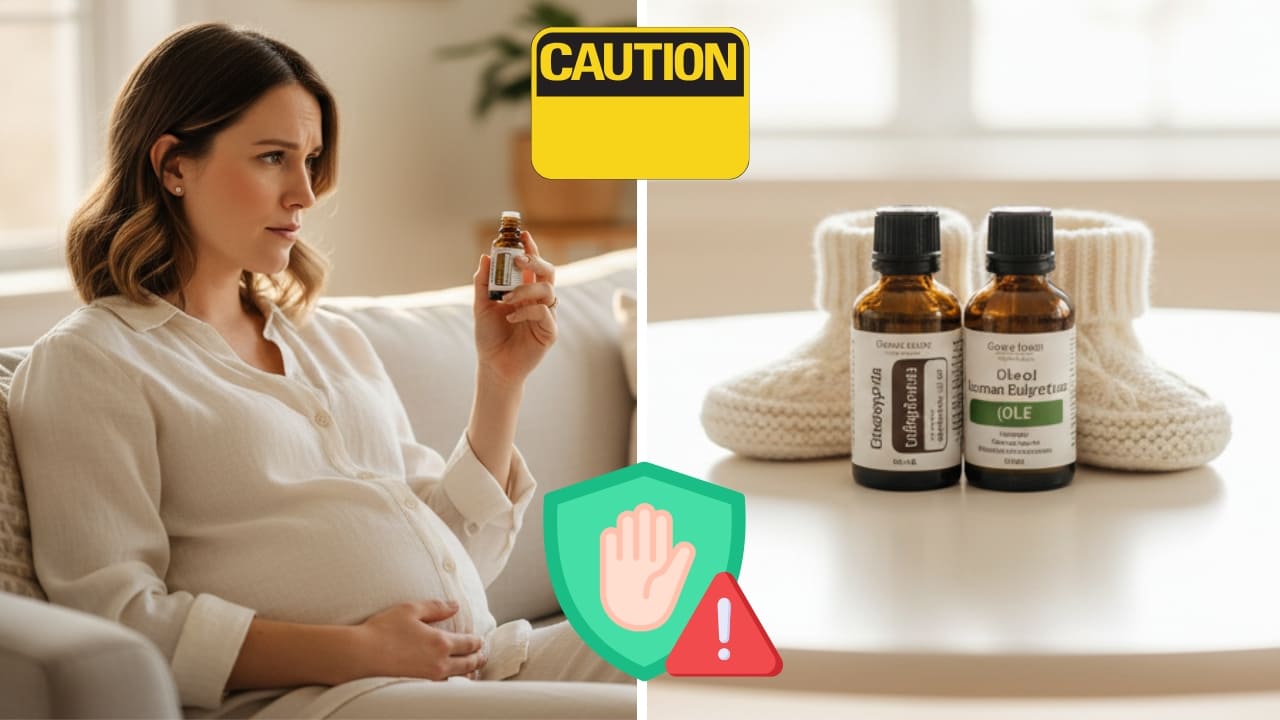
Image Credit: Illustration by Author
i) Uterotonic Effects and Contraction Risk
The most commonly cited concern with eucalyptus oil in pregnancy is the potential uterotonic effect of eucalyptol — meaning it may stimulate uterine muscle activity. Some terpenoid compounds have documented smooth muscle-stimulating properties, and eucalyptol falls within this category.
In normal aromatherapy use at low concentrations, the risk of triggering contractions from eucalyptus oil is probably low. But “probably low” is not the same as “no risk,” and for a pregnant woman — particularly one in the first trimester or with any history of preterm labor or miscarriage — probably low is not good enough. The first trimester is the period of highest embryonic vulnerability and is almost universally flagged as the time to avoid eucalyptus oil entirely.
ii) Placental Crossing and Fetal Exposure
The placenta is not an impermeable barrier. Volatile organic compounds absorbed through the skin or inhaled into the maternal bloodstream can and do cross the placental barrier and reach the developing fetus. Eucalyptol is lipid-soluble, which means it moves through biological membranes relatively easily.
This does not mean every incidental encounter with eucalyptus scent harms a developing baby. It means that regular, sustained topical application or prolonged inhalation in poorly ventilated spaces creates a meaningful and cumulative fetal exposure. That exposure has not been adequately studied for safety. In the absence of that data, precaution is the appropriate response.
iii) Skin Sensitization During Pregnancy
Pregnancy changes skin in ways most people underestimate. Hormonal shifts increase skin sensitivity, alter pH, and change how topically applied substances are absorbed. Products that caused no reaction before pregnancy can cause irritation, sensitization, or allergic response during it.
Eucalyptus essential oil applied topically during pregnancy carries a higher risk of skin reaction than the same application in a non-pregnant adult. This is not a dealbreaker on its own — it is one more variable adding to the overall case for caution and reduced concentration if used at all.
Is Oil of Lemon Eucalyptus (OLE) Safe During Pregnancy?
This is a separate question from eucalyptus oil safety, and it matters because some pregnant women specifically seek out OLE as a natural DEET alternative for mosquito protection. The answer is not straightforward.
OLE and its active compound PMD have not been extensively studied in pregnant populations. The CDC lists OLE as a recommended repellent for the general population, but does not make a specific safety declaration for pregnancy. Most obstetric guidance defaults to recommending DEET and picaridin over OLE during pregnancy — not because OLE is known to be harmful, but because DEET has a much longer safety track record and more data behind it in pregnant populations.
If a pregnant woman is considering OLE as a mosquito repellent:
- Avoid it entirely during the first trimester as a precautionary measure
- If used in second or third trimester, apply to clothing and exposed skin only — not under clothing or over large body surface areas
- Do not use in diffusers or as an inhalation product during pregnancy
- Discuss with your obstetrician before using, particularly if you have a high-risk pregnancy
Eucalyptus Oil in Pregnancy: Trimester-by-Trimester Guidance
- First trimester — Avoid eucalyptus oil entirely, both topically and in diffusers. This is the period of organ development and highest sensitivity to external compounds. No safe threshold has been established.
- Second trimester — Risk reduces but does not disappear. If used at all, keep to very low dilution (0.5 to 1 percent in carrier oil), avoid large skin surface application, and keep diffuser sessions short and rooms well-ventilated. Stop immediately if any dizziness, nausea, or headache occurs.
- Third trimester — Similar guidance to second trimester. Additional caution around any compound with potential uterotonic properties as the pregnancy approaches term. Women who have had preterm labor history should continue avoiding entirely.
- Throughout all trimesters — Never ingest eucalyptus oil. Avoid applying near the abdomen. Avoid high-concentration products. If you develop any unusual symptoms after exposure, seek medical advice.
Pregnancy-Specific Concerns: Quick Reference
- Potential uterotonic effect — may stimulate uterine contractions at higher doses
- Placental crossing — eucalyptol is lipid-soluble and can reach the developing fetus
- Increased skin absorption during pregnancy — hormonal changes alter skin permeability
- Heightened skin sensitivity — higher risk of irritation and sensitization than outside of pregnancy
- No clinical safety data in pregnant populations — absence of evidence is not evidence of safety
- First trimester is the highest-risk period — avoid entirely
- High-risk pregnancies, history of miscarriage, or preterm labor — avoid eucalyptus oil throughout
- OLE (Oil of Lemon Eucalyptus) is a different product — its pregnancy safety profile is also not well established
The mosquito repellent angle adds one more dimension worth addressing directly. Pregnant women are genuinely more attractive to mosquitoes — increased CO2 output, elevated body temperature, and skin chemistry changes all play a role. That increased exposure risk is real and should not be ignored. Eucalyptus oil is not the right solution for it.
OLE carries its own uncertainties. For pregnant women in mosquito-heavy environments or regions with mosquito-borne disease risk, DEET at appropriate concentration and picaridin are the options that carry actual safety data and medical endorsement. Use those — and use them with your doctor’s guidance.
Is Oil of Lemon Eucalyptus (OLE) Safe During Pregnancy?
OLE gets asked about separately during pregnancy because many pregnant women specifically seek it out as a DEET alternative. Natural, plant-derived, CDC-recognized — it sounds like the responsible choice for someone who wants to avoid synthetic chemicals while pregnant. The reality is more complicated.
OLE has not been studied in pregnant human populations in any meaningful clinical way. The CDC recommends OLE for the general population but does not make a specific safety declaration for pregnancy. That silence is not approval. It reflects a lack of data rather than a clean bill of health.
PMD and Pregnancy — What We Know and Do Not Know
PMD, the active compound in OLE, is chemically distinct from eucalyptol in regular eucalyptus oil. But that does not mean it is automatically safe in pregnancy. A few things are worth understanding:
- PMD is lipid-soluble — like eucalyptol, it can cross biological membranes including the placental barrier
- No teratogenicity studies in humans — there is no clinical data on whether PMD affects fetal development at typical exposure doses
- Animal studies are limited — some animal data exists on PMD safety but it does not directly translate to human pregnancy safety conclusions
- The compound is more chemically processed than regular eucalyptus oil — it is not a simple plant extract, and its metabolites in the body are not fully characterized in pregnancy contexts
- OLE is applied topically at higher concentrations than aromatherapy-level eucalyptus oil — the exposure route and dose are different
OLE in Pregnancy: Trimester Guidance
- First trimester — Avoid OLE entirely. No safety data, period of highest fetal vulnerability, and no compelling reason to use it when better-studied alternatives exist.
- Second trimester — If mosquito protection is genuinely needed and no alternative is accessible, limited topical application to clothing and skin in open-air settings may carry lower risk than going unprotected in a disease-endemic area. This is a risk-benefit decision that should involve your doctor.
- Third trimester — Same guidance as second trimester. The closer to term, the more cautious around any compound with unknown effects on uterine activity or fetal systems.
- High-risk pregnancies — Avoid OLE throughout regardless of trimester. History of miscarriage, preterm labor, or pregnancy complications increases the reason for caution with any insufficiently studied compound.
OLE vs DEET vs Picaridin in Pregnancy: Which is Safe for Pregnant Women
This is the conversation most pregnant women actually need to have. DEET has decades of safety data in pregnant populations. Multiple studies have followed pregnant women who used DEET and tracked outcomes. The evidence does not show harm at recommended concentrations. DEET is approved by the CDC, WHO, and most obstetric guidelines as safe for use during pregnancy at concentrations up to 30 percent.
OLE has none of that history. It is newer, less studied, and specifically understudied in pregnancy. The instinct to choose OLE over DEET during pregnancy because it is “more natural” is understandable — but it may actually be the less safe choice simply because less is known about it.
Picaridin sits in a similar position to DEET — reasonable safety data, generally accepted during pregnancy with medical guidance. Between DEET, picaridin, and OLE, OLE is the one with the least pregnancy-specific evidence. That matters.
Table 1: OLE vs DEET vs Picaridin in Pregnancy: Safety Comparison
OLE vs DEET vs Picaridin in Pregnancy: Safety Comparison
| Feature | DEET | Picaridin | Oil of Lemon Eucalyptus (OLE) |
|---|---|---|---|
| Type | Synthetic chemical repellent | Synthetic chemical repellent | Processed plant-based repellent |
| Active compound | N,N-Diethyl-meta-toluamide | Icaridin (KBR 3023) | PMD (para-menthane-3,8-diol) |
| CDC recommended | ✅ Yes | ✅ Yes | ⚠️ Yes (general population only) |
| WHO approved for pregnancy | ✅ Yes | ✅ Yes | ⚠️ Not specifically addressed |
| Clinical safety data in pregnant women | ✅ Extensive — multiple human studies | ✅ Moderate — sufficient for recommendation | ❌ Minimal — no meaningful pregnancy-specific studies |
| Years of use data | 70+ years | 30+ years | Less than 20 years in commercial form |
| Evidence of fetal harm at recommended doses | ✅ No harm shown | ✅ No harm shown | ⚠️ Unknown — insufficient data |
| Safe concentration in pregnancy | Up to 30% — CDC and WHO guidance | Up to 20% — standard guidance | ⚠️ Not established for pregnancy |
| Placental crossing risk | ✅ Low at recommended doses — studied | ✅ Very low — minimal skin absorption | ⚠️ Unknown — PMD is lipid-soluble |
| Recommended trimester use | ✅ All trimesters with doctor guidance | ✅ All trimesters with doctor guidance | ❌ Avoid first trimester — limited data 2nd and 3rd |
| Odor | Strong chemical scent | Minimal — nearly odorless | Mild, pleasant, citrus-like |
| Protection duration | 4–8 hours | 4–8 hours | 4–6 hours |
| Tick protection | ✅ Strong | ✅ Moderate | ⚠️ Limited |
| Natural perception | ❌ Synthetic — often avoided unnecessarily | ❌ Synthetic — often avoided unnecessarily | ✅ Plant-derived — often preferred without evidence basis |
| Overall pregnancy safety verdict | ✅ Most recommended — best evidence | ✅ Well accepted — good safety profile | ⚠️ Use with caution — insufficient pregnancy data |
| Pregnancy recommendation | 🥇 First choice — most evidence | 🥈 Strong second choice | ⚠️ Last choice — least pregnancy data |
Note: The irony worth naming directly — OLE is the option most pregnant women instinctively reach for because it sounds gentlest. But safety during pregnancy is not determined by how natural something sounds. It is determined by how much evidence exists. On that measure, OLE is the weakest of the three — not because it is known to be harmful, but because it is the least studied in the one population that matters most for this question. Always consult your obstetrician before using any repellent during pregnancy.
If you are pregnant and need reliable mosquito protection — especially in regions with dengue, Zika, malaria, or chikungunya risk — talk to your obstetrician. The conversation should be about which registered repellent carries the best safety evidence for your specific situation, not which one sounds most natural.
Eucalyptus Oil and OLE Safety: At-a-Glance Summary
| Oil Type | Babies (0–2 yrs) | Children (2–10 yrs) | Pregnant Women |
| Eucalyptus essential oil (undiluted) | Avoid completely | Avoid — especially near face | Avoid in first trimester |
| Eucalyptus oil (diluted, topical) | Not recommended | Use with caution, low dilution | Limited, consult doctor |
| Eucalyptus oil in diffuser | Not safe — airway risk | Brief, well-ventilated only | Short sessions, ventilated room |
| Oil of Lemon Eucalyptus (OLE) | Not recommended under 3 yrs | Not recommended under 3 yrs | Consult doctor before use |
| DEET (low concentration) | Not for under 2 months | Safe with guidelines | Generally considered safe |
| Picaridin | Some formulas safe from 2 months | Safe with guidelines | Generally considered safe |
Safer Mosquito Repellent Alternatives for Babies and Pregnant Women
Since eucalyptus oil — and OLE — are not appropriate for the youngest children or universally safe in pregnancy, what options actually work?
For Babies Under 2 Months
- Physical protection only — mosquito nets over strollers and cribs, long-sleeved clothing, avoiding outdoor exposure during peak mosquito hours (dawn and dusk)
- No repellent product is recommended for newborns under two months regardless of type
For Babies 2 Months and Older
- Picaridin-based repellents — some formulations are considered safe from two months with proper use
- DEET at low concentration (10 percent or below) — approved from two months by CDC guidelines
- Apply to clothing where possible, not directly to skin for very young children
- Never apply repellent to hands, eyes, mouth, or any area the baby might put in their mouth
For Pregnant Women
- DEET at concentrations up to 30 percent is considered safe during pregnancy according to CDC and WHO guidance
- Picaridin is similarly well-tolerated and has a good safety profile in pregnancy
- Physical barriers — screens, fans, appropriate clothing — reduce exposure without any chemical risk
- Avoid peak mosquito activity times outdoors when possible
- Always discuss repellent use with your obstetrician if you have any specific concerns
📰 Must Read,
✔️ Rain, Hot or Cold – What Weather Do Mosquitoes Enjoy?
✔️ Blood Type Preferences: What Blood Type Do Mosquitoes Like?
The Bottom Line on Eucalyptus Oil and OLE Safety
Neither eucalyptus oil nor Oil of Lemon Eucalyptus is a universally safe, use-anywhere natural product when it comes to babies and pregnant women. They are different products with different compounds and different risk profiles — but both carry meaningful cautions for these groups.
Eucalyptus essential oil should not be used on babies under two years old, avoided around the face of children under ten, and treated with real caution during pregnancy — particularly in the first trimester and in any high-risk pregnancy situation.
Oil of Lemon Eucalyptus should not be used on any child under three years old. During pregnancy it lacks the clinical safety data to be recommended with confidence, and better-studied alternatives exist.
The appeal of a plant-based option makes complete sense. Nobody wants to put unnecessary chemicals on their baby or into their body during pregnancy. But natural does not mean safe for everyone, and both of these oils are clear examples of that. The age restrictions, the pregnancy cautions, the trimester guidance — none of it is overcautious. It is the appropriate response to real biological vulnerabilities in the people who matter most.
If mosquito protection is the goal for an infant, a toddler, or a pregnant woman — there are better-studied, more age-appropriate options available. Use those first.
Frequently Asked Questions (FAQs)
Can pregnant women use eucalyptus oil?
Not recommended — particularly in the first trimester. Eucalyptol can cross the placental barrier and may stimulate uterine contractions at higher doses. Brief incidental scent exposure is unlikely to cause harm, but regular topical use or diffuser sessions are a different matter. Better-studied options like low-concentration DEET or picaridin exist — use those instead.
Q. Can I use eucalyptus oil in a diffuser near my baby?
No — and this one catches a lot of parents off guard because diffusing feels so much milder than applying oil directly to skin. It is not mild enough. Eucalyptol vapor in an enclosed nursery builds up faster than most people realize, and a sleeping infant is breathing that air continuously for hours.
Short incidental exposure in a large ventilated room is one thing. A diffuser running through the night in a closed baby’s room is a different situation entirely. Do not do it.
Q. My baby is 18 months — can I use diluted eucalyptus oil on their skin?
No. The guidance on this is not a sliding scale where more dilution means more acceptable. Under two years old, eucalyptus essential oil is not recommended regardless of concentration. The issue is not just skin irritation — eucalyptol affects the respiratory and central nervous system, and an 18-month-old’s liver simply cannot process it the way an adult’s can. Wait until your child is older, and even then keep it well away from the face.
Q. Is Oil of Lemon Eucalyptus safer than regular eucalyptus oil for children?
Not really — and this surprises most people. OLE actually has a higher age restriction than DEET. CDC guidance says OLE should not be used on children under three years old. Regular eucalyptus oil gets a similar caution under two years. Neither is a safe option for very young children. OLE is the more effective mosquito repellent for older children and adults — but do not mistake effectiveness for gentleness. PMD is a chemically processed compound, not a mild botanical.
Q. I am in my second trimester — is it okay to use eucalyptus oil occasionally?
Occasional, brief, well-diluted use in a ventilated space is probably lower risk in the second trimester than the first. Probably. The honest answer is that clinical safety data for eucalyptus oil in pregnant women simply does not exist in any robust form. The guidance to avoid it — especially in the first trimester — comes from what we know about eucalyptol’s biological activity, not from studies proving harm.
If you are in your second or third trimester and want to use it occasionally in a low concentration carrier oil, talk to your midwife or obstetrician first. That is genuinely the right call here.
Q. Which is safer during pregnancy — OLE or DEET?
DEET, almost certainly. This surprises people who assume the plant-based option is always the gentler choice. DEET has decades of use data in pregnant populations. Multiple studies have tracked pregnancy outcomes in women who used DEET — the evidence does not show harm at recommended concentrations.
OLE has none of that history. It is newer, less studied, and specifically understudied in pregnant women. Choosing OLE over DEET during pregnancy because it sounds more natural may actually be the less informed decision. Talk to your doctor — but do not assume natural means safer here.
Q. What mosquito repellent can I actually use on my 6-month-old?
DEET at low concentration — 10 percent or below — is CDC-approved from two months of age. Picaridin in appropriate formulations is also considered safe from two months. Neither eucalyptus oil nor OLE qualifies at that age. Apply to exposed skin and outer clothing, keep it away from hands and face, and do not apply in enclosed spaces. Physical protection — nets, long sleeves, avoiding outdoor exposure at dusk and dawn — is still your best first line for very young infants, with repellent as a backup layer when exposure risk is high.
Q. Can eucalyptus oil cause a miscarriage?
There is no documented evidence that incidental aromatherapy-level exposure to eucalyptus oil causes miscarriage in humans. That needs to be said clearly. The concern around first trimester avoidance is not based on miscarriage case reports — it is based on eucalyptol’s potential uterotonic properties at higher doses, meaning it may stimulate uterine muscle activity in theory.
The precaution exists because the first trimester is the highest-risk window for any external compound, not because eucalyptus oil is a known abortifacient. One accidental encounter with eucalyptus scent is not cause for alarm. Regular sustained topical use during early pregnancy is a different matter — and that is where the caution applies.
