
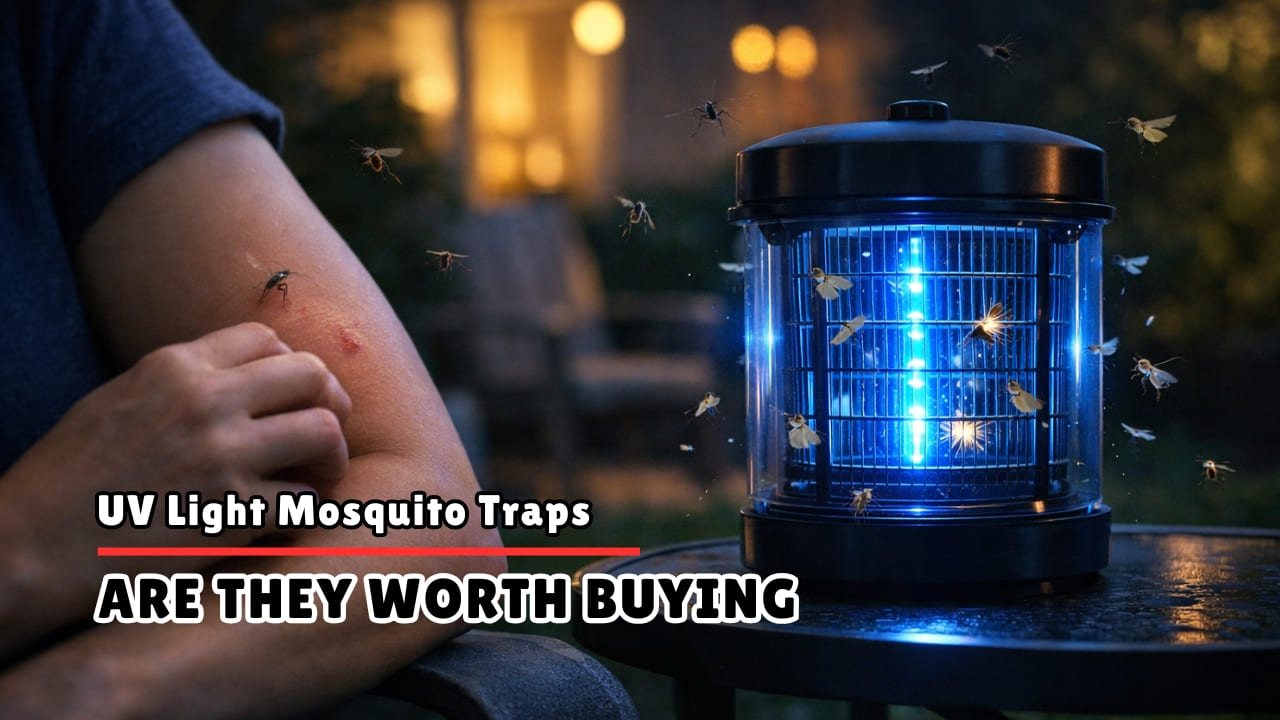
You buy the UV mosquito trap. You plug it in, hang it near the patio, and by morning there is a small graveyard of insects in the collection tray. You hear it zap a few times during the evening. It feels like it is working.
But here is the thing most people never stop to check: What exactly is dying in that trap?
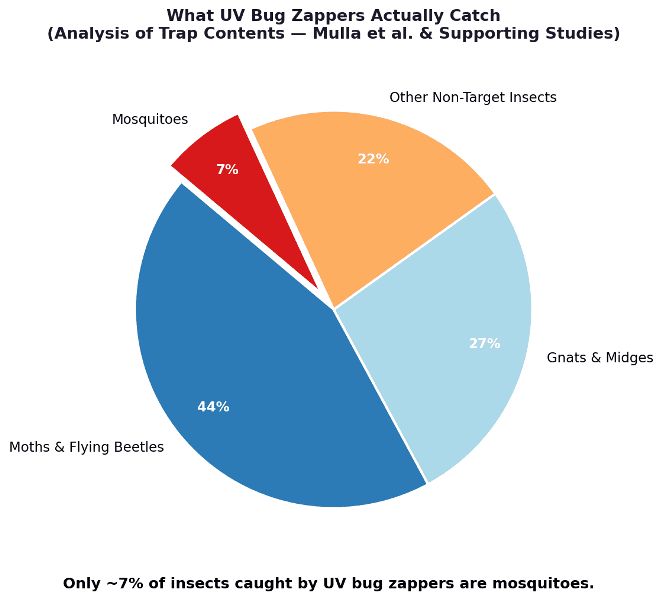
Almost certainly not mosquitoes. At least not in any meaningful number. The insects that UV light traps kill most effectively are moths, beetles, crane flies, gnats, and a wide range of other non-biting bugs that were going about their business completely unrelated to biting you. Studies analyzing the catch contents of residential UV bug zappers consistently find that mosquitoes make up somewhere around 4 to 7 percent of total insects killed. In some studies it is even lower.
This is not a minor detail buried in a footnote somewhere. It fundamentally changes the value proposition of these devices for anyone whose actual problem is mosquito bites.
So why do UV light mosquito traps seem so popular? UV light bug zappers – are they worth buying? Why do they keep selling? And more importantly, if they don’t really work for mosquitoes, what does? That’s what this article is about.
Are UV Mosquito Traps Worth Buying?
A balanced, evidence-based summary for homeowners and outdoor enthusiastsKill the wrong insects
They attract and electrocute light-seeking insects — mostly moths and beetles. Effective for general insect reduction. Not designed around mosquito biology.
Section 1Mosquitoes follow CO₂, not light
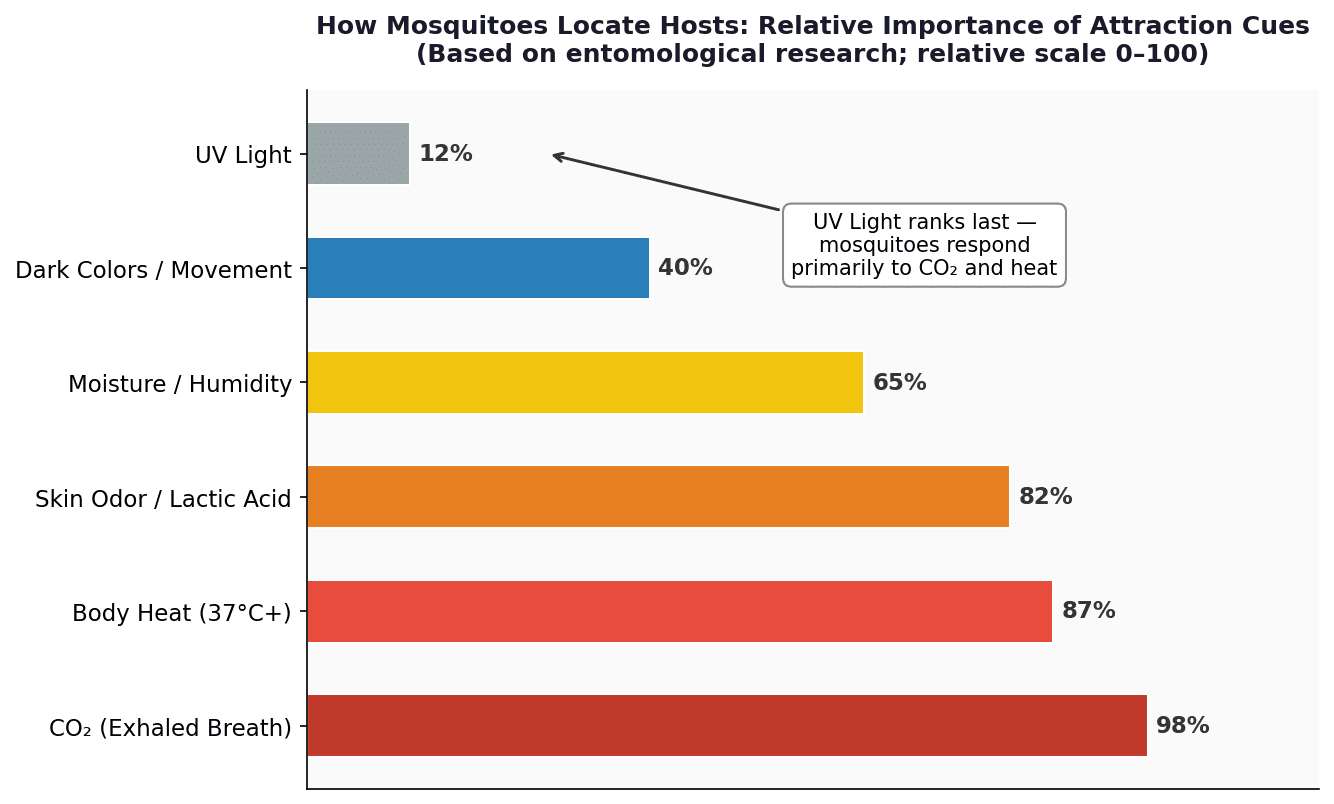
Mosquitoes locate hosts via exhaled CO₂, body heat, and skin odor. UV light ranks last in their sensory hierarchy. A trap producing no CO₂ is effectively invisible to them.
Sections 2–3Target mosquito biology
Source elimination, Bti larvicide, EPA repellents, and CO₂ traps all exploit how mosquitoes actually behave. Results are measurable and consistent.
Section 7Mulla et al. (foundational study): Mosquitoes and biting gnats combined made up fewer than 7% of residential bug zapper catch. Over 13% were beneficial insects including parasitic wasps.
University of Delaware (1996): 13,789 insects killed across six bug zappers over a full summer. Only 0.22% were mosquitoes or biting gnats.
What UV Light Mosquito Traps Are and How They Work
UV light mosquito traps, commonly called UV bug zappers, work on a simple principle: insects that are attracted to ultraviolet light fly toward the trap, touch an electrified grid, and are killed. Most devices emit UV wavelengths in the 320 to 400 nanometer range, which is at the edge of visible light for humans but highly visible to many insects.
The appeal is obvious. They require no chemicals, no sprays, no maintenance beyond emptying the collection tray. You plug them in and forget about them. The zapping sound provides satisfying feedback that something is happening.
But the core assumption built into that design is flawed when it comes to mosquitoes specifically. And understanding why requires a short detour into how mosquitoes actually find you.
Key question: If mosquitoes can see UV light, why don’t they fly toward it? The answer is in how their nervous system weighs and prioritizes different sensory inputs.
Mosquito Sensory Biology: What Actually Attracts Mosquitoes to Humans
Mosquitoes do not hunt randomly. They are remarkably sophisticated sensory machines that use multiple overlapping systems to zero in on a host. And almost none of those systems involve light.
Carbon Dioxide: The Primary Trigger
The single most powerful attractant for most mosquito species is carbon dioxide (CO2). When you exhale, you produce a plume of CO2 that disperses downwind and can be detected by a mosquito’s maxillary palp receptors from distances up to 50 meters away in some conditions. This is the initial long-range cue. It is why people who breathe more heavily, like pregnant women and larger adults, tend to get bitten more.
No UV trap produces CO2. So from the very first and most important step in a mosquito’s host-seeking behavior, a UV light trap is completely invisible.
Body Heat and Infrared Detection
Once a mosquito gets within a few meters of a potential host, heat becomes the dominant cue. The human body radiates infrared at roughly 37 degrees Celsius. Mosquitoes detect this with specialized thermal receptors and use it to orient toward bare skin. It is why mosquitoes bite exposed areas rather than hovering randomly around a fully clothed person.
Skin Odors and Lactic Acid
Sweat compounds, lactic acid, ammonia, octenol, and a range of other volatile organic compounds emitted by human skin serve as close-range attractants. Different people produce different ratios of these compounds, which is why some individuals consistently get bitten more than others in the same group. This is not a myth. It is documented in the scientific literature and largely comes down to individual skin microbiome differences.
Moisture and Humidity
Mosquitoes also detect moisture gradients, which helps them locate the humid microclimate around a person’s skin and breath. High local humidity is another soft cue that draws them in.
Where Does UV Light Fit In?
It does not fit in particularly well, at least not for most mosquito species. Mosquitoes have compound eyes and can detect UV wavelengths. Some studies have shown weak phototactic responses in certain species under controlled laboratory conditions. But in the real world, with CO₂, heat, and odor cues competing for their attention, light is low priority. It is simply not the cue they evolved to follow toward blood meals.
Moths, on the other hand, use light for navigation and are highly phototactic. They make up the bulk of what UV traps actually catch.
Do UV Bug Zappers Kill Mosquitoes: Shocking Reality of UV Light Mosquito Traps
What the Research Actually Says About UV Trap Effectiveness
This is not a case of inconclusive or mixed evidence. The research on UV bug zappers and mosquito control is actually fairly clear, and it has been clear for a while.
The Mulla Study and Its Findings
One of the most widely cited analyses was conducted by Mir Mulla and colleagues, who examined the insect catch of residential bug zappers over an extended period. Their findings: mosquitoes made up less than 7 percent of the total insects killed. The overwhelming majority were moths, beetles, and other non-target species, many of them ecologically beneficial. Similar findings were replicated in subsequent studies by researchers at universities including Notre Dame and Kansas State.
The University of Delaware Research
A study out of the University of Delaware examined the contents of six residential bug zappers over a full summer. Over 13,000 insects were killed. Of those, 0.22 percent were mosquitoes or biting gnats combined. The rest were harmless or beneficial insects including parasitic wasps and other predators. The researchers explicitly stated the devices were not an effective method of mosquito control.
What About Traps That Combine UV With CO₂ or Octenol?
This is where the conversation gets a little more nuanced. Some commercial mosquito traps add CO2 generation, heat, or chemical attractants like octenol alongside UV light. These are fundamentally different devices from a standard bug zapper. The UV in those cases may be a minor contributing factor, but the real work is being done by the CO2 and octenol mimicking human presence.
If a trap is working, it is probably not because of the UV.
Expert Insight: ‘Light traps that also emit CO₂ capture significantly more mosquitoes than those relying on light alone. The light component alone has limited utility for mosquito control in residential settings.’ — Adapted from American Mosquito Control Association technical bulletins.
The Ecological Problem Nobody Mentions
There is a secondary issue with UV traps that does not get enough attention in consumer-facing discussions.
The insects these devices are very good at killing are not the insects most of us want dead. Moths pollinate plants. Parasitic wasps and beetles are natural predators of garden pests. Crane flies and midges are food sources for birds and fish. The collateral damage from a residential UV trap running through a summer night can be ecologically meaningful at the local scale.
Meanwhile the mosquitoes are still out there, still biting you, and probably not even slightly bothered by the glowing purple device humming in the corner of your yard.
Table 1: Mosquito Host-Seeking Cues vs. What UV Traps Provide
| Attraction Cue | Importance to Mosquito | UV Trap Provides? | Notes |
|---|---|---|---|
| CO2 (exhaled breath) | Critical – primary trigger | No | Detected up to 50m away; most powerful cue |
| Body heat (37C+) | Very High | Partial – minimal heat | Infrared radiation from skin; dominant at close range |
| Skin odors and lactic acid | High | No | Individual variation explains why some attract more bites |
| Moisture and humidity | Moderate | No | Close-range humidity gradient around breath and skin |
| Dark colors and visual movement | Low-Moderate | No | Visual cues used at very close range only |
| UV and visible light | Low | Yes – this only | Weak phototactic response; easily overridden by other cues |
Practical Field Observations
Beyond the laboratory data, field experience from pest control professionals reinforces the same conclusion. Ask any licensed mosquito management specialist whether they use UV light traps as a primary control method and the answer will be no. They use source reduction, larviciding, targeted adulticide application, and CO2-based surveillance traps.
The CO2 traps used in professional mosquito surveillance look nothing like a bug zapper. They are specifically designed to mimic human breath and body chemistry. They use propane combustion or compressed CO2, heat, and often octenol or other lures. These are expensive pieces of equipment used to measure mosquito populations, not the $30 purple light you hang on the porch.
A recurring observation from homeowners who have genuinely tested UV traps: the trap catches plenty of bugs, mosquito bites don’t decrease, and eventually the trap gets moved to the garage. The positive reviews online often conflate general insect killing with mosquito control, which are very different things.
Table 2: UV Bug Zappers vs. Evidence-Based Mosquito Control Methods
| Method | Targets Mosquitoes Specifically | Uses Mosquito Biology | Estimated Effectiveness | Best Use Case | Cost Range |
|---|---|---|---|---|---|
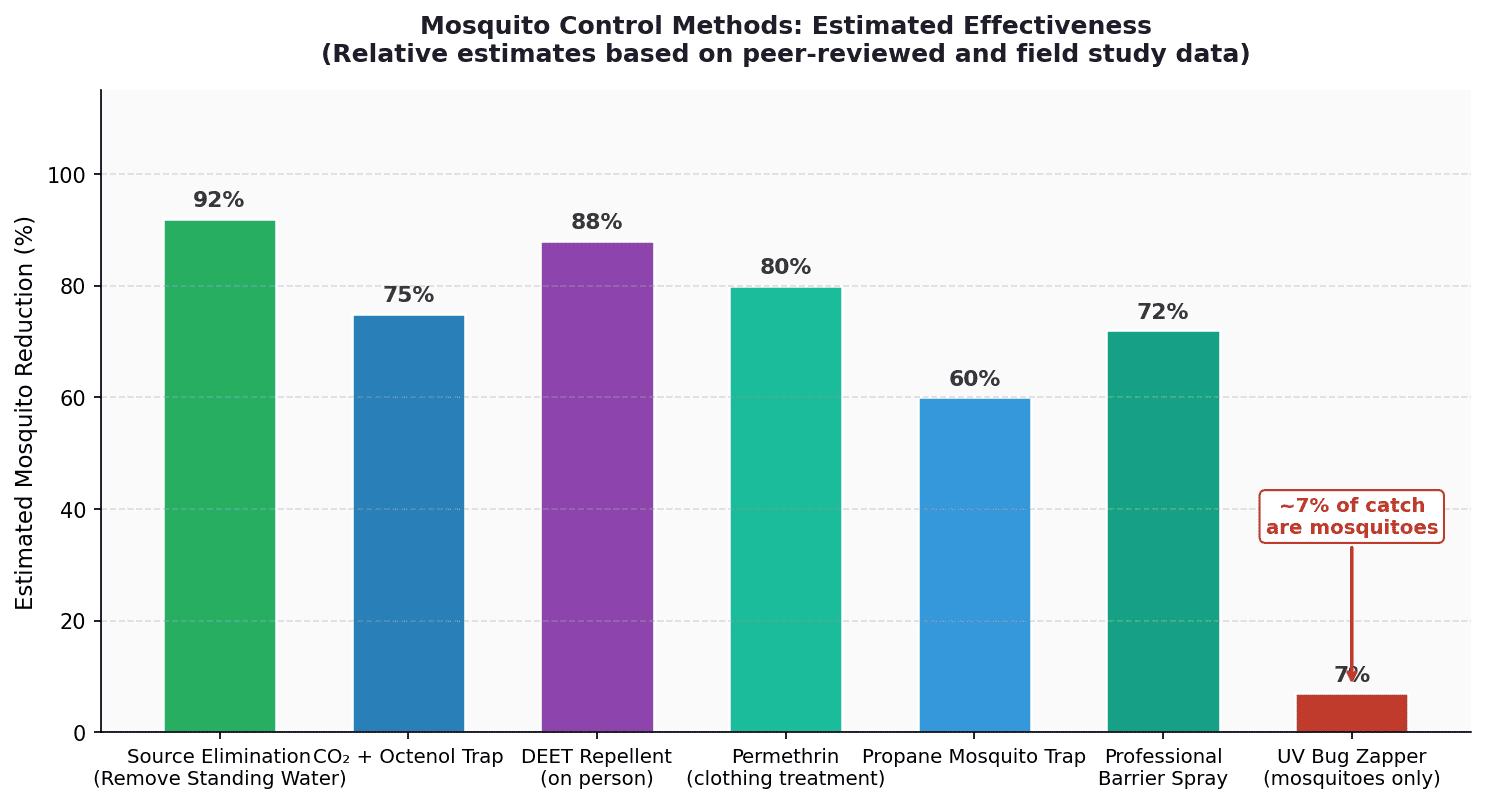
| UV Bug Zapper | No | No | ~7% of catch | General insect reduction only | $20-$80 |
| Source Elimination | Yes | Yes – breaks breeding cycle | Up to 92% | All environments; foundational step | Free |
| DEET Repellent (on skin) | Yes | Yes – blocks olfactory receptors | ~88% | Personal protection outdoors | $5-$20 |
| Picaridin Repellent | Yes | Yes | ~85% | Personal protection; less odor than DEET | $8-$20 |
| CO2 + Octenol Trap | Yes | Yes – mimics CO2 and odor | ~75% area reduction | Yard perimeter; ongoing monitoring | $200-$600 |
| Bti Larvicide (Dunks) | Yes | Yes – kills larvae | ~90% in treated water | Standing water; pools; ponds | $8-$20 |
| Permethrin Clothing | Yes | Yes – contact repellent | ~80% | Hiking; camping; field work | $10-$20 |
| Professional Barrier Spray | Yes | Yes | ~72% per treatment | Yard-wide seasonal treatment | $75-$150 |
Evidence From Research: The Studies Worth Knowing
For readers who want to go deeper, here are the most relevant pieces of evidence shaping the scientific consensus on this question:
- Mulla et al. (foundational study): Analyzed residential bug zapper catch over multiple seasons. Mosquitoes and biting gnats combined: under 7% of total catch. Beneficial insects including parasitic wasps: over 13%. The study concluded UV light traps have no meaningful role in integrated mosquito management.
- University of Delaware (1996): Six bug zappers, full summer, 13,789 insects killed. 0.22% were mosquitoes or biting gnats. 48% were aquatic insects like midges and mayflies with no relation to human biting. The paper explicitly stated the devices should not be promoted as mosquito control.
- American Journal of Tropical Medicine and Hygiene: Multiple studies examining CO₂ vs. UV-only traps for surveillance found CO₂-baited traps captured 50 to 100 times more mosquitoes than UV-only devices. The differential was consistent across Aedes, Culex, and Anopheles genera.
- CDC light trap comparisons: Professional entomologists use CDC light traps for surveillance, but these use incandescent bulbs combined with CO₂. The CO₂ does the heavy lifting. The light plays a secondary and largely administrative role in the design.
- Journal of Medical Entomology – species-specific phototaxis studies: While some Anopheles species show mild positive phototaxis in controlled settings, field behavior data does not support UV as a meaningful control strategy. Culex and Aedes – the primary public health threats in North America – show minimal UV attraction.
What Actually Works: Better Alternatives Ranked
Here is what a rational, evidence-based mosquito control plan looks like. Not ranked by how satisfying they feel to use, but by what the research actually supports.
1. Source Elimination – The Foundation of Everything
Mosquitoes need water to breed. A single breeding site near your home can produce hundreds of adults per week. Every container that holds water – birdbaths, clogged gutters, pool covers, old tires, flowerpot saucers, kids’ toys left outside – is a potential production facility.
Eliminating standing water is the single highest-impact thing you can do. It attacks the population before it bites you, not after. It is also free and requires no chemicals. The American Mosquito Control Association consistently lists source reduction as the cornerstone of any effective program.
2. Bti Larvicide (Mosquito Dunks)
For water you cannot drain – ornamental ponds, rain barrels, drainage ditches, pool covers – Bacillus thuringiensis israelensis (Bti) is a naturally occurring soil bacterium that kills mosquito larvae and nothing else. It is the same organism used in municipal mosquito control programs. Safe for pets, birds, fish, humans. It does not affect any other insects.
Drop a dunk in any standing water you can’t eliminate. One dunk treats 100 square feet of water surface for up to 30 days.
3. EPA-Registered Repellents on Your Skin
For personal protection, nothing matches the convenience and efficacy of a good repellent applied directly to exposed skin. DEET at 20 to 30 percent remains the gold standard with decades of safety data. Picaridin at 20 percent is equally effective and has a lighter feel and less odor. Oil of Lemon Eucalyptus is the best plant-based option but requires more frequent reapplication.
These work because they block the mosquito’s ability to detect your skin odor chemicals. The mosquito simply cannot find you.
4. CO₂-Based Mosquito Traps for Yard Coverage
If you want a trap that actually catches mosquitoes, you need one that mimics what mosquitoes are actually looking for. Propane-powered CO2 traps combine CO₂, heat, and octenol or other lures. They can meaningfully reduce mosquito populations in a defined area over several weeks of consistent operation.
They are expensive. A quality unit costs $300 to $600 and requires ongoing propane and lure cartridges. They need to be positioned correctly – downwind of your activity areas. But they work on mosquito biology rather than against it.
5. Permethrin-Treated Clothing
For camping, hiking, or working in high-pressure mosquito environments, permethrin applied to clothing provides a contact repellent that persists through multiple washes. When a mosquito lands on treated fabric, it repels or kills the mosquito before it can probe for skin. Combined with a skin repellent, this is close to a complete personal protection system.
6. Professional Barrier Spray
Seasonal treatments from a licensed pest control company, typically pyrethroid-based sprays applied to vegetation where mosquitoes rest during the day, can reduce adult populations significantly for three to four weeks per treatment. Expensive over a full season but effective for property-wide coverage before outdoor events.
Table 3: Quick-Reference – Mosquito Control by Situation
| Your Situation | Best Primary Control | Avoid |
|---|---|---|
| Backyard entertaining | CO2 trap + source elimination + fans | UV zapper – will not reduce bites |
| Camping or hiking | DEET or picaridin + permethrin clothing | UV devices – not effective anyway |
| Pool area mosquitoes | Pool cover pump + Bti dunks on cover water | UV zapper positioned near pool |
| Yard-wide infestation | Source elimination + professional barrier spray | Relying on UV zappers as primary solution |
| Standing water (can’t drain) | Bti Mosquito Dunks weekly | UV light has no effect on water breeding |
| Personal protection (any situation) | EPA-registered repellent on skin | Wristbands, ultrasonic devices, UV traps |
Other Mosquito Control Products That Don’t Work as Advertised
UV light traps are not the only mosquito control product category that promises more than the science delivers.
- Ultrasonic repellent devices: No credible peer-reviewed evidence supports ultrasonic sound as a mosquito repellent. Multiple studies have tested these devices and found zero measurable effect on mosquito behavior.
- Citronella candles and torches: Citronella has mild repellent properties in direct contact with skin in high concentrations. As ambient candles outdoors, the effect is minimal. A gentle breeze disperses any repellent effect immediately.
- Vitamin B1 (thiamine) supplements: A persistent folk belief that taking B1 vitamins makes your skin smell unattractive to mosquitoes. Multiple controlled trials have found no difference in bite rates between B1 takers and placebo groups.
- Mosquito-repelling plants (alone): Citronella grass, lavender, marigolds, and similar plants do contain repellent compounds. But unless you are actively crushing the leaves and rubbing them on your skin, the ambient release is insufficient to repel mosquitoes at meaningful distances.
- Wristbands and patches with DEET or picaridin: Repellent needs to cover your skin to work. A wristband only protects the immediate area around the wrist. Mosquitoes will find every other exposed surface without hesitation.
📰 Must Read,
✔️ Where to Place Mosquito Traps for Best Outdoor Protection?
✔️ Mosquito Traps: Different Types and their Working Mechanism
Frequently Asked Questions (FAQs)
Do UV mosquito traps work at all?
They kill insects, including some mosquitoes, but mosquitoes represent roughly 4 to 7 percent of their total catch. For most homeowners dealing with meaningful mosquito pressure, a UV trap alone will not produce a noticeable reduction in bites.
Are there any UV-based traps that actually work for mosquitoes?
Some UV traps combine UV light with CO2 generation, heat, and chemical attractants like octenol. These work meaningfully better than UV-only devices because they target the cues mosquitoes actually respond to. The UV is essentially a bonus; the CO2 is doing the work.
Why do bug zappers seem to catch so many bugs if mosquitoes don’t like UV?
Because there are far more moths, beetles, gnats, and other UV-attracted insects flying around at night than most people realize. A bug zapper in a residential yard will kill tens of thousands of insects over a season. Most of them are harmless or beneficial insects with nothing to do with biting you.
What is the most effective single thing I can do to reduce mosquitoes?
Eliminate every source of standing water within 100 meters of where you spend time outdoors. This attacks the mosquito population at its source before it produces biting adults. No product you can buy replaces this foundational step.
Is DEET safe to use regularly?
DEET has one of the most extensive human safety records of any pesticide in widespread use, backed by decades of testing. At concentrations of 20 to 30 percent, it is safe for adults and children over 2 months of age when used as directed. The EPA and CDC both recommend it as the most reliable repellent option available.
Can I use UV traps alongside other methods?
Yes. A UV mosquito trap used in combination with source elimination, Bti larvicide, and personal repellents will not hurt anything. Just don’t expect the UV trap to be contributing much to the mosquito reduction specifically. Think of it as background insect control while the other methods handle the mosquitoes.
The Bottom Line
UV light mosquito traps are genuinely effective at killing insects. The problem is that the insects they kill most effectively are not the ones biting you.
Mosquitoes navigate primarily by CO2, body heat, and skin odor. UV light ranks last in their sensory hierarchy. Decades of research consistently find that UV bug zappers capture mosquitoes at a rate of roughly 4 to 7 percent of total catch. The rest is moths, beetles, beneficial insects, and things that were never going to bite you anyway.
The good news is that mosquito control actually works when you do the right things. Source elimination is free and high-impact. Bti larvicide is cheap and highly specific. EPA-registered repellents protect you immediately. CO2-based traps work on real mosquito biology rather than against it.
If you have a UV trap and want to keep it, fine. Run it alongside methods that are actually based on mosquito science. But if you are trying to figure out why you are still getting bitten after buying one, now you know.
Have you tested a UV trap alongside other methods? What results did you see? Share your experience in the comments – real-world observations help other readers make better decisions.
