
Table of Contents
You’ve probably heard that fire pits repel mosquitoes. Maybe you even bought one thinking it would solve your mosquito problem. But here’s the thing—it’s more complicated than that.
Fire pits help. But they don’t work the way most people think.
Mosquitoes are known for ruining our good times with their bites and potential diseases they spread. There are many methods which people have tried and tested against mosquitoes. One such method which people usually asks and enquire about its effectiveness is – Using fire pits to keep mosquitoes away?
Does Fire Keep Mosquitoes Away?
Yes, but only partially.
Fire pits can reduce mosquito activity around you, but they’re not a complete solution. Here’s what actually happens:
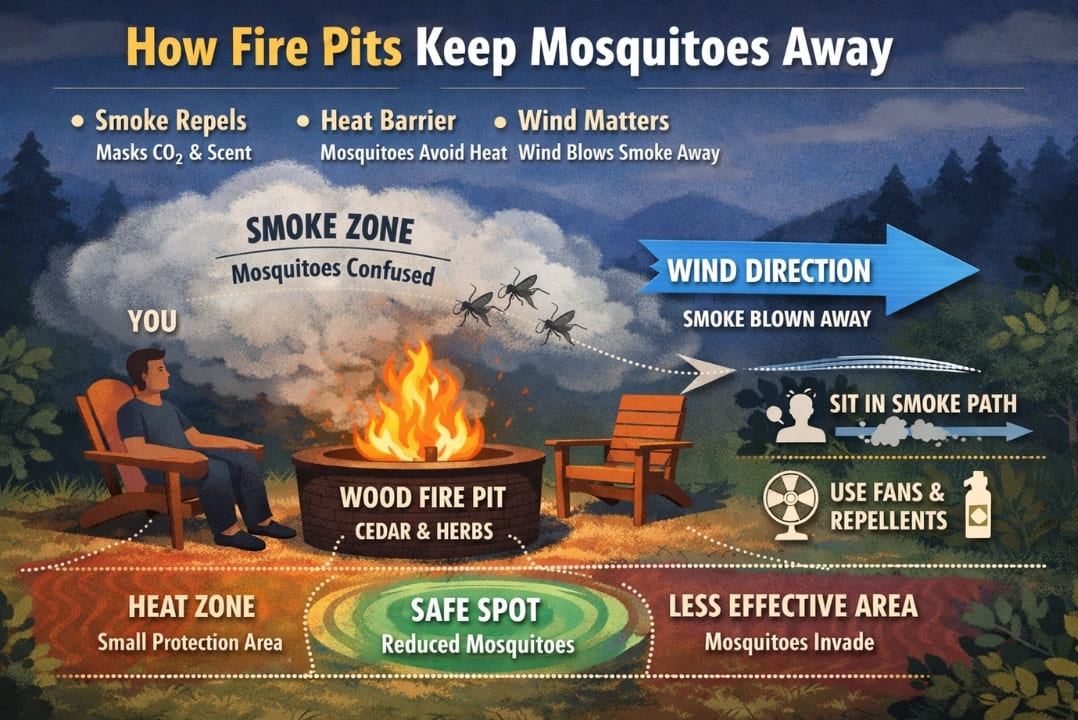
- Smoke masks your scent – This confuses mosquitoes temporarily
- Heat creates a small barrier – But only right near the flames
- Wind ruins everything – Once smoke disperses, protection disappears
The biggest factor? Smoke. Not the fire itself.
If you’re using a gas fire pit with no smoke, you’re getting almost zero mosquito protection.
How Mosquitoes Actually Find You (And Why Fire Pits Matter)
To understand why fire pits only sort of work, you need to know how mosquitoes hunt.
Mosquitoes don’t see you. They smell you.
Three things attract them:
- Carbon dioxide (CO₂) – From your breath
- Body heat – You’re warmer than the air
- Skin chemicals and microbiome – Lactic acid, ammonia, other compounds, skin bacteria, etc.
Mosquitoes can detect CO₂ from over 100 feet away. That’s how they zero in on you from across the yard.
Once they’re close, body heat and skin odor guide them to landing spots.
This is why bug spray works. It blocks those scent signals.
We will now explore how actually do fire keep mosquitoes away. As we have discussed the behavior of mosquitoes and how they find and locate humans and what attracts them. In the article, What Foods can you Eat to Repel Mosquitoes, we have explained the cause and factors that attracts mosquitoes.
So, we know that human releases carbon dioxide, lactic acid, ammonia, body heat, sweat and other chemical compounds, along with these there are some environmental factors also that contributes to this attraction. These are humidity, climate, temperature, sunlight, air quality, and color of the hosts surface, etc.
Altering any of these favorable conditions for mosquitoes, may provide different extent of mosquito repellency. And, using fire pits for keeping mosquitoes away is one such method that really works and quiet effective.
However, the effectiveness of how actually fire pits repel mosquitoes, can be extended by taking care of certain things like –
- what type of wood to be used,
- using some fire-starter logs,
- strength/intensity of flame,
- amount of smoke produced,
- use of additives like special herbs,
- known mosquito repellents like citronella oil, or even
- burning coffee grounds for increased effectiveness.
How Does Fire Pits Repel Mosquitoes?
Fire pits create an unfavorable and hostile environment for mosquitoes where they find it difficult to locate hosts. The fire pits usually work by releasing four of its main components, Heat, Smoke, Carbon dioxide, and Open Flame. Let us understand in detail below, how do fire pits keep mosquitoes away.

Image Credit: Pexels, Mohammad Azmi | Content License
1. Smoke Disrupts Their Navigation System
This is the main reason fire pits help at all.
Smoke is generally considered as a natural mosquito repellent.
Smoke contains volatile organic compounds (VOCs) that overwhelm mosquito receptors. It’s like spraying air freshener in a room—suddenly they can’t smell you anymore. It becomes difficult for mosquitoes to detect the carbon dioxide, sweat and other emissions, and body smell of humans, which are primarily the factors how mosquitoes find and locate human hosts.
It interferes with the mosquitoes smelling sense and they fail to locate human hosts as the human scents, chemical trails and body odor are get masked with the smoke. The smoke gets filled in the vicinity around the fire pit which mosquitoes finds unbearable and leave.
The smoke acts as a physical barrier. It masks the CO₂ you’re breathing out. It covers up your body odor.
But there’s a catch. You need to be in the smoke zone. If you’re upwind or the smoke’s blowing away from you, you’re unprotected.
2. Heat Creates an Uncomfortable Zone
Mosquitoes don’t like extreme heat.
Mosquitoes like heat and they sense human body heat to locate them. The intense heat that comes out of fire pits is much more than moderate body heat of humans which mosquitoes find attractive. It creates an inhospitable environment for mosquitoes and so they stay away from fire pits. This heat causes mosquitoes to repel and restricts them from coming closer to the pit.
The area right around the fire—maybe 3 to 5 feet—gets hot enough to push them away. But that’s a tiny zone.
Step back from the fire to cool off? You’re back in mosquito territory.
3. Carbon Dioxide From Fire Pits
The carbon dioxide released here from fire pits is massive in volume as compared to what humans exhale, and it covers a huge area. This confuses mosquitoes in finding their human targets.
4. Open Flame
The open flame causes huge area to light up which attracts the mosquitoes but the heat and huge carbon dioxide levels around disrupts the mosquitoes navigation and so they prefer to stay away.
5. Certain Herbs and Type of Woods Add Extra Repellent Properties
Not all smoke is equal.
Some woods produce smoke with stronger mosquito-repelling compounds:
- Cedar
- Eucalyptus
- Sage
- Rosemary
These release oils that mosquitoes find even more irritating. It’s why outdoor coils and incense often use these scents.
Enhancing the Effectiveness of Fire Pits to Repel Mosquitoes
As like other methods, this one is also not completely reliable and so some additional measures should be taken to improve its effectiveness. A combination of methods or using natural known mosquito repellents in conjunction may boost its effectiveness.
What to Put in Fire to Keep Mosquitoes Away?
We can use certain herbs and additives in the fire pit to get impressive results. Find below the list of some natural herbs that can be used, however their availability, cost, and side effects, should be considered first.
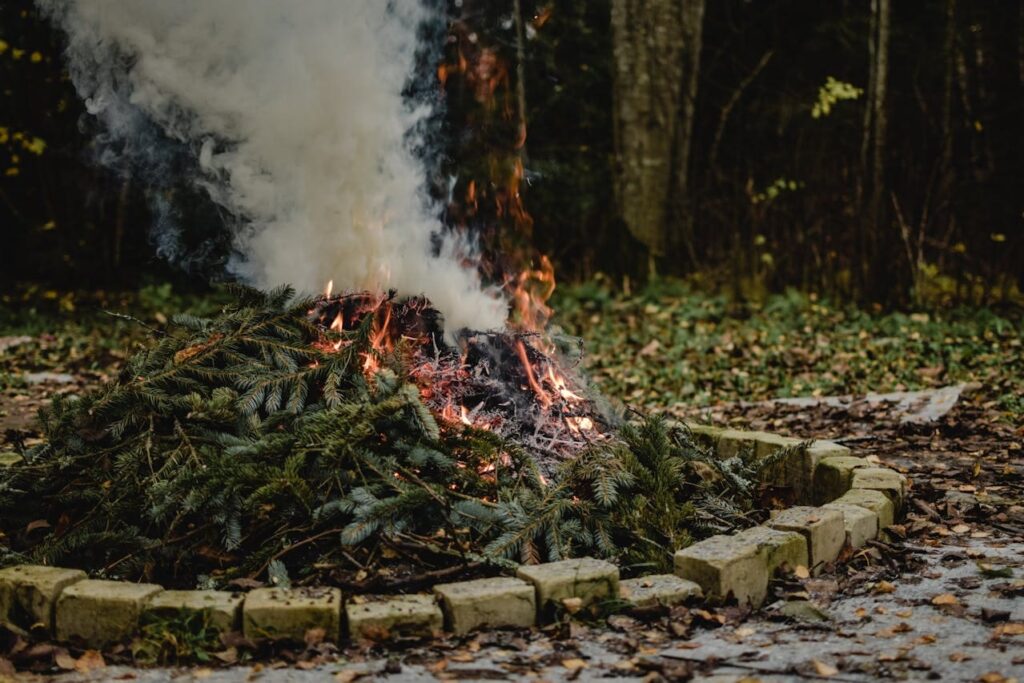
Image Credit: Pexels, Eva Bronzini | Content License
What to Burn in Fire Pit to Keep Mosquitoes Away?
List of herbs and additives to enhance Fire Pit effectiveness in repelling mosquitoes:
| Herb/Additive (Mosquito repellent for fire pit) | How it Works | How to use in Fire Pit |
|---|---|---|
| Citronella | Contains natural oils that masks human body odor and smell of sweat, and makes difficult for mosquitoes to detect and locate hosts. | Can add citronella leaves directly in fire or place citronella candles around the fire pit. |
| Lavender | Releases a pleasant aroma that is unappealing for mosquitoes. | Can add dried lavender leaves directly to the fire pit. |
| Thyme | Releases strong unpleasant smell that keeps mosquitoes away | Fresh or dried thyme twigs can be used |
| Sage | Releases pleasant smell which has mosquito repelling properties | Sage bundles or leaves can be directly added to the fire pit |
| Rosemary | Strong fragrance which keeps mosquitoes away | Can add Fresh or dried rosemary branches and twigs to the fire pit |
| Pine Needles | Aromatic smoke that has helps in repelling insects | Add a handful of pine needles into the fire pit |
| Eucalyptus leaves | Known for its mosquito repelling properties, has certain compounds which are very effective against mosquitoes. | Burn eucalyptus leaves directly in the fire pit |
| Cedarwood | Releases strong aroma that is unattractive for mosquitoes. | Add cedarwood chips or logs to the fire pit for a long lasting effect |
| Lemongrass | It efficiently repel mosquitoes as it has got rich source of citronella, a well known mosquito repellent | Add fresh or dried lemongrass to the fire pit |
| Peppermint/ Mint Leaves | Strong menthol based smell deters mosquitoes away | Burn dried peppermint leaves and stems in the fire pit |
| Clove | Contains eugenol, an efficient mosquito repelling compound | Add whole cloves into the fire |
| Basil | Contains aromatic oils repel mosquitoes | burn fresh or dried basil leaves directly into the fire pit |
| Garlic | Produces a strong pungent odor that repel mosquitoes away | Add garlic cloves or garlic powder to the fire |
| Marigold | Releases a refreshing scent that is not attractive for mosquitoes | Add dried marigold leaves in the fire pit |
| Tea Tree leaves | Contains compounds that has mosquito repelling properties | Add dried tea leaves into the fire |
| Bay Leaves | The strong aroma of bay leaves repel mosquitoes away | Can add dried bay leaves directly in to the fire |
| Cinnamon Sticks | Contains cinnamaldehyde that repels mosquitoes | Burn cinnamon sticks directly into the fire |
| Onion Skins | The pungent smell of onions helps in keeping mosquitoes away | Add leftover onion skins to the fire pit |
| Juniper Berries | Emits a strong scent that repel mosquitoes | Add few juniper berries to the fire pit |
| Coffee Grounds | Releases strong odor with smoke that mosquito finds unpleasant | Dried coffee grounds can be sprinkled over the fire pit |
| Orange Peels | Contains limonene that naturally repel insects due to its citrus scent | Add dried orange peels in to the fire pit |
| Coconut Husk | It releases smoke that causes mosquitoes to leave from the vicinity | Add dried coconut husks to the fire pit for long lasting smoke |
| Walnut Shells | It releases smoke that causes mosquitoes to leave from the vicinity | Crush walnut shells and add them in to the fire pit |
| Bayberry Wax | On burning releases a strong scent that deters mosquitoes away | Bayberry wax or candles can be added directly to the pit |
The above naturally available mosquito repellent for fire pit can be added to your fire pit routines that will surely enhance your outdoor experience with added safety and protection from mosquitoes.
Why Fire Pits DON’T Fully Work (The Problems Nobody Mentions)
i) Fire Pits Also Produce CO₂
Here’s the irony. You’re trying to hide from mosquitoes by reducing CO₂ signals.
But fires produce massive amounts of CO₂.
So while the smoke masks your personal CO₂, the fire itself is pumping out the exact chemical mosquitoes use to find prey. It’s like turning on a beacon while trying to hide.
ii) The Protection Zone is Tiny
Fire pits only protect the immediate area where smoke is concentrated.
Move 10 feet away? You’re exposed.
Sit upwind? You’re exposed.
Have any breeze at all? You’re exposed.
You need to basically sit in the smoke to get protection. Which isn’t exactly comfortable.
iii) Wind Destroys Effectiveness
This is the biggest problem.
Even a light breeze scatters smoke. Once it disperses, you lose all protection. Mosquitoes come right back.
On a calm night, a fire pit helps. On a breezy night, it does almost nothing.
iv) Gas Fire Pits Are Useless for Mosquitoes
Gas fire pits produce almost no smoke.
No smoke means no scent masking. No masking means mosquitoes find you just as easily as if there was no fire at all.
Gas pits look nice. They’re convenient. But for mosquito control? Completely ineffective.
Additional Benefits of Using Fire Pits to Repel Mosquitoes
- Natural Light: It provides natural light in the outdoors where proper lighting setup may take time to arrange. Also, the light provided does not require electricity so, can be setup in wild or campsites.
- Ambience: It gives a perfect ambience to a outdoor gathering and relaxation. Maybe a Saturday night or eve party, etc.
- Warmth: It is most desirous to spend evenings in winter outside in outdoors. A fire pit can provided that much needed warmth in winters, where people mostly stay indoors due to chilling temperatures outside.
- Cooking along: Many commercial fire pits are available that has an attached barbeque or grill. This makes the outdoor gatherings with hot and spicy meals more enjoyable and comfortable.
Do Gas Fire Pits Repel Mosquitoes?
No. Unfortunately gas fire pits do not repel mosquitoes as they don’t release smoke to that extent as a wood fired fire pit does. So there is only the heat factor that may deter some of the mosquitoes that too very near the fire pit. People still face mosquito bites and inconvenience while sitting at a distance from Gas Fire Pits.
Without smoke there is not much repelling effect against mosquitoes. However, you can use herbs and additives to compliment the mosquito repelling effect.
Wood Fire Pit vs Gas Fire Pit: Which Works Better?
TABLE 1: Wood Fire Pit vs Gas Fire Pit
| Feature | Wood Fire Pit | Gas Fire Pit |
|---|---|---|
| Smoke Production | High | Almost none |
| Mosquito Repelling | Moderate (when smoke is present) | Minimal to none |
| Consistency | Depends on wind and wood type | Consistent heat, no repelling effect |
| Practicality | Messy, requires maintenance | Clean, easy to use |
| Best For | Mild mosquito reduction + ambiance | Ambiance only |
In short, if you want any mosquito protection, wood is your only option. But even then, don’t expect miracles.
How to Make Your Fire Pit Actually Work Against Mosquitoes
If you’re going to use a fire pit for mosquitoes, do it right.
1. Burn the Right Materials
Use woods that produce more repellent smoke:
- Cedar logs
- Sage bundles
- Rosemary sprigs
- Eucalyptus branches
These release oils mosquitoes hate. Toss them on the fire periodically.
2. Create Smoke, Not Just Flames
Big flames look cool. But they’re not what repels mosquitoes.
You want a smoldering fire with lots of smoke. Not a roaring blaze.
Let the fire die down a bit. Add green wood or herbs to create more smoke. That’s where the protection comes from.
3. Position Yourself in the Smoke Path
This sounds obvious, but most people get it wrong.
You need to sit where the smoke is drifting. If you’re upwind, you’re getting zero protection.
Pay attention to wind direction. Move your chair as needed.
Yes, this means occasionally sitting in smoke. That’s the tradeoff.
4. Combine Fire Pits with Other Methods
This is the most important tip.
Fire pits should never be your only defense. Stack multiple methods:
- Use a fan – Mosquitoes are weak fliers. A strong fan disrupts their flight.
- Apply repellent – DEET or picaridin on exposed skin.
- Remove standing water – Eliminate breeding sites in your yard.
- Use mosquito coils – Add them around your seating area.
Think of the fire pit as part of a system, not the whole solution.
Common Myths About Fire Pits and Mosquitoes
❌ “The bigger the fire, the better the protection”
Nope. Bigger fires produce more CO₂ (which attracts mosquitoes) and less focused smoke. You want controlled smoke, not massive flames.
❌ “Fire pits keep mosquitoes away from the whole yard”
Not even close. The effective zone is maybe 10 feet at best. And that’s only if you’re in the smoke.
❌ “All fire pits work the same for mosquitoes”
Wood fire pits provide some benefit. Gas fire pits provide almost none. Huge difference.
❌ “You don’t need bug spray if you have a fire pit”
Terrible idea. Fire pits reduce mosquitoes slightly. Bug spray actually works.
Better Alternatives to Fire Pits for Mosquitoes
Let’s be honest. If your main goal is mosquito control, there are better options.
TABLE 2: Fire Pit Alternatives for Mosquito protection
| Method | Effectiveness | How It Works |
|---|---|---|
| Fire Pit (wood) | Low to Moderate | Smoke masks scent temporarily |
| Oscillating Fan | High | Disrupts mosquito flight patterns |
| DEET/Picaridin Repellent | Very High | Blocks scent receptors directly |
| Mosquito Coils | High | Releases pyrethroid insecticides |
| Screened Enclosure | Very High | Physical barrier |
| Remove Standing Water | Very High (prevention) | Eliminates breeding sites |
The most effective strategy? Use a fan and apply repellent. These two alone outperform a fire pit by a huge margin.
Fans are underrated. Mosquitoes can’t fly well in wind. A strong box fan creates a barrier they physically can’t cross.
When Fire Pits Work Best for Mosquitoes?
Fire pits aren’t useless. They’re just limited.
Best conditions:
- Calm nights with little to no wind
- Small gatherings (fewer people to protect)
- When combined with fans and repellent
- If you’re burning cedar or other aromatic woods
Worst conditions:
- Windy evenings
- Large outdoor parties
- Gas fire pits
- Relying on fire alone
Safety Tips While Using Fire Pits to Keep Mosquitoes Away
Although, fire pit routines are not new to anybody, but still people are advised to take some safety preventive measures to avoid any fire accidents. Here are some safety tips to be taken care of:
- Choose a safe location: Always place fire pits on ground instead of any elevated table or setup. Remove any flammable substance from the nearby areas and check if there are any low hanging branches, etc.
- Keep safe distance: Maintain a safe distance from the fire pit to avoid any accidental burns, and avoid seating closer.
- Have a fire extinguisher ready: Keep a fire extinguisher, Water drum or buckets filled with water ready. Keeping such tools handy will help in taking control over any uncertain accident without any major loss.
- Keep First-Aid box handy: Small burns and minor injuries can happen with anyone anytime. Burn injuries are healed when proper care is taken on the spot.
- Never leave the fire alone, unattended: Always leave the area after extinguishing the fire pit and till it cools down completely.
📰 Must Read,
✔️ What Kind of Smell Repels Mosquitoes?
✔️ Mosquito Traps: Different Types and their Working Mechanism
Conclusion: Should You Use a Fire Pit for Mosquitoes?
Fire pits are not a mosquito solution. They’re a nice addition that provides minor help.
If you were planning to get a fire pit anyway for ambiance, great. You’ll get a small mosquito benefit as a bonus. But if you’re buying a fire pit specifically to solve a mosquito problem, save your money. Invest in fans, repellent, and eliminating standing water instead.
Think of a fire pit as ambiance first, mosquito control second.
Fire Pits alone cannot be that effective against mosquitoes, as in outdoors due to greenery, the population of mosquitoes will be too high. So, this method should be complemented with other methods and additives as mentioned earlier, like mosquito repellent herbs and bubble machines can be used if it is a celebration. This method needs proper yard or lawn maintenance.
The intense heat and smoke released from a fire pit may also shift the swarm of mosquitoes in nearby surroundings, and cause disturbance to your neighbours.
With proper knowledge and additional methods you can restrict these unwanted guests to enter your gatherings and keep them away, without bothering your guests.
Editorial Team & Contributors

Raashid Ansari, Founder, Content Researcher & Author - MosquiTalk
Not an entomologist — just a genuinely curious writer who started researching mosquitoes and couldn't stop. What began as casual reading about repellents and bite prevention gradually turned into a deep ongoing dive into vector biology, disease epidemiology, animal health impacts, and the real science behind mosquito control. Everything published here is carefully edited, and written with one purpose: giving readers accurate, accessible information they can actually trust and use to protect themselves, their families, and their pets, birds and cattle.
Active across social platforms, regularly publishes, and genuinely invested in spreading mosquito awareness where it matters most. Because informed readers make better decisions — and better decisions save lives.